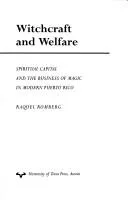
Witchcraft and welfare
 62
62

Witchcraft and welfare


Raquel Romberg's 'Witchcraft and Welfare' is a luminous beacon in the study of modern spiritualities. Moving beyond sterile anthropological case studies, Romberg plunges readers into the evocative intimacy of Puerto Rican magical practice, capturing the lived realities of its adherents with profound empathy. The work brilliantly dissects the symbiotic relationship between spiritual endeavors and social welfare, revealing how ritualistic acts offer tangible support and resilience. This is essential reading for scholars of magic, anthropology, and religious studies, as well as practitioners seeking to understand the deep roots and contemporary manifestations of folk magic. It is a testament to the enduring power of the sacred in the face of societal pressures.
📝 Description
62
Raquel Romberg's 2003 ethnography examines witchcraft in Puerto Rico not as superstition, but as a system of welfare.
Raquel Romberg’s "Witchcraft and Welfare" investigates the role of magical practices within Puerto Rican communities. The book details how beliefs and rituals related to witchcraft function as a means of social support, healing, and protection. Romberg shows that these practices are not separate from everyday life or social structures; instead, they are deeply integrated into how individuals and groups cope with hardship and maintain well-being.
The ethnography focuses on the lived experiences of people who engage with these traditions. It reveals how inherited spiritual beliefs and actions continue to be relevant in contemporary society. The work argues that witchcraft, often wrongly perceived, is a vital force that offers individuals agency and a sense of community. It presents magic as a dynamic element shaping human experience, particularly for those on the margins.
This work connects to traditions of studying folk magic and popular spirituality. It examines how marginalized spiritual systems provide frameworks for understanding and managing life's challenges. By focusing on the practical application of beliefs, Romberg places the study within a context of how esoteric practices function as adaptive strategies for communities, particularly those facing social and economic pressures. It looks at the real-world impact of spiritual beliefs and practices, rather than solely their theoretical or historical aspects.
💡 Why Read This Book?
Uncover the potent, often hidden, interplay between magic and daily life in Puerto Rico. This book offers a rare, evocative glimpse into how witchcraft provides social support and resilience. Ideal for seekers of esoteric knowledge, cultural anthropologists, and practitioners interested in the practical application of spiritual traditions.
⭐ Reader Reviews
Honest opinions from readers who have explored this book.
❓ Frequently Asked Questions
What is the primary focus of 'Witchcraft and Welfare'?
The book explores the intricate relationship between witchcraft practices in Puerto Rico and the social welfare of its communities, examining how spiritual traditions provide support and meaning.
How does Romberg's approach differ from other anthropological works?
Romberg's approach is distinguished by its deep evocation and immersive quality, allowing readers to experience the events and individuals rather than merely analyze them as case studies.
What historical context is explored in the book?
The book touches upon the historical persecution of witchcraft during colonial times and its subsequent perception as charlatanry, contrasting this with its enduring significance.
Who is the intended audience for this book?
The book is intended for a broad audience, including scholars of anthropology and religious studies, practitioners of magical traditions, and anyone interested in the intersection of spirituality and social dynamics.
What key insights can be gained from reading 'Witchcraft and Welfare'?
Readers can gain profound insights into the resilience of marginalized spiritual practices, the symbolic power of ritual, and the ways in which communities find strength and support through their beliefs.
🔮 Key Themes & Symbolism
The Living Current of Magic
This theme explores the dynamic and evolving nature of witchcraft, demonstrating how it is not a static historical artifact but a vibrant, living force in contemporary society. Romberg illustrates how ancient spirits and rituals are actively invoked and adapted to address modern challenges, offering a powerful counterpoint to secularization. The narrative emphasizes the agency and creative power of practitioners who combine magic into the fabric of their daily lives, providing solace, protection, and a sense of interconnectedness.
Spirituality as Social Support
The book meticulously examines how magical practices function as a crucial form of social welfare, offering tangible support and resilience to individuals and communities. Beyond mere superstition, these traditions provide frameworks for understanding misfortune, fostering collective healing, and reinforcing social bonds. Romberg highlights the profound psychological and communal benefits derived from ritual, demonstrating that spiritual engagement can be a powerful engine for well-being and empowerment, especially in contexts of socio-economic hardship.
Bridging the Seen and Unseen
A central theme is the seamless integration of the spiritual and material realms. 'Witchcraft and Welfare' reveals how practitioners navigate a world where the influence of spirits, ancestors, and symbolic energies is as real and impactful as any physical force. This exploration clarifies the esoteric, showcasing how seemingly abstract metaphysical concepts manifest in concrete actions and outcomes, influencing health, relationships, and community dynamics. It underscores the holistic worldview inherent in many magical traditions, where the boundaries between the sacred and the mundane are fluid and permeable.
💬 Memorable Quotes
Direct passages from the work, attributed to the author.
“...this stands out on account of its skill at evocation, at getting inside people and events...”
— This emphasizes the book's immersive and empathetic narrative style, promising a deeper, more personal understanding of the subject matter.
“...not merely using them as examples or 'case studies.'”
— This underscores the book's departure from detached academic analysis, suggesting a focus on lived experience and human connection within the study of magic.
“The enduring power of inherited traditions.”
— This phrase points to the deep historical roots and continuous transmission of magical knowledge and practices across generations.
“Magic as a potent force for healing, protection, and social cohesion.”
— This succinctly captures the functional and beneficial aspects of witchcraft as explored in the book, moving beyond sensationalism.
💡 Key Ideas
Editorial paraphrase of the work's core concepts — not direct quotes.
Persecuted as evil during colonial times, considered charlatans during the Enlightenment...
This quote highlights the historical marginalization and misrepresentation of witchcraft, setting the stage to reveal its true, often misunderstood, significance.
🌙 Esoteric Significance
Tradition
The book primarily engages with the esoteric traditions of Puerto Rican folk magic, often referred to as 'brujería' or 'espiritismo.' These traditions are deeply rooted in Afro-Caribbean and indigenous spiritual beliefs, blended with elements of Catholicism and shamanistic practices. Romberg explores the intricate cosmology, the pantheon of spirits, and the ceremonial behaviors that form the backbone of this esoteric system, revealing its sophisticated understanding of energetic forces and sympathetic magic.
Symbolism
Key symbols within this tradition often include natural elements (herbs, stones, water), divine and spiritual figures (saints, ancestors, elemental spirits), and personalized talismans or charms. The book likely explores the potent symbolism of ritual objects, the meaning embedded in specific incantations, and the way these symbols act as conduits for spiritual power and intention. The act of tying, bathing, or the use of specific colors can all carry profound symbolic weight, facilitating communication with the unseen and influencing the material world.
Modern Relevance
The modern relevance of 'Witchcraft and Welfare' lies in its powerful demonstration of how esoteric knowledge and practices can provide vital social, psychological, and spiritual support in contemporary life. In an age often marked by alienation and rapid change, these traditions offer a sense of belonging, meaning, and agency. Romberg shows that magic is not merely a relic of the past but a living, adaptive system that helps individuals and communities navigate hardship, assert their identities, and find resilience, making it profoundly relevant to understanding human needs for connection and empowerment.
👥 Who Should Read This Book
Scholars of anthropology, religious studies, and Latin American studies will find 'Witchcraft and Welfare' an indispensable resource for its rigorous ethnographic methodology and theoretical insights. Seekers of esoteric wisdom and practitioners of magical arts will be drawn to its evocative descriptions of ritual and its exploration of the practical applications of spiritual power. Beginners interested in understanding the intersection of culture, belief, and social well-being will appreciate the accessible yet profound narrative. Ultimately, anyone curious about the enduring influence of indigenous and marginalized spiritualities in the modern world will find this book a compelling and useful read.
📜 Historical Context
Published in an era increasingly interested in the resurgence of folk magic and alternative spiritualities, 'Witchcraft and Welfare' arrives as a crucial ethnographical contribution. The late 20th and early 21st centuries witnessed a growing academic and public fascination with the ways in which indigenous and marginalized spiritual practices endure and adapt in the face of globalization and modernization. Romberg's work directly addresses the colonial legacy that often demonized such practices, offering a nuanced perspective that recognizes their inherent value and resilience. It sits within a broader anthropological tradition that seeks to understand the complexities of belief systems not as relics, but as active forces shaping individual and collective lives, particularly within post-colonial contexts where cultural identity and spiritual heritage are actively negotiated.
📔 Journal Prompts
How do you perceive the relationship between spiritual practices and practical support systems in your own life or community?
Reflect on a time when you witnessed or experienced the power of ritual or symbolic action to create change.
Consider the historical narratives surrounding 'witchcraft' or similar marginalized practices in your cultural context. What are the underlying truths and what has been obscured?
Explore the concept of 'welfare' beyond material provisions. How can spiritual or communal practices contribute to overall well-being?
Imagine a contemporary challenge you face. How might an approach rooted in symbolic action or connection to unseen forces offer a different perspective or solution?
🗂️ Glossary
Brujería
A broad term in Puerto Rican and Latin American culture referring to witchcraft or magical practices, often associated with folk healing, divination, and spiritual intervention.
Espiritismo
A spiritualist tradition originating in the 19th century, emphasizing communication with spirits and their role in healing and guidance, particularly prominent in Puerto Rico.
Evocation
In this context, refers to the author's skill in bringing the subject matter to life through vivid descriptions and an immersive narrative, making the reader feel present.
Sympathetic Magic
A type of magic based on the principle that like affects like, or that a person or object can affect another person or object by means of a visible resemblance or connection.
Cosmology
The understanding of the origin, structure, and workings of the universe, often including the relationship between the physical world and spiritual realms within a particular belief system.
This book appears in 3 collections
🔮 Readers Also Liked
Browse all →




More by Raquel Romberg
All books →




From the “Ritual Magic” Collection
View all →





More Free Magic & Ritual Books
View all →