Witch Crafting

 76
76

Witch Crafting
Phyllis Curott's "Witch Crafting" offers a lucid and accessible entry point into the world of modern witchcraft, a welcome departure from more esoteric or sensationalized accounts. The book excels in its clear articulation of core Wiccan principles and its emphasis on personal empowerment through connection with nature. Curott's strength lies in translating complex spiritual concepts into practical, relatable terms. However, the work occasionally leans towards a generalized portrayal of witchcraft, which, while serving accessibility, might lack the granular detail some advanced practitioners seek. A particular passage discussing the "Wheel of the Year" effectively illustrates the book's ability to ground abstract spiritual concepts in tangible, seasonal cycles. It serves as a foundational text, illuminating the path for those new to the Craft.
📝 Description
76
Phyllis Curott's 2001 book details the resurgence of modern witchcraft, particularly Wicca.
Phyllis Curott's "Witch Crafting," published in 2001, examines the growth and contemporary practice of witchcraft, with a focus on Wiccan and Neopagan traditions. The book covers the philosophy, rituals, and ethics of the Craft. Curott seeks to explain witchcraft to those unfamiliar with it, showing it as a living spiritual path rather than an ancient relic.
This book is for people interested in modern witchcraft and Paganism, especially those drawn to nature-based spirituality. It offers fundamental knowledge for new practitioners, deeper context for experienced witches, and a clear perspective for those studying religious traditions. Curott's work emerged during a time of increased visibility for Neopaganism.
Published in 2001, "Witch Crafting" arrived as Neopaganism gained wider recognition. Following changes in UK law in the 1950s and the work of figures like Gerald Gardner, witchcraft became more open. Curott's book links modern Wicca to earlier European traditions while noting the impact of 20th-century occult writers. It places contemporary practice within a historical and spiritual lineage.
💡 Why Read This Book?
• Gain a foundational understanding of modern witchcraft, including its ethical framework and core tenets, by examining Curott's detailed explanation of the Wiccan Rede. • Connect with nature-based spirituality and the cyclical understanding of life through the book's focus on seasonal rituals and lunar phases. • Explore the concept of personal empowerment and self-discovery within a spiritual context, as illuminated by Curott's exploration of magic as a tool for growth.
⭐ Reader Reviews
Honest opinions from readers who have explored this book.
❓ Frequently Asked Questions
When was Phyllis Curott's 'Witch Crafting' first published?
Phyllis Curott's "Witch Crafting" was first published in 2001, marking its entry into the contemporary discourse on witchcraft and Neopaganism.
What is the central philosophy presented in 'Witch Crafting'?
The book centers on modern witchcraft as a spiritual path focused on nature, personal empowerment, and the ethical principle of 'An it harm none, do what ye will'.
Does 'Witch Crafting' discuss historical witchcraft or modern practice?
While acknowledging historical roots, the book primarily focuses on the contemporary practice and philosophy of witchcraft, particularly within the Wiccan tradition.
Is 'Witch Crafting' suitable for complete beginners?
Yes, the book is designed to be accessible to beginners, demystifying witchcraft and providing a clear introduction to its concepts and practices.
What role does nature play in the spirituality described by Curott?
Nature is presented as central to witchcraft, with divine immanence in the natural world and the cycles of seasons and the moon being key elements of the spiritual practice.
What is the 'Wiccan Rede' as explained in the book?
The book explains the 'Wiccan Rede' as a primary ethical guideline for witches, famously summarized by the phrase 'An it harm none, do what ye will'.
🔮 Key Themes & Symbolism
Nature as Sacred
Curott posits nature not merely as a backdrop but as the sacred manifestation of the divine. The book explores how seasonal cycles, lunar phases, and the elements form the bedrock of witchcraft practice. It details rituals and meditations designed to foster a profound connection with the Earth, recognizing its inherent divinity and life-giving forces. This theme underscores witchcraft as a path deeply interwoven with the natural world's rhythms and energies.
Personal Empowerment
A central pillar of "Witch Crafting" is the concept of personal empowerment. Curott presents witchcraft as a means for individuals to reclaim their agency, connect with their inner strength, and shape their reality through intentional action and magical practice. This is not about external control, but about fostering self-reliance, confidence, and a deep understanding of one's own capabilities within a spiritual framework.
The Wiccan Rede
The book thoroughly examines the ethical code known as the Wiccan Rede, particularly its most famous tenet: 'An it harm none, do what ye will.' Curott interprets this as a call for responsible action, mindful intention, and a commitment to non-violence and personal integrity. This principle guides magical work and daily life, ensuring that practices are aligned with spiritual growth and respect for all beings.
Ritual and Sacred Space
Curott details the importance of ritual in witchcraft for marking significant life events, connecting with deities, and creating altered states of consciousness. The establishment of sacred space, often through the "casting of a circle," is presented as crucial for focusing energy and providing a protected environment for magical workings. These practices are shown to be vital tools for spiritual discipline and connection.
💬 Memorable Quotes
Direct passages from the work, attributed to the author.
“The Craft is a path of empowerment.”
— This concise statement captures the book's core message, emphasizing that witchcraft is not about external forces but about cultivating inner strength and personal agency.
“Nature is the ultimate temple.”
— This highlights the immanent divinity Curott associates with the natural world, positioning the Earth and its cycles as the primary focus of spiritual reverence in witchcraft.
“The ethical foundation is 'An it harm none, do what ye will'.”
— This directly references the central ethical principle of the Wiccan Rede, stressing the importance of responsible action and intention in all magical and personal endeavors.
“Magic is the art of changing consciousness according to will.”
— This interpretation defines magic not as manipulation, but as a disciplined internal process of focusing intent and will to effect transformation, beginning with oneself.
💡 Key Ideas
Editorial paraphrase of the work's core concepts — not direct quotes.
We are all connected to the divine and to each other.
This paraphrase speaks to the interconnectedness that is a fundamental concept in many spiritual paths, including the one Curott describes, emphasizing unity and belonging.
🌙 Esoteric Significance
Tradition
"Witch Crafting" primarily engages with the Gardnerian and Alexandrian streams of Wicca, foundational traditions within modern Western witchcraft. It aligns with the broader Neopagan movement's emphasis on nature worship, polytheism (or duotheism), and cyclical time. While not strictly Hermetic or Kabbalistic, it shares with these traditions an interest in symbolism, ritual efficacy, and the manipulation of subtle energies for personal and spiritual development, placing it within the broader umbrella of Western Esotericism.
Symbolism
Key symbols explored include the "Wheel of the Year," representing the eight seasonal festivals (Sabbats) and the cyclical nature of life, death, and rebirth. The Moon, with its distinct phases, symbolizes divine feminine energy, intuition, and the ebb and flow of magic. The Pentacle, often used in ritual, represents the five elements (Earth, Air, Fire, Water, and Spirit) and is a symbol of protection and connection to the divine.
Modern Relevance
Curott's work continues to be influential for contemporary witches and Pagans, particularly those seeking a structured introduction to Wiccan philosophy and practice. Its emphasis on ethical conduct, personal empowerment, and ecological spirituality speaks to modern movements focusing on social justice and environmental activism within spiritual contexts. Thinkers and practitioners exploring ecofeminism and nature-based spiritualities often find "Witch Crafting" a valuable reference point.
👥 Who Should Read This Book
• Aspiring witches and Neopagans seeking a clear, comprehensive introduction to the philosophy, ethics, and core practices of modern witchcraft. • Individuals interested in comparative religion or spirituality who wish to understand contemporary Wicca beyond stereotypes and misconceptions. • Practitioners of other nature-based or earth-centered spiritual paths looking for insights into a well-established tradition's worldview and ritual structure.
📜 Historical Context
Published in 2001, "Witch Crafting" emerged during a period of significant public engagement with Neopaganism, following decades of underground development and increasing visibility. The late 20th century saw a growing academic and popular interest in Wicca, partly fueled by figures like Doreen Valiente and Stewart Farrar, who documented and popularized the work of Gerald Gardner. Curott's book contributed to this discourse by offering a comprehensive, accessible guide to modern practice, distinguishing it from earlier, more secretive or sensationalized portrayals. It arrived in a landscape where authors like Starhawk had already paved the way for feminist and earth-centered spiritualities. The reception was generally positive within Neopagan circles, seen as a solid articulation of contemporary Wiccan philosophy, though some more traditional or eclectic practitioners might have found its focus on a specific lineage limiting.
📔 Journal Prompts
The connection between the 'Wheel of the Year' and personal life cycles.
Reflections on the principle 'An it harm none, do what ye will' in daily decisions.
Identifying personal sacred spaces in nature.
Exploring the concept of immanent divinity within one's environment.
The role of personal empowerment in spiritual growth.
🗂️ Glossary
Wicca
A modern Pagan religion that emphasizes nature worship, ritual magic, and the veneration of a God and Goddess. It emerged in the mid-20th century, notably through the work of Gerald Gardner.
Neopaganism
A broad term for modern religious movements that seek to revive or re-interpret pre-Christian, polytheistic, or nature-based spiritual traditions of Europe.
Wiccan Rede
The ethical code central to Wicca, famously summarized by the phrase 'An it harm none, do what ye will,' guiding practitioners' actions and intentions.
Wheel of the Year
The cycle of eight seasonal festivals (four major, four minor) celebrated in Wicca and some other Pagan traditions, marking the solar year and its connection to agricultural and natural rhythms.
Casting a Circle
A ritual practice, common in Wicca and witchcraft, used to create a sacred and protected space for spellwork, divination, or spiritual communion.
Immanence
The philosophical or theological concept that the divine is present within the material world, as opposed to transcendence, where the divine is seen as existing outside of it.
Sabbats
The eight major festivals of the Wheel of the Year, typically including Samhain, Yule, Imbolc, Ostara, Beltane, Litha, Lughnasadh, and Mabon.
🔮 Readers Also Liked
Browse all →




More by Phyllis Curott
All books →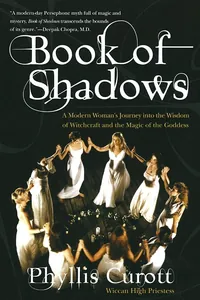



More Free Witchcraft & Paganism Books
View all →