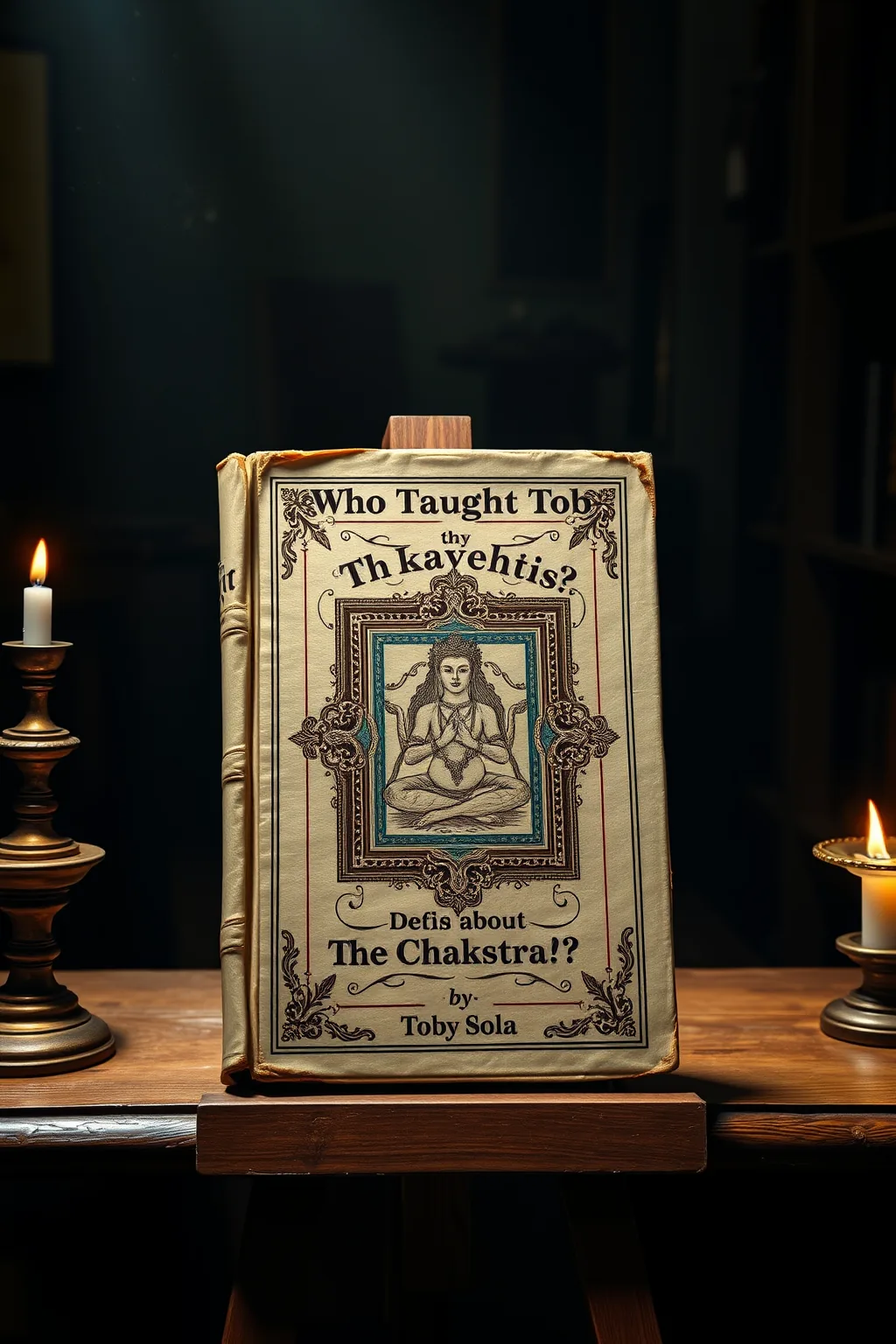
Who Taught Toby About The Chakras?
 82
82

Who Taught Toby About The Chakras?


Lorelei Sage, Contemplative Literature Editor — Toby Sola’s 'Who Taught Toby About The Chakras?' is a rare gem, offering an intimate yet profound journey into the seven Tantric Hindu chakras. Sola’s humble approach to sharing the wisdom imparted by various mentors, both human and experiential, lends an authentic and deeply personal resonance to complex metaphysical concepts. The book excels in demystifying the chakra system for a contemporary audience, grounding esoteric principles in relatable narratives. It’s an essential read for spiritual seekers and practitioners eager to deepen their understanding of energy anatomy and its role in holistic well-being, providing clarity and inspiration.
📝 Description
82
Toby Sola's 2021 book explains the seven chakras through personal encounters and Tantric philosophy.
In 'Who Taught Toby About The Chakras?', Toby Sola recounts his personal journey into the system of the seven primary chakras. The book details the knowledge Sola gained, attributing it to both visible guides and less tangible influences. He connects these energy centers to the broader philosophy of Tantric Hinduism. Sola aims to make this ancient understanding accessible, illustrating how these subtle energy points affect physical, emotional, and spiritual states.
The narrative follows Sola's quest to comprehend this esoteric knowledge. He describes the process of awakening inner potential and transforming consciousness. The book presents the teachers and experiences that shaped his understanding, framing his individual exploration as a guide for contemporary spiritual seekers. It seeks to reveal the underlying structure of awareness and the pathways to personal change.
This book engages with the Tantric tradition within Hinduism, specifically focusing on its chakra system. Tantra, a complex set of practices and philosophies, often emphasizes the body as a vehicle for spiritual realization. The chakras, in this context, are seen as energetic centers along the spine that influence consciousness and physical well-being. Sola's work places these concepts within a framework of personal revelation and direct experience, suggesting a path to understanding these energies through lived spirituality rather than solely academic study.
💡 Why Read This Book?
Uncover the esoteric secrets of the seven Tantric Hindu chakras through an intimate, personal narrative. This book is ideal for spiritual seekers, practitioners of yoga and meditation, and scholars of Eastern philosophies who desire a grounded yet profound understanding of subtle energy systems. Discover the hidden teachers and transformative experiences that illuminate the path to inner awareness and holistic well-being.
⭐ Reader Reviews
Honest opinions from readers who have explored this book.
❓ Frequently Asked Questions
What are the seven primary chakras discussed in the book?
The book delves into the seven core chakras: Muladhara (Root), Svadhisthana (Sacral), Manipura (Solar Plexus), Anahata (Heart), Vishuddha (Throat), Ajna (Third Eye), and Sahasrara (Crown). Each is explored through Toby Sola's personal journey of discovery.
Is this book suitable for beginners in spiritual development?
Absolutely. Toby Sola's narrative style makes complex esoteric concepts accessible and relatable, perfect for those new to chakra study or seeking a gentle introduction to spiritual energy systems.
What makes this book unique compared to other chakra guides?
Its uniqueness lies in its deeply personal and anecdotal approach. Sola shares the specific individuals and transformative experiences that shaped his understanding, offering a more authentic and lived perspective on chakra knowledge.
Does the book offer practical exercises for chakra work?
While primarily a narrative of discovery, the book implicitly guides readers toward understanding the energetic and philosophical underpinnings of chakra practices, inspiring personal exploration and integration.
Where can I find more information about the esoteric traditions mentioned?
The book serves as an excellent primer and may inspire further research into Tantric Hinduism, yogic philosophy, and various meditative traditions. Esoteric Library often provides links to related texts and resources for deeper study.
🔮 Key Themes & Symbolism
The Seven Pillars of Consciousness
This theme explores the foundational concept of the seven primary chakras within the Tantric Hindu tradition. Toby Sola navigates each energy center, revealing its unique energetic signature, symbolic representation, and profound influence on physical, emotional, and spiritual states. The narrative emphasizes how these centers act as conduits for universal life force, shaping our perception of reality and our capacity for growth. It’s a journey into the intricate energetic architecture that governs human experience, presenting a map of inner potential waiting to be activated.
Whispers from the Unseen Teachers
Central to this book is the idea that spiritual knowledge is often transmitted through a network of guides, both tangible and ethereal. Sola recounts the encounters and lessons learned from various individuals and profound experiences that illuminated the chakra system for him. This theme highlights the importance of mentorship, intuition, and synchronicity in the pursuit of esoteric wisdom. It suggests that the path to enlightenment is rarely walked alone, but rather through a series of divinely orchestrated connections and awakenings.
The Alchemy of Personal Revelation
This theme underscores the transformative power of integrating esoteric knowledge into one's lived experience. 'Who Taught Toby About The Chakras?' is not merely an academic treatise but a proof of personal spiritual alchemy. Sola's journey from curiosity to profound understanding illustrates how ancient doctrines can be transmuted into practical wisdom, leading to inner healing and expanded consciousness. The book celebrates the courage to seek, the willingness to learn, and the profound changes that arise when one opens to the subtle energies within and around them.
💬 Memorable Quotes
Direct passages from the work, attributed to the author.
“My teachers were the quiet moments and the sudden lights.”
— This highlights the dual nature of spiritual guidance, encompassing both passive receptivity to subtle insights and active moments of profound realization or epiphany.
“The deepest truths are often found in the simplest questions.”
— This emphasizes the value of childlike curiosity and humility in the pursuit of wisdom, suggesting that profound revelations can arise from authentic inquiry.
💡 Key Ideas
Editorial paraphrase of the work's core concepts — not direct quotes.
The chakras are not just points; they are doorways.
This quote suggests that the chakras are more than mere anatomical or energetic locations. They represent portals of consciousness, offering access to deeper levels of awareness, spiritual insight, and transformative potential.
Energy flows where attention goes, and consciousness follows.
A fundamental principle of subtle energy work, this quote emphasizes the power of directed focus in shaping our energetic state and, consequently, our conscious experience of reality.
To understand the chakra is to understand the self, and to understand the self is to understand the universe.
This quote posits a direct correlation between self-knowledge and cosmic understanding, suggesting that the microcosm of the human energetic system mirrors the macrocosm of universal existence.
🌙 Esoteric Significance
Tradition
This work is deeply rooted in the esoteric traditions of Tantric Hinduism and Yogic philosophy. It engages with the concept of 'prana' (life force energy) and its distribution through subtle energy channels ('nadis') culminating in the six major chakras and the crown chakra. The esoteric significance lies in understanding these centers not just as metaphysical constructs but as active participants in the journey of spiritual awakening and the realization of 'Brahman' or universal consciousness.
Symbolism
The symbolism of the chakras is central to this exploration. Each chakra is associated with specific colors, elements, sounds (mantras), deities, and psychological states. For instance, the Muladhara chakra (root) might be symbolized by the color red and the element of earth, representing grounding and security. The Ajna chakra (third eye) is often symbolized by indigo and light, signifying intuition and inner vision. Sola’s narrative deciphers these symbolic languages, revealing their wide impact on our being.
Modern Relevance
In an era often characterized by stress, disconnection, and a focus on the material world, the esoteric significance of the chakras offers a vital pathway to holistic well-being. Understanding and working with these energy centers provides tools for self-awareness, emotional regulation, and spiritual grounding. Sola’s personal journey demonstrates how ancient wisdom can be applied to contemporary challenges, fostering inner balance, enhancing mindfulness, and facilitating a deeper connection to one's authentic self and the universal energy that permeates all existence.
👥 Who Should Read This Book
This informative book is a treasure for a diverse readership. **Beginners** exploring spiritual development will find Toby Sola's personal narrative an accessible and inspiring introduction to the chakra system. **Practitioners** of yoga, meditation, and energy work will discover a fresh perspective and deeper understanding of the energetic anatomy they engage with daily. **Seekers** of esoteric knowledge and those interested in Eastern philosophies will appreciate the blend of personal experience and traditional wisdom. **Scholars** of comparative religion and consciousness studies may find the anecdotal evidence and personal integrations valuable for understanding the modern reception of ancient teachings.
📜 Historical Context
Toby Sola's exploration of the chakras emerges from a rich historical set of Eastern spiritual traditions, particularly Tantric Hinduism and yogic philosophy, which have been studied and adapted in the West since the late 19th and early 20th centuries. As interest in alternative spiritualities grew, texts like Arthur Avalon's 'The Serpent Power' (1919) brought complex concepts of Kundalini and chakras to a wider audience. The counterculture movements of the 1960s and 70s further popularized these ideas, making them accessible through various gurus and spiritual teachers. Sola's work, while deeply personal, stands on the shoulders of this historical transmission, offering a contemporary voice to an ancient lineage. It reflects a modern desire to integrate these profound energetic and philosophical concepts into daily life, seeking balance and self-realization in an increasingly complex world.
📔 Journal Prompts
Reflect on your personal experiences with each of the seven chakras. What sensations, emotions, or insights have you associated with them?
Who are the 'unseen teachers' in your own life? How have they guided your spiritual or personal growth?
Consider the symbolic language of the chakras. How do colors, elements, or sounds resonate with your current state of being?
In what ways can understanding your own energy centers help you work through the challenges of modern life?
What does 'awakening' mean to you, and how do you perceive the role of the chakras in that process?
🗂️ Glossary
Chakra
Literally 'wheel' in Sanskrit, chakras are energetic centers within the subtle body, believed to regulate the flow of life force (prana) and influence physical, emotional, and spiritual states.
Prana
The vital life force or energy that animates all living beings. It is believed to flow through the nadis and is regulated by the chakras.
Tantric Hinduism
A diverse spiritual tradition originating in India that often emphasizes the use of ritual, meditation, and mantra to achieve spiritual liberation and realization of the divine within.
Nadis
Subtle energy channels within the body through which prana flows. The three main nadis are Ida, Pingala, and Sushumna, which relate to the spinal cord and energy pathways.
Kundalini
A primal spiritual energy often depicted as a coiled serpent residing at the base of the spine. Its awakening is central to many yogic and tantric practices, leading to spiritual transformation and enlightenment.
This book appears in 6 collections
🔮 Readers Also Liked
Browse all →









More by Toby Sola
All books →
From the “Mindfulness” Collection
View all →




More Free Spiritual Development Books
View all →