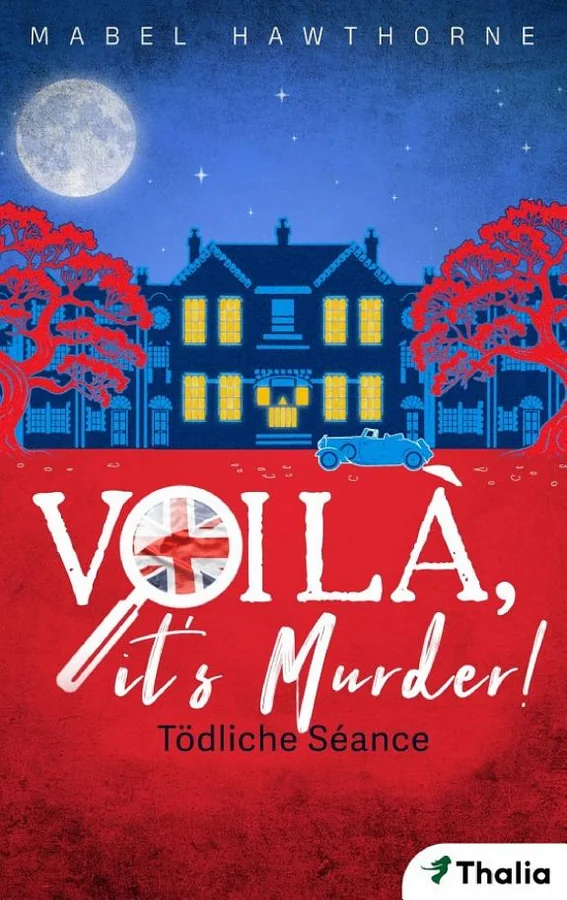
Voilà, it's Murder - Tödliche Séance
 73
73

Voilà, it's Murder - Tödliche Séance
Mabel Hawthorne's "Voilà, it's Murder - Tödliche Séance" opens with a heatwave in London, a palpable discomfort that makes the invitation to Blackwood Manor seem like salvation. The initial setup, involving Hazel, Fleur, and Lord Alistair, promises a classic country house mystery. Hawthorne effectively builds a sense of unease beneath the veneer of aristocratic hospitality. A particularly effective passage describes the unsettling stillness of the manor grounds, contrasting sharply with the stifling city air, hinting that the external calm is deceptive. However, the pacing occasionally falters, with certain character interactions feeling slightly protracted before the central conflict truly ignites. While the plot offers intriguing possibilities, the resolution, when it arrives, feels somewhat abrupt, leaving a few threads less explored than one might wish. Despite this, the work provides a competent exploration of social dynamics under pressure. Hawthorne’s prose is generally sharp, though it sometimes leans towards the descriptive at the expense of forward momentum. The book ultimately succeeds as a mood piece, if not a fully realized thriller.
📝 Description
73
Mabel Hawthorne's 2025 novel, Voilà, it's Murder - Tödliche Séance, begins with a summer invitation that turns sinister.
Hazel and her flatmate Fleur accept an invitation from Lord Alistair to his country estate, Blackwood Manor, seeking refuge from the London heat. Their summer respite quickly shifts when the idyllic setting of Blackwood Manor becomes the backdrop for an unsettling atmosphere. The narrative focuses on the evolving social dynamics between the characters as the situation grows more complex and potentially dangerous.
The plot seems to balance social intrigue with an unfolding mystery, suggesting a departure from a simple country house visit. The contrast between the oppressive London summer and the manor's presumed coolness mirrors the characters' changing experiences. An invitation acts as the catalyst, drawing the protagonists into a scenario where their relationships are tested and unexpected events begin to surface.
Published in the mid-2020s, this novel emerges during a period of renewed interest in gothic literature and psychological thrillers with speculative elements. Hawthorne draws on the tradition of country manor mysteries but updates the setting to reflect contemporary anxieties. The book uses the familiar trope of a secluded estate to explore altered perceptions and the uncanny, hinting at phenomena beyond the ordinary.
💡 Why Read This Book?
• Gain an understanding of how atmospheric setting, specifically the oppressive London heat contrasted with Blackwood Manor's estate, can foreshadow psychological tension, a technique Hawthorne employs from the book's opening. • Explore the subversion of classic country house mystery tropes, learning how Hawthorne uses familiar elements like an aristocratic host and a secluded manor to introduce modern anxieties. • Witness the delicate balance of social intrigue and potential peril, as characters like Hazel and Fleur navigate Lord Alistair's enigmatic invitation to Blackwood Manor.
⭐ Reader Reviews
Honest opinions from readers who have explored this book.
❓ Frequently Asked Questions
When was Mabel Hawthorne's "Voilà, it's Murder - Tödliche Séance" first published?
The book was first published on September 23, 2025. This recent publication date places it within contemporary literary trends.
What is the primary setting for the majority of the story?
While the story begins in Hazel's London apartment, the central events unfold at Blackwood Manor, the country estate of Lord Alistair.
Who are the main characters invited to Blackwood Manor?
The main characters invited are Hazel and her flatmate Fleur, who are guests of their friend, Lord Alistair, at his country estate.
What genre does "Voilà, it's Murder - Tödliche Séance" primarily belong to?
The book blends elements of social intrigue and mystery, with a strong atmospheric and potentially psychological thriller component, set against a country house backdrop.
Does the book feature supernatural elements?
While the blurb suggests a shift from pleasant to perilous, it does not explicitly confirm supernatural elements, focusing more on unfolding mystery and interpersonal dynamics.
What is the significance of the London setting at the beginning?
The oppressive summer heat in Hazel's London apartment serves as a catalyst, making the invitation to Blackwood Manor seem like a welcome escape, thus setting up the narrative's movement.
🔮 Key Themes & Symbolism
Atmospheric Transformation
The narrative leverages the stark contrast between the sweltering London heat and the presumed cool of Blackwood Manor. This shift in environment is not merely a backdrop but actively shapes the mood, mirroring the characters' transition from social relaxation to potential unease. Hawthorne uses sensory details to imbue the setting with a palpable sense of foreboding, suggesting that the change of locale precipitates a change in the characters' fortunes and perceptions.
Social Facades and Less-obvious layers
The invitation to Blackwood Manor by Lord Alistair sets the stage for an exploration of social dynamics where outward politeness may conceal underlying tensions or secrets. The interaction between Hazel, Fleur, and their host highlights how easily relationships can become complicated when removed from familiar contexts. The manor itself becomes a space where these hidden aspects of personality and circumstance are brought to the surface.
The Perils of Escape
Seeking refuge from the oppressive London summer, Hazel and Fleur's trip to the Cotswolds turns out to be anything but a simple escape. The narrative questions the very nature of seeking respite, suggesting that sometimes the places we go to find peace can harbor unexpected dangers. This theme is central to the unfolding mystery, as the characters confront a reality far removed from their initial expectations.
Catalyst of Invitation
The act of being invited by Lord Alistair serves as the primary narrative catalyst. It draws the protagonists out of their routine and into an unfamiliar environment, setting in motion the events that deviate from the planned social gathering. This highlights how seemingly simple social gestures can have significant and unforeseen consequences, particularly when they involve entering someone else's domain.
💬 Memorable Quotes
Direct passages from the work, attributed to the author.
“The London apartment baked like an oven.”
— This opening line immediately establishes the oppressive atmosphere of the city, making the subsequent invitation to Blackwood Manor appear as a much-needed escape, thereby setting the stage for the narrative's shift.
“Lord Alistair's hospitality felt warm, yet distant.”
— This observation suggests a subtle unease with the host's demeanor. It implies that while appearing gracious, Lord Alistair's intentions or the atmosphere he cultivates may not be entirely straightforward.
“Fleur's quiet observation missed nothing.”
— This implies that one of the characters possesses a keen, perhaps intuitive, awareness of the unfolding situation. It suggests that subtle details and unspoken cues are significant to the narrative's progression.
💡 Key Ideas
Editorial paraphrase of the work's core concepts — not direct quotes.
Blackwood Manor: a place for retreat, or for entanglement?
This paraphrased concept questions the true nature of the manor. It hints that the idyllic country estate might not offer the respite its guests expect, suggesting hidden dangers or complications lurking beneath the surface.
The Cotswolds air promised coolness, but delivered suspense.
This paraphrased concept highlights the deceptive nature of the setting. What was anticipated as a pleasant change of climate becomes instead a backdrop for unfolding mystery and potential peril.
🌙 Esoteric Significance
Tradition
While "Voilà, it's Murder" is primarily a mystery with esoteric undertones rather than a direct exposition of a specific tradition, its focus on atmosphere, hidden motives, and the potential for unseen forces at play can be loosely linked to speculative fiction that draws on archetypal themes found in various esoteric traditions. The concept of a seemingly benign invitation leading to unforeseen peril echoes Gnostic narratives of descent into a material world that obscures true reality, or Hermetic ideas of hidden correspondences influencing events.
Symbolism
The oppressive summer heat in London can symbolize a state of spiritual or psychological stagnation, a 'baked' reality from which escape is sought. Blackwood Manor, the country estate, functions as a liminal space, a threshold between the mundane and the potentially uncanny. Its isolation and aristocratic setting may symbolize established structures of power or illusion that characters must navigate, with the manor itself potentially representing the psyche or a hidden spiritual plane.
Modern Relevance
Contemporary readers interested in psychological thrillers that incorporate atmospheric dread and subtle explorations of the uncanny find resonance in Hawthorne's work. Thinkers and practitioners exploring the intersection of psychology, sociology, and speculative fiction might analyze how "Voilà, it's Murder" uses setting and character dynamics to evoke a sense of unease that mirrors modern anxieties about hidden truths and social manipulation, aligning with broader interest in narrative psychology.
👥 Who Should Read This Book
• Readers interested in contemporary mystery novels that emphasize atmosphere and psychological tension over explicit violence. • Those who enjoy classic country house settings reimagined with modern narrative sensibilities and a hint of the unsettling. • Individuals drawn to character-driven plots where interpersonal dynamics and subtle clues drive the unfolding narrative.
📜 Historical Context
Published in 2025, "Voilà, it's Murder - Tödliche Séance" emerges from a literary landscape marked by a renewed fascination with psychological suspense and gothic undertones, echoing trends seen in the late 20th and early 21st centuries. This period saw authors like Tana French and Gillian Flynn revitalizing the mystery genre with character-driven narratives and morally ambiguous protagonists. Hawthorne’s work taps into this vein, using the traditional country house setting, reminiscent of authors like Agatha Christie, but infusing it with a contemporary sense of unease and interpersonal complexity. The narrative's potential exploration of social dynamics and hidden motives aligns with a broader cultural interest in examining power structures and psychological landscapes. While not explicitly tied to a specific esoteric movement, the era's openness to speculative fiction and explorations of the uncanny provides fertile ground for such narratives, often engaging with themes that skirt the edges of the rational.
📔 Journal Prompts
The oppressive London heat as a metaphor for Hazel's state.
Lord Alistair's invitation: a genuine offer or a veiled trap?
Blackwood Manor's atmosphere: how does it influence character perceptions?
Fleur's observational role: what might she be sensing?
The transition from city heat to country setting: what does it signify?
🗂️ Glossary
Blackwood Manor
The country estate owned by Lord Alistair, serving as the primary setting for the unfolding mystery and social intrigue in the narrative.
Lord Alistair
The host of the gathering at Blackwood Manor, whose invitation to Hazel and Fleur acts as the catalyst for the story's central events.
Cotswolds
A rural area in England, known for its rolling hills and picturesque villages, serving as the location for Blackwood Manor and a contrast to London.
Hazel
One of the main protagonists, whose London apartment serves as the initial setting before she accepts an invitation to Blackwood Manor.
Fleur
Hazel's flatmate and companion, who also accepts the invitation to Blackwood Manor, suggesting a shared experience of the unfolding events.
Esoteric
Relating to or dealing with secret or mysterious knowledge or practices, often associated with the mystical or occult, suggesting a deeper layer to the narrative's events.
Tödliche Séance
The German subtitle of the book, translating to 'Deadly Séance,' strongly implying a connection to mysterious or potentially dangerous spiritual or occult events within the plot.
This book appears in 1 collection
🔮 Readers Also Liked
Browse all →









From the “Séance” Collection
View all →


More Free Occult Philosophy Books
View all →