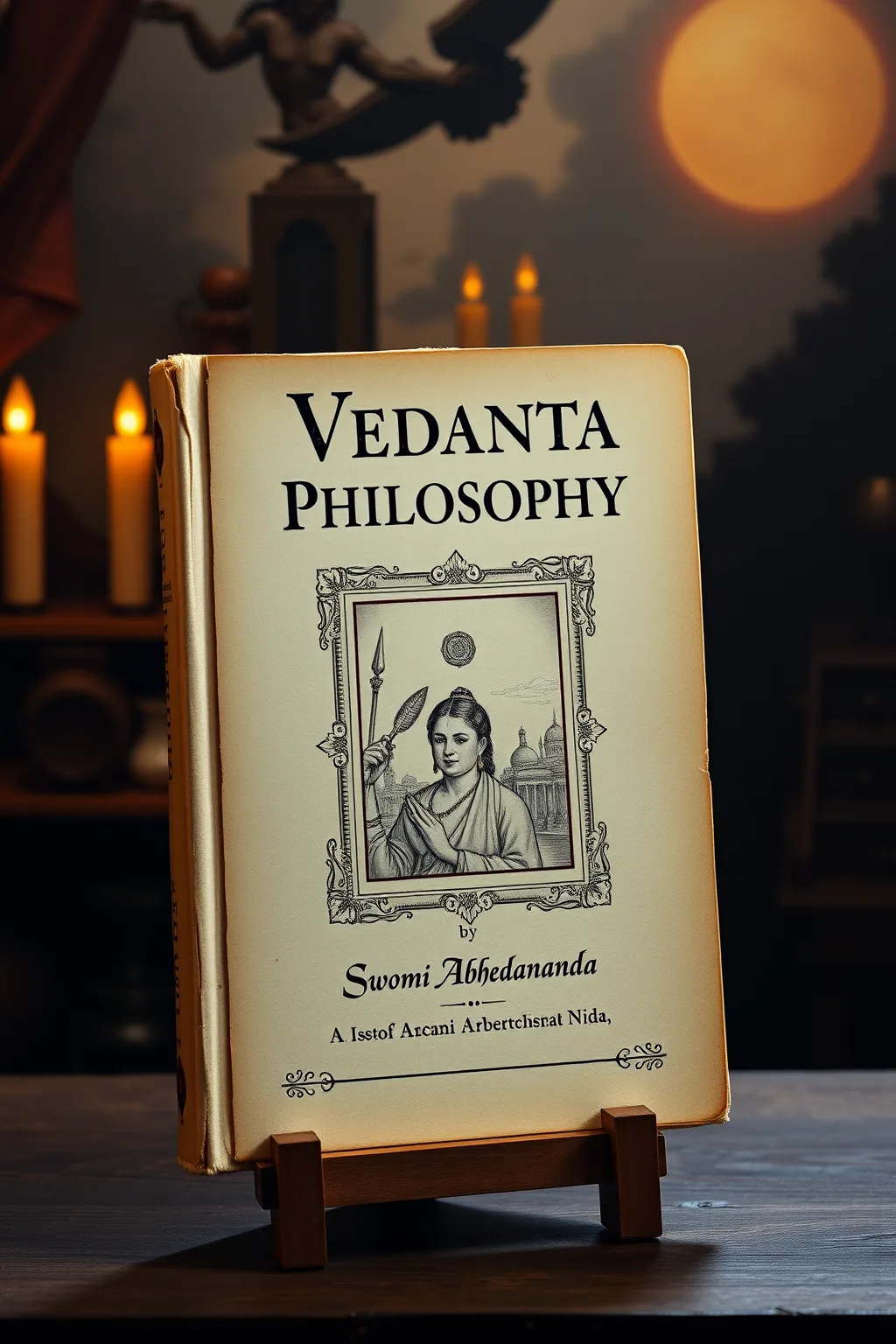
Vedanta Philosophy
 71
71

Vedanta Philosophy



Celeste Moreau (Divination & Symbolism Reviewer) — Swami Abhedananda’s ‘Vedanta Philosophy’ is a luminous beacon for serious students of the inner sciences. Delivered with palpable spiritual authority, these lectures from 1900-1901 offer a rare glimpse into the practical application of Vedantic principles for spiritual liberation. Abhedananda’s ability to distill complex metaphysical concepts into accessible, yet profound, insights is remarkable. He masterfully reveals how the mind's entanglement with external stimuli obstructs our innate divine nature. This work is particularly potent for those seeking to understand the energetic and psychological roots of spiritual bondage, offering a clear roadmap to inner freedom. A must-read for practitioners of meditation and advanced yogis.
📝 Description
71
Swami Abhedananda delivered these lectures on Vedanta philosophy in New York City in 1902.
Delivered in New York in 1902, these lectures by Swami Abhedananda explain core tenets of Vedanta philosophy. He discusses how the mind, driven by a desire for temporary sensory satisfaction, creates attachments that lead to suffering. Abhedananda aims to show how understanding the nature of consciousness can lead to the realization of the true Self, free from these limitations. He explains the philosophical concepts in a way that aims to guide the spiritual seeker toward a deeper understanding of reality.
The text addresses the common human experience of being caught in cycles of desire and dissatisfaction. By examining the structure of consciousness, Abhedananda suggests a path to freedom from these binds. The goal is to help readers recognize the unconditioned nature of the Self, distinct from the transient experiences of the material world. This work provides a philosophical framework for those interested in spiritual awakening.
Vedanta philosophy, originating in ancient India, is a school of thought within Hinduism that explores the nature of reality, the self, and the path to liberation. Swami Abhedananda, a disciple of the famed Ramakrishna, belonged to the Advaita Vedanta tradition, which emphasizes the non-dual nature of existence – the idea that the individual soul (Atman) is identical with the ultimate reality (Brahman). His lectures aim to present these complex philosophical ideas in a way accessible to a Western audience, focusing on the practical application of Vedanta principles for spiritual development and self-realization.
✍️ Author

Swami Abhedananda
Swami Abhedananda was a disciple of Ramakrishna Paramahansa and founder of Ramakrishna Vedanta Math.
Mystic
💡 Why Read This Book?
Unravel the ancient secrets of spiritual liberation. Swami Abhedananda provides clear guidance on transcending mental enslavement to sensory pleasures. This book is ideal for seekers yearning for self-realization, scholars interested in comparative philosophy, and practitioners seeking to deepen their understanding of consciousness and its inherent freedom. Discover the path to inner peace and eternal bliss.
⭐ Reader Reviews
Honest opinions from readers who have explored this book.
❓ Frequently Asked Questions
What is Vedanta Philosophy?
Vedanta Philosophy is a school of Hindu philosophy that explores the nature of reality, the self, and the ultimate goal of human existence, aiming for liberation (Moksha) through self-knowledge and the realization of the oneness of the individual soul (Atman) with the universal consciousness (Brahman).
Who was Swami Abhedananda?
Swami Abhedananda was a direct disciple of Sri Ramakrishna Paramahamsa and a prominent Vedanta philosopher and speaker who played a crucial role in spreading Vedanta in the West during the early 20th century, establishing Vedanta Societies in various cities.
What is the core message of this book?
The core message is that our minds, driven by the senses, become enslaved by external pleasures. True freedom and happiness lie in realizing our inherent spiritual nature, which is beyond the transient experiences of the material world.
How does this book relate to modern spiritual practices?
It provides a foundational understanding of consciousness and the mind, which is essential for many modern practices like meditation, mindfulness, and self-inquiry. It offers the philosophical underpinning for achieving inner peace and spiritual growth.
Is this book suitable for beginners?
While it delves into profound philosophical concepts, Swami Abhedananda's clear and accessible style makes it suitable for dedicated beginners who are genuinely seeking deeper spiritual understanding. Patience and an open mind are key.
🔮 Key Themes & Symbolism
The Nature of Mind and Its Bondage
This theme explores the intricate workings of the human mind, dissecting its incessant drive towards sensory gratification. Swami Abhedananda expounds on how attachment to fleeting pleasures creates a form of psychological enslavement, obscuring our true spiritual identity. The text illuminates the subtle interplay between desires, attachments, and the resulting limitations on consciousness, offering a profound understanding of the root causes of suffering and the illusion of separateness.
Spiritual Unfoldment and Self-Realization
Central to this work is the concept of spiritual unfoldment – the gradual awakening and expansion of consciousness towards its divine potential. Swami Abhedananda presents Vedanta as a practical path to Self-Realization, the ultimate goal of recognizing the eternal, unchanging nature of the Self (Atman) as identical with the Universal Being (Brahman). This theme guides the reader through the inner journey of shedding ignorance and realizing their inherent divinity and boundless bliss.
The Illusion of the Material World
The lectures critically examine the nature of the material world as perceived through the senses, identifying it as a area of impermanence and illusion (Maya). Swami Abhedananda reveals how our identification with this transient reality leads to suffering and a distorted perception of self. By understanding the illusory nature of phenomena, the seeker is encouraged to turn inward, seeking the permanent and unchanging truth that lies beyond the veil of sensory experience.
💬 Memorable Quotes
Direct passages from the work, attributed to the author.
“Our minds are constantly seeking new objects of pleasure.”
— This highlights the restless nature of the untrained mind, perpetually drawn to external stimuli for temporary satisfaction, a fundamental obstacle to inner peace.
“The mind becomes a slave to it.”
— Illustrates the binding power of attachment, where the mind loses its freedom by becoming dependent on fleeting pleasures and desires.
“If anything happens to come in the way and prevent the mind...”
— Suggests the inherent fragility of happiness derived from external sources and the inevitable suffering when these sources are disrupted.
“We are not the body, nor the mind, nor the senses.”
— A foundational Vedantic assertion pointing towards the transcendent nature of the true Self, distinct from physical and mental constructs.
“Realize the Atman, the true Self within.”
— An imperative call to introspection and the pursuit of Self-knowledge as the direct path to spiritual liberation and ultimate fulfillment.
🌙 Esoteric Significance
Tradition
This work is deeply rooted in the Advaita Vedanta tradition, a major school of Hindu philosophy emphasizing non-duality. Its esoteric significance lies in its unveiling of the underlying unity of all existence, the identity of the individual soul (Atman) with the Absolute Reality (Brahman), and the path to realizing this truth through knowledge and contemplation, transcending the illusion of separation.
Symbolism
The lectures subtly employ symbolic language to represent spiritual concepts. The 'gates of the senses' symbolize the external world's allure, acting as conduits for attachment. The 'mind' is depicted as a dynamic entity, capable of enslavement or liberation. The 'true Self' represents the pure, unconditioned consciousness, often symbolized by light or infinite space, the ultimate goal of the spiritual quest.
Modern Relevance
In an era saturated with external distractions and a constant barrage of information, Swami Abhedananda's teachings on mind control and the pursuit of inner contentment are more relevant than ever. The book offers timeless wisdom for navigating psychological turmoil, understanding the roots of addiction to external validation, and cultivating a profound sense of inner peace and self-awareness, essential for mental well-being.
👥 Who Should Read This Book
This useful text is important for spiritual seekers yearning for a profound understanding of existence and their place within it. Scholars of comparative philosophy and religious studies will find its rigorous exposition of Vedantic thought enlightening. Practitioners of yoga and meditation will benefit immensely from its insights into the nature of consciousness and the mind's role in spiritual progress. Beginners seeking a foundational text on Eastern spirituality will discover a clear, yet deep, introduction to one of the world's most ancient and profound wisdom traditions.
📜 Historical Context
Delivered between 1900-1901 in New York, these lectures by Swami Abhedananda emerged during a period of burgeoning interest in Eastern philosophies in the West. The late Victorian and Edwardian eras saw a significant intellectual and spiritual curiosity, fueled by Orientalist studies and the presence of figures like Swami Vivekananda. This was a time when Westerners, disillusioned with purely materialistic outlooks, actively sought alternative spiritual and philosophical frameworks. Abhedananda’s eloquent exposition of Vedanta provided a sophisticated, yet accessible, introduction to a profound system of thought, resonating with those yearning for deeper meaning and spiritual transcendence amidst rapid industrialization and societal change.
📔 Journal Prompts
Reflect on a recent instance where your mind sought pleasure through the senses. What was the object of desire, and what was the resulting feeling? How long did it last?
Consider the concept of the mind being a 'slave' to attachment. In what areas of your life do you feel most bound by external dependencies or desires?
If your mind is constantly seeking new pleasures, what does this imply about your perception of your own inner state or inherent fulfillment?
Swami Abhedananda suggests turning inward for true happiness. What are the biggest obstacles you perceive to looking inward and finding contentment within yourself?
How might understanding the illusory nature of the material world (Maya) help you to detach from transient worries and anxieties?
🗂️ Glossary
Vedanta
A school of Hindu philosophy that explores the ultimate nature of reality, the self, and the path to liberation, drawing from the Upanishads, the Bhagavad Gita, and the Brahma Sutras.
Atman
The individual soul or self, often described as the eternal, unchanging essence of a being, which in Advaita Vedanta is identical with Brahman.
Brahman
The ultimate, unchanging reality or absolute consciousness that underlies all existence in Hinduism; the Universal Self.
Maya
A Sanskrit term referring to illusion, divine magic, or the power that conceals the true nature of reality, making the phenomenal world appear real.
Spiritual Unfoldment
The process of gradual spiritual growth, awakening, and expansion of consciousness, leading towards the realization of one's true divine nature.
This book appears in 1 collection
🔮 Readers Also Liked
Browse all →









More by Swami Abhedananda
All books →




![Vedanta Philosophy Self-knowledge [atma-jnana]](/img/thumb/vedanta-philosophy-self-knowledge-atma-jnana-swami-abhedananda-114980.webp)
From the “Spiritual Awakening” Collection
View all →









More Free Spiritual Development Books
View all →