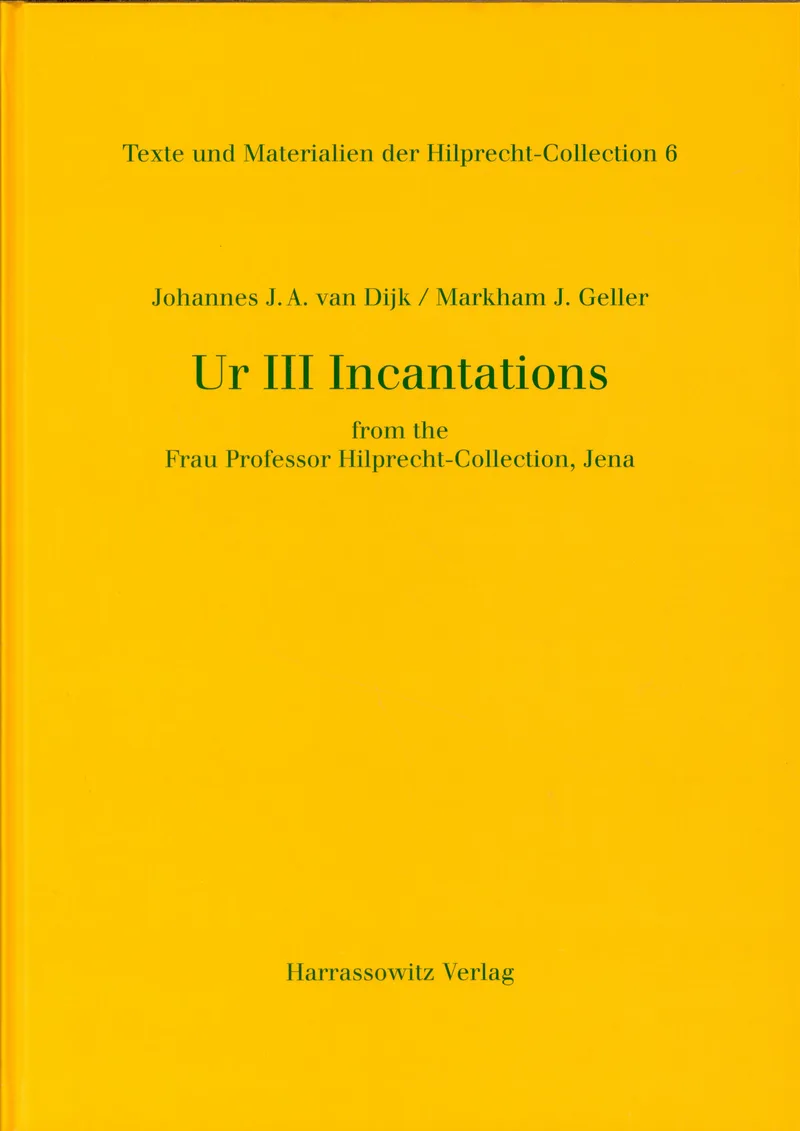
Ur III Incantations from the Frau Professor Hilprecht-Collection, Jena
 76
76

Ur III Incantations from the Frau Professor Hilprecht-Collection, Jena
The scholarly rigor applied to the Ur III Incantations from the Frau Professor Hilprecht-Collection is immediately apparent. Geller’s completion of van Dijk’s work ensures a cohesive and authoritative presentation of these ancient Sumerian texts. The commentaries are particularly valuable, shedding light on the grammatical nuances and cultural underpinnings of the incantations designed to counter demonic activity. A notable strength lies in the detailed analysis of specific demonological concepts prevalent in the third millennium BCE. However, for readers not already versed in Akkadian or Sumerian philology, the sheer density of the scholarly apparatus might present a significant barrier to entry. The focus is decidedly academic, offering little in the way of speculative interpretation for the lay practitioner. Nevertheless, for the dedicated scholar, this volume is an essential resource for understanding the practical magic and religious beliefs of the Ur III period.
📝 Description
76
This 1985 volume presents 23 incantations from the Ur III period, circa 2112-2004 BCE.
This book meticulously presents 23 incantations from the Ur III period, sourced from Nippur and held in the Frau Professor Hilprecht-Collection in Jena. It includes scholarly transcriptions, accurate translations, and detailed commentaries. These texts originate from a significant era in Mesopotamian history, a time of centralized administration and developing literature. The incantations were composed to combat demonic influence, giving readers a direct view into the spiritual concerns and protective practices of that age. The central focus of these incantations is warding off malevolent spirits and supernatural afflictions. They describe the methods used to identify, confront, and neutralize forces believed to cause illness, misfortune, and spiritual distress. This reflects a complex understanding of the cosmos and humanity's role within it.
The incantations documented in this volume belong to the rich tradition of Mesopotamian magic, a practice deeply interwoven with religion and medicine. These rituals aimed to understand and manipulate unseen forces, particularly malevolent spirits believed to cause illness and misfortune. Their structure and content reveal a sophisticated worldview where divine and demonic powers directly impacted human lives. Studying these texts offers insight into early attempts to impose order on chaos through ritual and spoken word, a practice found in various forms across ancient cultures.
💡 Why Read This Book?
• Gain direct access to 23 Ur III incantations from Nippur, understanding their structure and translation as presented by scholars like Markham J. Geller. • Explore the specific methods and concepts used in ancient Mesopotamia to combat demonic influence, as detailed in the commentaries. • Appreciate the historical and religious context of the Ur III period (circa 2112-2004 BCE) through the scholarly analysis of these potent magical texts.
⭐ Reader Reviews
Honest opinions from readers who have explored this book.
❓ Frequently Asked Questions
What is the significance of the Ur III period for these incantations?
The Ur III period (circa 2112-2004 BCE) was a time of significant cultural and administrative development in Mesopotamia, providing a stable environment for the creation and preservation of literature, including these magical incantations.
Who were the primary authors or editors of this collection?
The work is a collaborative effort, with initial work by J. J. A. van Dijk and completion and editing by Markham J. Geller and Joachim Oelsner.
What is the main purpose of the incantations presented?
The incantations were composed primarily to combat the harmful work of demons and protect individuals from supernatural malevolence and its perceived consequences.
Where are the original tablets housed?
The original tablets, originating from Nippur, are now part of the Frau Professor Hilprecht-Collection, located in Jena, Germany.
What academic disciplines does this book serve?
This book is crucial for Assyriology, ancient Near Eastern studies, the history of religion, and the academic study of magic and exorcism.
What level of prior knowledge is assumed for readers?
A foundational understanding of ancient Mesopotamian languages (Sumerian/Akkadian) and scholarly conventions in cuneiform studies is beneficial for full comprehension.
🔮 Key Themes & Symbolism
Demonology and Exorcism
The core of this volume lies in the detailed examination of ancient Mesopotamian demonology. The incantations are presented as practical tools designed to identify, confront, and expel malevolent entities believed to cause illness and misfortune. The scholarly commentary elucidates the specific types of demons, their perceived powers, and the ritualistic actions prescribed for their removal, offering a glimpse into the anxieties and protective strategies of the Ur III period.
Sumerian Religious Practice
These texts offer direct evidence of religious and magical practices during the Ur III period (circa 2112-2004 BCE). They showcase the integration of ritual, incantation, and belief in supernatural forces within daily life. The meticulous transcriptions and translations allow scholars to reconstruct aspects of Sumerian worldview, their understanding of cosmic order, and the human role in maintaining it against perceived threats.
Cuneiform Textual Analysis
The volume represents a significant contribution to the field of cuneiform studies. It demonstrates the rigorous process of transcribing, translating, and interpreting ancient Mesopotamian clay tablets. The work highlights the challenges and rewards of engaging with primary source material from millennia ago, making complex texts accessible to a specialized academic audience interested in the linguistic and cultural nuances.
The Frau Professor Hilprecht-Collection
This collection, housing these valuable Ur III incantations from Nippur, serves as a crucial repository of ancient Mesopotamian artifacts. The scholarly presentation of these specific tablets underscores the importance of such curated collections for preserving and disseminating knowledge about early civilizations. The provenance of the texts adds another layer of historical significance to their study.
💬 Memorable Quotes
Direct passages from the work, attributed to the author.
“Incantations composed to combat the work of demons.”
— This concise statement from the original blurb expresses the primary function of the texts: they are not merely descriptive, but active magical formulae intended to neutralize supernatural threats. This highlights the practical application of religious belief in ancient Mesopotamia.
“23 Ur III incantations from Nippur.”
— This factual anchor points to the specific corpus of texts examined and their geographical origin. It situates the scholarly work within a defined historical and archaeological context, emphasizing the specificity of the research.
“Work begun by the late van Dijk.”
— This acknowledges the scholarly lineage and collaborative nature of the project. It signifies the continuation of academic inquiry across different generations of researchers, building upon foundational work.
“Now held in a collection in Jena.”
— This detail provides the current physical location of the source material, the Frau Professor Hilprecht-Collection. It is crucial for researchers and scholars who may wish to consult the original tablets or verify the transcriptions.
“Geller here completes work begun by the late van Dijk.”
— This emphasizes the editorial process and the scholarly dedication involved in bringing these ancient texts to light. It suggests a meticulous and comprehensive approach to their study and publication.
🌙 Esoteric Significance
Tradition
While not strictly fitting into later Western esoteric traditions like Hermeticism or Kabbalah, these Ur III incantations represent a foundational stratum of ritualistic practice and belief in supernatural forces. Their significance lies in being among the earliest documented attempts to systematize the understanding and manipulation of unseen energies and entities for protective purposes, predating many later magical systems.
Symbolism
The incantations often invoke divine authority and cosmic principles to counter chaos represented by demons. Specific symbols might include divine names, protective amulets (though not always explicitly detailed in translation), and the powerful act of 'binding' or 'banishing' malevolent forces. The very act of reciting the incantation is a symbolic ritual designed to restore order and purity.
Modern Relevance
Contemporary scholars of ancient religions and comparative mythology draw directly from works like this to understand the roots of ritualistic practices found across many cultures. Practitioners of modern magical traditions, particularly those interested in historical shamanism or ancient Near Eastern magic, may find these texts informative for understanding archetypal patterns of spirit interaction and protective rites.
👥 Who Should Read This Book
['• Scholars of Ancient Near Eastern Studies: Gain access to critical editions of primary texts from the Ur III period, enhancing research on Mesopotamian religion and society.', '• Researchers of Comparative Mythology: Understand the origins of demonological concepts and exorcism rituals that may have influenced later traditions.', '• Students of the History of Magic: Explore early systematic approaches to combating supernatural threats, providing a historical baseline for magical practices.']
📜 Historical Context
The Ur III Incantations originate from the Sumerian Ur III period (circa 2112-2004 BCE), a time often considered a Sumerian renaissance, characterized by a centralized empire under rulers like Ur-Nammu and Shulgi. This era saw a flourishing of cuneiform literature, administrative reforms, and a strong cultural identity. The incantations themselves reflect a deeply ingrained belief system where demons and malevolent spirits were active agents causing illness and misfortune, necessitating ritualistic countermeasures. This period followed the Gutian period and predated the Old Babylonian Empire, placing it firmly within the Bronze Age Near East. While specific contemporary reception events like censorship or prizes are not widely documented for this precise type of text, their preservation within temple archives and scholarly collections indicates their importance. The work by van Dijk, Geller, and Oelsner engages with a long tradition of Assyriological scholarship, building upon the foundational work of scholars who established the understanding of Sumerian and Akkadian languages and literature throughout the 19th and 20th centuries.
📔 Journal Prompts
The specific methods used to combat demons in the Ur III incantations.
The role of Nippur as a source for these ancient magical texts.
The concept of demonic influence as presented by Geller and van Dijk.
The significance of the Frau Professor Hilprecht-Collection for preserving these texts.
The relationship between ritual recitation and perceived efficacy in Ur III magic.
🗂️ Glossary
Ur III Period
A historical period in Sumerian civilization, roughly 2112-2004 BCE, known for its centralized empire and significant cultural output, including literature and administrative records.
Incantation
A spoken or chanted magical formula, often used in ancient cultures as a ritualistic method to invoke supernatural powers or ward off malevolent forces.
Nippur
An ancient Sumerian city, considered a major religious center, whose archaeological findings, including vast numbers of cuneiform tablets, have been crucial for understanding Mesopotamian civilization.
Demons
In the context of Ur III beliefs, malevolent supernatural beings or spirits believed to cause illness, misfortune, and other afflictions to humans.
Frau Professor Hilprecht-Collection
A significant collection of ancient Near Eastern antiquities, particularly cuneiform tablets, housed in Jena, Germany, named after the scholar Friedrich Delitzsch and his predecessor Hermann Volrath Hilprecht.
Cuneiform
An ancient writing system characterized by wedge-shaped marks impressed on clay tablets, used in Mesopotamia for various languages including Sumerian and Akkadian.
Exorcism
The practice of evicting demons or evil spirits from a person or place, often through religious rituals, prayers, or incantations.