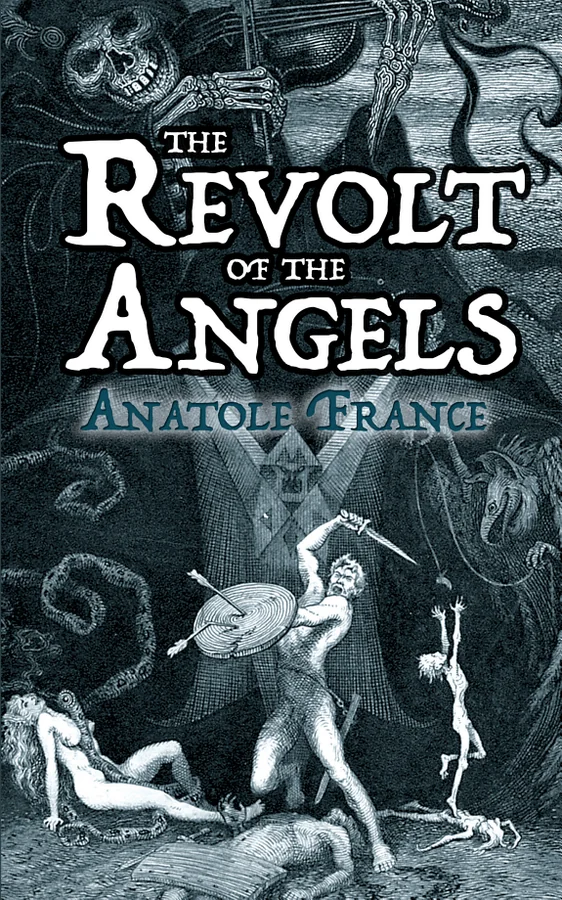
The Revolt of the Angels
 72
72

The Revolt of the Angels
Anatole France's "The Revolt of the Angels" is less a theological treatise and more a biting social commentary delivered with a celestial smirk. The premise, featuring fallen angels observing and critiquing human society from their earthly sojourn, provides ample opportunity for France's characteristic wit and skepticism. The satire lands with precision, particularly in its skewering of religious hypocrisy and governmental absurdities, echoing the anxieties of pre-World War I Europe. While the narrative occasionally meanders through philosophical discussions, its strength lies in its sharp observations and the audacious reimagining of biblical narratives. A particular delight is the character of Abdiel, the angelic informant, whose earnest reports from Earth highlight the ridiculousness of human affairs. However, the sheer volume of philosophical musing can sometimes overshadow the narrative momentum, making certain passages feel dense. Despite this, the novel remains a potent, if somewhat dated, critique of power and belief. It is a work that challenges without demanding easy answers.
📝 Description
72
Anatole France published "The Revolt of the Angels" in 1914, a satire on divine and human authority.
Anatole France's 1914 novel, "The Revolt of the Angels," uses a theological fantasy framework to critique established institutions. The story follows fallen angels who return to Earth, observing human society with a cynical eye. Their interactions and commentaries expose the hypocrisies found in religion, government, and military structures. The novel questions fundamental concepts of good and evil, the nature of authority, and divine justice, all through the experiences of these celestial exiles.
This work is suited for readers who enjoy philosophical fiction, dark humor, and analyses of power. It will appeal to those interested in the blend of mythology, religion, and social critique. Readers familiar with early 20th-century French literature or Anatole France's own skeptical humanism will find its subversion of traditional religious narratives particularly resonant. It is for those who appreciate intellectual engagement and are comfortable challenging conventional viewpoints.
Published just before World War I, "The Revolt of the Angels" emerged during a period of significant intellectual and social change in Europe. Anatole France, a Nobel laureate known for his skepticism, addressed themes of anticlericalism and pacifism. The novel reflects a growing disillusionment with traditional authority and a critique of religious dogma common in the Belle Époque. Its questioning of divine order aligns with a broader European literary trend of challenging established values, seen also in writers like H.G. Wells and George Bernard Shaw.
💡 Why Read This Book?
• Understand the Luciferian archetype as a symbol of intellectual defiance, moving beyond simplistic notions of evil, as explored through the fallen angels' descent in "The Revolt of the Angels." • Gain insight into the pre-World War I European intellectual climate, characterized by skepticism towards established religion and government, evident in the novel's 1914 publication context. • Appreciate Anatole France's satirical method of critiquing societal hypocrisy and the construction of morality through the lens of angelic observation.
⭐ Reader Reviews
Honest opinions from readers who have explored this book.
❓ Frequently Asked Questions
When was Anatole France's 'The Revolt of the Angels' originally published?
Anatole France's 'The Revolt of the Angels' was first published in 1914, a period marked by significant social and political tensions in Europe.
What is the central theme of 'The Revolt of the Angels'?
The central theme is a critique of religious, governmental, and military authority through the satirical lens of fallen angels observing human society.
Who illustrated the 1914 edition of 'The Revolt of the Angels'?
The original 1914 edition of 'The Revolt of the Angels' featured illustrations by the renowned British artist Frank C. Papé.
How does 'The Revolt of the Angels' relate to Milton's 'Paradise Lost'?
It echoes the theme of angelic rebellion found in 'Paradise Lost' but subverts it with a modern, satirical, and skeptical perspective on the nature of good and evil.
Is 'The Revolt of the Angels' considered an esoteric text?
Yes, it is often categorized as esoteric due to its reinterpretation of biblical narratives, exploration of angelic hierarchies, and critique of established dogma from a non-traditional viewpoint.
What kind of satire does Anatole France employ in this novel?
France employs a philosophical and biting satire, using the perspective of fallen angels to expose the follies, hypocrisies, and absurdities of human institutions and beliefs.
🔮 Key Themes & Symbolism
Critique of Authority
The novel systematically dissects and mocks established hierarchies, from the divine to the earthly. The fallen angels, having experienced divine tyranny firsthand, are uniquely positioned to observe and comment on the arbitrary nature of human power structures. They witness the corruption within religious institutions, the futility of war, and the self-serving machinations of governments, framing these earthly powers as mere elements of celestial oppression. This critique extends to the very concept of divine right and unquestioning obedience, suggesting that rebellion, even when originating from a place of perceived sin, can be an act of intellectual liberation.
Reinterpretation of Evil
France challenges the conventional dichotomy of good and evil. Lucifer and his cohort are not portrayed as inherently malevolent but as intellectual rebels against a dogmatic and perhaps tyrannical divine order. Their 'fall' is reframed as a liberation from blind faith and an embrace of critical thought. This subversion invites readers to question who defines 'evil' and whether perceived righteousness is always synonymous with justice. The work suggests that true evil might lie not in rebellion, but in the oppressive systems that necessitate it.
The Nature of Free Will
Central to the narrative is the struggle between predetermined fate and individual agency. The fallen angels grapple with their status as outcasts, questioning whether their rebellion was a choice or an inevitable consequence of their nature and circumstances. Their earthly experiences further complicate this, as they navigate a world seemingly governed by human caprice and divine indifference. The novel prompts contemplation on whether true freedom lies in embracing one's perceived destiny or in forging a path independent of external doctrines, be they divine or societal.
Hypocrisy and Deception
The fallen angels, particularly through their observations of human behavior, expose the pervasive hypocrisy embedded in societal and religious norms. They see through the sanctimonious pronouncements of religious leaders, the self-aggrandizing rhetoric of politicians, and the manufactured justifications for warfare. The narrative implies that deception is a fundamental tool of control, used by both divine and earthly powers to maintain order and subjugation. The angels' journey becomes a revelation of the gap between professed ideals and actual practices.
💬 Memorable Quotes
Direct passages from the work, attributed to the author.
“The most beautiful and most liberal religion is the religion of reason.”
— This statement captures France's humanist and skeptical leanings, positioning rational thought as the ultimate authority, superior to revealed dogma or institutionalized faith.
“It is the nature of men to be more affected by the evils which they inflict than by those which they suffer.”
— This observation highlights a perceived human tendency towards self-deception and a lack of empathy, suggesting a moral blindness that the fallen angels find perplexing.
“It is lawful for the people to revolt against a king who commands them to do evil.”
— This concept, central to the book's premise, suggests that rebellion is not only justified but a moral imperative when faced with unjust or immoral authority.
“The world is a stage, and all the men and women merely players.”
— This echoes Shakespeare but, in the context of the fallen angels' perspective, implies a cosmic play orchestrated by indifferent or manipulative forces, with humans as unwitting performers.
💡 Key Ideas
Editorial paraphrase of the work's core concepts — not direct quotes.
We are the servants of God, and we are His instruments.
Spoken by an angel, this line underscores the theme of divine will and obedience, which the rebellious angels fundamentally question throughout the narrative.
🌙 Esoteric Significance
Tradition
While not strictly adhering to a single esoteric lineage, "The Revolt of the Angels" engages with Gnostic themes of a flawed creator or demiurge and the concept of liberation through knowledge (gnosis). It also touches upon Hermetic principles regarding the correspondence between the celestial and terrestrial realms, using the angels' descent as a lens to examine earthly affairs. The work departs from orthodox religious interpretations by presenting a nuanced view of rebellion and questioning the inherent goodness of the established divine hierarchy.
Symbolism
The primary symbol is the fallen angel, representing intellectual rebellion, the critique of dogma, and the pursuit of independent thought against oppressive authority. The celestial hierarchy itself symbolizes any rigid, unquestionable system of power. Earth, in the novel, becomes a symbolic microcosm of flawed governance and societal folly, observed by beings with a unique perspective on cosmic and human injustice. The library where some angels gather symbolizes a repository of knowledge, both sacred and profane, from which true understanding might be gleaned.
Modern Relevance
Contemporary thinkers exploring critiques of power structures, religious fundamentalism, and the nature of consciousness often reference "The Revolt of the Angels." Its re-evaluation of the Luciferian archetype as a symbol of liberation resonates within modern occult and philosophical circles that seek to deconstruct traditional dualities. The novel's questioning of authority and its exploration of moral ambiguity remain pertinent in discussions of political dissent, secular humanism, and the ongoing dialogue between faith and reason.
👥 Who Should Read This Book
• Students of comparative religion and mythology interested in alternative interpretations of biblical narratives and the Luciferian figure. • Readers of philosophical fiction and satire who appreciate critiques of power, hypocrisy, and societal norms, particularly from the early 20th century. • Those exploring esoteric concepts of rebellion, free will, and the nature of good and evil beyond conventional religious frameworks.
📜 Historical Context
Published in 1914, Anatole France's "The Revolt of the Angels" emerged during a period of profound intellectual ferment and societal anxiety in Europe, just as the continent teetered on the brink of World War I. France, a celebrated humanist and Nobel laureate (1921), infused the novel with his characteristic skepticism towards religious institutions and governmental authority. The work tapped into a vein of anticlericalism and pacifism prevalent in the Belle Époque, challenging the established order with a satirical critique that resonated with a growing disillusionment. Its exploration of rebellion against divine tyranny found echoes in contemporary philosophical debates and literary works that questioned traditional morality and power structures. The novel's reception, while generally positive among admirers of France's wit, also encountered criticism from those defending religious orthodoxy, reflecting the era's polarized views on faith and reason.
📔 Journal Prompts
The fallen angels' critique of divine and human authority. Reflect on instances where authority seemed arbitrary or unjust.
Abdiel's perspective on earthly follies. Consider what aspects of modern society might appear most absurd to an outside observer.
The redefinition of Lucifer's rebellion. Analyze the line between challenging dogma and embracing destructive chaos.
The nature of free will versus divine plan as experienced by the angels. Explore a personal instance where you felt caught between choice and destiny.
The symbolism of the earthly library visited by the angels. What does knowledge represent in your own pursuit of understanding?
🗂️ Glossary
Demiurge
In Gnostic cosmology, the creator of the material world, often depicted as flawed or malevolent, distinct from the ultimate, transcendent God.
Lucifer
The name traditionally associated with the chief fallen angel, often interpreted as 'light-bringer,' symbolizing rebellion against divine authority.
Gnosticism
A diverse set of ancient religious ideas and systems that emphasize knowledge, particularly esoteric knowledge of the divine, as the means of salvation.
Anticlericalism
Opposition to the clergy or to religious or ecclesiastical power and influence, particularly in political matters.
Satire
The use of humor, irony, exaggeration, or ridicule to expose and criticize people's stupidity or vices, particularly in the context of contemporary politics and other topical issues.
Belle Époque
A period of French history traditionally dated from the end of the Franco-Prussian War (1871) to the beginning of World War I (1914), characterized by optimism and relative peace.
Theodicy
The branch of theology and philosophical divinity concerned with justifying the nature and actions of God, especially in the face of evil.
This book appears in 1 collection
🔮 Readers Also Liked
Browse all →








From the “Angels” Collection
View all →

More Free Occult Philosophy Books
View all →