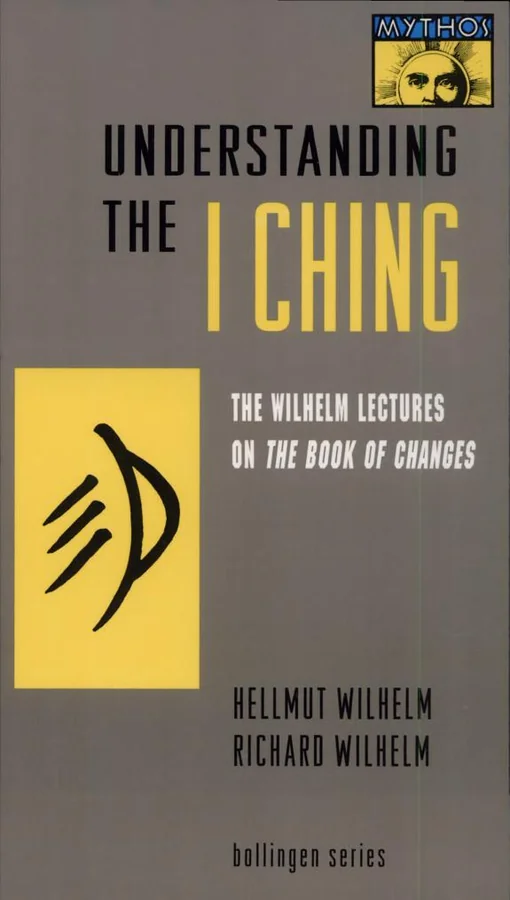
Understanding the I Ching
 81
81

Understanding the I Ching
Richard Wilhelm's *I Ching* translation has long been the standard for English-speaking audiences, and this edition, co-authored with his son Hellmut, offers a valuable layer of scholarly interpretation. The emphasis on the *I Ching* as a mirror to the collective unconscious, a perspective shared by C.G. Jung, is particularly illuminating. It moves the text beyond mere fortune-telling into the realm of psychological exploration. However, the sheer density of philosophical and symbolic material, even with Hellmut's contributions, can still present a steep learning curve for newcomers. The section discussing the trigrams, for instance, requires careful study to fully grasp their interconnectedness. This is not a casual read, but for those willing to engage, it offers a deep well of wisdom. It stands as an essential, if demanding, resource for understanding one of humanity's oldest wisdom traditions.
📝 Description
81
Richard Wilhelm's 1995 English translation of the I Ching, with analysis by Hellmut Wilhelm, arrived when Eastern philosophies were gaining traction.
This volume presents the English translation of the *I Ching* by Richard Wilhelm, a work that shaped Western engagement with this classical Chinese text. His son, Hellmut Wilhelm, adds further analysis, making the material accessible for contemporary readers. While often viewed as an oracle, the *Book of Changes* is shown here as a psychological mirror. Richard Wilhelm, influenced by Carl Jung, interpreted the hexagrams and their texts as reflections of the human psyche and the collective unconscious. The *I Ching* fundamentally addresses transformation. It examines the dynamic forces in the universe and human life, suggesting that recognizing these shifts leads to more informed action. The work provides a structure for seeing patterns and responding with flexibility.
This translation and analysis place the *I Ching* within the Western esoteric tradition, particularly as it relates to depth psychology and comparative religion. Richard Wilhelm's engagement, influenced by Carl Jung, saw the text not just as a divinatory tool but as a symbolic map of the human psyche. This perspective aligns with Gnostic ideas of inner knowledge and self-understanding, viewing the hexagrams as archetypal patterns that can illuminate personal transformation. The book serves as a bridge, connecting ancient Chinese thought with modern Western psychological and spiritual inquiries.
💡 Why Read This Book?
• Gain a psychological lens on the *I Ching*, moving beyond simple divination to understand its connection to the collective unconscious, a concept explored by C.G. Jung. • Understand the historical reception of the *I Ching* in the West, particularly through Richard Wilhelm's 1995 translation and its role in bridging Eastern and Western thought. • Grasp the core principle of change as illustrated through the 64 hexagrams, learning to perceive patterns in life's flux and respond with greater awareness.
⭐ Reader Reviews
Honest opinions from readers who have explored this book.
❓ Frequently Asked Questions
When was Richard Wilhelm's I Ching translation first published in English?
Richard Wilhelm's influential translation of the I Ching, originally published in German in 1949, was first made available in English in 1995 through this edition.
What is the significance of Hellmut Wilhelm's contribution to this edition?
Hellmut Wilhelm, Richard's son, provides additional commentary and analysis, deepening the text's philosophical and psychological dimensions for contemporary readers.
How does this book connect the I Ching to Carl Jung's work?
The edition highlights C.G. Jung's preface and his view of the I Ching as a reflection of the collective unconscious, offering a psychological framework for interpreting its symbols.
What are the primary philosophical traditions associated with the I Ching?
The I Ching is deeply rooted in Taoist and Confucian philosophies, exploring concepts of cosmic balance, ethical conduct, and the cyclical nature of existence.
Is this book suitable for beginners interested in the I Ching?
While comprehensive, the book's depth requires dedicated study. It is best suited for those committed to understanding the philosophical and psychological underpinnings of the I Ching.
What does the term 'hexagram' refer to in the I Ching?
A hexagram is a figure composed of six horizontal lines, each line being either solid (yang) or broken (yin), representing fundamental states of change and interaction.
🔮 Key Themes & Symbolism
The Collective Unconscious
Drawing heavily on C.G. Jung's interpretation, this work posits the *I Ching* not merely as a divination tool but as a profound repository of the collective unconscious. The 64 hexagrams are presented as archetypal patterns that manifest across cultures and epochs, reflecting universal human experiences and psychological dynamics. Understanding these patterns, as explored in the text, allows for a deeper comprehension of both individual psyche and shared human heritage.
Dynamic Equilibrium
A central theme is the philosophy of change as a constant, dynamic process. The *Book of Changes* illustrates how forces are perpetually in flux, moving between yin and yang, creation and dissolution. The work emphasizes that true wisdom lies not in resisting change, but in understanding its flow and maintaining a state of dynamic equilibrium, adapting to circumstances with foresight and balance, as depicted in the hexagram interpretations.
Ethical Cultivation
Intertwined with its metaphysical and psychological aspects, the *I Ching* offers a guide to ethical conduct and personal cultivation, particularly through its Confucian influences. The text explores how aligning one's actions with the natural order, as revealed by the hexagrams, leads to harmony in personal life, family, and society. This aspect highlights the practical application of the *I Ching*'s wisdom for moral development.
Synchronicity and Meaningful Coincidence
Echoing Jung's concept of synchronicity, the *I Ching* suggests that the oracular pronouncements are not random but meaningful coincidences reflecting the querent's inner state and the outer situation. The work details how the selection of a hexagram and its associated text can provide clear insights by mirroring the underlying patterns of a situation, revealing connections that might otherwise remain hidden.
💬 Memorable Quotes
Direct passages from the work, attributed to the author.
“The I Ching is a book of magic that does not work magic.”
— This statement, likely originating from the Wilhelm lineage, reframes the text's function. It suggests the *I Ching*'s power isn't in supernatural intervention but in its capacity to illuminate reality, enabling wiser human action through understanding.
“The Book of Changes is a mirror of the human soul.”
— This interpretation, influenced by Jung, emphasizes the *I Ching*'s psychological utility. It implies the hexagrams and their meanings reflect the archetypal patterns and inner states of the individual psyche.
“Change is the only constant.”
— This core principle of the *I Ching* underscores its focus on flux and transformation. It suggests that recognizing and adapting to continuous change is key to navigating life effectively.
“The hexagrams represent fundamental forces in interaction.”
— This highlights the structural and symbolic nature of the *I Ching*. Each hexagram is a combination of yin and yang lines, symbolizing the dynamic interplay of cosmic and earthly energies.
“Wisdom lies in understanding the flow of time.”
— This captures the predictive and insightful nature of the *I Ching*. It implies that by perceiving the tendencies of current circumstances, one can act with greater efficacy.
🌙 Esoteric Significance
Tradition
The *I Ching* primarily fits within the Taoist and Confucian philosophical traditions, but its reception in the West, particularly through Jungian psychology, has imbued it with esoteric significance. It's viewed not just as philosophy but as a system for accessing deeper layers of consciousness, akin to Hermetic or Kabbalistic texts in its symbolic language and divinatory applications. Its cyclical nature and emphasis on cosmic patterns align it with universalist esoteric frameworks.
Symbolism
The core symbolism lies in the 64 hexagrams, each composed of six lines representing yin (broken) and yang (solid). These lines combine to form trigrams (three-line figures), such as Heaven (☰) and Earth (☷), which are fundamental cosmic forces. The interaction and transformation of these hexagrams symbolize the myriad ways change manifests in the universe and human affairs, offering a symbolic map of reality.
Modern Relevance
Contemporary practitioners of Western esotericism, particularly those interested in Jungian psychology, archetypal studies, and transpersonal development, frequently engage with the *I Ching*. Its principles of change, balance, and synchronicity are drawn upon in various forms of self-inquiry, coaching, and even in creative fields seeking to understand complex systems and emergent patterns.
👥 Who Should Read This Book
• Students of comparative philosophy and religion seeking to understand the foundational texts of Taoism and Confucianism in a comprehensive Western interpretation. • Psychologically-oriented readers interested in archetypal patterns and the concept of the collective unconscious, particularly those familiar with C.G. Jung's work. • Individuals engaged in self-reflection and personal development who are looking for a structured, symbolic system to gain perspective on life's challenges and transitions.
📜 Historical Context
Richard Wilhelm's German translation of the *I Ching*, completed just before his death in 1930 and published posthumously in 1933, was a monumental undertaking. Its introduction to the English-speaking world, particularly through the 1995 edition featuring his son Hellmut's contributions, occurred during a period of burgeoning interest in Eastern spirituality and psychology in the West. This era saw figures like Alan Watts popularizing Taoist thought, and C.G. Jung's engagement with the *I Ching* (evident in his preface to the 1950 German edition and later English translations) provided a crucial bridge for Western intellectuals. Wilhelm's work competed with earlier, often more sinologically focused, translations, but its depth and accessibility, especially with Hellmut's added scholarly context, cemented its place. The text navigated the intellectual currents of comparative religion and depth psychology, finding favor among scholars and seekers alike, and faced minimal reception issues due to its philosophical nature.
📔 Journal Prompts
The interplay of yin and yang lines within a specific hexagram.
Reflections on the concept of change as presented in the hexagram interpretations.
The connection between Richard Wilhelm's translation and C.G. Jung's theories.
Applying the wisdom of a chosen hexagram to a current life situation.
The symbolism of Heaven (☰) and Earth (☷) trigrams.
🗂️ Glossary
Hexagram
A figure composed of six horizontal lines, each line being either solid (yang) or broken (yin). There are 64 unique hexagrams in the *I Ching*, representing fundamental states and processes of change.
Trigram
A figure composed of three horizontal lines, each either solid (yang) or broken (yin). The eight trigrams (Pa Kua) are fundamental building blocks of the hexagrams and represent basic natural forces.
Yin
In the *I Ching*, represented by a broken line (-- --). It symbolizes passive, receptive, dark, feminine, and yielding qualities.
Yang
In the *I Ching*, represented by a solid line (-----). It symbolizes active, creative, light, masculine, and assertive qualities.
Taoism
An ancient Chinese philosophy and religion emphasizing living in harmony with the Tao (the Way), the natural order of the universe. The *I Ching* is a foundational text within this tradition.
Confucianism
A system of thought and ethics based on the teachings of Confucius, emphasizing moral cultivation, social harmony, and good governance. The *I Ching* is also considered a classical Confucian text.
Collective Unconscious
A term coined by C.G. Jung, referring to a layer of the unconscious psyche inherited and shared by all humankind, containing archetypes and primordial images.
This book appears in 1 collection
🔮 Readers Also Liked
Browse all →








From the “I Ching” Collection
View all →









More Free Occult Philosophy Books
View all →