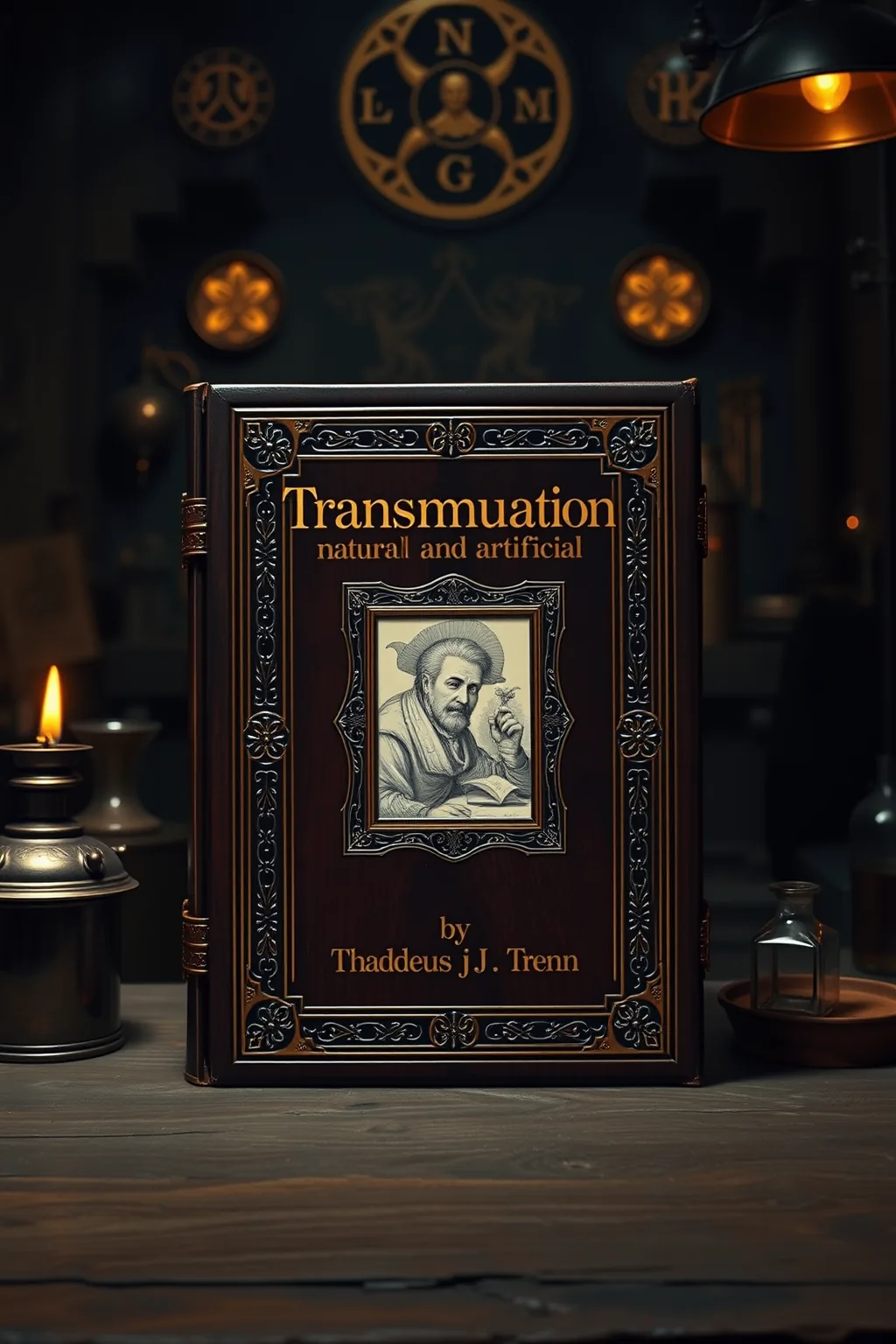
Transmutation, natural and artificial
 79
79

Transmutation, natural and artificial
Trenn's "Transmutation, Natural and Artificial" presents a commendably direct engagement with alchemical theory, focusing on the conceptual framework of transformation rather than its purely symbolic dimensions. The strength lies in its methodical breakdown of alchemical claims, attempting to reconcile them with philosophical and nascent scientific thought from the late medieval and Renaissance periods. However, the book's analytical rigor, while valuable, can sometimes leave the reader yearning for a deeper exploration of the psychological or spiritual dimensions that many historical alchemists themselves integrated into their work. A particularly compelling section discusses the alchemical concept of the 'philosophical mercury' as a principle of transformation, highlighting its abstract nature. This work is a solid contribution for those interested in the intellectual history of alchemy.
📝 Description
79
Thaddeus J. Trenn's 1981 book examines alchemy's central idea: the transformation of substances.
First published in 1981, Thaddeus J. Trenn's "Transmutation, Natural and Artificial" offers a detailed look at one of alchemy's main ideas: changing one substance into another. The book moves away from purely mystical interpretations. Instead, it uses philosophical and scientific ideas to examine the concepts behind alchemical change. Trenn asks if the processes alchemists wrote about, often in symbolic terms, might relate to natural events or if they required a special, perhaps artificial, process. This work is for those interested in the serious study of esoteric philosophy and the history of science. Readers looking only for symbolic or spiritual meanings of alchemy might find its focus on physical and conceptual change difficult. It speaks to people interested in how matter and change were understood across different times, and what the limits of natural law might be.
The book's main point is the difference between natural events and what alchemists created through artifice. Trenn looks at how alchemical ideas about matter, like the prima materia or the use of catalysts, were discussed. He questions if these theories were attempts to understand natural processes or represented a separate kind of knowledge. The work engages with texts from the late Middle Ages and Renaissance, considering their philosophical meaning.
Published in 1981, "Transmutation, Natural and Artificial" appeared during a time when scholars were increasingly interested in the history of science and alchemy. This work contrasts with earlier interpretations that focused heavily on symbolic or psychological meanings, such as those proposed by Carl Jung. Trenn's approach favors a more empirical and philosophical analysis. He investigates the possibility of literal or conceptual transmutation within natural frameworks, rather than purely spiritual allegories. The book draws on alchemical texts from the late medieval and Renaissance periods to discuss their philosophical implications regarding the transformation of matter.
💡 Why Read This Book?
• Gain a clearer understanding of the philosophical distinctions between natural change and alchemical artifice, as Trenn analyzes the concept of the 'prima materia'. • Explore the historical discourse surrounding the possibility of literal transmutation, examining how thinkers in the late medieval period grappled with these ideas. • Appreciate the intellectual rigor applied to alchemical texts, moving beyond purely symbolic interpretations to consider their conceptual and material implications, especially regarding the 'philosophical mercury'.
⭐ Reader Reviews
Honest opinions from readers who have explored this book.
❓ Frequently Asked Questions
What is the primary focus of Thaddeus J. Trenn's "Transmutation, Natural and Artificial"?
The book focuses on the philosophical and conceptual underpinnings of alchemical transmutation, examining whether alchemical processes were viewed as natural phenomena or required artificial intervention, particularly in the late medieval and Renaissance periods.
When was "Transmutation, Natural and Artificial" first published?
The work was first published in 1981, placing it within a period of renewed academic interest in the history of science and esoteric traditions.
Does the book offer a symbolic or literal interpretation of alchemy?
Trenn's approach is primarily philosophical and conceptual, attempting to analyze the logic behind alchemical claims of transformation rather than exclusively focusing on symbolic or spiritual allegories, though it acknowledges these aspects.
Who would benefit most from reading this book?
Students of esoteric philosophy, the history of science, and scholars interested in the intellectual history of alchemy, particularly those focused on the late medieval and Renaissance eras, will find this analysis beneficial.
What alchemical concepts are explored in the text?
Key concepts include the prima materia, the philosophical mercury, and the fundamental distinction between natural processes and the deliberate artifice of the alchemist in achieving transmutation.
Is "Transmutation, Natural and Artificial" available online for free?
Information on the availability of "Transmutation, Natural and Artificial" for free online is not readily available. It is primarily found through academic libraries and booksellers specializing in esoteric literature.
🔮 Key Themes & Symbolism
The Nature of Alchemical Change
This theme dissects the alchemist's conception of transformation. Trenn scrutinizes whether the promised transmutation of metals or substances was understood as an extension of natural processes, accelerated or guided by art, or something fundamentally distinct. The work probes the theoretical frameworks that allowed alchemists to posit such dramatic material alterations, differentiating between observable natural cycles and the deliberate, often secret, methods of the laboratory.
Prima Materia and Philosophical Principles
The concept of the prima materia, or first matter, is central to understanding alchemical potential. Trenn examines how this foundational substance was theorized as the source from which all other substances could be derived through proper manipulation. Alongside this, the role of principles like 'philosophical mercury' and 'philosophical sulfur' is analyzed, not merely as symbolic elements but as conceptual tools for understanding the underlying mechanics of transmutation as envisioned by historical alchemists.
Artifice vs. Nature in Transformation
A core debate within the book is the demarcation between what nature can achieve on its own and what requires the intervention of the alchemist's art. Trenn explores how alchemical texts navigated this boundary, often suggesting that while nature contained the potential for change, it was the alchemist's skill and knowledge that could unlock or direct it. This distinction is crucial for understanding the alchemist's role as a mediator or manipulator of natural forces.
Conceptual Frameworks of Material Science
The book investigates the pre-modern scientific and philosophical ideas that informed alchemical theories of matter. It looks at how concepts of elements, qualities, and inherent potentials were understood and applied to the problem of transmutation. This offers a window into an alternative lineage of material science, one that predates modern chemistry but was deeply concerned with the fundamental nature of substances and their capacity for change.
💬 Memorable Quotes
Direct passages from the work, attributed to the author.
“The notion of a singular 'first matter' offered a unifying theoretical basis for the diversity of material forms.”
— This interpretation focuses on the philosophical utility of the prima materia concept. It suggests that alchemists posited a fundamental, undifferentiated substance as a way to explain how all the varied materials in the world could potentially be reduced to, or derived from, a common origin.
“Transmutation implies not just change, but a directed change towards a more perfect or valuable state.”
— This interpretation emphasizes the teleological aspect of alchemical transmutation. It suggests that the goal was not merely any transformation, but a specific, often upward, alteration in quality or essence, reflecting an underlying belief in inherent perfection within matter.
“The 'philosophical mercury' acted as a solvent and agent for change, distinct from common mercury.”
— This highlights the specific meaning of a key alchemical term. It differentiates the symbolic or operational 'philosophical mercury' from its mundane counterpart, positioning it as a principle or substance vital for facilitating the alchemical process of transformation.
💡 Key Ideas
Editorial paraphrase of the work's core concepts — not direct quotes.
The alchemist sought to understand the principles by which nature operates, not to contradict them, but to employ them with greater efficacy.
This paraphrased concept highlights the alchemist's perspective as one of working *with* natural laws, albeit in a highly specialized and accelerated manner, rather than in opposition to them. It underscores the idea of alchemical art as a perfected or intensified form of natural process.
Distinguishing between natural decay and artificial dissolution was key to alchemical procedure.
This paraphrased idea points to the critical discernment required in alchemical practice. It implies that alchemists needed to understand the difference between spontaneous breakdown and the controlled breakdown necessary for initiating transmutation, a process requiring precise knowledge and intervention.
🌙 Esoteric Significance
Tradition
Trenn's work engages with the Hermetic and proto-scientific traditions that historically informed alchemy. While not explicitly aligned with a single esoteric school, it analyzes the philosophical and conceptual architecture of alchemical transformation, a practice deeply rooted in Hermetic principles of correspondence and the belief in the unity of matter. The book fits within a lineage of scholarship that seeks to understand alchemy's intellectual history, bridging the gap between mystical speculation and early empirical inquiry.
Symbolism
The text directly addresses concepts like the 'prima materia,' often symbolized by chaos or an undifferentiated substance, representing the potential for all forms. It also dissects the role of 'philosophical mercury' and 'philosophical sulfur,' archetypal principles of fluidity/receptivity and fixedness/activity respectively, which were seen as essential agents in the transformative process, guiding the change from base to noble states.
Modern Relevance
Contemporary interest in the philosophy of science, the history of consciousness, and the integration of spiritual traditions into modern thought finds resonance in Trenn's work. Thinkers exploring the boundaries between materialism and emergent consciousness, or those re-examining pre-modern scientific paradigms for insights into matter and transformation, can draw upon Trenn's analytical framework for understanding historical alchemical thought.
👥 Who Should Read This Book
• Students of the history of science and alchemy: Gain a nuanced understanding of how alchemists conceptualized material change and the philosophical debates surrounding it. • Practitioners of Western Esotericism: Develop a deeper appreciation for the intellectual foundations of alchemical practice, moving beyond purely symbolic interpretations to grasp its conceptual rigor. • Philosophers of Science: Engage with historical perspectives on matter, transformation, and the boundaries between natural law and deliberate artifice.
📜 Historical Context
Published in 1981, Thaddeus J. Trenn's "Transmutation, Natural and Artificial" emerged within a scholarly landscape increasingly focused on the history of science and the philosophical underpinnings of early modern practices. The era saw a move beyond simplistic interpretations of alchemy as mere charlatanry or purely symbolic allegory, with scholars like Allen Debus and Betty Jo Teeter Dobbs examining the complex intellectual milieu. Trenn's work contributes to this by rigorously analyzing the conceptual frameworks of transmutation, engaging with texts from the late medieval and Renaissance periods. It implicitly contrasts with the psychological interpretations offered by Carl Jung in the mid-20th century, instead grounding its analysis in the philosophical and proto-scientific discourse of the time. The book’s detailed examination of alchemical logic provided a counterpoint to purely spiritual readings, offering a more material and philosophical perspective on a tradition often shrouded in mystery.
📔 Journal Prompts
The concept of the prima materia: how does its potentiality relate to modern ideas of quantum fields?
Analyze the alchemical distinction between natural decay and artificial dissolution as presented by Trenn.
Reflect on the 'philosophical mercury' as a principle of change. What are its characteristics?
Consider the historical context of 1981: how might this have influenced Trenn's analytical approach to alchemy?
What does the goal of 'transmutation' imply about the alchemist's view of inherent value in matter?
🗂️ Glossary
Prima Materia
The fundamental, undifferentiated substance from which all other substances are believed to originate in alchemical theory. It represents pure potentiality before specific forms manifest.
Philosophical Mercury
An alchemical principle representing fluidity, volatility, and the agent of dissolution and combination. It is distinct from common mercury and acts as a catalyst in the Great Work.
Philosophical Sulfur
The alchemical principle associated with fixedness, combustibility, and the agent of fixation and color change. It represents the 'spirit' or active principle in the transmutation process.
Transmutation
In alchemy, the process of changing one substance into another, most famously the conversion of base metals (like lead) into noble metals (like gold), or the transformation of the human soul.
Artifice
In the context of the book, 'artifice' refers to the deliberate intervention, skill, and knowledge applied by the alchemist in the laboratory, as opposed to spontaneous natural processes.
Natural Processes
Phenomena that occur in the world without direct human intervention, governed by the inherent laws and cycles of nature. Trenn explores how alchemy related to or sought to influence these.
Late Medieval/Renaissance Alchemy
The period roughly spanning the 14th to 17th centuries, during which alchemical practices and theories were highly influential, blending philosophical, mystical, and early scientific inquiry.
🔮 Readers Also Liked
Browse all →









More by Thaddeus J. Trenn
All books →
More Free Occult Philosophy Books
View all →