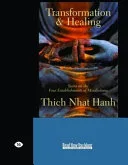
Transformation and Healing
 83
83

Transformation and Healing
Thich Nhat Hanh’s approach to the Satipatthana Sutta in Transformation and Healing offers a clarity that is both disarming and deeply effective. He manages to distill the profound philosophical underpinnings of this ancient text into language readily applicable to the everyday struggles with anger, desire, and mental turmoil. The strength of the book lies in its unwavering focus on direct experience, urging readers to become intimate observers of their own minds rather than intellectualizing Buddhist doctrine. A limitation, perhaps, is that the sheer density of the sutra's original exposition might leave some readers wishing for more extended practical exercises beyond the foundational explanations. The passage detailing the observation of feelings, particularly how to sit with unpleasant sensations without immediate aversion, is a powerful reminder of the sutra’s direct therapeutic potential. This work serves as an essential, unadorned guide to the heart of Buddhist contemplative practice.
📝 Description
83
Thich Nhat Hanh's 2008 book unpacks the Satipatthana Sutta for modern emotional regulation.
In Transformation and Healing, Thich Nhat Hanh examines the Satipatthana Sutta, a core Buddhist text on mindfulness. He presents the sutra's teachings not as abstract philosophy but as practical tools for understanding and transforming personal suffering. The book details the four establishments of mindfulness: observing the body, feelings, mind states, and mental objects. Through these practices, readers learn to cultivate awareness and gain insight into the roots of difficult emotions like anger and grief.
This work is suited for those who want to move beyond basic mindfulness exercises. It addresses individuals struggling with intense emotions and seeking to understand their origins. While rooted in Buddhist practice, the book welcomes anyone interested in contemplative methods for psychological well-being and personal development. Those already familiar with Thich Nhat Hanh's teaching style will find this book a natural continuation of his approach.
The Satipatthana Sutta has been a central text for Buddhist practitioners for over two thousand years, originating in early India. It forms a cornerstone of monastic and lay training, offering a systematic approach to insight meditation. Thich Nhat Hanh's interpretation connects this ancient framework to contemporary needs, showing its relevance for psychological health and emotional balance. His work emphasizes the sutra's original strength as a method for deep personal transformation.
💡 Why Read This Book?
• You will learn a method for observing your own mind's reactions to difficult emotions, as outlined in the Satipatthana Sutta, enabling you to respond with greater equanimity rather than automatic reactivity. • You will gain insight into the Buddhist concept of 'mental objects' and how cultivating awareness of them, as taught in the sutra, can deconstruct ingrained patterns of suffering. • You will understand the historical lineage of mindfulness, tracing contemporary practices back to their source in the Satipatthana Sutta, first studied 2,500 years ago in India.
⭐ Reader Reviews
Honest opinions from readers who have explored this book.
❓ Frequently Asked Questions
What is the Satipatthana Sutta and why is it important?
The Satipatthana Sutta is a foundational discourse in Buddhism, considered the 'sutra on the four establishments of mindfulness.' It's crucial because it provides the explicit instructions and framework for cultivating deep awareness, which is central to the Buddhist path of liberation and understanding suffering.
How does Thich Nhat Hanh explain mindfulness in this book?
Thich Nhat Hanh explains mindfulness as the practice of paying attention to the present moment, specifically through observing the body, feelings, mind, and mental objects. He emphasizes mindful observation without judgment as a tool for transformation.
Is this book suitable for beginners in mindfulness?
Yes, Transformation and Healing is very suitable for beginners. Thich Nhat Hanh's clear, compassionate style breaks down complex teachings from the Satipatthana Sutta into understandable and actionable steps for anyone new to these practices.
Can this book help with managing anger and negative emotions?
Absolutely. The book directly addresses how the principles of the Satipatthana Sutta can be applied to understand the roots of anger, jealousy, and other difficult emotions, offering methods to transform them through mindful awareness.
What is the difference between this book and other mindfulness guides?
Unlike many secular guides, this book grounds mindfulness in the specific teachings of the Satipatthana Sutta, a 2,500-year-old Buddhist text. It retains the depth and philosophical context of its origin while remaining practical.
When was Thich Nhat Hanh's 'Transformation and Healing' first published?
Thich Nhat Hanh's 'Transformation and Healing' was first published in October 2008, offering his interpretation of the Satipatthana Sutta to a modern audience.
🔮 Key Themes & Symbolism
The Four Establishments of Mindfulness
This central theme details the Satipatthana Sutta's structure: contemplation of the body, feelings, mind, and mental objects. Thich Nhat Hanh presents these not as abstract concepts but as direct portals to understanding reality. By observing the breath, noting physical sensations, recognizing mental states like concentration or distraction, and examining the arising and passing of phenomena, practitioners gain insight into impermanence and the nature of suffering. This systematic approach forms the bedrock of Buddhist contemplative practice for 2,500 years, offering a method to dismantle unskillful habits.
Transforming Difficult Emotions
A core practical application explored is the transformation of negative emotions such as anger, jealousy, and fear. The book explains how, through mindful observation, one can understand the impermanent nature of these feelings and their arising conditions, rather than being overwhelmed by them. Instead of suppressing or acting out, the teachings encourage a compassionate witnessing of emotions, leading to their natural dissolution and preventing the accumulation of further suffering. This process is presented as a direct path to inner peace.
Mindfulness as a Path to Insight
Beyond mere stress reduction, Thich Nhat Hanh emphasizes mindfulness as a profound tool for developing insight (vipassanā). The systematic observation of all aspects of experience, as outlined in the sutra, reveals the interconnectedness and impermanent nature of all phenomena. This insight into 'non-self' and 'emptiness' is not intellectual but experiential, leading to liberation from clinging and the cycle of suffering. The practice cultivates wisdom by seeing things as they truly are.
💬 Memorable Quotes
Direct passages from the work, attributed to the author.
“The sutra teaches us how to deal with anger and jealousy.”
— This concise statement from the original blurb highlights a primary practical benefit of the Satipatthana Sutta. It signals that the ancient teachings offer concrete methods for managing common, difficult emotions, making them relevant to contemporary psychological challenges.
“The Sutra on the Four Establishments of Mindfulness has been studied, practiced, and handed down with special care from generation to generation for 2,500 years.”
— This highlights the historical weight and enduring relevance of the text. It assures the reader that the teachings are time-tested and have been carefully preserved, indicating their profound efficacy across centuries and cultures.
“We must be able to observe our feelings without being carried away by them.”
— This captures the essence of mindful observation of feelings. It points to the practice of maintaining a detached yet aware perspective, allowing one to understand emotions without becoming identified with or controlled by them.
💡 Key Ideas
Editorial paraphrase of the work's core concepts — not direct quotes.
The four establishments of mindfulness are the direct way to the purification of beings, for the overcoming of sorrow and lamentation, for the disappearing of pain and distress, for the attainment of the right method, for the realization of Nirvana.
This paraphrased concept from the sutra itself underscores the ultimate goal of the practice. It presents mindfulness not just as a coping mechanism, but as a fundamental path leading to profound spiritual realization and liberation from suffering.
Mindfulness is the energy that protects our loved ones.
An interpretation of Hanh's broader teachings, this quote emphasizes the outward-reaching benefit of mindfulness. Cultivating inner awareness and peace allows one to be more present, compassionate, and effective in interactions with others, thereby safeguarding relationships.
🌙 Esoteric Significance
Tradition
While rooted in the Theravada Buddhist tradition, the Satipatthana Sutta, as interpreted by Thich Nhat Hanh, carries significant esoteric weight. Its emphasis on direct, experiential realization rather than dogma aligns with esoteric principles across various traditions. The meticulous observation of internal states—body, feelings, mind, phenomena—mirrors alchemical processes of purification and transformation. It offers a non-dualistic approach to understanding consciousness, a common thread in many esoteric systems seeking to transcend ordinary perception and achieve a unified awareness.
Symbolism
The primary 'symbolism' in the Satipatthana Sutta lies in its direct experiential focus rather than external icons. The breath, for instance, is not merely air but a symbol of the present moment, the anchor to reality. Feelings (vedana) symbolize the impermanent, conditioned nature of all experience, whether pleasant, unpleasant, or neutral. The mind (citta) and mental objects (dhammas) symbolize the entire field of consciousness, revealing the illusory nature of a fixed self when observed closely.
Modern Relevance
Thich Nhat Hanh’s work on the Satipatthana Sutta is highly relevant to contemporary esoteric and spiritual seekers. It provides a bridge between ancient Eastern contemplative science and modern Western psychological and spiritual inquiry. Thinkers and practitioners in fields like Integral spirituality, transpersonal psychology, and secular mindfulness programs often draw upon the core principles articulated in this sutra, seeking its depth and efficacy for personal growth and societal well-being.
👥 Who Should Read This Book
• Individuals seeking to move beyond superficial stress-reduction techniques into deeper contemplative practice, particularly those drawn to Buddhist philosophy and the historical roots of mindfulness. • Practitioners experiencing persistent difficult emotions like anger, anxiety, or grief, who desire a structured, experiential method to understand and transform these states, as taught in the Satipatthana Sutta. • Students of comparative religion or Eastern philosophy interested in the foundational texts of Buddhism and Thich Nhat Hanh's accessible interpretations of core teachings.
📜 Historical Context
The Satipatthana Sutta, the subject of Thich Nhat Hanh's *Transformation and Healing*, originates from the early Buddhist period in ancient India, likely around the 3rd century BCE. This discourse represents a core part of Theravada Buddhism, emphasized for its systematic approach to meditation and insight. In its time, it offered a rigorous path distinct from the more ritualistic or ascetic practices prevalent in the broader Indian spiritual landscape. While Buddhism later branched into various schools, the Satipatthana Sutta has remained a universally respected text, forming the basis for monastic training and lay practice across traditions. Thich Nhat Hanh's 2008 publication arrives centuries after the sutra's initial codification, contextualizing it within modern secular mindfulness movements, which often draw inspiration from Buddhist practices but may omit the deeper philosophical framework present in Hanh's work.
📔 Journal Prompts
The arising and passing of feelings: Observe one unpleasant feeling for five minutes without reacting.
Mindful awareness of the body: Notice the sensations of sitting, focusing on the breath.
Observing mental objects: Identify one recurring thought pattern and note its impermanence.
The nature of anger: How does the Satipatthana Sutta's approach to observing emotions differ from your usual reaction?
Cultivating equanimity: Reflect on a neutral feeling and its role in the Four Establishments of Mindfulness.
🗂️ Glossary
Satipatthana Sutta
The foundational Buddhist discourse on the Four Establishments of Mindfulness, considered a core text for developing insight and liberation.
Mindfulness
The practice of paying attention to the present moment, non-judgmentally, often focusing on the body, feelings, mind, and mental objects.
Four Establishments of Mindfulness
The four areas of focus taught in the Satipatthana Sutta: contemplation of the body, feelings, mind, and mental objects (dhammas).
Feelings (Vedana)
The sensations arising from contact with sense objects, categorized as pleasant, unpleasant, or neutral. Observing them is key to understanding impermanence.
Mental Objects (Dhammas)
In this context, refers to the phenomena or contents of the mind, including sensory data, concepts, emotions, and the elements of existence, as observed in mindfulness practice.
Insight (Vipassanā)
A profound understanding of the true nature of reality, particularly impermanence, suffering, and non-self, cultivated through systematic mindfulness meditation.
Nirvana
The ultimate goal in Buddhism; the cessation of suffering, the extinguishing of the fires of greed, hatred, and delusion.