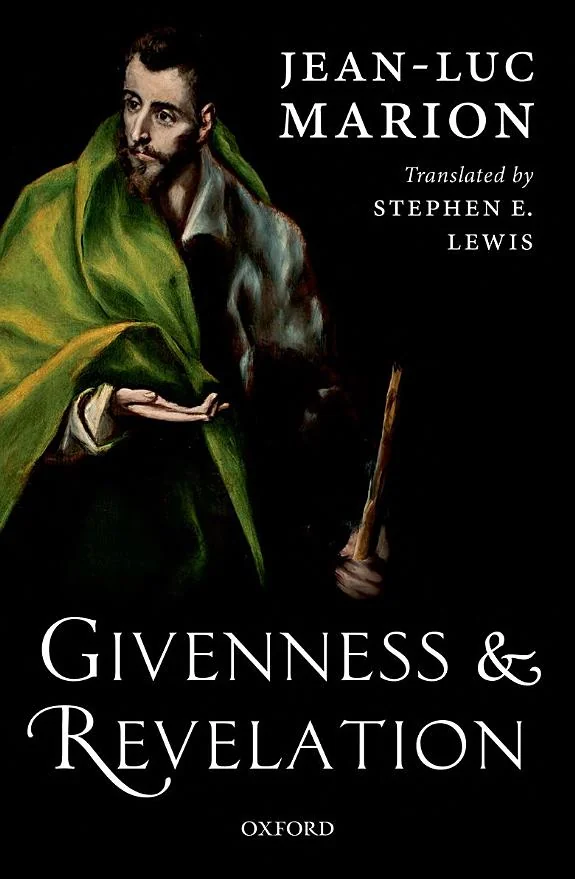
Givenness and Revelation
 75
75

Givenness and Revelation
Jean-Luc Marion's "Givenness and Revelation" is an intellectually demanding but ultimately rewarding exploration of how theological truths are encountered. Marion's characteristic precision is on full display as he dissects the phenomenological conditions for experiencing divine revelation. The strength of the book lies in its meticulous deconstruction of language and experience, offering novel ways to think about God's self-disclosure beyond traditional theological frameworks. He skillfully interrogates how the "givenness" of God exceeds our usual modes of apprehension, particularly in the concept of the "saturated phenomenon." However, the text's academic density and reliance on specific philosophical terminology can present a significant barrier for those not deeply immersed in continental philosophy. A particular passage detailing the "anecdotal" nature of revelation, where it is presented as an event that cannot be fully contained by prior categories, highlights both the book's originality and its challenge. "Givenness and Revelation" offers a significant, albeit steep, ascent into a philosophy of theological experience.
📝 Description
75
Jean-Luc Marion's 2016 Gifford Lectures examine divine presence through phenomenology.
Delivered at the University of Glasgow in 2016, Jean-Luc Marion's "Givenness and Revelation" offers a philosophical analysis of how divine presence appears in human experience. Marion, a significant voice in contemporary philosophy, moves beyond dogma, focusing instead on the structures of experience itself to understand revelation. He applies phenomenological methods to theological questions, building on thinkers like Husserl and Heidegger.
This work is suited for advanced students and scholars in philosophy, theology, and religious studies. It assumes a prior grasp of phenomenology and continental philosophy. Readers interested in the philosophical basis of religious experience, particularly how "givenness" and "revelation" function as events that disrupt everyday perception, will find substantial engagement here. The book addresses critical theological discourse and Marion's own philosophical output.
Emerging from the tradition of philosophical theology and phenomenology, "Givenness and Revelation" engages with the long-standing philosophical questions surrounding the nature of God and human encounter with the divine. Marion situates his work within the lineage of the Gifford Lectures, established to foster natural theology. His approach, while indebted to Husserl and Heidegger, distinctly applies their phenomenological tools to theological domains, seeking to understand revelation not as a doctrine but as an event experienced.
💡 Why Read This Book?
• Understand the philosophical concept of "givenness" as Marion develops it, offering a new lens for interpreting religious experiences beyond mere belief, specifically as explored in his lectures. • Grasp the phenomenological account of "revelation" as an event that interrupts ordinary experience, moving beyond static doctrines to consider the encounter itself, a core theme from 2016. • Engage with Marion's concept of the "saturated phenomenon," a key idea for understanding experiences that resist easy categorization and offer a distinct approach to theological insight.
⭐ Reader Reviews
Honest opinions from readers who have explored this book.
❓ Frequently Asked Questions
What philosophical tradition does Jean-Luc Marion's "Givenness and Revelation" belong to?
The work is deeply rooted in phenomenology, drawing heavily on the methods of Edmund Husserl and Martin Heidegger, while applying them to theological and metaphysical questions.
When and where were the Gifford Lectures that form the basis of this book delivered?
The lectures were delivered by Jean-Luc Marion at the University of Glasgow in 2016.
What is the central concept Marion explores regarding how God is made known?
Marion focuses on "givenness," examining how divine presence is presented to consciousness, and "revelation" as an event of self-disclosure rather than a fixed doctrine.
Does the book require prior knowledge of specific theological doctrines?
While not strictly requiring prior theological knowledge, a familiarity with philosophical concepts, particularly phenomenology, is highly beneficial for understanding Marion's arguments.
What is the "saturated phenomenon" as discussed by Marion?
It refers to an experience that exceeds the capacity of our concepts and intentionality, often characteristic of revelatory events that cannot be fully contained by prior understanding.
What is the primary philosophical contribution of this work?
Marion offers a phenomenological account of revelation, seeking to articulate a philosophical language for divine encounters that respects their unique givenness and irreducible character.
🔮 Key Themes & Symbolism
The Structure of Givenness
Marion's exploration of "givenness" moves beyond simple perception to examine the fundamental way in which reality, particularly divine reality, presents itself to consciousness. He argues that revelation is not an abstract concept but an experience of something being given that cannot be reduced to our prior categories or intentions. This theme is crucial for understanding how theological claims can be grounded in experience, suggesting that God's presence is not merely inferred but directly encountered, a concept central to his phenomenological method.
Revelation as Event
Central to the book is the redefinition of revelation not as a static set of texts or doctrines, but as a dynamic event. Marion posits that revelation occurs when the divine makes itself known in a way that breaks through ordinary experience, often exceeding our conceptual frameworks. This "event" aspect highlights the unpredictable and often surprising nature of encountering the sacred, challenging purely rationalist or historical interpretations of religious phenomena and emphasizing the active role of the divine in self-disclosure.
The Saturated Phenomenon
Marion introduces the "saturated phenomenon" as a critical concept for understanding encounters with the divine that resist full conceptualization. These are experiences that overwhelm our intentionality, presenting themselves with an excess of evidence or presence that cannot be contained within our pre-existing categories. This concept is vital for grasping how genuine revelation can occur, suggesting that such moments are characterized by an irreducible givenness that demands a new philosophical language to articulate.
Critique of Intentionality
The work undertakes a profound critique of traditional philosophical notions of intentionality, particularly as developed in phenomenology. Marion suggests that while intentionality describes how consciousness is directed toward objects, revelation often involves phenomena that exceed this directedness. He argues that to understand divine encounter, we must move beyond a model where consciousness solely constitutes its object, and instead embrace a mode where the object (God) freely gives itself, thereby challenging the anthropocentric limits of certain philosophical approaches.
💬 Memorable Quotes
Direct passages from the work, attributed to the author.
“Revelation always arrives as an event, not as a content.”
— This interpretation highlights Marion's emphasis on revelation as a dynamic occurrence rather than a static body of information. It suggests that the act of God revealing Himself is more significant than the specific content that might be conveyed.
“Theological language must adapt to the unconditional nature of revelation.”
— This interpretation suggests that traditional philosophical and theological vocabularies may be insufficient to describe genuine divine encounters. Marion calls for a language that respects the unique, unconditional character of God's self-disclosure.
💡 Key Ideas
Editorial paraphrase of the work's core concepts — not direct quotes.
The saturated phenomenon exceeds intentionality.
This paraphrase points to Marion's key concept, suggesting that certain profound experiences, particularly those of divine encounter, are so overwhelming that they cannot be fully grasped or contained by our usual ways of directing our consciousness.
Givenness describes how something presents itself without being constituted by the subject.
This paraphrase clarifies Marion's philosophical use of "givenness," distinguishing it from mere perception. It emphasizes that the object's own active self-presentation is paramount, especially in theological contexts.
We receive revelation; we do not produce it.
This paraphrase underscores the passive reception inherent in encountering divine revelation. It contrasts with philosophical models that might emphasize the subject's active role in constructing meaning or knowledge.
🌙 Esoteric Significance
Tradition
While "Givenness and Revelation" is primarily a work of academic philosophy and phenomenology, its focus on direct encounter with the divine and the limits of human apprehension can resonate with esoteric traditions. It departs from overtly mystical or occult lineages, yet its exploration of how the sacred manifests beyond rational comprehension aligns with Gnostic or Hermetic concerns about hidden knowledge and direct spiritual insight. Marion's rigorous method, however, grounds these explorations in philosophical analysis rather than purely intuitive or revelatory claims, offering a bridge between academic theology and esoteric sensibilities.
Symbolism
The book does not focus on traditional esoteric symbols in a direct sense. However, the core concepts themselves function symbolically. "Givenness" can be seen as symbolizing the divine outpouring or grace that precedes human reception. "Revelation" acts as a symbol for the moment of divine unveiling, the irruption of the sacred into the mundane. The "saturated phenomenon" itself functions symbolically, representing experiences that are so potent they defy ordinary description, much like the ineffable nature of the divine in many esoteric systems.
Modern Relevance
Marion's work is highly relevant to contemporary thinkers grappling with the limits of secular reason and the resurgence of interest in spiritual experience. His phenomenological approach to revelation informs discussions in contemporary philosophy of religion, comparative theology, and even fields like consciousness studies. Thinkers who explore embodied experience, the limits of language, and the possibility of transcendent encounters find his work invaluable. His analysis provides a sophisticated philosophical framework for understanding phenomena that traditional materialism or secularism struggles to address.
👥 Who Should Read This Book
• Scholars of phenomenology and continental philosophy interested in its application to theological questions, offering a rigorous framework for understanding divine encounter. • Advanced students in theology and religious studies seeking to engage with contemporary philosophical approaches to revelation and the nature of religious experience. • Philosophers and theologians who wish to explore alternative understandings of "givenness" and "revelation" that move beyond traditional doctrines and engage with lived experience.
📜 Historical Context
Delivered in 2016, Jean-Luc Marion's Gifford Lectures, published as "Givenness and Revelation," arrived at a time when phenomenology and philosophy of religion continued to explore the boundaries of human experience and divine encounter. Marion, already a significant figure in post-Husserlian phenomenology, engaged with a lineage of thinkers who sought to bridge the gap between philosophical inquiry and theological reflection. His work implicitly responds to the linguistic turn in theology and philosophy, seeking to establish a more direct phenomenological basis for understanding revelation. While thinkers like Karl Barth had previously emphasized God's radical transcendence and revelation solely through Christ, Marion's approach, rooted in a phenomenological analysis of experience, offers a different path. His emphasis on "givenness" and the "saturated phenomenon" provides a distinct contribution to contemporary debates, engaging with philosophers like Michel Henry who also explored the spiritual dimension of experience, albeit with different terminologies and focuses.
📔 Journal Prompts
The nature of the saturated phenomenon in your own experiences.
Reflecting on moments of "givenness" that exceeded your prior understanding.
How does the concept of revelation as an event alter your perception of religious texts?
The limits of intentionality in describing encounters with profound presence.
Articulating experiences that resist simple categorization.
🗂️ Glossary
Givenness
In Marion's philosophy, this refers to the way in which something is presented to consciousness, emphasizing its self-presentation and irreducibility to the subject's intentions or constitution.
Revelation
Marion understands revelation not as a static body of doctrine, but as an event of divine self-disclosure that breaks into human experience, often exceeding our conceptual grasp.
Saturated Phenomenon
A type of experience characterized by an excess of givenness, where the phenomenon presents itself with such intensity and evidence that it cannot be fully contained by the subject's intentionality or prior concepts.
Intentionality
The property of consciousness by which it is directed toward an object; a central concept in phenomenology, which Marion critically re-examines in relation to revelation.
Phenomenology
A philosophical method focused on the structures of experience and consciousness, aiming to describe phenomena as they appear to us without presupposing their objective reality.
Gifford Lectures
A series of prestigious lectures established to promote the study of natural theology, delivered annually at Scottish universities, with past lecturers including prominent philosophers and theologians.
Anecdotal
In Marion's context, referring to phenomena that are encountered as unique, singular events rather than instances of generalizable categories or empirical data.
This book appears in 1 collection
🔮 Readers Also Liked
Browse all →









From the “Revelation” Collection
View all →




More Free Occult Philosophy Books
View all →