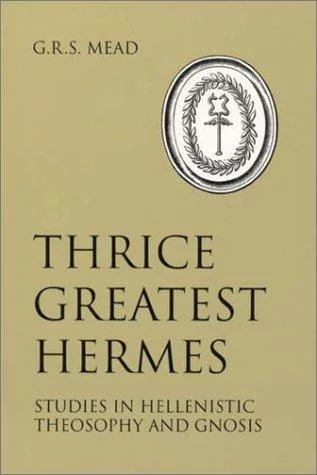
Thrice-greatest Hermes
 72
72

Thrice-greatest Hermes
Mead’s meticulous rendering of the Hermetic Corpus in "Thrice-greatest Hermes" offers a vital portal into a foundational esoteric tradition. His scholarly approach, grounded in the late 19th and early 20th centuries, provides context often missing in more contemporary, less rigorous interpretations. The strength lies in its comprehensive nature, presenting a significant portion of the Hermetic literature in a coherent manner. However, the prose can occasionally feel dense, reflecting its academic origins, which might present a hurdle for readers new to the subject matter. The section detailing the 'Poimandres' tractate, with its vivid allegorical journey of the soul, exemplifies the text's profound, albeit sometimes challenging, spiritual cosmology. It remains an essential, if demanding, resource for understanding the roots of Western esotericism.
📝 Description
72
G. R. S. Mead's 1906 edition presents the Hermetic Corpus in English translation.
G. R. S. Mead's "Thrice-greatest Hermes" offers a translation and commentary on the Hermetic Corpus, a collection of ancient Greek texts attributed to Hermes Trismegistus. Mead, active in early 20th-century esoteric scholarship, worked to reconstruct and interpret these writings, which are central to Western esoteric thought. The book examines the philosophical, religious, and mystical ideas found within these texts, exploring the blend of Greek and Egyptian deities that formed the figure of Hermes Trismegistus.
The work is aimed at those seriously studying Hermeticism, Gnosticism, Neoplatonism, and the history of Western esotericism. It serves scholars who require critical editions and interpretations, as well as practitioners interested in the core principles of traditions influenced by these documents. Readers interested in the philosophical basis of Renaissance magic or the intellectual currents affecting early Christian and medieval thought will find significant content.
The Hermetic texts themselves are thought to date from the 2nd and 3rd centuries CE. Mead's own work, published in the early 20th century, reflects the scholarly engagement with these texts during a period of renewed interest in esoteric traditions. His scholarly approach to these foundational documents was particularly relevant during this time.
This book engages with the Hermetic Corpus, a body of ancient Greek philosophical and religious writings. These texts, traditionally attributed to Hermes Trismegistus, a Hellenistic figure merging Greek Hermes and Egyptian Thoth, are a cornerstone of Western esotericism. They influenced Neoplatonism, Gnosticism, and later esoteric movements, including Renaissance magic and alchemy. Mead's work situates itself within the scholarly study of these influential documents, contributing to their understanding in the early 20th century.
💡 Why Read This Book?
• Gain a foundational understanding of the Hermetic tradition, including its cosmology and ethical teachings, as presented in the 'Poimandres' and other key texts, offering insights distinct from later Gnostic or Kabbalistic interpretations. • Explore the philosophical underpinnings of Renaissance occultism by examining the concepts of Nous and the Demiurge, which directly influenced figures like Marsilio Ficino and his circle in 15th-century Florence. • Grasp the historical reception of these ancient texts, understanding how scholars like G. R. S. Mead positioned them within the intellectual landscape of the early 20th century, providing a unique academic perspective.
⭐ Reader Reviews
Honest opinions from readers who have explored this book.
❓ Frequently Asked Questions
What is the historical origin of the Hermetic texts translated in 'Thrice-greatest Hermes'?
The Hermetic texts themselves are generally dated between the 2nd and 3rd centuries CE, emerging from a Hellenistic milieu in Egypt that blended Greek philosophical and religious ideas with Egyptian traditions.
Who was Hermes Trismegistus?
Hermes Trismegistus is a legendary, syncretic figure, a personification of divine wisdom. He is a fusion of the Greek god Hermes, messenger of the gods, and the Egyptian god Thoth, deity of writing, magic, and wisdom.
What is the significance of the 'Emerald Tablet' mentioned in the book?
The 'Emerald Tablet' is a short, cryptic text attributed to Hermes Trismegistus, famous for the phrase 'As above, so below.' It's considered a foundational text for alchemy and Hermetic philosophy, outlining principles of correspondence and transformation.
What philosophical school is most closely associated with the Hermetic Corpus?
The Hermetic Corpus is most closely associated with Hermeticism, a philosophical and religious tradition that draws upon the purported teachings of Hermes Trismegistus. It shares influences with Neoplatonism and Gnosticism.
When was G. R. S. Mead's translation and commentary first published?
G. R. S. Mead's comprehensive work on the Hermetic texts, 'Thrice-greatest Hermes,' was first published in 2001, though his scholarly work on the subject dates much earlier.
Does 'Thrice-greatest Hermes' include the 'Corpus Hermeticum'?
Yes, 'Thrice-greatest Hermes' includes extensive translations and commentary on the 'Corpus Hermeticum,' which is the primary collection of philosophical and religious writings attributed to Hermes Trismegistus.
🔮 Key Themes & Symbolism
The Divine Mind (Nous)
Mead's work extensively explores the concept of Nous, the supreme, incorporeal intellect or Mind that is the source of all creation in Hermetic thought. This divine Mind is presented as the ultimate reality from which the material world emanates. The texts detail how human consciousness can aspire to reconnect with this divine Nous through contemplation and gnosis, viewing it as the guiding principle of the cosmos and the ultimate goal of spiritual ascent.
Cosmology and Emanation
The book unpacks the intricate Hermetic cosmology, detailing a hierarchical structure of reality. It describes the creation of the universe through a process of emanation from the Divine Mind, often involving intermediaries like the Demiurge. The influence of the seven planetary spheres on the sublunary world is a recurring theme, providing a framework for understanding the forces that shape human destiny and the material realm.
Gnosis and Spiritual Ascent
A central theme is the pursuit of gnosis, or direct, intuitive knowledge of the divine. Mead highlights how the Hermetic texts portray spiritual liberation as an awakening of the soul from ignorance and material entanglement. This involves a journey of purification and ascent through the cosmic spheres, shedding lower influences to ultimately reunite with the divine source, mirroring Neoplatonic and Gnostic ideas.
The 'Emerald Tablet' and Alchemy
The enigmatic 'Emerald Tablet,' with its famous axiom 'As above, so below,' is presented as a core text linking philosophical Hermeticism to its alchemical interpretations. Mead examines its cryptic pronouncements on the unity of all things and the process of transformation, suggesting that its principles apply not only to material transmutation but also to spiritual and psychological change.
💬 Memorable Quotes
Direct passages from the work, attributed to the author.
“The One is All, and the All is the One.”
— This concise statement expresses the Hermetic principle of unity and correspondence. It suggests that the diversity of the manifest world is ultimately an expression of a single, unified divine source, and conversely, that the divine essence is present within every part of creation.
“The Mind of God is the cause of all things.”
— This highlights the central role of Nous (the divine Mind) in Hermetic cosmology. It posits that creation is not a random event but an intentional act of divine intelligence, making the pursuit of understanding this Mind the key to comprehending the universe.
“As above, so below.”
— Attributed to the 'Emerald Tablet,' this famous phrase signifies the principle of analogy and correspondence between the macrocosm (the universe) and the microcosm (humanity or the individual). It implies that understanding one can lead to understanding the other.
“Know thyself.”
— While also famously associated with the Oracle of Delphi, this maxim is central to the Hermetic path of gnosis. It emphasizes that self-knowledge is intrinsically linked to divine knowledge, as the divine spark resides within the human soul.
“The universe is a living being.”
— This interpretation reflects the Hermetic view of the cosmos as a divinely animated organism, rather than a purely mechanical system. It implies an inherent interconnectedness and consciousness pervading all existence, from the highest spiritual planes to the material world.
🌙 Esoteric Significance
Tradition
This work is foundational to the Western Esoteric Tradition, specifically Hermeticism. It provides direct access to the primary texts attributed to Hermes Trismegistus, forming the bedrock of concepts later explored in alchemy, Rosicrucianism, Freemasonry, and modern ceremonial magic. Mead's presentation bridges ancient philosophical Hermeticism with its later esoteric interpretations, positioning it as a key lineage that predates and informs Kabbalistic and Gnostic traditions.
Symbolism
Central symbols include the Caduceus, representing the union of opposites and cosmic balance, often associated with Hermes himself. The Emerald Tablet, a cryptic source of alchemical wisdom, symbolizes the principle of 'As above, so below' and the interconnectedness of all planes of existence. The seven planetary spheres represent cosmic forces and hierarchical stages of spiritual development, guiding the soul's journey.
Modern Relevance
Contemporary practitioners of Western esoteric traditions, including modern alchemists and ceremonial magicians, frequently reference the Hermetic Corpus for its foundational principles. Thinkers in comparative mythology and spirituality also draw upon its archetypal narratives. The concept of 'As above, so below' continues to be a touchstone for understanding macrocosm-microcosm relationships in various spiritual and psychological frameworks.
👥 Who Should Read This Book
• Students of Western Esotericism seeking primary source material on Hermetic philosophy and its historical impact. • Comparative religion scholars interested in the syncretic origins of spiritual thought in the Hellenistic period. • Aspiring practitioners of alchemy and ceremonial magic looking to understand the foundational texts that inform their disciplines.
📜 Historical Context
G. R. S. Mead's publication of "Thrice-greatest Hermes" emerged during a period of intense scholarly and popular interest in ancient wisdom traditions. While the Hermetic texts themselves originated in the Hellenistic Egyptian milieu of the 2nd and 3rd centuries CE, their influence profoundly shaped the Renaissance, particularly through the translations and commentaries of Marsilio Ficino in the 15th century. Mead's work, published in the early 20th century, engaged with late 19th-century esoteric revivalism, including the Theosophical Society's interest in ancient origins. It provided a more academically rigorous approach compared to some contemporary esoteric writers. The book’s reception was within intellectual circles exploring comparative religion, Neoplatonism, and the roots of Western esotericism, standing as a counterpoint to purely historical or theological analyses.
📔 Journal Prompts
The concept of Nous as the Divine Mind and its relation to individual consciousness.
The principle of 'As above, so below' and its manifestation in the natural world.
The soul's journey through the planetary spheres as described in the 'Poimandres'.
Hermes Trismegistus as a syncretic figure bridging Greek and Egyptian divine traditions.
The role of gnosis versus faith in achieving spiritual understanding within the Hermetic framework.
🗂️ Glossary
Hermetic Corpus
A collection of ancient philosophical and religious writings attributed to Hermes Trismegistus, forming the core of Hermeticism. It includes texts like the 'Corpus Hermeticum' and 'Asclepius'.
Nous
The Greek term for 'Mind' or 'Intellect,' referring in Hermetic philosophy to the supreme, divine Mind or intellect that is the ultimate source of creation and the goal of spiritual attainment.
Gnosis
Greek for 'knowledge,' referring in esoteric traditions to intuitive, direct, or spiritual knowledge, often seen as the key to salvation or liberation, as opposed to rational or empirical knowledge.
Demiurge
In Platonic and Hermetic thought, the craftsman or creator of the physical universe, often seen as subordinate to the supreme God or Mind (Nous).
Emerald Tablet
A short, cryptic text attributed to Hermes Trismegistus, revered in alchemy and Hermeticism for its concise pronouncements on cosmic principles, notably 'As above, so below'.
Macrocosm/Microcosm
The principle that the larger universe (macrocosm) and the individual human being (microcosm) are analogous and interconnected, reflecting similar patterns and laws.
Hellenistic Period
The historical period in ancient Greece and the Mediterranean world from the death of Alexander the Great (323 BCE) to the rise of the Roman Empire (c. 31 BCE), a time of significant cultural and intellectual synthesis.
🔮 Readers Also Liked
Browse all →






More by G. R. S. Mead
All books →





More Free Theosophy & Anthroposophy Books
View all →