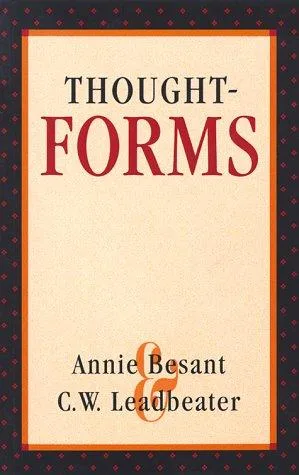
Thought Forms
 79
79

Thought Forms
Besant and Leadbeater's "Thought Forms" offers a fascinating, if occasionally dated, taxonomy of the energetic residue left by human consciousness. The authors' meticulous descriptions of how emotions like anger or love manifest as distinct, visualized entities in the astral plane are particularly arresting. Their assertion that specific colors and shapes correlate directly with psychological states, such as a "red, jagged form" for anger, provides a concrete, if highly speculative, model for understanding psychic influence. However, the work suffers from its inherent reliance on subjective clairvoyant observation, presented without rigorous empirical verification. The 1901 publication date also means its framework feels rooted in a specific historical moment of Theosophical exploration, which might not fully align with contemporary understandings of consciousness. Despite these limitations, the book remains a significant artifact of early 20th-century esoteric thought, detailing concepts that continue to inform visualization and energy work practices.
📝 Description
79
Published in 1901, "Thought Forms" details how mental states manifest visible energies.
Annie Wood Besant and Charles Webster Leadbeater, prominent members of the Theosophical Society, wrote "Thought Forms" to illustrate their observations of how human thoughts and emotions take on distinct shapes and colors in unseen realms. The book presents detailed descriptions and illustrations of these "thought-forms," positing that they are not abstract concepts but have a tangible effect on individuals and their surroundings. Besant and Leadbeater suggest that by understanding the nature of these forms, one can gain insight into the energetic underpinnings of consciousness and psychic phenomena.
The authors categorize these manifestations based on the specific thought or emotion that created them, correlating colors, shapes, and movements to the mental state. This work emerged during a period of heightened interest in spiritualism and occultism in late Victorian England. It builds upon the foundational work of Helena Blavatsky and aims to offer a framework for understanding subjective experiences beyond purely materialist explanations. The book is intended for those engaged with esoteric philosophy and comparative religion.
First appearing in 1901, "Thought Forms" is a key text within the Theosophical movement, which sought to synthesize Western occult traditions with Eastern philosophies. Authors Besant and Leadbeater, both leaders in the Theosophical Society, expanded on Helena Blavatsky's ideas about subtle planes of existence. They focused on the practical application of Theosophical principles, attempting to provide empirical descriptions of psychic phenomena and the manifestation of mental energies. This work contributed to a broader cultural fascination with spiritualism and the unseen world prevalent in the late 19th and early 20th centuries.
💡 Why Read This Book?
• Gain insight into the Theosophical Society's early 20th-century exploration of consciousness, specifically the concept of "thought-forms" as described by Besant and Leadbeater. • Understand how specific emotions and intentions are depicted as having visible, energetic manifestations, as detailed in the book's descriptions of colored, shaped entities. • Appreciate the historical context of psychic research in the early 1900s, noting how this work engaged with contemporary debates on the mind and subtle energies.
⭐ Reader Reviews
Honest opinions from readers who have explored this book.
❓ Frequently Asked Questions
What is the primary purpose of 'Thought Forms' by Besant and Leadbeater?
The book aims to illustrate how thoughts and emotions can create distinct, visible energetic forms in the unseen realms, influencing both the individual and their environment. It details the appearance and behavior of these 'thought-forms'.
When was 'Thought Forms' first published?
The original publication date for 'Thought Forms' by Annie Wood Besant and Charles Webster Leadbeater was 1901.
What are thought-forms according to Besant and Leadbeater?
Thought-forms are described as semi-physical manifestations generated by human thoughts and emotions. Their color, shape, and movement are said to directly reflect the quality and intensity of the originating mental or emotional state.
Who were Annie Wood Besant and Charles Webster Leadbeater?
They were prominent leaders and influential authors within the Theosophical Society in the late 19th and early 20th centuries, known for their extensive writings on esoteric philosophy and psychic phenomena.
Does the book offer practical exercises for creating thought-forms?
While the book primarily focuses on describing and categorizing observed thought-forms, its detailed explanations implicitly guide readers toward understanding the principles of visualization and mental energy control, which can inform practice.
Is 'Thought Forms' considered a scientific text?
No, 'Thought Forms' is considered an esoteric or metaphysical text. It is based on clairvoyant observation and subjective experience rather than empirical, scientific methodology as understood today.
🔮 Key Themes & Symbolism
Manifestation of Thought
The core theme is the tangible manifestation of thoughts and emotions. Besant and Leadbeater detail how mental energy, when projected with sufficient intensity, coalesces into distinct, observable forms in the astral or mental planes. These forms are not static but possess life-like qualities, interacting with their surroundings. The book emphasizes that the quality of the thought directly dictates the nature and effect of the resulting form, providing a framework for understanding the energetic impact of consciousness.
Color and Shape Symbolism
A significant aspect of the work is the detailed correlation between specific colors, shapes, and the psychic states they represent. For instance, certain shades of red might indicate anger, while blues could signify peace or devotion. The authors map out a complex symbolic language where the visual characteristics of a thought-form are directly interpretable. This provides a visual lexicon for understanding the subtle energies generated by human experience, suggesting a universal grammar of psychic expression.
Influence on the Environment
The book posits that thought-forms exert a real influence on the physical and psychic environment. They can affect the mood and well-being of individuals, impregnate places with specific energies, and even interact with other thought-forms. This concept extends the understanding of consciousness beyond the individual, suggesting a pervasive network of energetic exchanges. The authors explore how both positive and negative thought-forms contribute to the collective psychic atmosphere, highlighting the responsibility that comes with mental creation.
Theosophical Cosmology
Within the broader context of Theosophy, "Thought Forms" serves to illustrate key tenets regarding the nature of reality and the human being's place within it. It supports the idea of planes of existence beyond the physical and the existence of subtle bodies animated by thought and emotion. The work aligns with Theosophical teachings on karma and reincarnation, suggesting that the energetic imprints of our thoughts contribute to our ongoing spiritual evolution and the unfolding of cosmic law.
💬 Memorable Quotes
Direct passages from the work, attributed to the author.
“Thought-forms… are living things, born of the thought of man, and moulded by it.”
— This statement underscores the book's central thesis: that thoughts are not ephemeral mental events but possess a dynamic, quasi-independent existence, capable of independent action and influence.
“The colour-sense is highly developed in the astral body, and the colours perceived in thought-forms are as definite and as easily distinguished as are the colours of the physical spectrum.”
— This highlights the authors' reliance on clairvoyant perception and their assertion that the astral plane has its own distinct sensory apparatus, enabling the detailed observation of thought-form characteristics.
“The colour of the thought-form depends on the emotion that produced it.”
— This captures the symbolic system presented in the book, where specific emotional states are directly translated into visual chromatic expressions within the thought-form.
“A thought of anger… will manifest as a jagged, fiery form.”
— This is a concrete example of the symbolic language employed, illustrating how a particular emotion (anger) is visually represented by a corresponding energetic shape (jagged, fiery).
“The form of a thought is the symbol of the thought.”
— This interpretation emphasizes the direct correspondence between the mental content and its energetic representation, suggesting that the form is an immediate, symbolic outflow of the mind.
🌙 Esoteric Significance
Tradition
This work is deeply embedded within the Theosophical tradition, a major esoteric movement of the late 19th and early 20th centuries that sought to synthesize Eastern and Western spiritual philosophies. Besant and Leadbeater, as prominent leaders, expanded upon Helena Blavatsky's teachings, particularly concerning the nature of consciousness, subtle bodies, and the planes of existence. "Thought Forms" exemplifies Theosophy's interest in developing and describing psychic faculties and the energetic underpinnings of reality, offering a visual language for concepts previously discussed in more abstract terms.
Symbolism
The book's primary symbolism lies in its detailed mapping of colors and shapes to specific emotions and mental states. For example, the authors associate certain vibrant blues with devotion or peace, while fiery reds and jagged forms represent anger or aggression. These color-symbolic correlations are central, suggesting a universal, albeit esoteric, language of psychic manifestation. The shapes themselves—spheres, spirals, jagged lines—are imbued with meaning, representing the flow, intensity, and quality of the thought or emotion that generated the thought-form.
Modern Relevance
Contemporary practices in visualization, mindfulness, and energy healing often draw implicitly or explicitly on the principles articulated in "Thought Forms." Thinkers and practitioners in fields such as Neuro-Linguistic Programming (NLP), Jungian psychology (particularly concerning archetypes and the collective unconscious), and various New Age spiritual movements utilize concepts related to the power of focused intention and the energetic impact of thoughts. The book's visual approach to abstract concepts continues to influence modern methods of exploring and influencing consciousness.
👥 Who Should Read This Book
• Students of Theosophy and early 20th-century occultism seeking primary source material on psychic phenomena and esoteric cosmology. • Individuals interested in the visualization techniques and the energetic theory behind consciousness, particularly those exploring the connection between mind and matter. • Researchers of comparative religion and parapsychology looking to understand historical perspectives on the nature of thought and its perceived influence.
📜 Historical Context
Published in 1901, "Thought Forms" emerged from the fertile ground of late Victorian spiritual and intellectual ferment, a period marked by widespread interest in the unseen and the challenges posed to Victorian materialism. The Theosophical Society, with Annie Besant and Charles Webster Leadbeater at its helm following Helena Blavatsky's death, was a dominant force in esoteric circles. This work built upon Blavatsky's foundational texts, offering detailed, visual descriptions of psychic phenomena derived from the authors' alleged clairvoyant abilities. It provided a compelling, albeit subjective, counterpoint to the burgeoning scientific materialism of the era. While figures like Sir Arthur Conan Doyle championed spiritualism, mainstream science remained skeptical. "Thought Forms" offered a coherent, if speculative, framework for understanding consciousness that resonated with many seeking alternatives to orthodox religion and science, distinguishing itself from earlier, less visually descriptive occult literature.
📔 Journal Prompts
Reflect on the described colors associated with specific emotions, such as the fiery reds for anger, and consider their personal resonance.
Analyze the concept of thought-forms as 'living things' and their potential impact on your immediate surroundings.
Consider the symbolic language of shapes and colors presented for thought-forms and how it might relate to your own mental states.
Explore the Theosophical context of this work and how it attempts to bridge Eastern and Western spiritual ideas.
How might the intentional creation of positive thought-forms, as implied by the authors, influence your daily life?
🗂️ Glossary
Thought-form
A visualized or energetic manifestation created by a human thought or emotion, possessing a distinct shape, color, and life-like quality in the subtle realms.
Astral Body
In Theosophical thought, a subtle body composed of finer matter than the physical, associated with emotions and desires, and believed to be the vehicle of consciousness during sleep or after death.
Mental Plane
A higher plane of existence in esoteric cosmology, distinct from the physical and astral planes, where abstract thoughts and consciousness reside.
Clairvoyance
The alleged psychic ability to perceive objects, events, or people that are not within the range of the normal senses, often through extrasensory perception.
Theosophy
A spiritual philosophy founded in the late 19th century, seeking to synthesize various religious, philosophical, and scientific traditions, emphasizing universal brotherhood and the study of comparative religion and occultism.
Subtle Realms
Non-physical dimensions or planes of existence, such as the astral and mental planes, believed to be inhabited by energies, consciousness, and non-physical entities.
Psychic Energy
The hypothesized energy generated by thoughts, emotions, and consciousness, believed to have tangible effects and form the basis of phenomena such as thought-forms.
🔮 Readers Also Liked
Browse all →






More by Annie Wood Besant, Charles Webster Leadbeater
All books →
More Free Theosophy & Anthroposophy Books
View all →