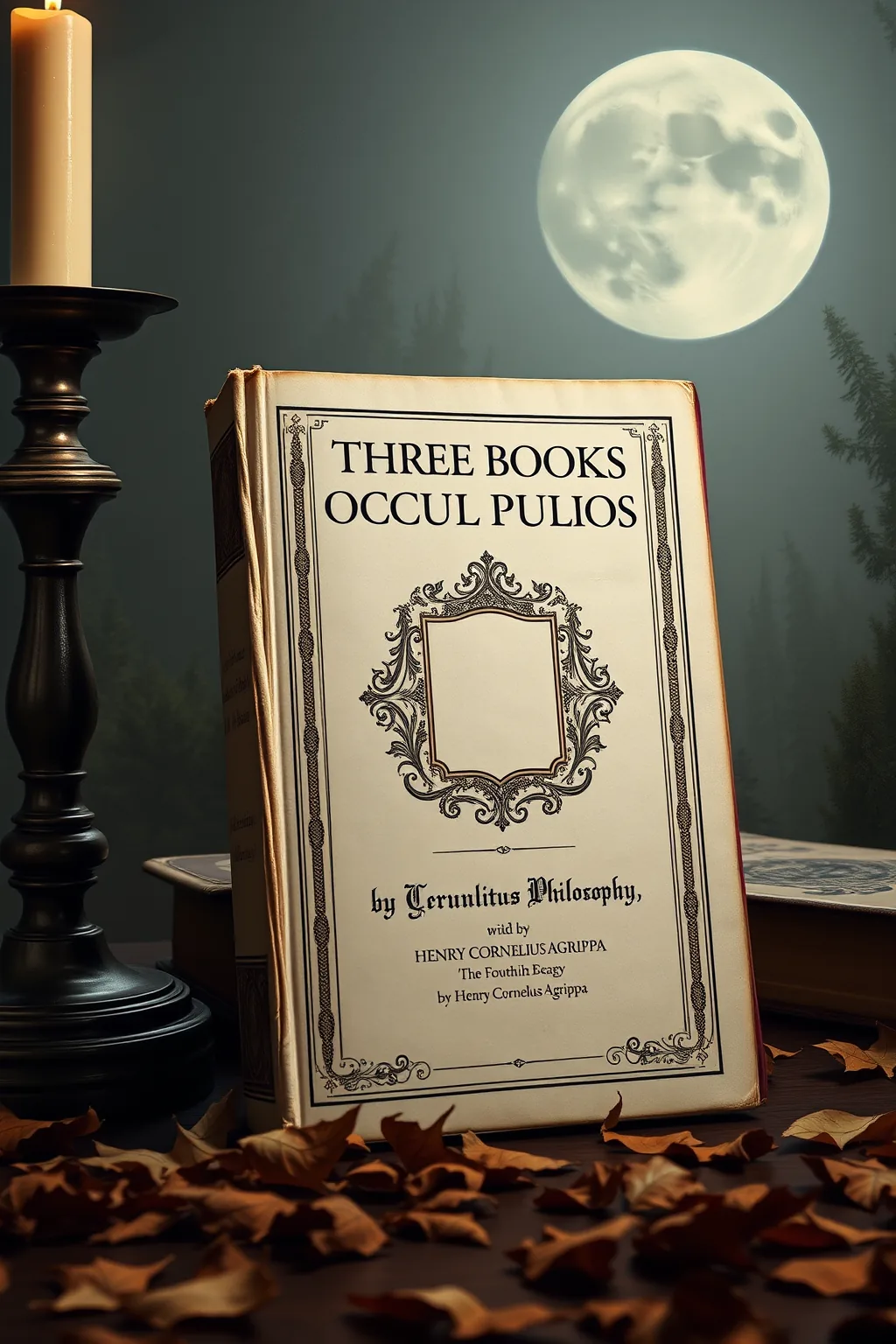
Three Books of Occult Philosophy + of Ceremonial Magic ,the Fourth Book + of Geomancy
 61
61

Three Books of Occult Philosophy + of Ceremonial Magic ,the Fourth Book + of Geomancy



Evander Ashcroft (Alchemy & Hermeticism Editor) — Agrippa's 'Occult Philosophy' remains an unassailable pillar of Western magical tradition. This edition, enhanced with the vital Fourth Book and Geomancy, offers a holistic view of Agrippa's intricate system. Its strength lies in its comprehensive scope, detailing natural, celestial, and ceremonial magic with unparalleled depth. The author’s ability to weave together Neoplatonic philosophy, Kabbalah, and Hermetic principles creates a coherent, albeit challenging, framework for understanding the universe's hidden mechanics. Essential for serious students of magic, hermeticism, and Renaissance intellectual history, this work demands rigorous study but rewards the diligent reader with profound insights into the art of spiritual transformation and cosmic communion.
📝 Description
61
Published in 1531, Henry Cornelius Agrippa's 'Three Books of Occult Philosophy' became a central text in Western magic.
Henry Cornelius Agrippa's 'Three Books of Occult Philosophy,' first published in 1531, along with its later additions 'Of Ceremonial Magic, the Fourth Book' and 'Of Geomancy,' presents a systematic view of magic. Agrippa examines the connections between the macrocosm (the universe) and the microcosm (humanity). He discusses how celestial bodies, angelic beings, and elemental forces influence the world and human lives. The text details a cosmology where everything is interconnected through divine principles and correspondences.
Agrippa outlines three distinct orders of magic: natural, celestial, and divine or ceremonial. The natural magic deals with the inherent properties of things in the world. Celestial magic concerns the influence of stars and planets, and how to harness their power through astrological timing and talismans. Divine magic focuses on invoking spiritual entities, including angels, through rituals and prayers. This work aims to provide a framework for understanding the hidden order of creation and for engaging with spiritual forces.
Agrippa's work is a product of the Renaissance revival of ancient philosophies, particularly Hermeticism and Neoplatonism. It synthesizes various traditions, including Kabbalah, Christian mysticism, and classical magic. The book reflects a worldview where the universe is seen as a divinely ordered, interconnected system, and magic is a legitimate means of interacting with that order. It became a foundational text for subsequent magical traditions, influencing figures from the Elizabethan era onwards.
💡 Why Read This Book?
Unravel the foundational principles of Western occultism and Renaissance magic. Discover Agrippa's masterful synthesis of philosophy, natural science, and spiritual practice. This text offers a unique lens through which to understand the interconnectedness of all things, providing essential knowledge for seekers, scholars, and practitioners aiming to deepen their esoteric understanding.
⭐ Reader Reviews
Honest opinions from readers who have explored this book.
❓ Frequently Asked Questions
What is the primary focus of Agrippa's 'Three Books of Occult Philosophy'?
The 'Three Books' systematically explore natural, celestial, and ceremonial magic, detailing the correspondences between the macrocosm and microcosm, elements, planets, and divine powers.
How does the 'Fourth Book' expand upon the 'Three Books'?
The 'Fourth Book' delves into practical ceremonial magic, outlining rituals, invocations, and the construction of magical instruments, offering a more hands-on approach to occult practice.
What is Geomancy as presented by Agrippa?
Geomancy is a form of divination using figures derived from combinations of earth and spirit, offering insights into questions about the past, present, and future through symbolic interpretation.
Is this book suitable for beginners in occult studies?
While comprehensive, Agrippa's work is dense and intellectually demanding. Beginners may benefit from supplementary guides or a foundational understanding of Hermeticism and Neoplatonism.
What makes Agrippa's work so influential?
Agrippa synthesized vast amounts of esoteric knowledge from various traditions, creating a coherent and systematic framework for magic that profoundly influenced subsequent occult thinkers and practitioners for centuries.
🔮 Key Themes & Symbolism
The Interconnectedness of the Cosmos
Agrippa posits a universe where everything is divinely linked, from the smallest atom to the furthest star. He meticulously details the doctrine of correspondences, illustrating how the terrestrial realm mirrors the celestial, and how human actions can influence or be influenced by these divine connections. This theme emphasizes a holistic worldview, suggesting that true understanding comes from recognizing these intricate relationships and the underlying unity of existence, forming the bedrock of magical practice.
The Three Worlds of Magic
The 'Three Books' present a tripartite division of magic: Natural, Celestial, and Ceremonial. Natural magic deals with the inherent properties of earthly substances and their sympathetic connections. Celestial magic focuses on the influences of planets, stars, and divine intelligences. Ceremonial magic, detailed in the Fourth Book, involves direct invocation and the manipulation of spiritual forces through ritual and sacred operations. Together, these divisions offer a comprehensive system for engaging with the hidden forces of reality.
The Divine Image and Microcosm
A central tenet is the concept of humanity as a 'microcosm' reflecting the 'macrocosm' of the universe. Agrippa explores how the human being, with their intellect, soul, and body, is a perfect image of the divine order. Understanding this profound connection allows practitioners to access spiritual power and knowledge by working with their own inner divine spark and aligning it with cosmic principles, facilitating spiritual growth and magical efficacy.
💬 Memorable Quotes
Direct passages from the work, attributed to the author.
“There is nothing in the inferior world which is not represented in the superior.”
— This captures Agrippa's core doctrine of correspondences, asserting a fundamental mirroring between the earthly and celestial realms.
“The world is but a book, and they that do not travel read only one page.”
— A powerful metaphor for the pursuit of knowledge and experience, encouraging exploration beyond the immediate and familiar.
“For all things are from the Word, and by the Word.”
— Highlights the power of divine utterance and intention as the creative force behind all existence, a foundational concept in many mystical traditions.
“The wise man... doth not only understand the nature of things, but can also apply them.”
— Distinguishes between theoretical knowledge and practical application, emphasizing the active role of the magician in utilizing occult principles.
“Magic is the perfection of natural philosophy.”
— Positions magic not as superstition, but as the ultimate expression and application of understanding the natural world and its hidden laws.
🌙 Esoteric Significance
Tradition
Agrippa's work is a monumental synthesis of Hermeticism, Neoplatonism, Kabbalah, and Christian mysticism. It represents a peak of Renaissance occult philosophy, aiming to create a unified system of magic that bridges the natural, celestial, and spiritual realms. It is a central to Western esotericism, influencing grimoires, magical orders, and philosophical thought for centuries.
Symbolism
The text is rich with symbolism, drawing from angelic hierarchies, planetary intelligences, elemental forces, and numerological systems. Agrippa uses these symbolic frameworks to describe the hidden connections within the universe, illustrating how specific signs, talismans, and incantations can evoke corresponding spiritual or material effects. Understanding these symbols is key to deciphering the layered meanings within the work.
Modern Relevance
Despite its historical origins, Agrippa's 'Occult Philosophy' remains profoundly relevant for contemporary seekers. It offers a systematic approach to understanding consciousness, the nature of reality, and the principles of spiritual development. Its exploration of correspondences and symbolic language provides valuable tools for modern practitioners of magic, meditation, and self-discovery, encouraging a deeper connection with the universe.
👥 Who Should Read This Book
This key work is essential for serious students of Western esotericism, Hermeticism, and Renaissance philosophy. Beginners in occult studies will find it a challenging but rewarding deep dive into foundational concepts. Scholars of intellectual history will appreciate its comprehensive synthesis of ancient and medieval esoteric traditions. Aspiring practitioners of ceremonial magic and divination will discover detailed explanations of ritualistic practices and symbolic interpretation.
📜 Historical Context
Written during the zenith of the Renaissance (published in 1531-1533), Agrippa's 'Occult Philosophy' emerged in an era of intense intellectual and spiritual ferment. This period saw a resurgence of interest in ancient Greek philosophy, Kabbalah, Hermeticism, and Neoplatonism, alongside ongoing theological debates. Scholars and mystics sought to reconcile Christian doctrine with pagan wisdom, viewing the universe as imbued with divine meaning and accessible through symbolic understanding and magical arts. Agrippa, a physician, lawyer, and astrologer, synthesized these diverse streams of thought into a comprehensive system of magic, aiming to restore a lost understanding of the cosmos and humanity's place within it. His work became a central to Western esotericism, influencing generations of occultists, philosophers, and alchemists.
📔 Journal Prompts
Reflect on a personal 'correspondence' you've observed in nature or your life. How does Agrippa's concept of macrocosm/microcosm apply here?
Meditate on the concept of the divine image within yourself. How does Agrippa's view of humanity as a microcosm inform your self-perception?
Analyze a specific ritual or invocation described in the Fourth Book. What are its potential symbolic meanings and practical applications?
Consider the principles of Geomancy. How might this divinatory system offer insights into a current dilemma or question in your life?
Agrippa synthesizes many traditions. How can you approach the study of esoteric knowledge with a similar spirit of integration and synthesis?
🗂️ Glossary
Macrocosm
The universe considered as a vast, ordered whole, often seen as a reflection or counterpart to the human being.
Microcosm
The human being, viewed as a miniature representation of the universe, containing within themselves all the elements and principles of the macrocosm.
Correspondences
The doctrine that elements, planets, numbers, colors, etc., in the terrestrial realm have sympathetic relationships or are reflections of celestial or spiritual realities.
Talismans
Objects inscribed with symbols or sigils, believed to possess magical power derived from celestial influences or divine forces, used for protection or to attract specific energies.
Invocation
The act of calling upon a divine or spiritual being for assistance, guidance, or power, typically through ritualistic prayer or ceremony.
This book appears in 7 collections
🔮 Readers Also Liked
Browse all →








More by Henry Cornelius Agrippa
All books →

From the “Occultism” Collection
View all →





More Free Divination & Tarot Books
View all →