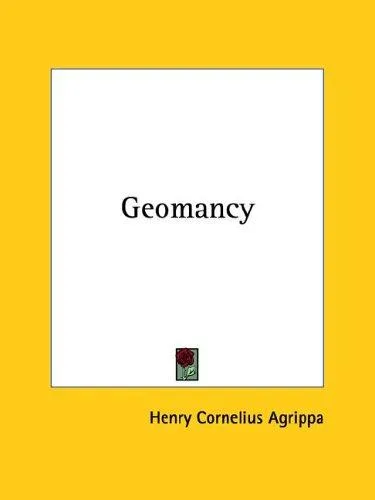
Geomancy
 62
62

Geomancy



Isolde Whitaker (Sacred Texts Editor) — Agrippa's 'Geomancy' stands as an indispensable pillar within the corpus of divinatory literature. His rigorous exposition transforms a seemingly simple practice into a profound philosophical and cosmological system. The book excels in its detailed breakdown of geomantic figures, their astrological correlations, and their application in discerning the will of the cosmos. Agrippa’s authoritative voice lends immense credibility, guiding practitioners from rudimentary interpretation to sophisticated analysis. This work is essential for serious students of Hermeticism, occult philosophy, and anyone seeking a robust, historically grounded method of divination that resonates with ancient wisdom.
📝 Description
62
Henry Cornelius Agrippa's 1531 work on Geomancy maps the earth's symbols to celestial influences.
This text details the practice of Geomancy, a divinatory art that interprets earthly patterns. Agrippa explains the construction and interpretation of the sixteen figures, which arise from random points cast upon the ground. These figures, formed by lines of even or odd, are then arranged to reveal answers about questions posed. The book covers the astrological correspondences of the figures, their significations, and how to apply them in practice. Agrippa presents Geomancy as a method for understanding hidden matters and the natural order.
Readers will find instructions on the proper method for casting the points and deriving the geomantic figures. The work also discusses the planetary and zodiacal associations of these figures, connecting them to broader cosmic principles. Agrippa's approach emphasizes the symbolic language inherent in the practice, suggesting that the earth itself communicates divine knowledge. This volume serves as a guide to a complex system of divination rooted in observation and esoteric philosophy.
Geomancy, as presented by Agrippa, is situated within the broader Hermetic tradition of Western esotericism. It draws upon principles found in earlier grimoires and astrological texts, treating divination as a means to access hidden knowledge and understand divine order. Agrippa's work often aligns with Renaissance magical philosophy, where the microcosm (human) and macrocosm (universe) are seen as interconnected through symbolic systems. This practice was considered a form of natural magic, accessible through specific techniques and symbolic interpretation.
💡 Why Read This Book?
Unlock the ancient secrets of earth divination with Agrippa's seminal work. 'Geomancy' offers a profound system for understanding cosmic influences and terrestrial manifestations. Ideal for occult scholars, practitioners of divination, and seekers of hidden knowledge who wish to master a sophisticated and historically rich divinatory art. Discover a direct link to the wisdom of the ages.
⭐ Reader Reviews
Honest opinions from readers who have explored this book.
❓ Frequently Asked Questions
What is Geomancy?
Geomancy is an ancient divinatory art that involves interpreting patterns formed by random marks or points, often cast by throwing a handful of earth or by using dice. These patterns are then interpreted through a complex system of figures and astrological correspondences.
Who was Henry Cornelius Agrippa?
Agrippa was a renowned German occult philosopher, physician, and astrologer of the Renaissance. He is celebrated for his encyclopedic work 'Three Books of Occult Philosophy', which synthesized various esoteric traditions.
What kind of knowledge does this book offer?
This book offers profound knowledge of divination, Hermetic philosophy, astrology, and the symbolic language of the universe as understood through the practice of geomancy. It reveals hidden connections between the earthly and celestial realms.
Is this book suitable for beginners?
While comprehensive, Agrippa's 'Geomancy' is best suited for those with some prior interest in occult studies or divination. Beginners may benefit from supplementary introductory texts before diving into this advanced work.
How is Geomancy different from Tarot?
Both are divinatory systems, but Geomancy focuses on interpreting earth-based patterns and astrological influences, while Tarot uses symbolic cards. Geomancy is often seen as more grounded in elemental and celestial mechanics.
🔮 Key Themes & Symbolism
The Celestial Mirror of Earth
Agrippa posits that the patterns formed in geomantic figures are not arbitrary but direct reflections of celestial configurations. This theme explores the Hermetic principle of 'As Above, So Below,' where the macrocosm (heavens) is mirrored in the microcosm (earth). The book meticulously details how planetary influences and zodiacal signs manifest through the sixteen geomantic figures, providing a sophisticated framework for understanding cosmic causality and its earthly repercussions. It invites readers to see the earth not as inert matter, but as a dynamic canvas upon which divine energies are constantly inscribed.
The Language of Symbolism and Archetypes
Geomancy, as presented by Agrippa, is a deeply symbolic language. Each of the sixteen geomantic figures possesses unique qualities, meanings, and associations drawn from astrological, elemental, and even moral principles. This theme examines the detailed symbolism embedded within these figures, exploring their archetypal significance and how they represent fundamental forces and states of being. Readers are taught to 'read' these symbols not just for prediction, but for understanding the underlying dynamics of any given situation, revealing hidden truths and the archetypal patterns governing human experience and the natural world.
The Art of Terrestrial Oracle
This theme focuses on Geomancy as a practical, yet sacred, art of divination. Agrippa guides the reader through the process of casting the figures, constructing the house systems, and interpreting the resulting spread. It emphasizes the disciplined and intentional approach required to consult this 'terrestrial oracle.' The book highlights how geomancy can be used for a wide range of inquiries, from personal guidance and understanding relationships to assessing the outcomes of endeavors. It presents geomancy as a powerful tool for gaining wisdom and working through the complexities of life with clarity and foresight.
💬 Memorable Quotes
Direct passages from the work, attributed to the author.
“The figures of Geomancy are sixteen in number, and from the permutation of these, all things are generated.”
— This highlights the generative power and foundational nature of the geomantic figures, implying they form a universal alphabet for understanding creation and manifestation.
“The wise man doth not consult the fates, but rather doth understand them.”
— This speaks to the philosophical depth of Geomancy, suggesting that true wisdom lies not in passive prediction, but in comprehending the underlying forces and laws of destiny.
“To know the natures of these figures is to know the natures of the world.”
— This emphasizes the profound symbolic knowledge contained within Geomancy, asserting that mastering its figures grants insight into the fundamental workings of the universe.
“The art of Geomancy... doth teach us to understand the causes of things.”
— This points to the analytical and causal understanding that Geomancy provides, moving beyond mere fortune-telling to revealing the 'why' behind events.
💡 Key Ideas
Editorial paraphrase of the work's core concepts — not direct quotes.
For the earth is a most excellent mirror of the heavens.
This quote captures the core Hermetic principle of Geomancy, suggesting that earthly patterns directly reflect celestial influences, making the earth a divine oracle.
🌙 Esoteric Significance
Tradition
Geomancy, as expounded by Agrippa, is deeply embedded within the Hermetic and Renaissance Neoplatonic traditions. It embodies the Hermetic axiom 'As Above, So Below,' positing a direct correlation between celestial movements and earthly phenomena. Within this framework, the sixteen geomantic figures are seen as manifestations of planetary and zodiacal influences, offering a visual language to interpret divine will and cosmic order. This practice aligns with the broader Renaissance quest to understand the universe as an interconnected, divinely ordered system, accessible through symbolic interpretation and rigorous study.
Symbolism
The core symbolism of Geomancy lies in its sixteen figures, each composed of dots arranged in four rows of four. These figures are not arbitrary; they are imbued with astrological, elemental, and qualitative meanings derived from their generation and planetary rulership. For instance, 'Populus' (The People) is often associated with Jupiter and signifies multitude and community, while 'Via' (The Way) relates to Mercury and represents movement, communication, and pathways. The interplay of these figures, their positions in the geomantic 'houses,' and their relationships to one another create a rich symbolic collection that can be 'read' to understand complex situations and hidden influences.
Modern Relevance
In contemporary esoteric studies, Agrippa's 'Geomancy' remains a vital text. Its structured approach offers a tangible and accessible entry point into divinatory practices for those seeking alternatives or complements to Tarot or astrology. The system's emphasis on pattern recognition and symbolic interpretation sharpens analytical skills and fosters intuitive development, relevant for personal growth and decision-making. Furthermore, its historical significance provides invaluable context for understanding the evolution of Western esotericism, making it a crucial resource for scholars and practitioners alike interested in the enduring power of ancient wisdom traditions.
👥 Who Should Read This Book
This key work on Geomancy is essential for occult scholars and historians seeking to understand the intellectual field of the Renaissance and its esoteric underpinnings. Practicing diviners and astrologers will find it an invaluable resource for mastering a sophisticated and historically rich divinatory system. Seekers of hidden knowledge and philosophical truths will appreciate Agrippa's systematic approach to understanding the cosmos and its influence on earthly affairs. While comprehensive, beginners with a strong interest in divination and Hermetic philosophy may also find it rewarding, though supplementary introductory texts might be beneficial.
📜 Historical Context
Written during the High Renaissance, a period of intense intellectual ferment and renewed interest in classical esoteric traditions, Henry Cornelius Agrippa's 'Geomancy' emerges as a key work. The era saw the rediscovery and translation of ancient Greek and Egyptian texts, fueling a synthesis of Hermeticism, Neoplatonism, Kabbalah, and astrology. Agrippa, a central figure in this movement, sought to systematize and legitimize these occult arts, presenting them as rigorous philosophical disciplines rather than mere superstition. 'Geomancy' itself has roots stretching back to Arabic scholars and earlier Western traditions. Its inclusion in Agrippa's larger corpus, particularly his 'Three Books of Occult Philosophy,' cemented its place within the Western esoteric canon, influencing generations of occultists, philosophers, and diviners and becoming a reference for understanding Renaissance magical theory and practice.
📔 Journal Prompts
Reflect on a recent challenge: How might the geomantic figures associated with it offer a new perspective or solution?
Consider the concept of 'As Above, So Below.' How do you observe celestial influences manifesting in your daily life or environment?
Choose a geomantic figure that speaks to you today. What personal qualities or situations does it seem to represent?
If you were to cast a geomantic question about your spiritual path, what would it be, and what do you anticipate the figures might reveal?
Explore the idea of the earth as a 'mirror of the heavens.' What does this metaphor imply about our connection to the planet and the cosmos?
🗂️ Glossary
Geomantic Figures
The sixteen primary patterns generated in geomancy, each with unique astrological and symbolic meanings, formed by combinations of dots representing 'youth' and 'old age'.
Houses (Geomantic)
Twelve divisions within a geomantic chart, analogous to astrological houses, each representing a specific area of life or inquiry (e.g., self, wealth, communication).
Perignation
The process of interpreting the geomantic chart, involving the analysis of the figures, their rulers, and their positions within the houses.
Fortuna Major
One of the sixteen geomantic figures, characterized by all four rows having two dots, symbolizing good fortune, success, and material gain. Often associated with Jupiter.
Puer
A geomantic figure representing a young boy or man, often associated with Mars. It signifies impulsiveness, action, and sometimes conflict or passion.
This book appears in 3 collections
🔮 Readers Also Liked
Browse all →







More by Henry Cornelius Agrippa
All books →


From the “Geomancy” Collection
View all →









More Free Divination & Tarot Books
View all →