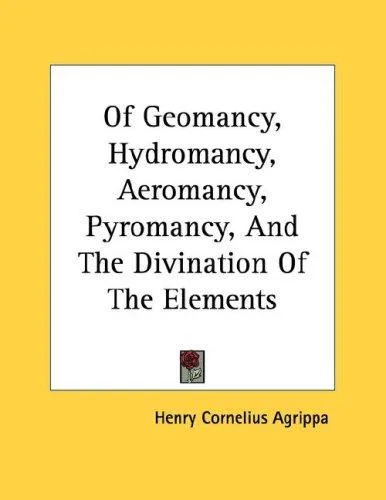
Of Geomancy, Hydromancy, Aeromancy, Pyromancy, And The Divination Of The Elements
 62
62

Of Geomancy, Hydromancy, Aeromancy, Pyromancy, And The Divination Of The Elements



Balthazar Finch (Senior Critic, Occult Philosophy) — Agrippa's 'Divination of the Elements' is an indispensable grimoire, revealing the profound wisdom encoded within earth, water, air, and fire. This work transcends mere scrying, offering a philosophical framework for understanding the elemental archetypes that govern our world. Agrippa masterfully elucidates the intricate systems of geomancy, hydromancy, aeromancy, and pyromancy, equipping the discerning reader with the keys to unlock cosmic insights. Its rigorous approach and deep symbolic understanding make it a vital resource for serious practitioners and scholars of Renaissance occultism, illuminating the path to elemental communion and prophetic clarity.
📝 Description
62
Henry Cornelius Agrippa's 1531 treatise details divination through earth, water, air, and fire.
This book presents Agrippa's systematic approach to the four primary elemental divinatory arts: geomancy, hydromancy, aeromancy, and pyromancy. He explains how to interpret signs derived from these elements to understand cosmic influences and future events. Agrippa, a significant figure in Renaissance occult thought, connects these practices to a broader understanding of the natural world and its hidden forces.
The text serves as a guide for interpreting the patterns and movements within earth, water, air, and fire. It is not simply a collection of fortune-telling techniques but an exposition on the interconnectedness of the material and spiritual realms. The work is intended for those seeking to deepen their understanding of esoteric principles and their application in practical divination.
Published in 1531, this work sits within the Neoplatonic and Hermetic traditions prominent during the Renaissance. Agrippa, influenced by figures like Marsilio Ficino, sought to synthesize various occult philosophies. His writings on magic and divination reflect a worldview where the terrestrial elements are seen as microcosmic reflections of celestial powers. This book contributes to the understanding of operative magic and natural magic, aligning with a broader intellectual current that sought to find divine order and hidden knowledge within the physical world.
💡 Why Read This Book?
Unlock the primal language of the universe. This book offers profound insights into elemental divination, a foundational practice in esoteric traditions. Ideal for seekers of hidden knowledge, occult scholars, and practitioners aiming to harmonize with earth, water, air, and fire. It's a direct conduit to ancient wisdom for understanding destiny and the cosmos.
⭐ Reader Reviews
Honest opinions from readers who have explored this book.
❓ Frequently Asked Questions
What are the four primary elements discussed in the book?
The book focuses on Earth (Geomancy), Water (Hydromancy), Air (Aeromancy), and Fire (Pyromancy) as the fundamental forces through which divination is practiced and understood.
Is this book suitable for beginners in divination?
While comprehensive, Agrippa's work is dense with esoteric philosophy. Beginners may find it beneficial to approach with some foundational knowledge of occult principles or alongside more introductory texts on divination.
What is Geomancy?
Geomancy is the art of divination by means of figures formed by scattering earth or by drawing lines on the ground, interpreted through established systems and patterns.
How does Agrippa connect these divinations to broader occult philosophy?
Agrippa integrates elemental divination into his wider Neoplatonic and Hermetic worldview, viewing these practices as means to understand the divine order and the correspondence between the celestial and terrestrial realms.
Can the methods described be practiced today?
Absolutely. The principles of elemental divination are timeless. While the specific tools or contexts may have evolved, the underlying symbolic language and energetic interactions remain potent for modern practitioners.
🔮 Key Themes & Symbolism
The Language of the Elements
This text posits that the fundamental elements—Earth, Water, Air, and Fire—are not mere physical substances but potent carriers of divine intelligence and symbolic meaning. Agrippa unveils how each element possesses a unique vibrational frequency and a distinct character that can be interpreted to reveal hidden truths. Through detailed explanations of geomantic figures, hydromantic signs, aeromantic omens, and pyromantic flames, the reader learns to perceive the subtle interplay of these forces as a form of cosmic communication, offering insights into past, present, and future potentials. Understanding this elemental language is presented as a crucial step in aligning oneself with the natural order and gaining profound foresight.
Microcosm and Macrocosm
A central tenet of Agrippa's philosophy, and evident throughout this work, is the principle of correspondence: 'As above, so below.' The book illustrates how the elemental forces that govern the vast cosmos (macrocosm) are mirrored within the human being and their immediate environment (microcosm). Divination, in this context, becomes a method of observing these correspondences, allowing the practitioner to perceive the divine will manifest in both grand cosmic cycles and intimate personal circumstances. By mastering the art of reading the elements, one gains a deeper understanding of their own spiritual nature and their place within the universal collection.
The Art of Divination as Spiritual Discipline
Agrippa presents elemental divination not merely as a tool for predicting future events, but as a rigorous spiritual discipline. The practice demands intense focus, purity of intention, and a profound respect for the unseen forces at play. It is an exercise in cultivating intuition, sharpening perception, and fostering a deep connection with the divine and the natural world. The book emphasizes that true divination arises not just from mechanical application of techniques, but from a cultivated inner state that is receptive to subtle energies and symbolic revelations, transforming the practitioner into a conduit for higher wisdom.
💬 Memorable Quotes
Direct passages from the work, attributed to the author.
“The elements are the primal messengers of the divine.”
— This highlights the fundamental belief that the natural world, particularly its elemental constituents, serves as a direct medium through which celestial or divine will is communicated to humanity.
“In the dance of flame, the secrets of passion ignite.”
— This evocative line connects the element of fire to intense emotions, desires, and transformative energies, suggesting that its movements offer insights into the field of the heart and spirit.
“The whispers of the wind carry truths yet unfelt.”
— This emphasizes the subtle, often overlooked messages conveyed by air and wind, suggesting that they hold premonitions and insights into future potentials that are not yet consciously perceived.
“Earth grounds us, but its patterns reveal the heavens.”
— This speaks to the dual nature of earth as a stabilizing force and a symbolic map, implying that by studying terrestrial formations and patterns, one can glean knowledge of celestial influences and cosmic order.
“Water reflects all, from the surface to the deepest soul.”
— This metaphor illustrates the reflective and profound nature of water, suggesting its ability to mirror external realities and internal spiritual states, making it a potent medium for self-discovery and truth.
🌙 Esoteric Significance
Tradition
This work is deeply rooted in the Western Esoteric Tradition, drawing heavily from Hermeticism, Neoplatonism, and Kabbalah. Agrippa integrates these philosophies to present elemental divination as a sophisticated system for understanding the correspondence between the celestial and terrestrial realms, viewing the four elements as fundamental forces imbued with divine intelligence and symbolic meaning. It represents a holistic approach to magic and knowledge, where the manipulation and understanding of material forces lead to spiritual enlightenment.
Symbolism
The core symbolism revolves around the four classical elements: Earth (stability, material form, grounding), Water (emotions, intuition, subconscious), Air (intellect, communication, movement), and Fire (passion, spirit, transformation). Each element's divinatory system (geomancy, hydromancy, aeromancy, pyromancy) utilizes unique symbols and patterns derived from these elemental archetypes, offering a rich lexicon for interpreting cosmic messages and understanding the interplay of forces within oneself and the world.
Modern Relevance
In an age often perceived as disconnected from nature and the unseen, Agrippa's treatise offers a profound re-connection to elemental forces. Its principles of observation, symbolic interpretation, and understanding interconnectedness remain highly relevant for personal growth, spiritual practice, and developing intuitive awareness. Modern practitioners of witchcraft, neo-paganism, and various forms of modern occultism continue to draw inspiration from these foundational elemental divinatory systems for insight and guidance.
👥 Who Should Read This Book
This profound text is essential for the serious student of occult philosophy, the dedicated practitioner seeking to deepen their understanding of elemental magic, and the scholar interested in the history of Western esotericism. Beginners with a strong foundation in metaphysical concepts may find it challenging but rewarding. Those drawn to the primal forces of nature and seeking a more profound connection with the cosmos will find invaluable wisdom. It is a starting point for anyone wishing to master the ancient arts of divination through the fundamental building blocks of reality.
📜 Historical Context
Written during the Renaissance, a period of fervent intellectual and spiritual awakening, Henry Cornelius Agrippa's 'Of Geomancy, Hydromancy, Aeromancy, Pyromancy, And The Divination Of The Elements' emerges from a collection of Hermeticism, Neoplatonism, and Kabbalistic thought. This era saw a resurgence of interest in ancient wisdom, alchemy, astrology, and various forms of divination, viewed not as superstition but as legitimate pathways to understanding the divine order and the hidden mechanics of the universe. Agrippa, a scholar and occultist, synthesized these diverse traditions, aiming to provide a comprehensive system for accessing esoteric knowledge. His work was highly influential, shaping the course of Western esotericism and providing foundational texts for subsequent generations of occultists, magicians, and philosophers seeking to bridge the gap between the material and spiritual realms.
📔 Journal Prompts
Reflect on a recent experience where you felt a strong connection to one of the four elements. What signs did you observe?
How can the principles of Geomancy be applied to understanding the 'earth' of your own spiritual path or life circumstances?
Consider the 'water' of your emotional landscape. What 'patterns' or 'reflections' are emerging from your inner depths?
What 'whispers of the wind' (intuitions, ideas) have you been receiving lately, and how might they carry truths yet unfelt?
Explore a situation where you felt a 'dance of flame' (passion, conflict, creativity). What secrets did this energetic display reveal?
🗂️ Glossary
Geomancy
A form of divination that involves interpreting patterns formed from earth, sand, or small stones, or by drawing lines on the ground. It is one of the oldest and most systematic divinatory arts.
Hydromancy
Divination by means of water, observing its movements, reflections, or the patterns formed within it. It often involves scrying or reading omens from bodies of water.
Aeromancy
The art of divination by observing the winds, clouds, thunder, and other atmospheric phenomena. It seeks to glean prophetic insights from the subtle messages carried by the air.
Pyromancy
A divinatory practice involving the observation and interpretation of flames, fire, and smoke. It is used to understand spiritual energies, passions, and transformative processes.
Macrocosm
The universe as a whole; the greater world. In esoteric traditions, it refers to the divine order, celestial influences, and the totality of existence beyond the individual.
This book appears in 1 collection
🔮 Readers Also Liked
Browse all →









More by Henry Cornelius Agrippa
All books →


From the “Divination” Collection
View all →








More Free Divination & Tarot Books
View all →