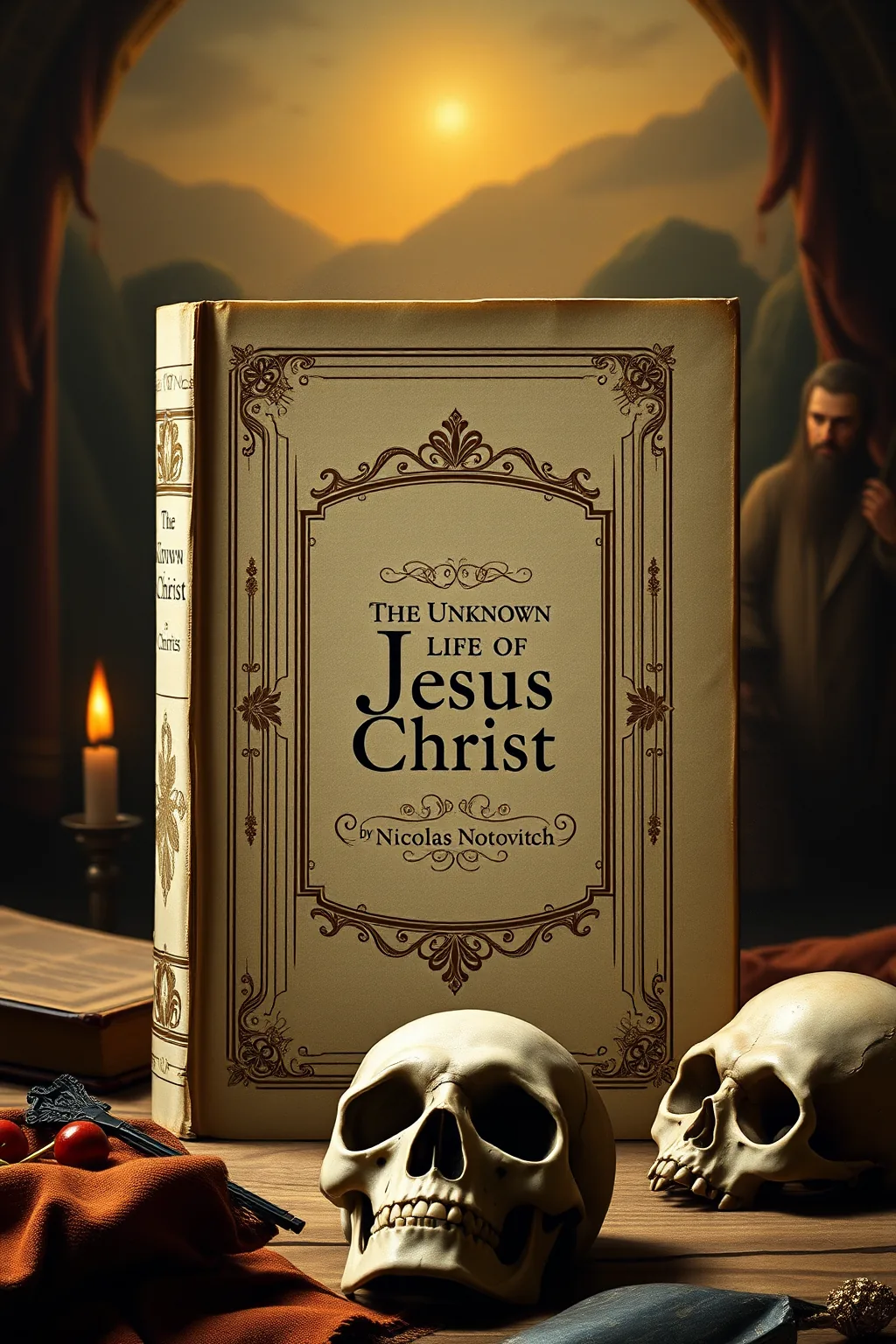
The Unknown Life of Jesus Christ
 83
83

The Unknown Life of Jesus Christ



Alaric Kestrel, Metaphysical Studies Reviewer: Nicolas Notovitch's 'The Unknown Life of Jesus Christ' remains a cornerstone for those who question the established historical Jesus. Its audacious claim, detailing Christ's Eastern sojourn, is supported by purported monastic records, offering a compelling alternative narrative. The book's strength lies in its evocative portrayal of a spiritual quest across India and Tibet, weaving together Christian theology with Eastern mystical traditions. While controversial, it serves as an essential catalyst for contemplating the universal aspects of spiritual awakening and the potential cross-pollination of divine wisdom across ancient cultures. Highly recommended for serious students of comparative religion and esotericism.
📝 Description
83
Nicolas Notovitch claimed in 1894 to have discovered ancient Buddhist manuscripts detailing Jesus's life in India.
Nicolas Notovitch's 1894 book, 'The Unknown Life of Jesus Christ,' presents a controversial account of Jesus's early adulthood. According to Notovitch, based on documents he purportedly found at the Hemis Monastery in Tibet, Jesus spent approximately 17 years in India and Tibet. During this period, known as the "lost years," he is said to have studied with Brahmins, Buddhists, and Jains, adopting the name 'Saint Issa.'
The narrative suggests that Jesus absorbed Eastern spiritual and philosophical traditions, including yogic practices and Buddhist teachings, before returning to the Middle East. Notovitch's work contrasts this with the biblical record, proposing that these Eastern influences shaped his later ministry. The book details Issa's interactions with various Indian spiritual schools and his development as a spiritual teacher.
This text invites readers to consider an alternative biography for Jesus, one that integrates his life with the spiritual currents of ancient Asia. It questions the traditional understanding of his formative years and posits a broader cultural and religious education than is commonly accepted.
Notovitch's work emerged during a period of intense Western interest in Eastern spirituality and theosophy. Books like this contributed to a burgeoning esoteric literature that sought to connect diverse religious traditions and uncover hidden spiritual histories. It aligns with a broader trend of reinterpreting biblical narratives through non-Western lenses, suggesting a universal spiritual source underlying different faiths. The claim of discovering lost texts from remote monasteries fit the era's fascination with ancient wisdom and secret knowledge.
✍️ Author

Nicolas Notovitch
Shulim or Nikolai Aleksandrovich Notovich (Russian: Николай Александрович Нотович; August 13, 1858 – after 1934), known in the West as Nicolas Notovitch, was a Crimean Jewish adventurer who claimed to be a Russian aristocrat, spy and journalist. Notovitch…
💡 Why Read This Book?
Uncover a hidden chapter of spiritual history, exploring Jesus's potential engagement with Eastern philosophies during his 'lost years.' This book is for seekers of esoteric knowledge, scholars of comparative religion, and anyone interested in the profound mystical connections between East and West. It offers a unique perspective on the development of Jesus's spiritual understanding, challenging conventional narratives and opening new avenues for contemplation.
⭐ Reader Reviews
Honest opinions from readers who have explored this book.
❓ Frequently Asked Questions
What are the 'lost years' of Jesus?
The 'lost years' refer to the period in Jesus's life between his youth and the beginning of his public ministry, for which there is little to no information in the canonical Gospels. Notovitch's book claims to fill this gap.
Where did Notovitch claim to find this information?
Nicolas Notovitch claimed to have discovered ancient manuscripts detailing Jesus's life at the Hemis Monastery in Ladakh, Tibet, during his travels.
What is the main claim of the book?
The central assertion is that Jesus, referred to as 'Saint Issa,' traveled extensively through India and Tibet during his formative years, immersing himself in Buddhist and Vedic teachings.
Is this book considered historically accurate?
The historical authenticity of Notovitch's claims and the existence of the manuscripts has been widely debated and is largely disputed by mainstream academia and biblical scholars.
What is the esoteric significance of the book?
Esoterically, the book suggests a universal flow of spiritual knowledge and the potential for Jesus to have integrated wisdom from diverse Eastern traditions, offering a broader understanding of divine revelation.
🔮 Key Themes & Symbolism
The Eastern Christ
This theme examines the radical proposition that Jesus Christ, referred to as 'Saint Issa,' spent his formative years not in obscurity within Judea, but undertaking a profound spiritual pilgrimage across the ancient lands of India and Tibet. It explores how exposure to Buddhist doctrines, Hindu philosophies, and yogic disciplines may have shaped his understanding of divine truth and human potential. This narrative suggests a universal Christ consciousness that transcends specific religious origins, hinting at a synthesis of Eastern and Western spiritual traditions that could redefine our perception of Jesus's teachings and his role in global spiritual evolution.
Lost Knowledge and Ancient Manuscripts
Central to Notovitch's work is the allure of lost knowledge, purportedly preserved in ancient Tibetan manuscripts hidden within the secluded Hemis Monastery. This theme speaks to the human fascination with uncovering forgotten wisdom and the idea that profound spiritual truths have been deliberately obscured or lost to time. The narrative of discovery fuels the imagination, positioning the book as a conduit to ancient esoteric lore. It encourages a critical re-examination of established historical narratives and invites readers to consider the possibility that vital spiritual insights lie dormant, waiting to be rediscovered by those with the courage and insight to seek them out.
Spiritual Syncretism and Universalism
The book powerfully advocates for spiritual syncretism, suggesting that the divine message is not confined to a single culture or religion, but rather flows through various traditions. It posits that Jesus, as 'Saint Issa,' integrated and perhaps even synthesized the profound spiritual insights of the East with his nascent Jewish heritage. This theme appeals to a universalist perspective, implying that the path to enlightenment and divine connection is many-sided and accessible through diverse spiritual practices and philosophies. It encourages readers to look beyond dogma and celebrate the shared wisdom that underpins all great spiritual paths.
💬 Memorable Quotes
Direct passages from the work, attributed to the author.
“Truth is a light that casts its rays on all.”
— This aphorism speaks to the universal and impartial nature of divine truth, suggesting it is accessible to all who are open to receiving it, regardless of their background or beliefs.
“The soul's journey is the ultimate pilgrimage.”
— This highlights the internal, spiritual quest as the most significant journey a person can undertake, prioritizing self-discovery and spiritual growth over external travels.
“Wisdom is not found in books alone, but in experience.”
— This underscores the importance of lived experience and direct personal insight in the acquisition of true wisdom, suggesting that spiritual understanding is cultivated through action and reflection.
“The divine resides within the heart of every man.”
— This asserts the inherent divinity within each individual, suggesting that the sacred is not an external force but an intrinsic part of our being, waiting to be recognized.
💡 Key Ideas
Editorial paraphrase of the work's core concepts — not direct quotes.
The great events of the world are made by the great minds.
This quote emphasizes the power of profound thought and vision to shape history and influence humanity's spiritual trajectory, suggesting that significant shifts in understanding originate from enlightened individuals.
🌙 Esoteric Significance
Tradition
The book draws heavily from Buddhist, Hindu, and possibly ancient Vedic traditions, suggesting a syncretic esoteric lineage for Jesus. It implies that the 'lost years' were spent in immersion with yogic practices, meditation techniques, and philosophical teachings that were not part of his known Judean context, aligning with esoteric notions of universal spiritual laws and accessible divine wisdom across cultures.
Symbolism
The journey itself symbolizes a quest for higher consciousness, with India and Tibet representing areas of ancient spiritual knowledge and profound self-realization. 'Saint Issa' becomes a symbol of the enlightened master who integrates diverse wisdom streams. The Hemis Monastery represents a repository of hidden truths, a sanctuary where the universal message of the divine is preserved beyond the reach of mainstream dogma.
Modern Relevance
In an age increasingly seeking cross-cultural understanding and universal spiritual principles, Notovitch's work remains relevant. It encourages a re-evaluation of religious exclusivity and promotes the idea that spiritual truths can be found in diverse traditions. The book serves as a catalyst for dialogue between different faiths and inspires individuals to explore their own spiritual paths with an open mind, seeking common threads of wisdom and enlightenment.
👥 Who Should Read This Book
This book is a compelling read for the **spiritual seeker** yearning to expand their understanding of Christ beyond traditional narratives. **Scholars of comparative religion and religious history** will find it a provocative, albeit controversial, text for examining historical claims and the interplay of Eastern and Western thought. **Practitioners of meditation and Eastern philosophies** may find resonance in the descriptions of spiritual disciplines potentially undertaken by Jesus. **Beginners** interested in esoteric thought will find an engaging entry point into the idea of hidden spiritual knowledge and the universality of divine wisdom.
📜 Historical Context
Published in 1894, Nicolas Notovitch's 'The Unknown Life of Jesus Christ' emerged during a period of burgeoning global interest in Eastern religions and philosophies. The late 19th century saw a significant increase in Western scholars and spiritual seekers exploring India, Tibet, and other parts of Asia, leading to the translation and dissemination of ancient texts. This era was marked by a questioning of established Western paradigms and a search for alternative spiritual wisdom. The Theosophical Society, founded by Helena Blavatsky in 1875, played an important role in popularizing concepts of Eastern mysticism and ancient hidden knowledge among Western audiences. Notovitch's book tapped into this zeitgeist, offering a sensational narrative that resonated with those eager to find universal truths and challenge conventional religious doctrines. Its reception, though controversial, reflects the era's fascination with the esoteric and the desire to bridge perceived divides between East and West.
📔 Journal Prompts
How might encountering Buddhist or Hindu philosophies have shaped Jesus's understanding of compassion and suffering?
Reflect on the concept of 'lost knowledge.' What spiritual truths do you believe have been obscured or forgotten in modern society?
If Jesus did travel East, what universal spiritual principles might he have integrated into his teachings that are not explicitly in the Bible?
Consider the symbolism of journeying to the East for spiritual enlightenment. What does this journey represent in your own life?
How does the idea of a universal Christ consciousness challenge or affirm your personal spiritual beliefs?
🗂️ Glossary
Saint Issa
The name used in the purported Tibetan manuscripts to refer to Jesus Christ during his travels in the East, suggesting a familiar and revered spiritual figure within those cultures.
Hemis Monastery
A prominent Buddhist monastery located in Ladakh, India, where Nicolas Notovitch claimed to have discovered ancient manuscripts detailing the life of 'Saint Issa'.
Lost Years
The period in Jesus Christ's life between his youth and the commencement of his public ministry, for which canonical biblical accounts offer minimal information.
Vedic Traditions
Ancient Indo-Aryan scriptures and the religious, philosophical, and cultural practices that originated from them, forming the foundation of Hinduism.
Buddhism
A religion and philosophy originating in ancient India, based on the teachings of Siddhartha Gautama (the Buddha), emphasizing enlightenment through meditation and ethical conduct.
This book appears in 1 collection
🔮 Readers Also Liked
Browse all →







From the “Christian Mysticism” Collection
View all →








More Free Mysticism & Contemplation Books
View all →