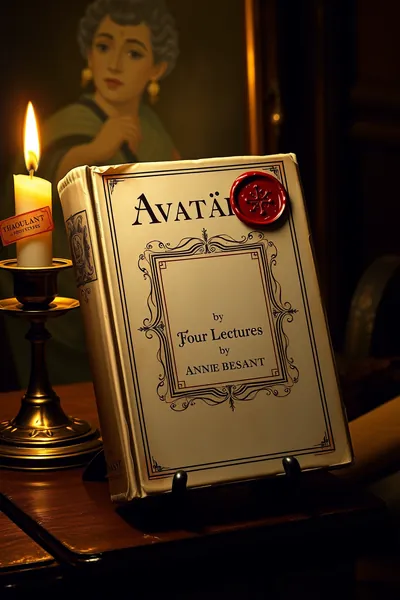
The doctrine of the heart

 83
83

The doctrine of the heart
Annie Wood Besant’s The Doctrine of the Heart offers a detailed, if somewhat dense, exposition on the heart as the primary organ of spiritual perception. The strength of the work lies in its systematic approach, breaking down the complex concept of the heart-center into understandable components. Besant avoids the common pitfall of overly sentimentalizing the heart, instead grounding its function in a rigorous esoteric framework. A passage discussing the influence of "thought-forms" on the heart's energetic state, particularly how they can obscure intuitive clarity, is especially illuminating. However, the prose can be quite academic, at times lacking the immediate experiential resonance one might expect from a text so focused on inner feeling. While the concepts are well-articulated, the book requires dedicated study to fully absorb its teachings. It is a valuable, albeit demanding, contribution to understanding the esoteric anatomy of consciousness.
📝 Description
83
Annie Wood Besant published 'The Doctrine of the Heart' to detail the heart's spiritual significance.
Annie Wood Besant's 'The Doctrine of the Heart' examines the human heart not as a biological pump, but as the core of consciousness and spiritual perception in esoteric philosophy. Besant details the heart's function as a center for psychic energy, a conduit to higher awareness, and the seat of intuition and emotion. The book outlines a method for unlocking the heart's latent abilities, advocating for a move from intellectual grasp to direct, lived experience. She asserts that the heart is the primary tool for recognizing truth and achieving connection with a universal consciousness.
This text is for dedicated students of esoteric thought, especially those focused on consciousness and intuition development. It suits individuals who wish to apply occult studies practically, cultivating internal powers rather than relying solely on intellect. Readers familiar with Theosophy, comparative mysticism, or philosophies that highlight the heart-center as a source of knowledge will find common ground. It also speaks to those interested in the psychological and spiritual aspects of human existence, viewed outside standard materialist perspectives.
Published in 1986, 'The Doctrine of the Heart' appeared during a resurgence of interest in esoteric thought. Annie Wood Besant, a leading figure in Theosophy, drew on her extensive background to write this work. Her active period in the late 19th and early 20th centuries coincided with the rise of occult and philosophical groups like the Hermetic Order of the Golden Dawn and the Theosophical Society. These organizations aimed to unify Eastern and Western mystical ideas. Besant's writings frequently addressed concepts explored by these concurrent movements.
💡 Why Read This Book?
• Gain a structured understanding of the heart as a spiritual faculty, moving beyond its purely physical definition, as explored in Besant's detailed analysis of the "heart-center." • Learn about the esoteric concept of "thought-forms" and how they are believed to influence emotional states and spiritual perception, providing practical insight into internal states. • Discover the Theosophical perspective on developing intuitive capacities through "inner purification" of the heart, offering a distinct approach to spiritual growth not commonly found in secular psychology.
⭐ Reader Reviews
Honest opinions from readers who have explored this book.
❓ Frequently Asked Questions
What is the primary focus of Annie Wood Besant's The Doctrine of the Heart?
The book's central theme is the heart not just as a physical organ, but as the paramount seat of spiritual consciousness and intuitive perception within esoteric philosophy.
When was The Doctrine of the Heart first published?
The first publication of The Doctrine of the Heart by Annie Wood Besant was in 1986.
Who was Annie Wood Besant and what was her connection to this work?
Annie Wood Besant was a prominent figure in the Theosophical Society, a writer, and a lecturer. This work reflects her deep engagement with esoteric philosophy and consciousness studies.
What esoteric tradition does The Doctrine of the Heart primarily draw from?
The work is deeply rooted in Theosophy, a tradition that synthesizes elements of Eastern and Western mysticism, and explores concepts like subtle bodies and spiritual evolution.
Does the book discuss the heart in purely emotional terms?
No, while emotions are discussed, the book emphasizes the heart as a spiritual organ for perception and consciousness, distinct from mere sentimentality.
What is a 'thought-form' according to the concepts presented in the book?
A thought-form, in the context of the book, refers to an energetic construct created by thoughts and emotions, which can influence the heart's energetic field and perception.
🔮 Key Themes & Symbolism
The Heart as a Spiritual Organ
Besant posits the heart as the primary instrument of spiritual knowing, far exceeding its biological function. It is depicted as a focal point for subtle energies and a gateway to higher consciousness. The work elaborates on how cultivating this "heart-center" allows for direct perception of truth, moving beyond the limitations of the intellect. This perspective challenges conventional materialism by re-centering human potential within an inner, energetic anatomy, vital for esoteric understanding.
Intuition and Direct Perception
The book details the development of intuition as a faculty emanating from the refined heart-center. It contrasts this direct knowing with intellectual reasoning, arguing that true spiritual insight arises from a purified heart. Besant explains how emotional turbulence and impure thoughts, or "thought-forms," can obscure this intuitive faculty, necessitating a process of inner purification to access higher wisdom and make contact with subtle realities.
Thought-Forms and Energetic Influence
A significant theme is the concept of thought-forms – energetic structures created by human thought and emotion. The Doctrine of the Heart explains how these forms, particularly those generated by the heart's emotional states, can impact one's spiritual perception and energetic field. Understanding and managing these thought-forms is presented as crucial for maintaining the purity of the heart-center and facilitating its function as a channel for spiritual information.
Inner Purification and Spiritual Development
The work outlines a path of spiritual development centered on the purification of the heart. This process involves transcending lower emotional states and cultivating higher aspirations, thereby refining the heart-center's energetic vibration. Besant suggests that this inner work is essential for the aspirant to align with spiritual principles and effectively utilize the heart's capacity for useful insights and connection with universal consciousness.
💬 Memorable Quotes
Direct passages from the work, attributed to the author.
“The heart is the centre of the life of the soul.”
— This statement captures the core thesis, positioning the heart not just as a physical pump but as the vital nexus for spiritual existence and awareness within the esoteric framework.
“Thought-forms are the vehicles of thought.”
— This highlights the energetic manifestation of mental activity, suggesting that thoughts possess a tangible, albeit subtle, form that can interact with our consciousness and environment.
“Intuition is the voice of the inner guru.”
— This emphasizes the direct, non-intellectual nature of intuitive knowledge, presenting it as an internal guidance system connected to a higher wisdom or spiritual teacher.
“The lower heart is the seat of personality emotions; the higher heart is the seat of divine love.”
— This distinguishes between mundane emotional responses tied to the ego and the pure, selfless love associated with spiritual realization, mapping these onto different aspects of the heart-center.
“Purification of the heart is essential for spiritual vision.”
— This underscores the necessity of inner cleansing and ethical conduct for one to develop the capacity for genuine spiritual perception and understanding.
🌙 Esoteric Significance
Tradition
This work is firmly situated within the Theosophical tradition, which itself draws heavily from Neoplatonism, Hermeticism, Kabbalah, and Eastern philosophies like Vedanta and Buddhism. Besant's interpretation of the heart as a spiritual organ aligns with the Theosophical concept of subtle bodies and the chakras, particularly the anahata chakra. It extends the Theosophical doctrine by providing a focused treatise on the heart's specific role in consciousness and spiritual perception, viewing it as the primary channel for higher knowledge.
Symbolism
The most prominent symbol is the "heart" itself, representing not just emotion but the seat of the higher self and spiritual awareness. The book also implicitly engages with the symbolism of "light" and "purity," as the purified heart is depicted as a luminous center capable of receiving divine illumination. The concept of "thought-forms" can be seen as symbolic representations of the energetic residue of mental and emotional activity, influencing the aspirant's path.
Modern Relevance
Contemporary spiritual seekers, particularly those interested in embodied spirituality and consciousness studies, find value in Besant's systematic approach to the heart-center. It informs modern interpretations of energy work, mindfulness practices that focus on the heart, and the burgeoning field of transpersonal psychology. Thinkers and practitioners exploring the intersection of emotion, intuition, and higher states of awareness continue to reference Theosophical concepts like those presented here for a foundational understanding.
👥 Who Should Read This Book
• Students of Theosophy seeking a deeper understanding of the heart's role in spiritual development and consciousness as articulated by a key historical figure. • Individuals interested in comparative mysticism who wish to explore how different traditions conceptualize the "heart-center" as a locus of spiritual perception. • Aspiring practitioners of esoteric disciplines aiming to move beyond intellectual study towards cultivating inner faculties like intuition through focused inner work.
📜 Historical Context
Annie Wood Besant’s The Doctrine of the Heart, first published in 1986, emerged from a rich lineage of esoteric thought that gained significant traction in the late 19th and early 20th centuries. Besant herself was a key figure in the Theosophical Society, an organization founded in 1875, which sought to bridge Eastern and Western spiritual traditions. During her extensive career, she engaged with complex philosophical and spiritual ideas, often in dialogue with contemporaries like C.W. Leadbeater, though their interpretations sometimes diverged. The period saw a flourishing of interest in occultism, spiritualism, and comparative religion, partly as a reaction against prevailing materialism and scientific rationalism. While movements like the Hermetic Order of the Golden Dawn focused on ceremonial magic, Theosophy, championed by Besant, emphasized spiritual evolution and the study of ancient wisdom. The publication of her work decades later reflects the enduring appeal of these concepts and their continued exploration within esoteric circles.
📔 Journal Prompts
The heart-center's capacity for spiritual perception: how can its "lower" and "higher" aspects be distinguished in daily experience?
Reflecting on specific "thought-forms" observed: what emotional patterns do they correlate with, and how do they obscure intuitive clarity?
The process of "inner purification": what practical steps can be taken to refine the heart's energetic field?
Considering the "voice of the inner guru": how does intuition manifest, and how can it be trusted over intellectual reasoning?
The "life of the soul" as centered in the heart: how does this concept challenge a purely materialist view of existence?
🗂️ Glossary
Heart-Center
In esoteric philosophy, this refers to a subtle energetic point within the human subtle body, often associated with the physical heart, believed to be the seat of consciousness, intuition, and spiritual perception.
Thought-Form
An energetic construct believed to be created by the power of human thought and emotion, possessing a distinct form and influence on the mental and emotional atmosphere, and potentially on the subtle body.
Intuition
A faculty of direct knowing or perception that bypasses ordinary sensory input and logical reasoning, often described as a sudden flash of insight or understanding originating from a deeper, spiritual source.
Inner Purification
A spiritual practice aimed at cleansing the mind, emotions, and subtle body of impurities, negative influences, and lower vibrations to achieve a state of spiritual clarity and receptivity.
Subtle Body
In esoteric traditions, this refers to non-physical bodies or energetic sheaths that are believed to surround and interpenetrate the physical body, composed of finer matter and housing consciousness and vital energies.
Spiritual Perception
The ability to perceive realities beyond the physical senses, often involving insight into spiritual truths, the nature of consciousness, and subtle energetic phenomena.
Theosophy
A spiritual philosophy founded in the late 19th century, seeking to synthesize religious, philosophical, and scientific findings, and to explore the hidden spiritual laws governing the universe and humanity's place within it.
🔮 Readers Also Liked
Browse all →






More by Annie Wood Besant
All books →




More Free Theosophy & Anthroposophy Books
View all →