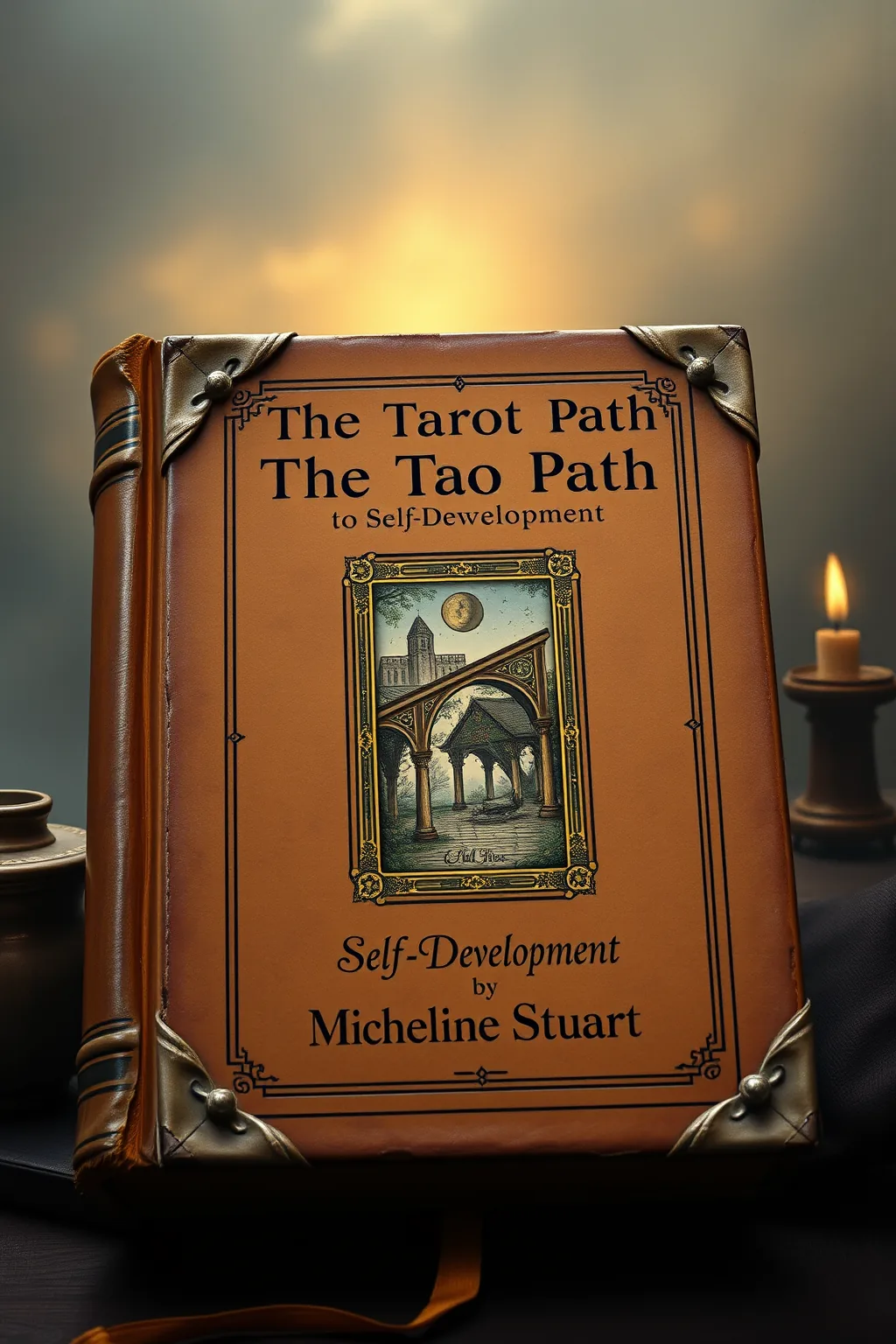
The tarot path to self development
 78
78

The tarot path to self development
Micheline Stuart's 1977 exploration of the Tarot offers a refreshing psychological lens, a welcome counterpoint to purely divinatory approaches that dominated the era. The strength of The Tarot Path to Self Development lies in its coherent mapping of the Major Arcana onto a developmental trajectory for the self. Stuart's interpretation of The High Priestess as representing the threshold of inner knowing, for example, is particularly well-articulated and serves as a solid anchor for the book's thesis. However, the work occasionally suffers from the era's didactic tone, which can feel less like a dialogue and more like a pronouncement. While the psychological framework is robust, the practical application for a modern reader might require some bridging, as the language and examples are firmly rooted in the 1970s. Nevertheless, it remains a valuable historical document for understanding the evolution of Tarot studies beyond mere fortune-telling.
📝 Description
78
Micheline Stuart's 1977 book frames the Tarot as a system for psychological growth, not just divination.
First published in 1977, The Tarot Path to Self Development presents the Tarot as a structured system for personal growth and psychological exploration. Micheline Stuart maps the archetypal journey of the Major Arcana onto the path of individual consciousness development. This book offers a framework for understanding life's challenges and potentials.
This work is for those seeking a deeper, more introspective engagement with the Tarot. It appeals to individuals interested in psychological archetypes, esoteric philosophy, and practical self-improvement techniques. Readers who approach the Tarot as a mirror for the soul, rather than a predictive oracle, will find value here.
Emerging in the mid-1970s, a period of growing interest in esoteric studies and psychological self-discovery, Stuart's book connected with a movement integrating spiritual and psychological disciplines. It offered a distinct perspective on the Tarot, moving beyond common fortune-telling applications. This approach aligned with contemporary explorations of Jungian psychology and Eastern philosophies, framing the Tarot as a tool for inner transformation.
💡 Why Read This Book?
• Gain a structured psychological framework for understanding the 22 Major Arcana, moving beyond predictive interpretations and focusing on personal growth as detailed in Stuart's developmental model. • Explore the concept of the Fool's Journey as a metaphor for consciousness development, a core thesis presented in the book's early sections, offering a unique perspective on life's stages. • Understand the Tarot's place within the esoteric landscape of the 1970s, contextualized by the book's publication year and its departure from contemporary fortune-telling practices.
⭐ Reader Reviews
Honest opinions from readers who have explored this book.
❓ Frequently Asked Questions
What is Micheline Stuart's primary approach to the Tarot in this book?
Micheline Stuart's approach in The Tarot Path to Self Development (1977) emphasizes the Tarot as a psychological and spiritual map for self-development, detailing the archetypal journey of the Major Arcana as stages of consciousness.
How does this book differ from other Tarot guides from the 1970s?
Unlike many contemporaries focused on divination, Stuart's work from 1977 positions the Tarot as a system for introspection and understanding the human psyche, aligning it with emerging psychological and esoteric thought.
What specific esoteric tradition does this book draw from?
The book engages with Western esoteric traditions, particularly those influenced by Jungian psychology and archetypal symbolism, interpreting Tarot cards as stages in individuation and spiritual evolution.
Can this book be used for learning Tarot card meanings?
Yes, it provides detailed interpretations of the Major Arcana, framing their meanings within a context of personal growth and psychological insight, rather than solely predictive outcomes.
Is 'The Tarot Path to Self Development' suitable for beginners?
It is suitable for beginners interested in a deeper, psychological understanding of the Tarot, but readers should be prepared for a less predictive and more introspective approach than some modern guides.
What historical significance does the 1977 publication date hold for this book?
The 1977 publication date places the book within a fertile period for psychological and esoteric exploration, marking a shift towards integrating Tarot with personal development and archetypal psychology.
🔮 Key Themes & Symbolism
Archetypal Journey of the Major Arcana
The central theme is the interpretation of the 22 Major Arcana cards as sequential stages in the development of human consciousness. Stuart frames this journey, beginning with The Fool and culminating with The World, as a metaphor for individuation and spiritual unfolding. Each card represents an archetypal force or challenge encountered on the path to self-realization, offering a structured model for understanding life's transformative processes and inner potentials.
Tarot as a Mirror for the Psyche
Stuart positions the Tarot not as a tool for external prediction but as an internal mirror reflecting the user's psychological state and potential. The cards are presented as symbolic representations of universal human experiences, emotions, and developmental phases. This perspective encourages introspection, allowing readers to engage with the imagery and symbolism to gain insight into their own inner landscape and personal growth.
Psychological Integration and Self-Development
The book advocates for the integration of the archetypal energies depicted in the Tarot for holistic self-development. It explores how understanding and working with these universal patterns can lead to greater self-awareness, emotional maturity, and a more integrated sense of self. The Tarot path becomes a practical guide for navigating personal challenges and fostering inner growth.
Esoteric Framework for Life's Stages
Within its esoteric framework, the book offers a system for understanding the cyclical nature of life and personal evolution. By mapping the Tarot archetypes onto life's journey, Stuart provides a symbolic language for comprehending transitions, confronting limitations, and embracing new potentials. This offers a structured, albeit symbolic, approach to personal metamorphosis.
💬 Memorable Quotes
Direct passages from the work, attributed to the author.
“The Fool's journey is the soul's entry into the material world.”
— This concept highlights the book's core thesis: that the Tarot's Major Arcana represent a progression of consciousness, starting with innocence and the leap into existence, and charting a course for spiritual and psychological development.
“The High Priestess symbolizes the threshold of inner knowing.”
— This interpretation frames The High Priestess not just as intuition, but as a gateway to deeper self-understanding and wisdom, emphasizing the internal nature of revelation central to Stuart's psychological approach.
“Each card represents a necessary step in the integration of universal principles.”
— This statement underscores the structured, developmental aspect of Stuart's Tarot system, suggesting that each archetype offers a lesson or principle essential for the completeness of the self.
“The Tarot serves as a mirror for the soul.”
— This core idea suggests the Tarot's primary function is introspection, reflecting one's inner state and potential for growth, rather than external prediction, aligning with psychological self-analysis.
“Archetypes are universal forces encountered on the path to self-realization.”
— This frames the Tarot cards not as mere images, but as potent, universal energies that individuals must confront and integrate to achieve a more complete and realized self.
🌙 Esoteric Significance
Tradition
This work fits within the Western Esoteric tradition, specifically drawing from Hermeticism and Neoplatonic thought, heavily influenced by mid-20th-century depth psychology, particularly the archetypal theories of Carl Jung. It interprets the Tarot's Major Arcana as a progression of consciousness and individuation, aligning with the Hermetic principle of 'As Above, So Below' applied to the inner human landscape.
Symbolism
Key symbols include The Fool, representing the soul's entry into the material world and the potential for new beginnings, and The High Priestess, symbolizing the threshold of intuitive knowledge and the subconscious. The progression through the numbered cards (I to XXI) signifies the integration of archetypal forces and life lessons necessary for the development of the complete self.
Modern Relevance
Stuart's framework continues to inform contemporary psychological Tarot readers and those interested in archetypal studies. Modern practitioners focusing on self-exploration, shadow work, and the integration of psychological and spiritual paths often reference or echo her approach, viewing the Tarot as a sophisticated tool for personal growth and understanding the psyche.
👥 Who Should Read This Book
• Students of Western Esotericism seeking to understand the psychological and developmental interpretations of the Tarot that gained prominence in the late 20th century. • Individuals interested in Jungian psychology and archetypes who wish to see these concepts applied systematically to a symbolic system like the Tarot. • Tarot practitioners looking to deepen their understanding beyond divination, focusing on using the cards as a tool for introspection, self-awareness, and personal transformation.
📜 Historical Context
Micheline Stuart's "The Tarot Path to Self Development," published in 1977, emerged during a vibrant period of psychological and esoteric exploration. The mid-1970s saw a significant public engagement with Jungian psychology, transpersonal psychology, and various Eastern philosophies, creating fertile ground for works that sought to synthesize these interests. Stuart’s book distinguished itself by focusing on the Tarot as a developmental model for the psyche, moving beyond the prevalent fortune-telling applications. This was a time when authors like Joseph Campbell were popularizing ideas of the hero's journey, and Jungian archetypes were increasingly discussed in popular literature. While figures like Carl Jung had written extensively on archetypes, Stuart applied these concepts directly to the structure of the Tarot deck. The work can be seen as part of a broader Western esoteric movement that sought to integrate ancient symbolic systems with modern psychological understanding, diverging from earlier, more purely mystical or divinatory interpretations.
📔 Journal Prompts
Reflect on The Fool's initial leap and its representation of your own willingness to embrace the unknown.
Consider The High Priestess as the threshold of inner knowing; what intuitive insights are you currently overlooking?
Map the archetypal challenges presented by The Magician and The High Priestess onto a current life situation.
How does the concept of 'integration of universal principles' from The World card apply to your current efforts at self-development?
Analyze your relationship with the archetypal forces represented by The Hierophant and The Lovers in your own life journey.
🗂️ Glossary
Major Arcana
The set of 22 trump cards in a Tarot deck, often seen as representing significant life lessons, archetypal forces, and spiritual milestones on the path of development.
Archetype
In Jungian psychology, a universal, inherited pattern of thought or image derived from the life experience of the human species, influencing behavior and perception.
Individuation
The psychological process of integrating the conscious and unconscious aspects of the self to become a distinct, whole individual; a central concept in Jungian psychology.
The Fool's Journey
A metaphorical interpretation of the Major Arcana sequence, depicting the soul's progression through various experiences and stages of consciousness from innocence to wisdom.
Psyche
The totality of the human mind, conscious and unconscious; encompassing thoughts, feelings, and desires.
Esoteric
Intended for or likely to be understood by only a small number of people with a specialized knowledge or interest; pertaining to inner or hidden knowledge.
Divination
The practice of seeking knowledge of the future or the unknown by supernatural means, often through tools like Tarot cards, astrology, or runes.
🔮 Readers Also Liked
Browse all →









More by Micheline Stuart
All books →
More Free Occult Philosophy Books
View all →