The tao of conversation
 74
74

The tao of conversation
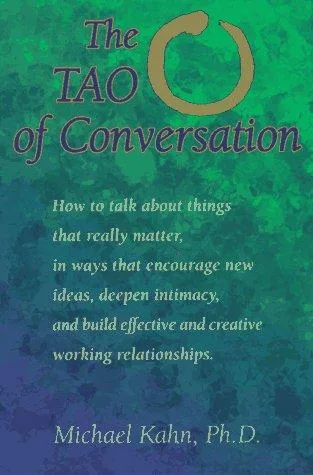
Michael Kahn's The Tao of Conversation offers a refreshing perspective by framing dialogue through the lens of Taoist principles. The strength of the book lies in its elegant application of concepts like Wu Wei and Yin/Yang to the often-fraught landscape of human interaction. Kahn skillfully demonstrates how embracing a more fluid, less forceful approach can unlock deeper understanding. A particularly insightful passage discusses how trying too hard to 'win' an argument or impose one's viewpoint is counterproductive, mirroring the Taoist idea of yielding to overcome. However, the book's primary limitation is its occasional generality; while the concepts are beautifully explained, concrete examples of applying them in highly contentious or complex modern scenarios could have been more extensive. Nevertheless, The Tao of Conversation provides a valuable, contemplative approach to improving one's relational skills.
📝 Description
74
Michael Kahn's 2000 book, The Tao of Conversation, connects Taoist principles to effective dialogue.
Published in 2000, The Tao of Conversation by Michael Kahn applies Taoist philosophy to everyday communication. Kahn suggests that speaking with others can be approached with the same mindful awareness and adaptability found in Taoism. The book examines how concepts like Wu Wei (effortless action) and Yin and Yang can change how we interact, turning conflict into understanding. This work is for anyone wanting to improve their connections, especially those feeling their current communication methods are inadequate. It appeals to people interested in self-help, mindfulness, and different views on psychology and philosophy. Those familiar with Eastern thought, particularly Taoism, will find its principles applied in a new way. It is also useful for professionals in fields like therapy, mediation, and leadership, as well as artists and writers aiming for authentic dialogue.
Kahn's book emerged during a time of growing interest in integrating Eastern philosophies with Western psychology and self-help. Unlike broader explorations of Taoism, Kahn focused specifically on the details of interpersonal communication. The early 2000s also saw concerns about superficial communication in the digital age, making Kahn's focus on presence and genuine connection seem particularly timely. His approach differs from more clinical or academic studies of communication.
This book places itself within the tradition of applying Eastern philosophical concepts to Western psychological and self-development practices. It draws directly from Taoism, a philosophy that emphasizes living in harmony with the Tao, or the natural way of the universe. Kahn's specific contribution is the translation of these ancient principles, such as effortless action and balance, into the practical arena of human conversation. It connects the subtle understanding of natural flow and non-resistance found in Taoist texts to the dynamics of interpersonal exchange, offering an alternative to purely rational or strategic models of communication.
💡 Why Read This Book?
• You will learn to apply the Taoist principle of Wu Wei to your conversations, allowing dialogue to flow naturally without forcing outcomes, a technique distinct from conventional negotiation tactics. • You will gain an understanding of how the interplay of Yin and Yang can be observed and leveraged in interpersonal exchanges, offering a unique framework for conflict resolution not typically found in Western communication guides. • You will discover the practice of 'listening with the whole self,' a method of deep, intuitive engagement that goes beyond passive hearing, as detailed in Kahn's exploration of mindful communication.
⭐ Reader Reviews
Honest opinions from readers who have explored this book.
❓ Frequently Asked Questions
What is the core philosophy behind 'The Tao of Conversation'?
The book's core philosophy is applying Taoist principles, such as Wu Wei (effortless action) and the balance of Yin and Yang, to interpersonal communication. It suggests that by embracing fluidity and receptivity, one can achieve more authentic and effective dialogue.
How does 'The Tao of Conversation' differ from other communication books?
Unlike many communication guides focused on assertiveness or specific techniques, Kahn's work emphasizes a contemplative, Taoist approach. It advocates for yielding, stillness, and intuitive listening rather than direct confrontation or strategic maneuvering.
Who is Michael Kahn and when was 'The Tao of Conversation' first published?
Michael Kahn is an author and therapist who explores the intersection of psychology and Eastern philosophy. 'The Tao of Conversation' was first published in 2000, reflecting a growing interest in integrating Eastern wisdom into Western self-help and relational practices.
Can the concepts in 'The Tao of Conversation' be applied to professional settings?
Absolutely. The book's principles on mindful listening, embracing opposing viewpoints (Yin and Yang), and allowing conversations to unfold naturally (Wu Wei) are highly applicable to leadership, mediation, and team collaboration.
What is the significance of 'Wu Wei' in the context of conversation?
In conversation, Wu Wei means letting go of the need to control the interaction or rigidly adhere to a pre-determined agenda. It encourages a responsive, adaptable approach where one 'acts' by not forcing action, allowing understanding to emerge.
Does the book offer practical exercises for improving conversation skills?
While not a workbook, the book's conceptual framework inherently guides practice. Readers are encouraged to cultivate mindful awareness, practice receptive listening, and observe the dynamic interplay of ideas, applying these principles to daily interactions.
🔮 Key Themes & Symbolism
Wu Wei in Dialogue
The book posits that the Taoist principle of Wu Wei, often translated as 'effortless action' or 'non-striving,' is crucial for effective conversation. Instead of forcing points or controlling outcomes, practitioners are encouraged to allow the dialogue to unfold naturally. This involves a form of active receptivity, where one responds authentically to the present moment of the conversation rather than adhering to a rigid script or agenda. Kahn suggests that this yielding approach can paradoxically lead to greater influence and understanding, as it reduces defensiveness in others and fosters a more open exchange.
Yin and Yang of Communication
Kahn applies the fundamental Taoist concept of Yin and Yang to represent the complementary and often opposing forces present in any conversation. Yin embodies receptivity, stillness, and listening, while Yang represents expression, action, and assertion. The work explores how a balanced interplay between these forces is essential for healthy communication. When one aspect dominates – for instance, an overly assertive Yang or a passively silent Yin – the dialogue suffers. The book guides readers to recognize and harmonize these dynamics, fostering a more dynamic and balanced exchange.
Mindful Listening and Presence
A central theme is the cultivation of deep, mindful listening, extending beyond merely hearing words to understanding the speaker's underlying intent and emotion. This involves being fully present in the moment, setting aside internal distractions and pre-conceived notions. Kahn frames this not as a passive act but as an active engagement requiring focused attention and empathy. Achieving this state of presence allows for more genuine connection and reduces misunderstandings, mirroring the Taoist emphasis on living in accordance with the natural flow of existence.
The Art of Conversational Flow
The book presents conversation as an organic process, akin to the natural flow of water or the changing seasons. It encourages participants to become attuned to the rhythm and direction of the dialogue, adapting their contributions accordingly. This involves recognizing when to speak and when to remain silent, when to assert and when to yield. By embracing this fluidity, individuals can move away from confrontational communication patterns towards a more harmonious and collaborative exchange, fostering mutual respect and deeper relational bonds.
💬 Memorable Quotes
Direct passages from the work, attributed to the author.
“Trying to control a conversation is like trying to hold water in a sieve.”
— This metaphor illustrates the futility of rigid control in dialogue. Just as water slips through a sieve, attempts to forcefully manage or direct a conversation often lead to its breakdown or superficiality, highlighting the need for a more adaptable approach.
“True listening is not waiting for your turn to speak, but disappearing into the speaker's world.”
— This emphasizes a profound shift from ego-driven conversation to empathetic engagement. It suggests that genuine listening involves a temporary suspension of self, allowing one to fully inhabit the other person's perspective and experience.
“The most powerful statement is often the one left unsaid.”
— This points to the wisdom of restraint and the power of silence in communication. It implies that sometimes, allowing space or refraining from immediate response can be more impactful than forceful articulation.
“When we push too hard, the other person pushes back; when we yield, the way opens.”
— This captures the essence of Wu Wei in conflict. It suggests that aggressive tactics create resistance, while a yielding, non-forceful approach can dissolve barriers and create opportunities for resolution and understanding.
“Conversation is a dance between stillness and movement.”
— This highlights the dynamic balance of Yin and Yang in dialogue. It suggests that effective communication requires both periods of active expression (movement) and receptive silence or listening (stillness).
🌙 Esoteric Significance
Tradition
This work draws heavily from Taoism, a philosophical and spiritual tradition originating in ancient China. While not strictly Hermetic, Kabbalistic, or Gnostic, Taoism shares with these traditions an emphasis on understanding natural laws, subtle energies, and the importance of inner cultivation for influencing the outer world. Kahn's application of Taoist concepts like Wu Wei and Yin/Yang to interpersonal dynamics aligns with the esoteric goal of harmonizing the individual with universal principles, extending this into the area of human interaction.
Symbolism
The primary symbolic framework is Taoist. 'Wu Wei' itself acts as a symbolic concept representing a state of being and acting in alignment with natural flow, a core tenure in many esoteric paths. The 'Yin and Yang' symbol is central, representing the dynamic interplay of complementary opposites—male/female, active/passive, light/dark—which Kahn uses to analyze conversational dynamics. The 'Tao' itself, the Way or the underlying principle of the universe, symbolizes the ideal, natural, and harmonious state that effective conversation seeks to emulate.
Modern Relevance
The principles articulated in The Tao of Conversation remain highly relevant today, particularly within contemporary mindfulness movements and non-violent communication (NVC) circles. Therapists and coaches interested in relational dynamics continue to find value in its emphasis on receptive listening and non-striving communication. Its Taoist underpinnings also appeal to those exploring comparative mysticism and transpersonal psychology, seeking wisdom traditions that offer practical frameworks for navigating complex human relationships in an increasingly fragmented world.
👥 Who Should Read This Book
• Individuals interested in Eastern philosophies, particularly Taoism, seeking to apply its principles to practical, everyday interactions. • Therapists, mediators, and counselors looking for contemplative frameworks to enhance active listening and conflict resolution skills beyond conventional techniques. • Anyone feeling dissatisfied with current communication patterns and seeking a more harmonious, less confrontational approach to building deeper connections.
📜 Historical Context
The Tao of Conversation, published in 2000, arrived as the Western world was increasingly exploring Eastern philosophies for practical applications in daily life and personal development. This era saw a surge in interest in mindfulness, mediation, and the integration of Taoist and Buddhist concepts into psychology, exemplified by figures like Jon Kabat-Zinn popularizing mindfulness-based stress reduction. Kahn’s work fits within this broader trend, offering a specific application of Taoist principles to the micro-interactions of human speech. It emerged in contrast to more assertive communication models that had dominated self-help literature for decades. While not directly engaging with academic discourse on communication theory, Kahn’s approach offered a contemplative alternative to the often-mechanistic strategies found in popular psychology, resonating with readers seeking deeper meaning and connection.
📔 Journal Prompts
The concept of Wu Wei in dialogue: how can effortless action manifest in your next conversation?
Reflecting on the Yin and Yang of your communication style: where is the balance needed?
Cultivating mindful presence: what distractions hinder your ability to truly listen?
Identifying conversational 'pushing': when have you resisted the natural flow of dialogue?
The art of conversational flow: how can you better adapt to the rhythm of another's speech?
🗂️ Glossary
Wu Wei
A core Taoist concept, often translated as 'effortless action,' 'non-striving,' or 'actionless activity.' It refers to acting in accordance with the natural flow of the Tao, without force or excessive effort, achieving results through natural means.
Yin and Yang
The Taoist principle of dualism, representing complementary, interconnected, and interdependent forces that shape the natural world and human experience. Yin is typically associated with passive, dark, feminine qualities, while Yang represents active, light, masculine qualities.
Tao
The fundamental principle of the universe in Taoism. It is the natural order, the Way, the source from which all things arise and to which they return. It is often described as ineffable and beyond human comprehension.
Mindful Listening
A form of attentive, present-moment listening that involves focusing fully on the speaker, understanding their words, emotions, and underlying intentions without judgment or distraction.
Receptivity
In the context of conversation, this refers to an open, willing, and non-resistant attitude towards what another person is communicating, allowing their perspective to be heard and understood.
Effortless Action
A synonym for Wu Wei, emphasizing the ability to achieve desired outcomes by acting in harmony with natural processes rather than through forceful exertion or control.
Conversational Flow
The natural, organic progression and rhythm of a dialogue, characterized by adaptability, responsiveness, and a sense of ease between participants.
🔮 Readers Also Liked
Browse all →









More by Michael Kahn
All books →
More Free Occult Philosophy Books
View all →