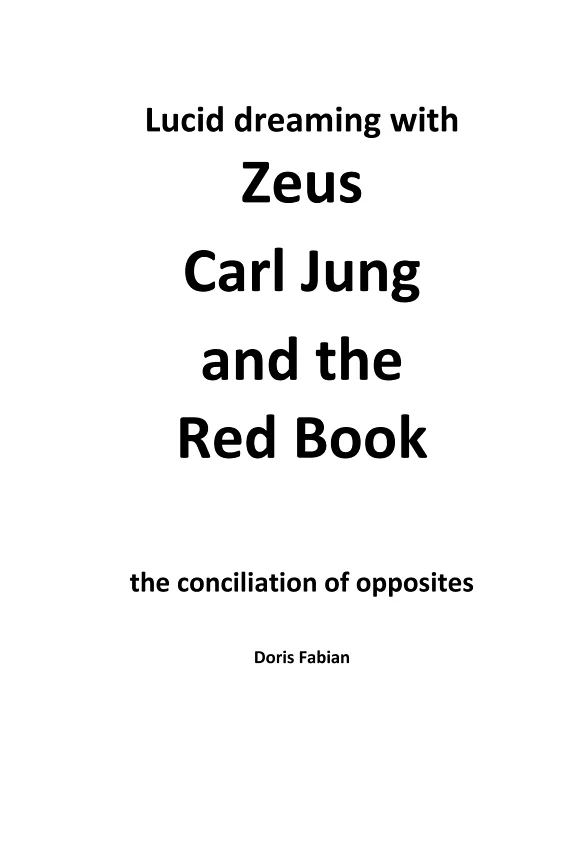
Lucid dreaming with Zeus, Carl Jung and the Red Book
 74
74

Lucid dreaming with Zeus, Carl Jung and the Red Book
Doris Fabian's *Lucid Dreaming with Zeus, Carl Jung and the Red Book* offers a striking personal account of engaging with archetypal figures through the lens of active imagination. The premise—that the Greek god Zeus communicated with the author concerning Carl Jung's *Red Book*—is audacious. Fabian's description of Zeus relating Jung's artistic process to her own artistic methods, and his charge for her to 'feel' the Red Book's images, provides a compelling narrative hook. The strength lies in its raw, unvarnished presentation of a deeply personal visionary experience linked to established psychological concepts. However, the work’s limitation is its high degree of subjectivity; readers unfamiliar with Jungian active imagination may find the narrative challenging to ground. A particularly intriguing passage explores how Zeus purportedly compared the Red Book's imagery to his own ten attributes, suggesting a layered symbolic system waiting to be deciphered. This book is a niche exploration for those already immersed in Jungian psychology and esoteric symbolism.
📝 Description
74
In 2021, Doris Fabian published a synthesis of personal experience and analytical psychology centered on Zeus.
Doris Fabian's 2021 book details her two decades of engagement with Carl Jung's active imagination technique, specifically her dialogue with the archetypal figure of Zeus. The narrative focuses on Zeus's communications regarding Jung's *Red Book*, its imagery, and its connection to artistic creation. According to Fabian, Zeus tasked her with experiencing the *Red Book*'s images viscerally, suggesting that Jung's own artistic output stemmed from a similar imaginative process. This text is for individuals interested in the meeting point of mythology, psychology, and creative practice. Readers familiar with Jung's analytical psychology, particularly active imagination and the collective unconscious, will find resonance. It appeals to those exploring the symbolic language of dreams and art, and anyone working with mythological figures as psychological archetypes. Artists, writers, and those seeking a deeper understanding of their inner world through imaginative engagement will find value.
Fabian's work is situated within post-Jungian thought and contemporary esoteric studies. It directly engages with Carl Jung's legacy, particularly his concepts of active imagination and the collective unconscious. The book's focus on imagery and symbolic language echoes Jung's introspective methods, especially those documented in his *Red Book*. Fabian adds a personal interpretative layer to these established psychological frameworks, bridging personal visionary experience with analytical psychology.
💡 Why Read This Book?
• Gain a unique perspective on Carl Jung's *Red Book* by understanding its imagery as a catalyst for renewed active imagination, as proposed by the author's dialogue with Zeus. • Explore the active imagination technique not just as a psychological tool but as a direct conduit to divine or archetypal communication, drawing from Fabian's 20 years of practice. • Understand the symbolic connections between ancient mythology (specifically Zeus) and modern psychological concepts, particularly through the framework of Zeus's '10 attributes' applied to Jung's visual work.
⭐ Reader Reviews
Honest opinions from readers who have explored this book.
❓ Frequently Asked Questions
What is 'active imagination' as discussed in Doris Fabian's book?
Active imagination, as practiced by Carl Jung and detailed in Fabian's work, is a method of engaging with the unconscious by consciously interacting with inner images, figures, and fantasies, allowing them to develop freely while maintaining a dialogue with the conscious mind.
How does Zeus relate to Carl Jung's *Red Book* in this book?
According to Fabian, Zeus communicated with her about Jung's *Red Book*, emphasizing that the imagery within it originated from Jung's own active imagination and should, in turn, evoke a similar imaginative response in the viewer, connecting it to Zeus's own symbolic attributes.
What is the significance of Zeus's '10 attributes' in the context of the book?
Zeus's '10 attributes' are presented as a comparative framework within the book, used by the archetypal figure of Zeus himself to interpret and categorize the symbolic imagery found in Carl Jung's *Red Book*, linking them to divine or cosmic principles.
When was *Lucid Dreaming with Zeus, Carl Jung and the Red Book* first published?
The book *Lucid Dreaming with Zeus, Carl Jung and the Red Book* by Doris Fabian was first published on November 6, 2021.
Is this book a guide to lucid dreaming techniques?
While the title mentions 'lucid dreaming,' the book's primary focus is on active imagination, mythological dialogue (with Zeus), and the interpretation of Carl Jung's *Red Book*, rather than practical instruction on achieving or controlling dream states.
What is the connection between art and active imagination in Fabian's book?
Fabian argues that all art, particularly Jung's work in the *Red Book*, stems directly from the active imagination. She suggests that engaging with this art can, in turn, reactivate the viewer's own active imagination, creating a cycle of creative and psychological exploration.
🔮 Key Themes & Symbolism
Active Imagination as Divine Dialogue
The book posits that Carl Jung's technique of active imagination serves not only as a psychological tool for accessing the unconscious but as a direct channel for communication with archetypal divine figures, specifically Zeus. Doris Fabian recounts her own experiences where Zeus communicated insights about Jung's *Red Book*, suggesting a profound, inter-dimensional exchange. This theme challenges conventional interpretations by framing imaginative engagement as a literal dialogue with higher consciousness or mythological entities, positioning Zeus as a revealer of esoteric truths.
The Red Book as a Catalyst for Creation
Central to Fabian's thesis is the idea that the visual and textual content of Carl Jung's *Red Book* is not merely a personal record but a potent source for reactivating the viewer's own active imagination. Zeus reportedly tasked the author with 'feeling' the images, implying a visceral, empathetic response. This suggests that Jung's artistic expression, born from his own deep imaginative work, retains an inherent power to stimulate similar creative and psychological processes in others, highlighting the reciprocal nature of symbolic expression.
Mythological Archetypes and Psychological Art
This theme explores the convergence of ancient mythology, represented by Zeus and his '10 attributes,' with the modern psychological insights found in Jung's *Red Book*. Fabian uses Zeus's attributes as a interpretive grid through which to understand the symbolic language of Jung's visionary art. The work proposes that these mythological figures are not just historical remnants but living archetypes that continue to inform and shape our understanding of the human psyche and its creative output.
Art as Manifestation of Inner Worlds
Fabian asserts that all art originates from the active imagination, a core concept linking her own artistic practice with that of Carl Jung. The book presents art not simply as aesthetic creation but as a direct manifestation of the artist's inner visionary experiences. By examining the imagery within Jung's *Red Book*, the author argues for a universal principle: that profound artistic works are tangible expressions of the deepest layers of the psyche, capable of transmitting potent imaginative energy.
💬 Memorable Quotes
Direct passages from the work, attributed to the author.
“Zeus told me to feel the images in Jung's Red Book because he used the same technique that I use in my art.”
— This statement expresses the book's core premise: that the author's artistic process and Jung's psychological explorations are fundamentally linked through active imagination, with Zeus acting as a divine arbiter and interpreter of this connection.
“Jung's images should create the active imagination again, because all his art comes from the active imagination.”
— This highlights the concept that the visionary art within *The Red Book* is not static but possesses an inherent power to stimulate and reactivate the viewer's own imaginative faculties, acting as a bridge to their unconscious.
“Zeus compared these images to his 10 attributes.”
— This suggests a structured, symbolic system wherein the archetypal figure of Zeus provides a framework for understanding the complex imagery presented in Jung's *Red Book*, linking it to divine attributes or cosmic principles.
“Through the practice of 20 years of Carl Gustav Jung's active imagination, I came to know Zeus.”
— This establishes the author's extensive background in Jungian practice as the foundation for her extraordinary experience of direct communication with the archetypal figure of Zeus, lending credibility to her narrative.
“He gave me a task: I should feel the images in the Red Book.”
— This conveys a directive from the divine archetype, Zeus, emphasizing a call to embodied, empathetic engagement with symbolic imagery as a means of accessing deeper psychological and spiritual truths.
🌙 Esoteric Significance
Tradition
This work draws heavily from the Jungian psychological tradition, which itself has deep roots in Hermeticism, Gnosticism, and alchemy through its emphasis on symbolism, archetypes, and the transformative power of the unconscious. Fabian's direct invocation of Zeus and the concept of divine communication places the book within esoteric spiritual practices that seek direct experiential knowledge of the divine or the numinous, bridging psychological exploration with ancient mythological frameworks.
Symbolism
The primary symbols are Zeus, representing supreme divine authority and archetypal fatherhood, and the imagery within Jung's *Red Book*, which functions as a complex symbolic language of the unconscious. Zeus's '10 attributes' serve as a specific symbolic system for interpreting the Red Book's visuals, suggesting a divine order or categorization of psychic phenomena. The act of 'feeling' the images signifies a symbolic embodiment and direct, non-intellectual apprehension of these profound inner realities.
Modern Relevance
Fabian's work appeals to contemporary interest in archetypal psychology, mythology as a living force, and the application of 'active imagination' beyond purely therapeutic contexts. Thinkers and practitioners in fields like depth psychology, mythological studies, and contemporary paganism, who seek to integrate ancient wisdom with modern understanding, find value in such direct, experiential accounts. It speaks to a growing audience interested in personalized spiritual paths and the creative potential unlocked by engaging with the collective unconscious.
👥 Who Should Read This Book
• Individuals deeply interested in Carl Jung's *Red Book* and seeking unconventional interpretations beyond academic analysis. • Practitioners of active imagination or those interested in developing a direct dialogue with archetypal figures, particularly within a mythological context. • Artists, writers, and creatives who explore the origins of their inspiration and seek to understand the link between their inner world and outer artistic expression.
📜 Historical Context
Published in 2021, Doris Fabian's work emerges in an era of renewed interest in Carl Jung's more esoteric writings, particularly his *Red Book* (*Liber Novus*). Jung's own creative and psychological journey, documented between 1913 and 1930, challenged the prevailing rationalism of early 20th-century psychology, offering an alternative in depth psychology and the exploration of the unconscious. While Jung's *Psychological Types* (1921) became a core part of his public work, the intensely personal *Red Book* remained largely private until its posthumous release in 2009, sparking new waves of interpretation. Fabian's book situates itself within this post-2009 discourse, directly engaging with the *Red Book*'s imagery and Jung's method of active imagination. It stands apart from more academic analyses by presenting a direct, dialogical encounter with a mythological archetype, Zeus, offering a unique, esoteric lens on Jungian concepts.
📔 Journal Prompts
Zeus's directive to 'feel the images' from Jung's Red Book: How can this be applied to your own creative work?
The nature of active imagination as a dialogue with the unconscious: What archetypal figures or symbols have appeared to you?
Zeus's '10 attributes' as a framework: How might these attributes offer a new perspective on recurring symbols in your dreams or art?
The connection between Jung's artistic output and the active imagination: Reflect on a piece of art that deeply stirred your inner world.
The concept of art originating from active imagination: Explore a personal creative endeavor and its roots in your own inner experiences.
🗂️ Glossary
Active Imagination
A technique developed by Carl Jung, involving conscious engagement with unconscious material such as images, fantasies, and figures, allowing for a dynamic dialogue between the conscious and unconscious mind.
Carl Gustav Jung
A Swiss psychiatrist and psychoanalyst who founded analytical psychology, known for his theories on archetypes, the collective unconscious, and the individuation process.
Zeus
The king of the gods in ancient Greek mythology, associated with the sky, thunder, law, order, and justice; here, also interpreted as a powerful archetype or divine entity communicating through active imagination.
The Red Book (Liber Novus)
Carl Jung's personal, elaborately illustrated journal documenting his period of self-experimentation with active imagination and his confrontation with the unconscious between 1913 and 1930.
Archetype
In Jungian psychology, a universal, archaic pattern and image that derives from the collective unconscious and is the psychic counterpart of an inherited structure.
10 Attributes of Zeus
A specific symbolic framework mentioned in the book, reportedly used by Zeus to categorize or interpret the imagery found within Carl Jung's Red Book, linking mythological concepts to psychological content.
Esoteric
Relating to or being concerned with the obscure, the hidden, or the specialized knowledge accessible only to initiates or those with specific understanding.
This book appears in 1 collection
🔮 Readers Also Liked
Browse all →








From the “Lucid Dreaming” Collection
View all →







More Free Occult Philosophy Books
View all →

![[Catalogue of Frederick Hockley's Book Sale]](/img/thumb/catalogue-of-frederick-hockley-s-book-sale-george-redway.webp)