The story of Atlantis
 82
82

The story of Atlantis
Scott-Elliot’s account of Atlantis is less a historical document and more a product of its time – a late Victorian/Edwardian speculative reconstruction channeling esoteric traditions. The strength lies in its thoroughness; it attempts to synthesize various threads of Atlantean lore into a coherent, albeit visionary, narrative. The limitation, however, is precisely this reliance on a specific esoteric framework, which may feel unsubstantiated to a secular reader. A notable passage, describing the Atlanteans’ development of a “will-power” distinct from psychic ability, highlights the book’s focus on spiritual evolution as the core of Atlantean civilization. While not a critical historical analysis, it serves as a fascinating window into esoteric thought regarding lost continents.
📝 Description
82
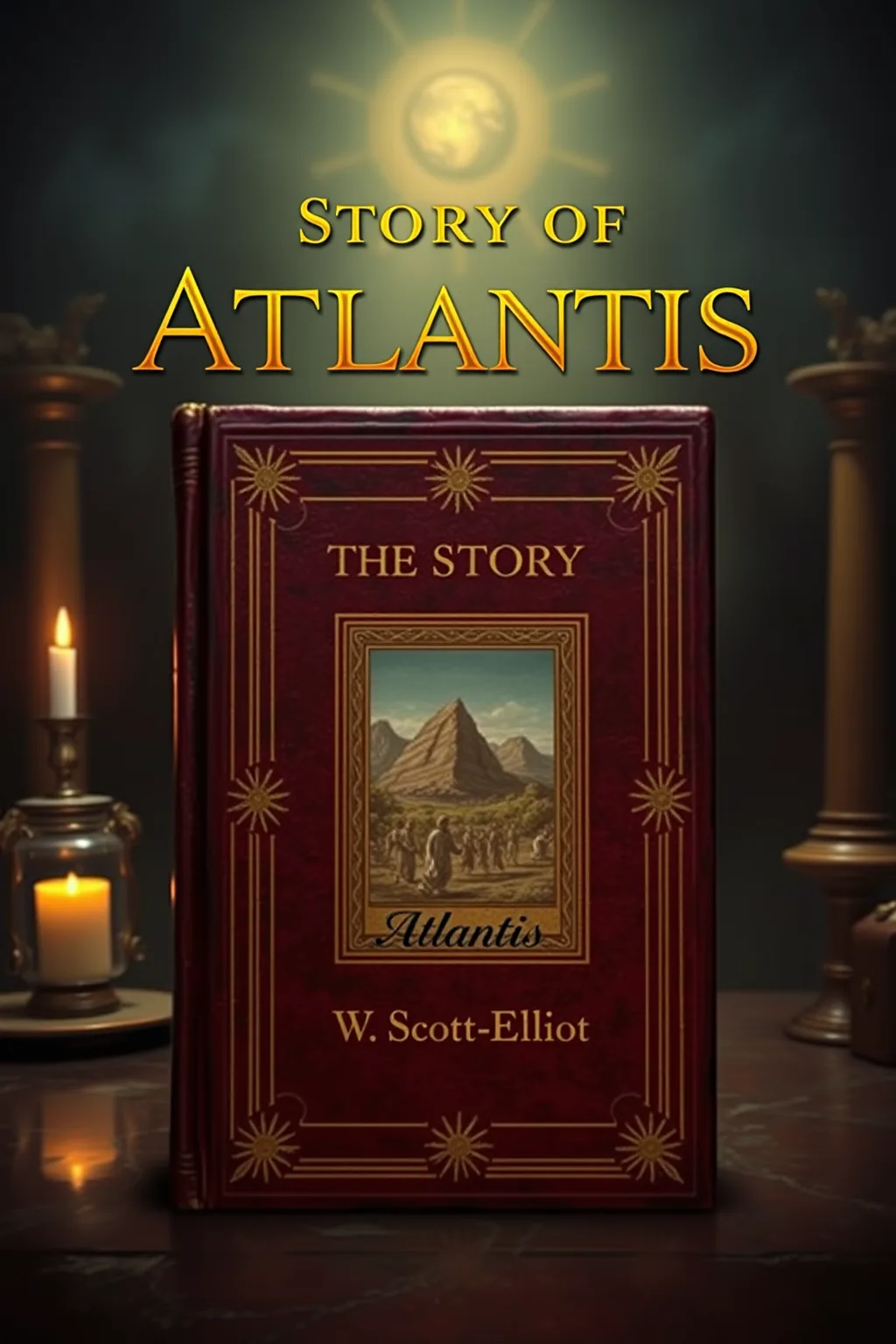
W. Scott-Elliot published 'The Story of Atlantis' in 1909, reconstructing the lost continent's history.
This book details the legendary lost continent of Atlantis, going beyond myth to reconstruct its history, society, and eventual destruction. Scott-Elliot draws on esoteric traditions and visionary accounts to depict Atlantean life, covering its physical geography and spiritual development. The narrative examines concepts like the evolution of consciousness on Atlantis, the use of psychic powers or advanced technologies, and the natural disasters or divine judgments that led to its sinking.
It posits a sophisticated society deeply connected to cosmic energies. Their downfall, according to the text, came from straying from spiritual principles. The work is intended for readers interested in the esoteric lore surrounding Atlantis, particularly those who appreciate speculative histories rooted in spiritual or occult philosophies. It appeals to students of ancient civilizations, comparative mythology, and theosophical literature.
Scott-Elliot's work emerged during a period of significant interest in esoteric subjects, influenced by movements like Theosophy. This era saw a rise in literature exploring lost civilizations and occult histories, with Atlantis frequently appearing as a central theme. The book contributes to this discourse by offering a structured, though speculative, account within this mystical framework, synthesizing ancient wisdom traditions with visionary insights.
💡 Why Read This Book?
• Understand the theosophical perspective on Atlantis: Gain insight into how W. Scott-Elliot, influenced by figures like Helena Blavatsky, envisioned Atlantean society, its spiritual evolution, and its eventual demise. • Explore the concept of Lemurian and Atlantean cycles: Learn about the cyclical view of human and planetary development that was prevalent in early esoteric thought, as presented in the book. • Examine visionary reconstruction of ancient history: Appreciate how speculative narratives, like the description of Atlantean cities and governance, can offer alternative interpretations of humanity's past.
⭐ Reader Reviews
Honest opinions from readers who have explored this book.
❓ Frequently Asked Questions
When was W. Scott-Elliot's 'The Story of Atlantis' first published?
The original publication date for W. Scott-Elliot's 'The Story of Atlantis' is not explicitly stated within the 2016 edition, but the author's significant works on related topics date to the late 19th and early 20th centuries.
What is the primary source material for Scott-Elliot's account of Atlantis?
Scott-Elliot's work draws heavily on esoteric traditions, including Theosophy, and appears to be based on visionary experiences or channeled information rather than archaeological evidence.
Does 'The Story of Atlantis' present scientific evidence for the continent?
No, the book focuses on spiritual and psychic reconstructions of Atlantis, aligning with esoteric and theosophical viewpoints rather than empirical scientific or historical data.
Who was W. Scott-Elliot and what was his background?
W. Scott-Elliot was a writer associated with the Theosophical Society, known for his works exploring ancient civilizations and esoteric philosophies during the late Victorian and Edwardian eras.
What is the significance of Atlantis in esoteric literature?
In esoteric literature, Atlantis often represents a highly advanced civilization whose fall serves as a cautionary tale about spiritual or moral decline, influencing subsequent human development.
Is this book a historical account or a speculative narrative?
This book is best understood as a speculative and esoteric narrative, offering a spiritual and visionary interpretation of the Atlantis legend rather than a verifiable historical record.
🔮 Key Themes & Symbolism
Atlantean Civilization and Culture
Scott-Elliot's work details a highly organized Atlantean society, describing its cities, governance, and the advanced spiritual and psychic capabilities of its inhabitants. The narrative suggests a culture deeply attuned to cosmic forces, with a complex social structure that mirrored divine principles. The book presents Atlantis not just as a physical place, but as a stage in human spiritual evolution, where consciousness developed in unique ways before its eventual decline.
Spiritual Evolution and Decline
A central theme is the spiritual trajectory of the Atlantean race. Scott-Elliot outlines a progression from high spiritual attainment to a gradual materialistic focus, which ultimately led to their downfall. This narrative serves as a cautionary allegory, illustrating how a civilization's advancement can be jeopardized by a loss of spiritual connection. The book explores the consequences of prioritizing material power over inner development, a common motif in esoteric traditions.
The Cataclysm and its Aftermath
The book vividly describes the cataclysmic events that led to Atlantis's submersion. This destruction is portrayed not as a random natural disaster, but as a consequence of the Atlanteans' spiritual and moral failings. Scott-Elliot's account attempts to explain the geological and possibly psychic forces involved, framing the event as a necessary purification. The aftermath suggests a lasting impact on the subsequent development of human history and consciousness on Earth.
Esoteric Cosmology and History
Scott-Elliot positions Atlantis within a larger esoteric cosmology, viewing its history as a crucial chapter in humanity's long evolutionary journey. The work is steeped in theosophical concepts, presenting a vision of past ages and root races. Atlantis is depicted as a key point, bridging earlier epochs (like Lemuria) and the rise of subsequent human civilizations, shaping the spiritual and physical range of the modern world.
💬 Memorable Quotes
Direct passages from the work, attributed to the author.
“The Atlanteans developed a distinct 'will-power' as they progressed spiritually.”
— This highlights Scott-Elliot's focus on inner development. The concept of 'will-power' here is not mere determination, but a refined spiritual faculty that became central to Atlantean consciousness and their advanced capabilities.
“The fall of Atlantis was a consequence of spiritual imbalance.”
— This interpretation underscores the moral dimension of the Atlantean narrative. It suggests that the continent's destruction was not arbitrary but a direct result of the civilization's deviation from its spiritual path.
“Atlantean society was structured according to cosmic principles.”
— This points to the perceived perfection and order of Atlantean civilization. Scott-Elliot implies that their societal organization reflected a deep understanding of universal laws, a stark contrast to later, more chaotic human societies.
“Humanity's evolution is tied to the cycles of lost continents.”
— This concept places Atlantis within a grander, cyclical view of history. It suggests that the rise and fall of such civilizations are integral to the unfolding of human consciousness and destiny.
“The Atlanteans possessed psychic abilities tied to their spiritual state.”
— This emphasizes the connection between inner spiritual development and external abilities in Scott-Elliot's portrayal. The psychic powers of the Atlanteans are presented as a natural outgrowth of their spiritual attainment.
🌙 Esoteric Significance
Tradition
This work is firmly rooted in the Theosophical tradition, which emerged in the late 19th century. Scott-Elliot's narrative of Atlantis aligns with theosophical teachings on root races, cyclical history, and the evolution of consciousness. It departs from purely historical accounts by framing Atlantis as a specific stage in humanity's spiritual and physical development, a precursor to our current era, and a civilization whose fate holds lessons for modern humanity.
Symbolism
Key symbols include the 'Great Cataclysm,' representing divine judgment and natural consequence for spiritual decline, and the 'Seven Cities' often mentioned in Atlantean lore, symbolizing stages of development or societal organization. The very concept of Atlantis itself symbolizes a lost golden age, a pinnacle of human potential corrupted by materialism, serving as an archetypal representation of civilization's fragility.
Modern Relevance
Contemporary esoteric practitioners and writers on ancient mysteries continue to draw upon Scott-Elliot's vision of Atlantis. Its narrative of spiritual evolution, societal decline, and cataclysmic end appeals to modern concerns about civilization's trajectory. Thinkers exploring consciousness, ancient civilizations, and theosophical philosophy often reference Scott-Elliot's detailed, albeit speculative, reconstruction.
👥 Who Should Read This Book
• Students of Theosophy and early esoteric movements: Gain a foundational text that synthesulates key theosophical ideas about ancient history and human evolution. • Enthusiasts of lost continent legends: Explore a comprehensive and detailed speculative account of Atlantis, distinct from purely mythological retellings. • Comparative mythology researchers: Analyze how esoteric traditions interpret and reconstruct ancient myths and legends, particularly concerning pre-historic civilizations.
📜 Historical Context
W. Scott-Elliot's 'The Story of Atlantis' emerged from the fertile ground of late 19th and early 20th-century esoteric thought, a period captivated by ancient mysteries and alternative histories. Influenced heavily by the burgeoning Theosophical movement, particularly the works of Helena Blavatsky, Scott-Elliot sought to synthesize spiritual visions and ancient legends into a coherent narrative. This era saw a widespread fascination with lost continents like Atlantis and Lemuria, often presented as cradles of advanced civilization and spiritual wisdom. The intellectual climate was ripe for such speculative works, contrasting sharply with the rationalism dominant in mainstream academia. While scientific consensus focused on established historical timelines, esoteric writers like Scott-Elliot, Rudolf Steiner, and Ignatius L. Donnelly explored these 'hidden histories' through psychic impressions, comparative mythology, and occult philosophies, offering a spiritual counterpoint to empirical discovery.
📔 Journal Prompts
The societal structure described for Atlantis and its relation to spiritual principles.
Atlantean technological or psychic advancements and their ethical implications.
The concept of 'root races' as presented in Scott-Elliot's work.
The cyclical nature of civilization as exemplified by Atlantis's fall.
Personal reflection on the balance between material progress and spiritual development, as seen in the Atlantean narrative.
🗂️ Glossary
Root Races
In Theosophy, a concept referring to successive stages of human evolution on Earth, with Atlantis being associated with a specific, advanced root race.
Theosophy
A spiritual philosophy founded in the late 19th century, seeking to understand the underlying principles of all religions and the nature of the universe and humanity.
Lemuria
A hypothetical lost continent, often described in esoteric literature as preceding Atlantis and representing an earlier stage of human evolution.
Psychic Abilities
In the context of the book, refers to non-physical faculties such as telepathy, clairvoyance, and precognition, attributed to advanced Atlanteans.
Will-Power
A spiritual faculty described by Scott-Elliot, distinct from mere determination, representing a refined control over consciousness and subtle energies.
Cataclysm
The catastrophic event, often depicted as a flood or earthquake, that led to the submersion of the continent of Atlantis.
Esoteric
Relating to or accessible only by a select group of people with a specialized knowledge or interest, often pertaining to spiritual or mystical subjects.
🔮 Readers Also Liked
Browse all →









More by W. Scott-Elliot
All books →





More Free Occult Philosophy Books
View all →