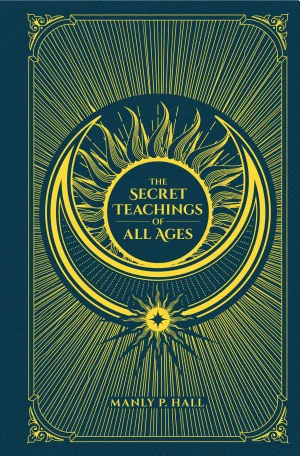
The Secret Teachings of All Ages
 77
77

The Secret Teachings of All Ages
Manly P. Hall's "The Secret Teachings of All Ages" is less a book and more a meticulously constructed edifice of esoteric knowledge. Its sheer scope, attempting to map the philosophical landscapes from ancient Egypt to Renaissance alchemy, is its most striking feature. Hall’s earnest dedication to presenting a unified vision of occult wisdom is palpable, particularly in his thorough cataloging of symbols and allegories. The inclusion of 16 color plates and numerous black-and-white illustrations is not mere decoration; they are integral to understanding the text, functioning as visual exegeses of complex ideas. A limitation, however, lies in Hall's tendency towards confident assertion, often presenting interpretations as established fact without always detailing the comparative analysis that led him there. For instance, his extensive chapter on the philosophical implications of the "Philosopher's Stone" synthesizes various alchemical traditions, but the interpretative leap connecting them to a singular mystical goal sometimes feels more speculative than evidenced. Nevertheless, the work remains an indispensable reference for anyone serious about the history of Western esotericism. It is an ambitious, if occasionally overreaching, compendium of hidden lore.
📝 Description
77
Manly P. Hall published 'The Secret Teachings of All Ages' in 1928, intending to unify esoteric traditions.
This 1928 volume by Manly P. Hall is an encyclopedic survey of esoteric philosophy and mystical traditions. Hall, a self-taught scholar, gathered material from ancient Egypt, Greece, India, and the Renaissance to trace threads of human spiritual development. The book contains 16 color plates and over 100 black-and-white illustrations that clarify complex symbols and concepts. It is intended for serious students of comparative religion, Western esotericism, and occult philosophy, appealing to those interested in a broad overview of historical mystical thought. Readers will find extensive material on Hermeticism, Rosicrucianism, Kabbalah, Freemasonry, and ancient mystery schools. The work's detailed and scholarly approach suits those committed to in-depth study. It is also of interest to scholars of intellectual history and those studying the influence of ancient ideas on modern thought. The book’s ambition was to synthesize disparate esoteric traditions into a unified philosophical system, reflecting a post-World War I search for meaning.
Published in 1928, Hall's work arrived during a period of Western interest in Eastern mysticism, fueled by figures like Helena Blavatsky. It also coincided with a fascination for Freemasonry and its symbolic language. Hall aimed to create a coherent philosophical system from various esoteric traditions, a synthesis that resonated with a broader post-war search for meaning.
💡 Why Read This Book?
• Understand the interconnectedness of global esoteric traditions, as Hall demonstrates how concepts like the "Emerald Tablet" from Hermeticism echo in various mystical schools, providing a comparative framework you won't find in single-tradition texts. • Grasp the symbolic language of ancient mystery schools, particularly the use of architectural motifs and astronomical alignments, which Hall details with specific examples, offering a visual and conceptual vocabulary for hidden meanings. • Appreciate the historical milieu of occult revivalism in the early 20th century by examining Hall's synthesis alongside contemporary movements like Theosophy, revealing how 1928's intellectual climate shaped the presentation of ancient wisdom.
⭐ Reader Reviews
Honest opinions from readers who have explored this book.
❓ Frequently Asked Questions
What is the original publication date of 'The Secret Teachings of All Ages'?
The original publication date for Manly P. Hall's 'The Secret Teachings of All Ages' was November 18, 1928. This hardcover edition is a faithful reprint of that seminal work.
How comprehensive is Manly P. Hall's coverage of esoteric subjects?
Hall's work is remarkably comprehensive, drawing from nearly 600 experts and surveying ancient and modern traditions including Hermeticism, Kabbalah, Rosicrucianism, and Freemasonry, among many others.
What kind of illustrations are included in this edition?
This edition features 16 pages of original color plates and over 100 black-and-white images, which are crucial for illustrating the complex symbols and concepts discussed throughout the book.
Is 'The Secret Teachings of All Ages' considered a primary source for occult studies?
While Hall synthesized information from many sources, his work is considered a foundational secondary text that consolidates and presents a wide range of esoteric philosophies for students of the occult and comparative religion.
Who was Manly P. Hall?
Manly P. Hall (1901-1990) was a Canadian-born author and mystic who became a prominent figure in the field of esoteric philosophy, lecturing and writing extensively on a vast array of spiritual and philosophical subjects.
What are some of the key esoteric traditions discussed in the book?
The book covers a broad spectrum, including ancient Egyptian cosmology, Pythagorean mathematics, Platonic philosophy, Hermeticism, the Kabbalah, Gnosticism, Rosicrucianism, Freemasonry, and various Eastern philosophies.
🔮 Key Themes & Symbolism
The Unity of Ancient Wisdom
Hall posits that beneath the diverse exoteric religions and philosophies of the world lies a single, unifying esoteric tradition. He argues that symbols, myths, and rituals across cultures, from the Egyptian Mysteries to the Kabbalah, are variations on a primordial, universal wisdom. This theme is explored through comparative analysis of alchemical allegories, Masonic symbolism, and the teachings of figures like Pythagoras, suggesting a coherent, albeit hidden, spiritual lineage that transcends geographical and temporal boundaries.
Symbolism as a Universal Language
A central tenet of the book is that symbolism is the primary language of the hidden realms and the subconscious mind. Hall meticulously deciphers the allegorical meanings embedded in geometric forms, astronomical cycles, mythological figures, and even architectural designs. He presents symbols not as mere historical artifacts but as living keys to understanding cosmic laws and human psychology, demonstrating how figures like the Serpent or the Triangle carry profound metaphysical significance across traditions.
The Great Work of Human Evolution
Hall interprets various esoteric practices and philosophical systems as pathways toward spiritual enlightenment and the perfection of the human being, often referred to as the "Great Work" or "Philosopher's Stone." He frames the pursuit of occult knowledge not as an end in itself, but as a process of inner transformation and self-realization. This involves understanding the microcosm (humanity) in relation to the macrocosm (the universe), aligning oneself with divine principles, and achieving a state of conscious unity.
The Hidden History of Secret Societies
The book studies the lineage and philosophical underpinnings of various secret societies, including the Rosicrucians, Freemasons, and ancient mystery schools. Hall presents these organizations not as mere fraternal orders but as custodians of esoteric knowledge, preserving and transmitting the ancient wisdom through initiatory rites and symbolic teachings. He examines their historical influence and their role in shaping Western intellectual and spiritual traditions, viewing them as vital conduits for the "secret teachings."
💬 Memorable Quotes
Direct passages from the work, attributed to the author.
“Man is a microcosm of the universe, and the principles governing the macrocosm are reflected within him.”
— This reflects the Hermetic axiom 'As Above, So Below.' It signifies Hall's belief that the study of the human being (microcosm) offers insights into the workings of the entire cosmos (macrocosm), and vice versa, highlighting the interconnectedness of all things.
“Ignorance is the great enemy of mankind, and the greatest enemy of ignorance is truth.”
— This statement underscores Hall's conviction that the pursuit of knowledge, particularly esoteric and philosophical understanding, is paramount for human progress and liberation. Truth, in this context, is presented as the antidote to the limitations and suffering caused by a lack of awareness.
“The symbols of the ancients are the hieroglyphics of eternity.”
— This emphasizes Hall's view that ancient symbols are not arbitrary but possess timeless, universal meanings that unlock profound spiritual and philosophical truths. They serve as a sacred language capable of conveying eternal principles across ages.
💡 Key Ideas
Editorial paraphrase of the work's core concepts — not direct quotes.
The world is a great ocean of truth, and the religions are but various streams flowing into it.
This paraphrase captures Hall's core idea that diverse religious and philosophical systems are expressions of a singular, underlying universal truth or wisdom. It suggests a comparative approach where the superficial differences between traditions are less important than the shared source from which they emerge.
To know oneself is the beginning of wisdom.
This paraphrase points to Hall's focus on introspection and self-awareness as the foundational step in any genuine spiritual or philosophical pursuit. True wisdom, in his framework, starts with understanding one's own inner nature and place in the universe.
🌙 Esoteric Significance
Tradition
Hall's work is deeply rooted in the Western Esoteric Tradition, drawing heavily from Hermeticism, Kabbalah, Rosicrucianism, and Freemasonry. It attempts a syncretic unification of these disparate streams, presenting them not as independent systems but as facets of a single, underlying "Ancient Wisdom." Hall positions his synthesis as a modern exposition of perennial philosophy, making complex esoteric concepts accessible while maintaining their allegorical and symbolic integrity, departing from more dogmatic or exclusive interpretations.
Symbolism
The book is a rich compendium of esoteric symbols. Key motifs include the Pythagorean Tetractys, representing cosmic order and the four elements; the Caduceus of Hermes, symbolizing balance, healing, and the union of opposites (often interpreted as the spinal energy Kundalini); and the Blazing Star, a potent Masonic symbol representing divine truth and the divine spark within humanity. Hall interprets these not merely as historical emblems but as dynamic keys to understanding universal laws and psychological states.
Modern Relevance
Modern practitioners of Western esotericism, comparative religion scholars, and those exploring consciousness studies frequently reference Hall's work. Contemporary authors on Hermeticism and alchemy, as well as New Age thinkers, often draw upon his interpretations of ancient symbolism and his unified vision of spiritual philosophy. His comprehensive approach continues to serve as a foundational text for individuals seeking to understand the historical development and interconnectedness of various mystical and occult traditions.
👥 Who Should Read This Book
• Students of Western Esotericism: Those seeking a comprehensive overview of Hermeticism, Kabbalah, Rosicrucianism, and Freemasonry will find extensive, cross-referenced material. • Comparative Religion Scholars: Individuals interested in the philosophical underpinnings and symbolic connections between global religious and mystical traditions will appreciate Hall's synthesis. • Aspiring Mystics and Philosophers: Readers starting a path of self-discovery and seeking to understand the perennial wisdom traditions will find a detailed roadmap of ancient thought.
📜 Historical Context
When "The Secret Teachings of All Ages" was first published in 1928, the Western world was undergoing a significant spiritual and intellectual reorientation. The spiritualist movements and the rise of Theosophy, heavily influenced by Helena Blavatsky's synthesis of Eastern and Western mysticism, had prepared a receptive audience for Hall's ambitious project. This era also witnessed a deep engagement with Freemasonry and its intricate symbolism, a subject Hall extensively covers. The book emerged in the shadow of World War I, a period marked by a search for order and meaning, which Hall sought to provide through a grand synthesis of esoteric traditions. While Hall was largely self-taught and operated outside conventional academia, his work was compared to the encyclopedic efforts of earlier occultists and philosophers. The book’s immediate success and enduring popularity made it a central to 20th-century occult literature, influencing subsequent generations of esotericists and scholars of mysticism, despite its lack of formal academic validation at the time.
📔 Journal Prompts
The concept of the "Philosopher's Stone" as presented by Hall.
The symbolic meaning of the "Caduceus" across different traditions.
Hall's interpretation of the "Tetractys" and its cosmic implications.
Reflect on the role of "secret societies" in preserving esoteric knowledge.
How does Hall's view of "Ancient Wisdom" compare to your understanding of universal truths?
🗂️ Glossary
Hermeticism
A philosophical and religious tradition based on writings attributed to Hermes Trismegistus, emphasizing divine wisdom, the unity of all things, and the principle of 'As Above, So Below.' It heavily influenced Western esotericism.
Kabbalah
A system of Jewish mysticism that explores the nature of God and the universe through symbolic interpretation of the Hebrew scriptures, often represented by the Tree of Life diagram.
Rosicrucianism
A mystical and esoteric movement originating in the 17th century, characterized by its symbolic teachings on alchemy, Christian mysticism, and the pursuit of hidden knowledge, often associated with secret societies.
Freemasonry
A fraternal organization with origins in stonemason guilds, known for its allegorical rituals and symbolic teachings related to morality, philosophy, and spiritual enlightenment, often referencing operative masonry as a metaphor.
Theosophy
A spiritual movement founded in the late 19th century by Helena Blavatsky, seeking to synthesize Western occultism with Eastern religions and philosophies, emphasizing universal brotherhood and the study of comparative religion and ancient wisdom.
Alchemy
An ancient practice that combines elements of chemistry, metallurgy, astrology, art, and mysticism, historically focused on transmuting base metals into gold and discovering a universal elixir for immortality, often interpreted as a spiritual process of transformation.
Microcosm and Macrocosm
The Hermetic principle that the human being (microcosm) is a reflection of the universe (macrocosm), and vice versa. Understanding one provides insight into the other, emphasizing universal interconnectedness.
This book appears in 1 collection
🔮 Readers Also Liked
Browse all →








From the “Occultism” Collection
View all →




More Free Occult Philosophy Books
View all →