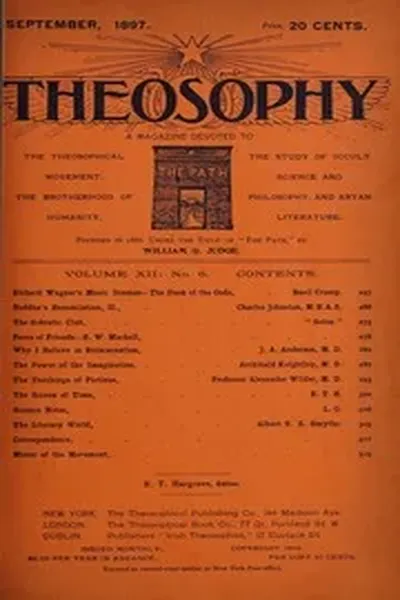
The Secret Doctrine, the Synthesis of Science, Religion, and Philosophy, by H.P. Blavatsky
 76
76

The Secret Doctrine, the Synthesis of Science, Religion, and Philosophy, by H.P. Blavatsky
H.P. Blavatsky's The Secret Doctrine is less a book and more a spiritual and intellectual Everest. Its ambition is staggering: to present a coherent, universal cosmogenesis and anthropogenesis derived from what she termed the "anciently universal wisdom-tradition." The original 1888 publication, and especially its subsequent indices like John P. Van Mater's 1997 compilation, offer access to an unparalleled repository of esoteric lore. Blavatsky's synthesis of Eastern scriptures, Western Hermeticism, and a speculative science was groundbreaking for its time, challenging Victorian scientism and religious orthodoxy. The sheer density of information, however, presents a significant barrier. The prose can be arcane, and the conceptual leaps require considerable reader investment. A passage discussing the "Seven Planes of Being" illustrates both its depth and its difficulty, demanding careful annotation and rereading. While its influence on subsequent esoteric movements is undeniable, The Secret Doctrine remains a text to be wrestled with rather than passively consumed. It is a foundational work for serious occultists, but its demanding nature means it will always occupy a specialized niche.
📝 Description
76
H.P. Blavatsky published The Secret Doctrine in two volumes in 1888, attempting a synthesis of science, religion, and philosophy.
The Secret Doctrine, published in 1888, presents a comprehensive cosmology and anthropology intended to codify a universal wisdom tradition. Blavatsky drew heavily on Sanskrit texts, Eastern philosophies, and Western esoteric currents to construct her vision. The work outlines a cyclical model of cosmic and human evolution, which includes detailed stages referred to as 'Root Races' and 'Rounds'. Its dense prose and ambitious scope demand careful study. John P. Van Mater's 1997 index provides a valuable guide to its vast contents. The book is aimed at serious students of comparative religion, ancient philosophy, and esoteric studies. Readers interested in the origins of Theosophy, the development of New Age thought, or the historical intersection of science and mysticism will find substantial material. It specifically addresses concepts such as karma, reincarnation, and spiritual evolution as understood in the late 19th century. Engaging with its philosophical and cosmological ideas requires patience.
The book emerged during a period of intellectual change in Europe and America. Scientific materialism and Darwinian evolution challenged established religious views. Concurrently, interest grew in spiritualism, Eastern religions, and occultism. Blavatsky's work sought to bridge ancient knowledge with these new scientific and philosophical ideas. It was a significant publication for the Theosophical Society, which aimed to explore these connections.
The Secret Doctrine stands as a cornerstone of modern esoteric thought, particularly within Theosophy. Blavatsky's work aimed to reconcile ancient spiritual traditions, found in texts like the Stanzas of Dzyan, with the scientific and philosophical advancements of her time. It posits a grand cosmic evolutionary scheme, a spiritual and material unfolding that predates and supersedes conventional historical and scientific accounts. The book draws from a wide array of sources, including Hermeticism, Kabbalah, Vedic scriptures, and Buddhist philosophies, presenting them as fragments of a single, unbroken stream of universal wisdom.
💡 Why Read This Book?
• Understand the Theosophical cosmology of "Root Races" and "Rounds," as detailed in Blavatsky's 1888 original volumes, to grasp the cyclical view of human and planetary evolution central to this tradition. • Explore Blavatsky's concept of "Adi-Buddha" and "Dhyan Chohans" to see how she reinterpreted Buddhist and Vedic principles within a Western esoteric framework, offering a unique perspective on divine intelligence and cosmic direction. • Utilize John P. Van Mater's 1997 Index to efficiently locate specific discussions on topics like "Astral Light" or "Monad," enabling focused study of complex ideas that are otherwise difficult to access in the original text.
⭐ Reader Reviews
Honest opinions from readers who have explored this book.
❓ Frequently Asked Questions
What is the primary purpose of H.P. Blavatsky's The Secret Doctrine?
The primary purpose of The Secret Doctrine, first published in 1888, is to present a synthesis of universal wisdom, aiming to demonstrate the underlying unity of science, religion, and philosophy across diverse ancient traditions and cosmic evolution.
Who was John P. Van Mater and why is his index important?
John P. Van Mater created a comprehensive 441-page index for The Secret Doctrine, published in 1997. This index is crucial for researchers and students, providing ready access to the vast and complex material within Blavatsky's original two volumes.
What does 'Root Race' mean in The Secret Doctrine?
In The Secret Doctrine, a 'Root Race' refers to a major stage in the evolutionary cycle of humanity on Earth, distinct from the modern concept of biological race. Blavatsky outlines seven such Root Races across vast geological and spiritual epochs.
Is The Secret Doctrine considered a scientific text?
While Blavatsky attempts to synthesize science, religion, and philosophy, The Secret Doctrine is best understood as an esoteric or metaphysical text. It presents speculative cosmologies and theories of evolution that differ significantly from mainstream scientific consensus.
What is the 'anciently universal wisdom-tradition' Blavatsky refers to?
Blavatsky uses this term to describe a perennial, hidden body of knowledge believed to underlie all major world religions and philosophical systems, passed down through esoteric lineages and preserved in ancient scriptures across various cultures.
How does The Secret Doctrine relate to Buddhism and Hinduism?
The Secret Doctrine draws extensively from Buddhist and Hindu scriptures and philosophies, reinterpreting concepts like karma, reincarnation, and cosmology within its own Theosophical framework. It aims to show common roots between these traditions and other ancient wisdom.
🔮 Key Themes & Symbolism
Cosmic Evolution Cycles
The Secret Doctrine posits that the universe and humanity evolve through vast, cyclical periods known as 'Rounds' and 'Manvantaras.' These cycles are guided by divine intelligences called 'Dhyan Chohans' and involve the gradual unfolding of consciousness and form across seven planes of existence. The work details the progression through seven 'Root Races' on Earth, each representing a distinct stage in human spiritual and physical development, moving from ethereal beginnings to more material forms before a subsequent spiritual ascent.
The Monad and Its Manifestation
Central to Blavatsky's philosophy is the concept of the 'Monad,' the ultimate spiritual spark or divine individuality. The Secret Doctrine explains how this indivisible spiritual principle undergoes a complex process of descent and manifestation through various vehicles or 'bodies'—physical, astral, mental, and spiritual—across different planes of reality. This journey of the Monad through successive incarnations and evolutionary stages is the core narrative of individual spiritual progression.
The Wisdom Tradition
Blavatsky claims to reveal fragments of a single, ancient, universal wisdom-tradition that predates all known religions and philosophies. This 'Secret Doctrine' is presented as the source from which all exoteric religious teachings have derived. The work meticulously analyzes Sanskrit texts, Vedic lore, Buddhist sutras, Hermetic principles, and Kabbalistic ideas to demonstrate this underlying unity and the esoteric interpretation of their shared symbolism and cosmology.
Astral Light and Akashic Records
The concept of 'Astral Light' is presented as a pervasive, universal medium that acts as both a creative force and a repository of all events, thoughts, and actions—akin to the Akashic Records. Blavatsky suggests this etheric substance influences terrestrial phenomena and human consciousness, holding the imprint of past occurrences. Understanding the Astral Light is key to comprehending the interconnectedness of all things and the nature of memory and causality within the cosmic scheme.
💬 Memorable Quotes
Direct passages from the work, attributed to the author.
“The Secret Doctrine is the one unbroken chain of universal laws, which binds each isolated discovery and phenomenon to all others.”
— This statement highlights Blavatsky's ambition to create a unified worldview, suggesting that all scientific discoveries and natural phenomena are interconnected through fundamental, unbroken laws that she seeks to illuminate.
“We are to understand that the evolution of the world and of our race proceeds in cycles within cycles.”
— This conveys the cyclical, rather than linear, view of existence presented in the book. It emphasizes that progress and change occur not in a straight line but through vast, repeating patterns of cosmic and human development.
“The Monad, whether it be the 'Father in Heaven' of the Christian, or the 'Father-Mother' of the Buddhist, is the same divine essence.”
— This illustrates Blavatsky's core thesis of universal spiritual unity, asserting that the highest divine principle described in different religious traditions is fundamentally the same spiritual entity undergoing manifestation.
“Man is the microcosm of the great world, and the great world is the macrocosm of man.”
— This classic Hermetic principle, central to esoteric thought, is employed to show the correspondence between the individual human being and the universe, suggesting that understanding one illuminates the other.
💡 Key Ideas
Editorial paraphrase of the work's core concepts — not direct quotes.
The universe is the manifestation of the divine thought.
This paraphrased concept reflects Blavatsky's idealist philosophy, suggesting that the material world originates from and is sustained by a divine consciousness or thought, emphasizing the primacy of spirit over matter.
🌙 Esoteric Significance
Tradition
The Secret Doctrine is a foundational text of the Theosophical tradition, a major esoteric movement that emerged in the late 19th century. It draws heavily from Eastern esoteric philosophies, particularly Vedanta and Mahayana Buddhism, alongside Western Hermeticism, Kabbalah, and Neoplatonism. Blavatsky sought to synthesize these into a unified "Wisdom Tradition," presenting a modern esoteric interpretation of ancient cosmologies and anthropogenesis that profoundly influenced subsequent New Age and occult movements.
Symbolism
Key symbols include the 'Ouroboros' representing cyclical time and cosmic unity, and the 'Chains' symbolizing the interconnectedness of beings and the stages of evolution. The 'Seven Steps' or planes of existence are crucial, as is the 'Lotus' motif, often associated with the unfolding of consciousness and spiritual development across the Root Races and planes. Blavatsky uses these and many other symbols to allegorically represent complex cosmic laws and evolutionary processes.
Modern Relevance
Contemporary esoteric practitioners, students of comparative religion, and researchers into the history of consciousness continue to engage with The Secret Doctrine. Its concepts of karma, reincarnation, spiritual evolution, and a unified wisdom tradition have permeated modern spiritual discourse. Thinkers and movements influenced by Theosophy, even if indirectly, often echo its foundational ideas, making it a persistent, albeit often unacknowledged, influence on contemporary spirituality and esoteric thought.
👥 Who Should Read This Book
• Aspiring Theosophists and students of Helena Blavatsky's work will find this the primary source text for understanding her complex cosmological and evolutionary theories. • Researchers in comparative religion and Western esotericism will benefit from its extensive compilation and unique synthesis of ancient doctrines and 19th-century speculative thought. • Serious occultists and philosophers of consciousness seeking to explore alternative models of reality, human origins, and spiritual development will find a vast, challenging, and influential body of ideas.
📜 Historical Context
The Secret Doctrine, published in 1888 by Helena Blavatsky, emerged during a period of profound intellectual upheaval. Victorian England was grappling with the implications of Darwinian evolution and burgeoning scientific materialism, which often dismissed spiritual and religious explanations. Simultaneously, there was a widespread fascination with spiritualism, Eastern religions like Hinduism and Buddhism (fueled by translations by scholars like Max Müller), and the occult revival. Blavatsky's work aimed to provide a comprehensive esoteric cosmology that would appear to reconcile these disparate currents, offering an alternative to both orthodox religion and atheistic materialism. The Theosophical Society, which Blavatsky co-founded, was a focal point for these interests. While celebrated by adherents, the work was met with skepticism and accusations of plagiarism from some quarters, notably by figures like Richard Hodgson of the SPR, whose report in 1885, though later contested, cast a shadow over Blavatsky's methods.
📔 Journal Prompts
The concept of the 'Seven Root Races' and their evolutionary trajectory.
Blavatsky's synthesis of Eastern scriptures with Western Hermetic principles.
The 'Monad' as the spiritual essence undergoing cyclic manifestation.
The role of the 'Dhyan Chohans' in guiding cosmic and human evolution.
The 'Astral Light' as a repository of universal records and influences.
🗂️ Glossary
Monad
The ultimate spiritual principle or divine spark, considered the true self or individuality that undergoes a process of reincarnation and evolution across multiple lifetimes and planes of existence.
Root Race
A major stage in the evolutionary cycle of humanity on Earth, spanning vast periods and characterized by distinct physical and spiritual attributes, according to Blavatsky's Theosophical cosmology.
Dhyan Chohans
Cosmic intelligences or celestial beings described as guiding the processes of cosmic and human evolution, often associated with the forces that shape the universe and its inhabitants.
Astral Light
A subtle, pervasive ether or medium believed to contain the records of all events, thoughts, and actions in the universe; it acts as a link between the spiritual and material realms.
Manvantara
A cosmic period of manifestation, a 'day' of Brahma in Hindu cosmology, representing a vast cycle of activity and existence within a larger cosmic scheme of creation and dissolution.
Akashic Records
A hypothetical repository of all knowledge, events, thoughts, and emotions that have ever occurred, are occurring, or may occur; often associated with the Astral Light.
Adi-Buddha
In some Buddhist traditions, the primordial, undifferentiated principle of supreme wisdom; Blavatsky uses it to denote the ultimate source of spiritual consciousness from which all manifests.