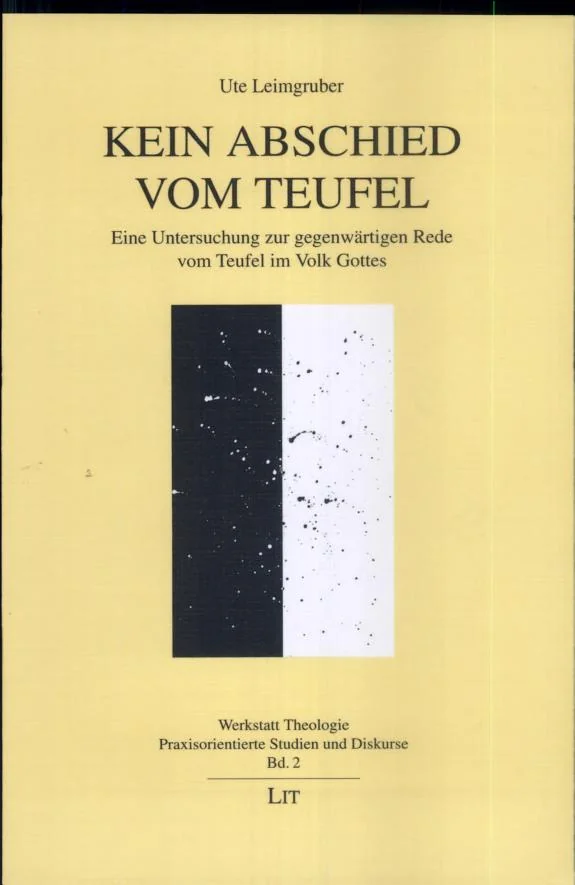
Kein Abschied vom Teufel
 76
76

Kein Abschied vom Teufel
Ute Leimgruber's "Kein Abschied vom Teufel" offers a meticulous dissection of the infernal archetype. The book's strength lies in its rigorous historical tracing of the Devil's conceptual evolution, particularly its engagement with Gnostic thought and its portrayal as a necessary antagonist in theological frameworks. Leimgruber avoids sensationalism, presenting a scholarly yet accessible argument. A limitation, however, is the dense academic prose which, at times, can obscure the more potent symbolic implications for a general esoteric reader. The section detailing the Devil's function as a foil to divine authority, especially in medieval scholasticism, is particularly illuminating. The work is a valuable resource for understanding the symbolic weight of this figure beyond simplistic good-versus-evil binaries.
📝 Description
76
Ute Leimgruber's 2004 study examines the Devil as a complex symbol across traditions.
Ute Leimgruber's "Kein Abschied vom Teufel" (No Farewell to the Devil) offers a scholarly look at the figure of the Devil through different religious and philosophical traditions. Published in 2004, the book moves past simple ideas of the Devil to show the varied theological and symbolic roles this figure has played across history. Leimgruber analyzes how societal fears, religious beliefs, and changing ideas about good and evil have all shaped the concept of the Devil.
The book is for students of religious studies, comparative mythology, and esoteric philosophy who want a detailed study of archetypal figures. It appeals to readers who see the Devil as more than a literal being, but as a symbol for deep fears, rebellion, and the darker sides of human nature. Those with a background in theology or an interest in Western esoteric history will find it especially valuable.
Emerging in the early 21st century, a time of renewed academic and counter-cultural interest in demonology, "Kein Abschied vom Teufel" engages with critical analyses of religious dogma. Leimgruber's work aligns with a discourse that re-examined traditional figures through psychological and post-structuralist lenses. It connects with ideas like René Girard's theories on mimetic desire and the scapegoat, while also looking back to earlier occult critiques of Christian demonology. The book understands the Devil as a projection of psychological states, linking Gnostic concepts like the Demiurge to later Christian Satanic figures and dualistic cosmologies.
💡 Why Read This Book?
• Gain a sophisticated understanding of the Devil's symbolic function, moving beyond simplistic portrayals to grasp its role as a philosophical and theological construct, as explored in the Gnostic sections. • Discover the historical trajectory of the Devil concept, tracing its roots and transformations through key periods like medieval scholasticism, offering a unique perspective on religious evolution. • Appreciate the Devil as an archetype representing rebellion and forbidden knowledge, providing insights relevant to modern psychological and philosophical explorations of the shadow self.
⭐ Reader Reviews
Honest opinions from readers who have explored this book.
❓ Frequently Asked Questions
What is the primary focus of Ute Leimgruber's "Kein Abschied vom Teufel"?
The book primarily examines the historical, theological, and philosophical evolution of the Devil figure, analyzing its symbolic functions across various traditions from Gnosticism to modern thought, rather than presenting a literal depiction.
When was "Kein Abschied vom Teufel" first published?
The work was first published in 2004, positioning it within contemporary academic discourse on religious studies and mythology.
Does the book offer a Christian perspective on the Devil?
While it addresses the Christian conception, "Kein Abschied vom Teufel" takes a broader, comparative approach, exploring the Devil's presence and function in non-Christian and heterodox traditions as well.
Who is the author, Ute Leimgruber?
Ute Leimgruber is a scholar whose work focuses on religious studies and the critical analysis of theological and mythological figures, with "Kein Abschied vom Teufel" being a significant contribution to the field.
Is this book suitable for beginners in esoteric studies?
It is more suited for advanced students or those with a background in religious studies or philosophy due to its scholarly depth and analytical approach to complex theological concepts.
What historical periods are covered in the book?
The book spans a wide historical range, discussing the concept of the Devil from ancient dualistic mythologies and Gnosticism through to its development in medieval scholasticism and contemporary philosophical interpretations.
🔮 Key Themes & Symbolism
The Devil as Symbol
This theme explores the Devil not as a literal entity but as a powerful symbol that has been consistently reinterpreted across centuries. Leimgruber examines how this figure embodies societal fears, the concept of rebellion against divine or established order, and the inherent dualism present in many cosmologies. The work highlights how the symbolic weight of the Devil shifts, serving as a necessary antagonist, a representation of the shadow self, or even a liberator from oppressive dogma, particularly evident in Gnostic traditions.
Gnostic Dualism and the Demiurge
A significant focus is placed on the influence of Gnostic thought, particularly the concept of the Demiurge, on the development of the Satanic figure. Leimgruber traces how the Gnostic idea of a flawed creator god, separate from the true, supreme deity, provides a conceptual foundation for later dualistic frameworks. This theme illustrates how the Devil can be understood as a manifestation of a lesser, material reality or an agent of opposition within a perceived cosmic hierarchy, challenging orthodox theological interpretations.
Theological and Philosophical Evolution
The book meticulously charts the evolution of the Devil concept through key historical and intellectual periods. It analyzes how theological debates, particularly during medieval scholasticism, solidified the Devil's role within Christian doctrine. Furthermore, it explores how philosophical movements, from early modern thought to contemporary interpretations, have engaged with or reimagined the Devil, often as a representation of existential freedom, forbidden knowledge, or the inherent dialectic of human existence.
Rebellion and Liberation
Leimgruber investigates the recurring motif of the Devil as a figure of rebellion and a potential agent of liberation. This perspective challenges the purely negative portrayal, examining how certain heterodox traditions or philosophical viewpoints have viewed the Devil as a symbol of defiance against tyrannical authority or rigid dogma. The work considers the allure of the forbidden and the potential for transformative insight that can arise from confronting or embracing what is deemed 'evil' or outcast.
💬 Memorable Quotes
Direct passages from the work, attributed to the author.
“The Devil often functions as a projection screen for societal anxieties.”
— This interpretation suggests that the figure of the Devil serves as a focal point for collective fears, prejudices, and the darker aspects of human nature that societies wish to externalize or condemn.
“Gnostic cosmologies provide a framework where the antagonist is intrinsic to creation.”
— This highlights how Gnostic philosophies conceptualize a creator (Demiurge) who is not the ultimate good, making the figure of opposition a fundamental part of the existing reality, distinct from later Abrahamic Satanic figures.
“Rebellion against divine law is often symbolized by the fallen angel.”
— This points to the iconic image of the Devil as a fallen angel, representing a primal act of defiance against ultimate authority, a theme explored in various theological and mythological narratives.
“Modern philosophy reinterprets the Devil as an emblem of freedom.”
— This suggests that contemporary thought sometimes views the Devil not as a malevolent force, but as a symbol for challenging norms, embracing individuality, and seeking liberation from restrictive systems or beliefs.
💡 Key Ideas
Editorial paraphrase of the work's core concepts — not direct quotes.
The concept of evil requires a counterpoint to define good.
This paraphrased concept underscores the dialectical relationship between good and evil, suggesting that the Devil's existence, even as a symbolic construct, is essential for the definition and understanding of its opposite.
🌙 Esoteric Significance
Tradition
While not strictly an occult text, "Kein Abschied vom Teufel" engages with themes relevant to Western Esotericism, particularly through its exploration of Gnostic dualism and the symbolic function of adversarial figures. It provides a critical, philosophical lens through which esoteric practitioners can re-evaluate traditional demonological concepts, understanding them as psychological and cosmological archetypes rather than literal entities. The work aligns with an intellectual current that seeks to deconstruct dogma and explore the deeper symbolic meanings within religious narratives, a common pursuit in Hermetic and Gnostic-inspired traditions.
Symbolism
Key symbols analyzed include the serpent, often representing forbidden knowledge or primal temptation, and the fallen angel, embodying rebellion against divine hierarchy. Leimgruber dissects the dualistic imagery prevalent in Gnostic texts, where the Demiurge represents a flawed creator and the adversarial forces are integral to the material world's structure. These symbols are explored not just within their religious contexts but as potent psychological motifs representing the shadow, the outcast, and the disruptive force necessary for transformation.
Modern Relevance
Contemporary thinkers and practitioners in fields ranging from depth psychology to comparative mythology find value in Leimgruber's nuanced analysis. Her work informs modern interpretations of the shadow archetype in Jungian psychology and provides a scholarly basis for understanding the Devil as a symbol of existential rebellion or the critique of oppressive systems. Esotericists interested in Gnosticism or Luciferian symbolism can use this book to contextualize their studies, moving beyond literal interpretations to grasp the profound philosophical underpinnings of these archetypal figures.
👥 Who Should Read This Book
• Advanced students of religious studies and comparative mythology seeking a scholarly examination of the Devil archetype across diverse traditions. • Philosophers and theologians interested in the historical development of dualistic thought and the symbolic representation of evil and rebellion. • Esoteric practitioners looking to deepen their understanding of archetypal figures, particularly Gnostic concepts and the symbolic role of adversarial forces in spiritual cosmology.
📜 Historical Context
Published in 2004, "Kein Abschied vom Teufel" emerged during a period of increased academic scrutiny of religious archetypes and a broader cultural fascination with demonology, often fueled by popular media. The early 21st century saw scholars re-examining traditional religious figures through psychological and critical lenses, moving away from purely dogmatic interpretations. Leimgruber's work can be seen in dialogue with post-structuralist critiques and a renewed interest in Gnosticism, which had gained traction through authors like Elaine Pagels. While not directly engaging with occult practices, the book’s analysis of the Devil’s symbolic evolution offered a counterpoint to more simplistic or sensationalist portrayals prevalent in some subcultures. It contributed to an academic discourse that sought to understand the enduring power of such figures in shaping human consciousness and societal structures, standing apart from the more New Age-oriented spiritual explorations of the era.
📔 Journal Prompts
The Gnostic Demiurge: How does this concept challenge conventional notions of divinity and the origin of evil?
The Devil as a symbol of rebellion: Reflect on instances where challenging authority leads to growth.
Symbolism of the serpent: Explore its complex meanings beyond temptation.
Dualism in creation: Consider how opposing forces shape understanding.
The Devil's role in defining good: Analyze the necessity of contrast in moral frameworks.
🗂️ Glossary
Demiurge
In Gnosticism, a subordinate creator deity, often seen as flawed or malevolent, responsible for the material world, distinct from the true, transcendent God.
Gnosticism
A diverse set of religious ideas and systems, prominent in the 2nd and 3rd centuries CE, characterized by a belief in salvation through secret knowledge (gnosis) and a dualistic worldview.
Dualism
The philosophical or theological concept that reality is composed of two fundamental, often opposing, principles or substances, such as good and evil, spirit and matter.
Archetype
In psychology and mythology, a primordial, universal symbol or motif that recurs across cultures and time, representing fundamental human experiences or concepts.
Scholasticism
A method of critical thought that dominated European universities during the High Middle Ages, characterized by dialectical reasoning and a systematic approach to theology and philosophy.
Heterodox
Belief or opinion differing from accepted or orthodox standards, particularly in religion; unconventional or unorthodox.
Symbolic Function
The role a figure, object, or concept plays as a representation of deeper meanings, ideas, or psychological states, rather than being interpreted literally.
This book appears in 1 collection
🔮 Readers Also Liked
Browse all →









From the “Exorcism” Collection
View all →








More Free Occult Philosophy Books
View all →