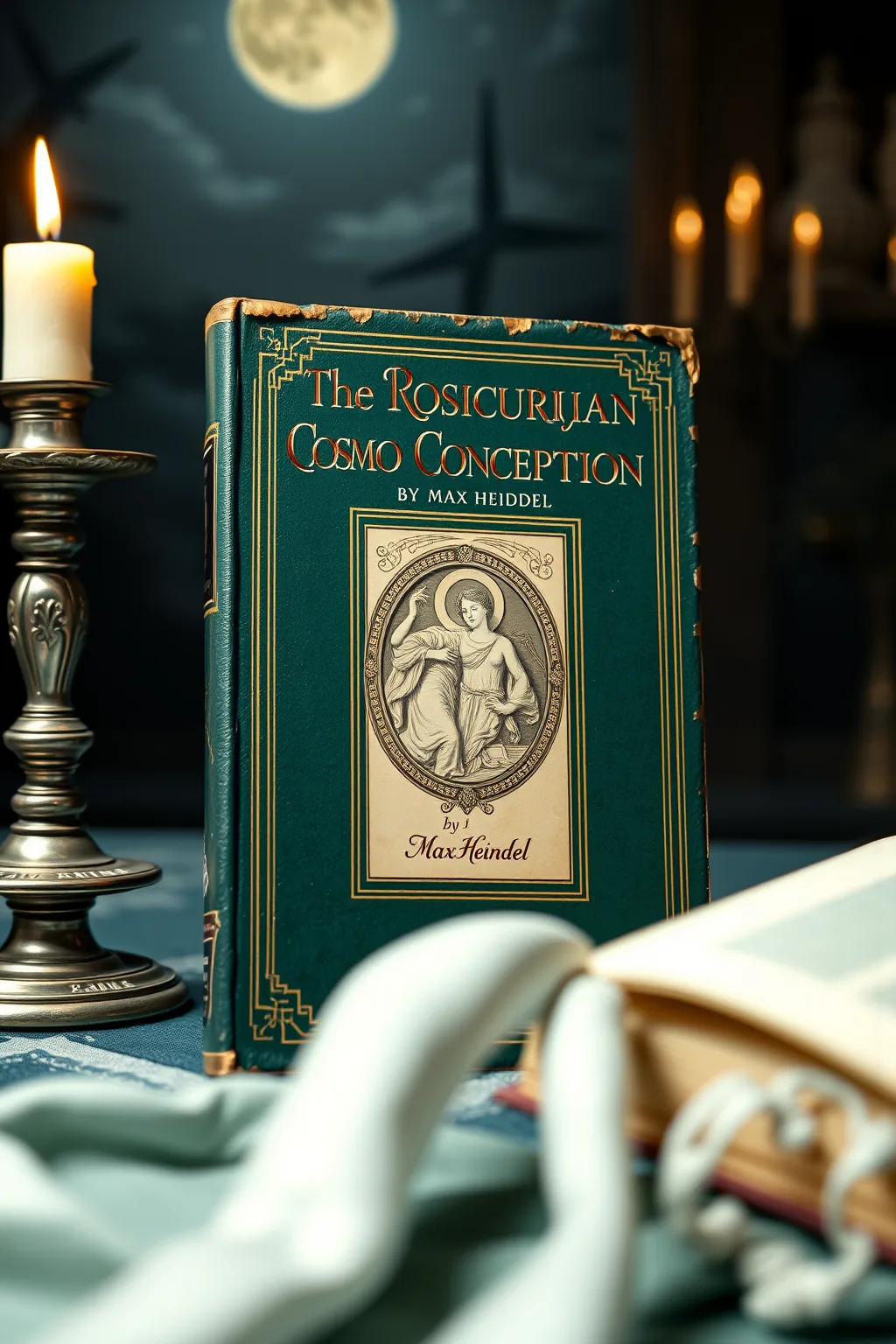
The Rosicrucian Cosmo Conception
 72
72

The Rosicrucian Cosmo Conception


Silas Hawthorne (Hermetic Studies Editor) — Max Heindel's 'The Rosicrucian Cosmo-Conception' remains an indispensable text for anyone aspiring to grasp the deeper currents of spiritual science. Its comprehensive yet accessible exposition of cosmic evolution and the human constitution offers unparalleled clarity. Heindel masterfully synthesizes ancient wisdom with a Christian esoteric perspective, providing a robust framework for understanding life's mysteries. The book's strength lies in its practical application, guiding the reader toward conscious spiritual development. Essential reading for serious students of occult philosophy and those seeking a profound understanding of their own spiritual journey.
📝 Description
72
Max Heindel published 'The Rosicrucian Cosmo-Conception' in 1909, detailing a Rosicrucian and Christian-mystical view of human evolution.
This 1909 work by Max Heindel lays out a detailed system of spiritual evolution from a Rosicrucian and Christian-mystical perspective. It covers the structure of the universe and the human being, including concepts like subtle bodies, the etheric realm, and the processes of death and rebirth. Heindel presents this information as a guide for spiritual development, describing involution and spiritual ascent. The book aims to show how divine forces shape existence and imbue reality with spiritual meaning. It seeks to foster an understanding of the unity of all things and the divine spark within each person.
Heindel's approach connects Rosicrucian teachings with Christian esotericism, aiming to explain the hidden workings of life, death, and reincarnation. The text addresses the evolution of consciousness and the various stages of spiritual growth. It is written for individuals seeking a structured understanding of these spiritual principles and their application in daily life. The author's intention is to provide a coherent cosmology that makes sense of the spiritual path.
Max Heindel's 'The Rosicrucian Cosmo-Conception' is a key text within early 20th-century Western esotericism, particularly in the Theosophical and Rosicrucian movements. It draws upon ideas found in Theosophy, such as reincarnation and the concept of various planes of existence, while grounding them in a specifically Rosicrucian framework that emphasizes a Christian-mystical interpretation. Heindel's work attempts to synthesize these traditions into a comprehensible system for spiritual seekers, offering a detailed cosmology that explains the workings of the visible and invisible worlds.
✍️ Author
Max Heindel
The Rosicrucian Cosmo-Conception or Mystic Christianity (also known as Western Wisdom Teachings) is a Rosicrucian text by Max Heindel, first published in 1909.
💡 Why Read This Book?
Embark on a profound journey of self-discovery and cosmic understanding. 'The Rosicrucian Cosmo-Conception' offers a unique, integrated worldview for spiritual seekers, metaphysical scholars, and devoted practitioners. It provides a clear, systematic framework for understanding life, death, and reincarnation, demystifying the esoteric path and illuminating the way towards conscious evolution and spiritual enlightenment.
⭐ Reader Reviews
Honest opinions from readers who have explored this book.
❓ Frequently Asked Questions
What is the main purpose of The Rosicrucian Cosmo-Conception?
The book's primary aim is to present a comprehensive esoteric cosmology and outline of human evolution, offering practical guidance for spiritual development from a Rosicrucian perspective.
Who was Max Heindel?
Max Heindel (1865-1919) was a Danish-American mystic and author, founder of the Rosicrucian Fellowship. He dedicated his life to disseminating esoteric spiritual teachings.
Is this book suitable for beginners?
Yes, while dense with information, Heindel's clear, systematic approach makes it accessible to sincere beginners seeking a foundational understanding of esoteric principles.
What is the role of Christian mysticism in the book?
The book integrates ancient esoteric wisdom with a Rosicrucian interpretation of Christian teachings, viewing Christ's life and teachings as central to spiritual evolution.
Where can I find more information on Rosicrucianism?
The Rosicrucian Fellowship, founded by Max Heindel, offers extensive resources and study groups dedicated to exploring the teachings presented in this book and related esoteric subjects.
🔮 Key Themes & Symbolism
Cosmic Evolution and Rebirth
The book meticulously details the grand cosmic plan, from the genesis of the universe to the intricate stages of human involution and evolution. It presents a cyclical view of existence, emphasizing the soul's journey through successive rebirths, each offering opportunities for growth and refinement. This theme explores the concept of 'days of manifestation' and the 'seven planets' as crucial phases in this grand evolutionary process, providing a profound understanding of our place within the universal scheme.
The Constitution of the Human Being
Heindel offers a detailed esoteric anatomy, describing the physical body, the vital body (etheric body), the desire body (astral body), and the mind (ego). Understanding these subtle vehicles is presented as essential for comprehending consciousness, emotions, and thought processes. This section illuminates the interconnectedness of the physical and spiritual realms, revealing how our inner worlds are shaped by these unseen forces and how we can consciously work with them for spiritual advancement.
Spiritual Development and the Christ Ideal
Central to the Cosmo-Conception is the path of conscious evolution, guided by the Christ ideal. The book outlines practical methods for spiritual purification, the development of higher faculties, and the eventual attainment of spiritual liberation. It emphasizes the importance of selfless service, wisdom, and the transmutation of desires as key steps towards realizing one's divine potential and contributing to the well-being of humanity and the cosmos.
💬 Memorable Quotes
Direct passages from the work, attributed to the author.
“When we understand the laws of God, we can make ourselves masters of conditions.”
— This emphasizes the power of knowledge and spiritual understanding to gain control over one's life and circumstances, moving from victimhood to mastery.
“The human being is a miniature universe, a microcosm of the macrocosm.”
— This profound statement underscores the interconnectedness of the individual and the cosmos, suggesting that understanding oneself is key to understanding the universe.
“Rebirth is a necessity for the soul's evolution.”
— This succinctly states a core tenet of the book, framing reincarnation not as punishment but as an essential mechanism for spiritual growth and development.
“The path of spiritual development is a path of love and service.”
— This highlights the ethical and compassionate dimensions of spiritual practice, emphasizing that true progress is intertwined with altruism and compassion for all beings.
💡 Key Ideas
Editorial paraphrase of the work's core concepts — not direct quotes.
The Rosicrucian teachings are not new; they are as old as the human race.
This quote highlights the timeless and universal nature of the wisdom presented, suggesting it taps into ancient, fundamental truths about existence and consciousness.
🌙 Esoteric Significance
Tradition
The book is a foundational text of modern Rosicrucianism, specifically within the lineage established by Max Heindel. It bridges ancient Hermeticism, Gnosticism, and Christian esoteric traditions, offering a unique synthesis. Heindel's work emphasizes a practical, Christ-centered approach to spiritual evolution, making complex esoteric doctrines accessible to a wider audience seeking divine wisdom.
Symbolism
Key symbols include the Tree of Life, the seven principles of man, and the allegorical journey of the soul. The text often employs alchemical symbolism and cosmic diagrams to illustrate concepts such as involution, evolution, and the transformation of consciousness. Heindel's interpretation of biblical narratives through an esoteric lens also reveals layers of hidden meaning and symbolic significance within religious texts.
Modern Relevance
In an age often marked by fragmentation and spiritual seeking, 'The Rosicrucian Cosmo-Conception' offers a comprehensive and unifying worldview. Its emphasis on the interconnectedness of all things, the purpose of life, and practical methods for self-improvement remains profoundly relevant. The book continues to guide individuals towards a deeper understanding of their spiritual nature and their role in the cosmic evolutionary process.
👥 Who Should Read This Book
This important work is essential for spiritual seekers yearning for a profound understanding of existence, the cosmos, and their own spiritual journey. Scholars of comparative religion and esoteric traditions will find it an invaluable resource for its systematic presentation of Rosicrucian philosophy. Practitioners of meditation, occult arts, or any path of self-discovery will benefit from its detailed teachings on the human constitution and spiritual evolution. Beginners curious about metaphysical concepts will find a clear, albeit dense, entry point into the deeper mysteries of life.
📜 Historical Context
Published in 1909, 'The Rosicrucian Cosmo-Conception' emerged during a vibrant period of occult revival and spiritual exploration in the Western world. The late 19th and early 20th centuries saw a surge of interest in Freemasonry, Theosophy, Spiritualism, and various esoteric traditions, as individuals sought answers beyond the prevailing materialism. Max Heindel, influenced by these currents and his own mystical experiences, sought to synthesize and clarify complex metaphysical concepts, particularly within the framework of Rosicrucianism and a spiritualized Christianity. The book provided a coherent, systematic esoteric philosophy that resonated with a growing audience looking for deeper meaning and a structured path to spiritual enlightenment, offering a counterpoint to the scientific rationalism of the era.
📔 Journal Prompts
Reflect on the concept of the 'seven principles of man' as described by Heindel. How might understanding these subtle bodies change your perception of yourself?
Consider the stages of involution and evolution presented. Where do you see yourself currently on this cosmic journey?
How does the concept of rebirth resonate with your current understanding of life and purpose?
What practical applications can you derive from the emphasis on selfless service and the Christ ideal in your daily life?
Explore the symbolism of the Tree of Life as presented in the book. How does it relate to your personal journey of growth and connection?
🗂️ Glossary
Involution
The process by which Spirit descends into matter, becoming increasingly individualized and embodied. It represents the outward unfolding of consciousness into the material plane.
Evolution
The process by which individualized consciousness ascends from matter back to Spirit, gaining wisdom and mastery through experience. It is the upward journey of the soul.
Vital Body
Also known as the etheric body, it is the life-giving principle that animates the physical body. It is composed of invisible ether and is the vehicle for vital forces.
Desire Body
The astral body, which is the vehicle of emotion and desire. It is sensitive to feelings and experiences, and plays an important role in the soul's journey.
Ego
The individualized consciousness or soul, the divine spark within each human being that persists through successive lives and reincarnations.
This book appears in 2 collections
🔮 Readers Also Liked
Browse all →





More by Max Heindel
All books →





From the “Secret Societies” Collection
View all →






More Free Freemasonry & Secret Societies Books
View all →