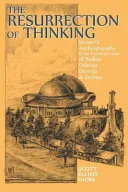
The Resurrection of Thinking
 72
72

The Resurrection of Thinking
Scott Elliot Hicks’s *The Resurrection of Thinking* tackles an ambitious project: forging a bridge between the esoteric phenomenology of Rudolf Steiner and the deconstructive philosophies of French postmodernism. The book’s strength lies in its detailed unpacking of Steiner’s methods for spiritualizing cognition, particularly the concept of deactualization, and its attempt to frame these within Derridean or Deleuzian theoretical vocabularies. This is not light reading; it demands significant prior engagement with both Steiner and thinkers like Badiou. One limitation is that the connections, while intellectually stimulating, sometimes feel more like parallel constructions than fully integrated arguments. A particularly compelling section demonstrates how Steiner’s notion of the 'Etheric Double' might be understood through the lens of what Deleuze and Guattari termed 'desiring-machines,' offering a novel perspective on the subtle bodies. While the synthesis is occasionally strained, the work provides a unique lens for those seeking to reconcile esoteric spiritual science with contemporary critical theory.
📝 Description
72
Scott Elliot Hicks's 2018 book connects Rudolf Steiner's spiritual science with postmodern philosophy.
The Resurrection of Thinking engages Rudolf Steiner's spiritual science with post-structuralist thinkers like Jacques Derrida, Alain Badiou, and Gilles Deleuze. It moves beyond mere exposition to investigate methods for deactualizing and spiritualizing core human faculties: thought, perception, sensation, language, and volition. The work aims to bridge the perceived gap between scientific materialism and spiritual inquiry. It offers practical applications of spiritual scientific principles to current intellectual challenges.
Published in 2018, the book emerged during a time of academic interest in Steiner's interdisciplinary potential and ongoing engagement with French postmodern thought. It specifically addresses the conceptual frameworks established by thinkers such as Derrida, whose deconstruction offered a lens for examining language, and Badiou, known for his theories on the event and the subject. The book's central ideas focus on 'deactualization,' a process of loosening the hold of fixed thinking and perception, and its counterpart, the 'spiritualization of thinking.' This involves cultivating original, living thought capable of engaging with spiritual realities. The text also considers the re-enchantment of perception and language's potential as a conduit for spiritual insight.
This work sits within the traditions of Theosophy and Anthroposophy, specifically engaging with the spiritual science developed by Rudolf Steiner. Steiner's approach sought to apply scientific rigor to the study of spiritual phenomena, proposing a path of inner development to access higher realities. Hicks connects this tradition to contemporary philosophical discourse, suggesting that Steiner's methods can address modern intellectual concerns and offer a path toward spiritual understanding independent of materialistic worldviews.
💡 Why Read This Book?
• You will learn how to actively 'deactualize' your thinking, moving beyond rigid conceptual frameworks. This is a core practice from Rudolf Steiner’s spiritual science, offering a method for fresh perception unavailable in standard philosophical texts. • You will explore the potential for spiritualizing language and perception, informed by the concrete philosophical methods of Jacques Derrida and Gilles Deleuze. This offers a unique approach to understanding the relationship between consciousness and the world. • You will gain insight into the conceptual relationship between Rudolf Steiner's spiritual science and French postmodernism, a connection rarely explored in depth. This provides a specific intellectual framework for reconciling esoteric insights with contemporary philosophical discourse.
⭐ Reader Reviews
Honest opinions from readers who have explored this book.
❓ Frequently Asked Questions
What is the primary intellectual challenge this book addresses?
The book confronts the perceived gap between Rudolf Steiner's spiritual science and the post-structuralist philosophies of thinkers such as Jacques Derrida and Gilles Deleuze, seeking conceptual common ground and practical synthesis.
What does Scott Elliot Hicks mean by 'deactualizing thinking'?
Deactualizing thinking involves a conscious effort to loosen the grip of fixed, habitual thought patterns and perceptions, making the mind more receptive to new, spiritual insights and original perception.
Which philosophers are discussed alongside Rudolf Steiner in this book?
The book engages directly with the ideas of Jacques Derrida, Alain Badiou, Gilles Deleuze, and Félix Guattari, examining their concepts in relation to Steiner's spiritual science.
Is this book suitable for beginners in esoteric studies?
Given its deep engagement with complex philosophical traditions and spiritual science concepts, it is best suited for readers with a solid foundational understanding of both Rudolf Steiner and at least one of the mentioned postmodern philosophers.
What is the significance of 'spiritualizing willing' mentioned in the blurb?
Spiritualizing willing refers to transforming the capacity for action and intention from being driven by egoistic or habitual impulses to being guided by conscious spiritual understanding and ethical impulses.
When was The Resurrection of Thinking first published?
The book was first published on October 19, 2018, positioning it within contemporary discussions on philosophy and esoteric thought.
🔮 Key Themes & Symbolism
Deactualization of Thought
The core practice explored is 'deactualization,' a method for disengaging from solidified, habitual modes of thinking and perception. This process, derived from Rudolf Steiner's spiritual science, aims to liberate consciousness from its ingrained assumptions and preconceptions, paving the way for genuine spiritual insight. The book investigates how this might be approached through the critical lenses offered by thinkers like Derrida, whose work interrogates the fixed structures of meaning, thereby offering a practical esoteric methodology for intellectual renewal.
Spiritualizing Perception and Language
This theme focuses on transforming our fundamental modes of experiencing the world and communicating about it. The text proposes that by deactualizing our current faculties—thinking, perception, sensation, and willing—we can begin to 'spiritualize' them. This involves developing a conscious relationship with the subtle forces and spiritual realities that underlie phenomena, moving beyond purely materialistic interpretations. The work examines how language, often seen as a barrier in postmodern thought, can potentially become a vehicle for spiritual apprehension.
Steiner Meets Postmodernism
The book's unique contribution lies in its direct confrontation and attempted synthesis between Rudolf Steiner's spiritual science and key figures of French postmodernism, including Derrida, Badiou, and Deleuze & Guattari. It seeks to demonstrate that these seemingly divergent intellectual traditions can inform each other, offering new pathways for understanding consciousness, reality, and the human condition. The work explores how postmodern critiques of metaphysics and language can paradoxically open doors for esoteric inquiry.
Original Spiritual Research
Presented as a 'living investigation,' the book embodies a form of original spiritual research. It moves beyond mere theoretical comparison to offer practical methods and directions for contemporary seekers. The emphasis is on cultivating new ways of thinking and perceiving that are not derived from external authority but from direct inner experience and disciplined spiritual work, facilitated by the conceptual tools forged in the dialogue between Steiner and postmodern thinkers.
💬 Memorable Quotes
Direct passages from the work, attributed to the author.
“The first full-length text in any language to wrestle with the conceptual relationship between the spiritual science of Rudolf Steiner and the French Postmodern thinking...”
— This statement highlights the book's pioneering status in attempting a direct synthesis between two highly distinct intellectual traditions: the esoteric spiritual science of Rudolf Steiner and the critical, deconstructive philosophies of French postmodernism.
“a living investigation of new ways of deactualizing and taking the first steps in spiritualizing thinking, perception, sensation, language, and willing.”
— This emphasizes the book's practical orientation, suggesting it offers not just theory but actionable methods for transforming core human faculties, moving them from conventional, 'actualized' states towards a more spiritually alive and conscious engagement with reality.
“a direction demonstration of original spiritual research”
— This positions the book as an example of how contemporary spiritual inquiry can be conducted, suggesting it offers a model or pathway for readers to undertake their own independent investigations into spiritual realities.
“It is a direction demonstration of original spiritual research and”
— This fragment suggests the work aims to guide readers toward a mode of inquiry that is both innovative and grounded in spiritual experience, rather than relying solely on established doctrines or interpretations.
“The Resurrection of Thinking: a direction demonstration of original spiritual research”
— This phrase implies that the book serves as a practical guide or example for conducting new forms of spiritual investigation, moving beyond theoretical discussions to demonstrate a method.
🌙 Esoteric Significance
Tradition
The work primarily engages with the esoteric lineage of Rudolf Steiner's spiritual science (Anthroposophy), viewing it as a modern form of spiritual science focused on the evolution of consciousness. It departs from purely Theosophical or older Hermetic traditions by grounding its methods in a detailed phenomenology of thinking and perception, and by directly confronting contemporary philosophical challenges, particularly those posed by French postmodernism.
Symbolism
While not heavily reliant on traditional esoteric symbols, the book implicitly uses concepts like 'thinking' and 'perception' as symbolic gateways. 'Thinking' itself, when 'deactualized' and 'spiritualized,' becomes a symbol for a transformed consciousness capable of apprehending spiritual realities. 'Language' acts as another motif, representing the boundary between the material and the spiritual, with the potential to become a bridge through conscious transformation.
Modern Relevance
This work is relevant to contemporary thinkers and practitioners interested in integrating spiritual development with critical intellectual engagement. It speaks to those grappling with the perceived limitations of materialistic science and the challenges posed by postmodern skepticism. Its approach to spiritualizing cognition finds echoes in contemporary mindfulness practices and consciousness studies, though grounded in a specific esoteric tradition and philosophical dialogue.
👥 Who Should Read This Book
• Advanced students of Rudolf Steiner's spiritual science seeking to understand its relationship with contemporary philosophy, particularly post-structuralism. • Scholars of comparative religion and philosophy interested in interdisciplinary approaches that bridge esoteric traditions with secular critical thought. • Individuals engaged in personal development who wish to explore practical methods for transforming their thinking and perception beyond conventional psychological or philosophical frameworks.
📜 Historical Context
Published in 2018, *The Resurrection of Thinking* entered a cultural moment where interest in Rudolf Steiner's anthroposophy persisted, while French postmodern thought, though past its peak influence, continued to shape critical discourse. The book's significance lies in its bold attempt to bridge these two intellectual landscapes, a connection rarely explored. While thinkers like Derrida were deconstructing language and meaning, and Deleuze and Guattari were exploring complex systems, Steiner was proposing a path to direct spiritual perception. The work engages with the intellectual currents of the late 20th and early 21st centuries, seeking to find common ground or productive tension between spiritual science and critical theory. Unlike purely academic analyses of postmodernism or introductions to Steiner, Hicks's text aims for a practical synthesis, a direction not widely pursued by contemporaries, who often kept these fields separate or viewed them as fundamentally incompatible.
📔 Journal Prompts
The process of deactualizing thinking: How does the habit of fixed thought manifest in your daily life?
Spiritualizing perception: Identify one everyday object and attempt to perceive it without preconceptions.
The role of language: Reflect on a time when language both obscured and revealed a deeper truth.
Original spiritual research: What does it mean to you to conduct 'original' inquiry into spiritual matters?
Connecting Steiner and Derrida: Consider how deconstruction might illuminate concepts in spiritual science.
🗂️ Glossary
Deactualization
A core concept referring to the process of loosening the grip of fixed, habitual, and 'actualized' (fully formed and solidified) ways of thinking, perceiving, and willing. It aims to create a state of mental openness for spiritual insight.
Spiritualization of Thinking
The transformation of thinking from a purely cognitive or materialistic process into one that is alive, creative, and capable of engaging with spiritual realities and truths directly.
Spiritual Science (Anthroposophy)
A body of knowledge and practice founded by Rudolf Steiner, aiming to investigate the spiritual worlds through methods of clairvoyance and spiritual perception, applied to understanding humanity and the cosmos.
Postmodernism
A broad philosophical and cultural movement characterized by skepticism towards grand narratives, objective truth, and universal reason, often focusing on deconstruction, subjectivity, and the critique of power structures.
Etheric Double
In Steiner's cosmology, a subtle, life-giving force-body that surrounds and organizes the physical body, distinct from the physical form itself. It is associated with life processes and formative forces.
Deconstruction
A method of critical analysis, primarily associated with Jacques Derrida, that questions the stability of meaning and binary oppositions within texts and philosophical systems, revealing underlying assumptions and hierarchies.
Volition
The faculty or power of using one's will; the act of making a conscious choice or decision. The book explores its spiritualization.