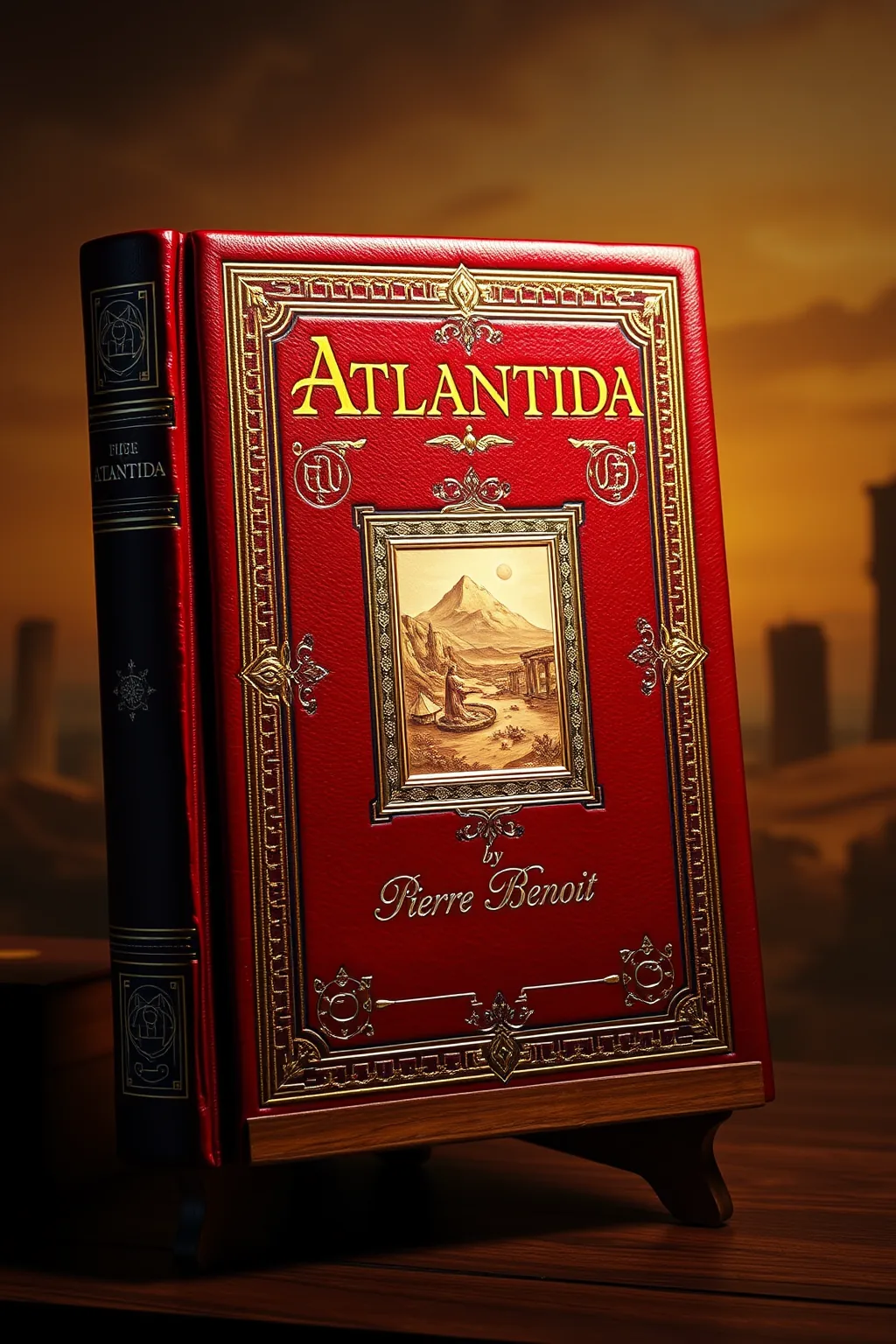
Atlantida
 77
77

Atlantida


Alaric Kestrel, Metaphysical Studies Reviewer — Pierre Benoit's 'Atlantida' stands as a monumental work within the lost civilization genre, offering a compelling blend of high adventure and esoteric undertones. Its Sahara setting is not merely a backdrop but a palpable character, imbued with ancient energies and the stark beauty of primal forces. The narrative's exploration of a hidden, advanced society and its last queen resonates with archetypal themes of immortality, wisdom, and the cyclical nature of existence. While tinged with a romantic pulp sensibility, the novel's enduring appeal lies in its potent evocation of myth and its sophisticated, albeit fictional, exploration of Atlantean lore. It’s a must-read for enthusiasts of esoteric fiction and those fascinated by the enduring power of legend.
📝 Description
77
Pierre Benoit's 1919 novel 'Atlantida' imagines a lost civilization in the Sahara.
Published in 1919, Pierre Benoit's 'Atlantida' transports readers to the Sahara desert, the setting for a story of survival and passionate love. The narrative uncovers ancient secrets hidden beneath the sands, focusing on a desert queen whose charm defies time and death. It also follows the persistent search for a civilization lost to myth. The novel is not simply an adventure; it examines human endurance against extreme challenges, the strong influence of myth, and the faint traces of old knowledge found in empty places. For those interested in hidden pasts, epic stories, and the study of esoteric traditions, this book creates a rich atmosphere and offers deep reflections on legend and humanity's lasting desire for the grand, the old, and the unknown.
Benoit's 'Atlantida' taps into the popular fascination with lost continents and ancient mysteries prevalent in early 20th-century esoteric thought. It plays with the idea of hidden wisdom and civilizations that predate recorded history, often found in remote or challenging environments like the Sahara. The novel reflects a broader interest in Atlantis and similar legendary places, suggesting that fragments of forgotten knowledge and advanced societies might still exist, influencing the modern world in unseen ways. This aligns with esoteric traditions that look beyond conventional history for deeper truths.
💡 Why Read This Book?
Discover the allure of a lost Atlantean civilization hidden within the Sahara's embrace. 'Atlantida' offers a captivating blend of desert survival, timeless romance, and profound esoteric mystery. Ideal for seekers of ancient wisdom, lovers of epic adventure, and scholars fascinated by the myth of Atlantis and its enduring cultural impact. This novel promises an unforgettable journey into the heart of legend.
⭐ Reader Reviews
Honest opinions from readers who have explored this book.
❓ Frequently Asked Questions
Is 'Atlantida' a factual account of Atlantis?
No, 'Atlantida' is a fictional novel by Pierre Benoit. It explores the *idea* of Atlantis through a compelling narrative set in the Sahara, drawing inspiration from mythological and speculative themes rather than historical documentation.
What is the primary setting of 'Atlantida'?
The novel is primarily set in the vast and evocative Sahara Desert, a starkly beautiful and mysterious landscape that becomes integral to the unfolding narrative of lost civilization and survival.
What makes 'Atlantida' an esoteric work?
Its esoteric nature stems from its exploration of a hidden, advanced civilization, ancient wisdom, and the symbolic journey of discovery, resonating with themes of lost knowledge and spiritual quests.
Why was Pierre Benoit sued over 'Atlantida'?
Pierre Benoit was sued by another author, likely H. Rider Haggard, as the plot of 'Atlantida' bore significant similarities to existing stories about lost civilizations and powerful queens, suggesting potential literary appropriation.
How influential has 'Atlantida' been?
'Atlantida' has been remarkably influential, inspiring over a dozen film adaptations and solidifying its place as a foundational text within the 'lost civilization adventure' subgenre.
🔮 Key Themes & Symbolism
The Traces of Atlantis
This theme examines the enduring myth of Atlantis, not as a literal historical event but as a potent symbol of lost wisdom, advanced civilization, and a precursor to modern humanity. Benoit's novel imagines Atlantis not as a sunken island, but as a hidden realm persisting in the desolate heart of the Sahara. It explores the concept of a lineage of knowledge and culture preserved against the ravages of time and natural catastrophe, resonating with Gnostic ideas of a spiritual past and the cyclical nature of creation and destruction. The narrative serves as a conduit for contemplating what humanity might have achieved, or what profound truths might have been held, by such an ancient, enlightened society.
Desert as a Threshold
The Sahara Desert in 'Atlantida' transcends its geographical reality to become a potent symbol and a spiritual threshold. It represents a place of ultimate trial and purification, where the mundane world fades and the extraordinary can manifest. The harshness of the desert mirrors the internal struggles of the characters, forcing introspection and stripping away superficialities. It is a landscape that guards ancient secrets, a vast, silent repository of forgotten histories and cosmic truths. The desert acts as a liminal space, a gateway between the known and the unknown, where the veil between ordinary perception and mystical reality is thinnest, inviting profound encounters with the self and the universe.
The Siren Call of the Eternal Queen
Central to 'Atlantida' is the figure of the last Queen of Atlantis, a being who embodies timeless allure, profound knowledge, and a connection to the ancient world. She represents the archetype of the eternal feminine, a potent force of nature and spirit whose existence challenges the passage of time and the limitations of mortality. Her presence evokes themes of immortality, the seductive power of the past, and the yearning for a lost golden age. She is a guide, a temptress, and a living embodiment of the secrets that lie hidden beyond the veil of everyday existence, drawing protagonists and readers alike into a profound and often perilous quest for connection with the eternal.
💬 Memorable Quotes
Direct passages from the work, attributed to the author.
“Where there is no hope, there is only truth.”
— This aphorism implies that in the face of absolute despair, one can find unvarnished reality, free from illusion or false comfort.
“She was the last flower of a lost garden.”
— This evocative line portrays the Queen as a singular, exquisite remnant of a vanished, magnificent civilization, emphasizing her rarity and preciousness.
“The sand remembers everything.”
— This poetic statement imbues the desert with a profound, enduring memory, suggesting that ancient events and hidden knowledge are preserved within its depths.
“Love is the only true conquest.”
— This sentiment elevates love to the ultimate achievement, surpassing all material or temporal victories, suggesting its profound and lasting power.
💡 Key Ideas
Editorial paraphrase of the work's core concepts — not direct quotes.
The desert is a book written by God.
This quote suggests the Sahara is a sacred text, holding divine wisdom and profound truths for those who can read its silent language.
🌙 Esoteric Significance
Tradition
The esoteric significance of 'Atlantida' draws heavily from the collection of Western esoteric traditions, particularly the myth of Atlantis, which has been a core part of speculative and occult thought since Ignatius Donnelly's influential work. It echoes themes found in Theosophy, which posited ancient, highly evolved civilizations, and Gnosticism, with its emphasis on lost knowledge and hidden spiritual truths. The novel's exploration of a hidden realm and its powerful, ancient Queen speaks to archetypal symbols of the divine feminine and the eternal wisdom that lies beyond ordinary human experience.
Symbolism
The novel is steeped in potent symbolism. The Sahara Desert itself acts as a symbol of the subconscious, the vast unknown, and a place of profound spiritual testing and revelation. The Queen of Atlantis embodies the archetype of the eternal feminine, representing ancient wisdom, timeless beauty, and a connection to primordial forces. The ruins and artifacts of the Atlantean civilization symbolize lost knowledge, forgotten power, and the cyclical nature of history. The journey into the desert can be interpreted as an alchemical quest for transformation and enlightenment, seeking a hidden treasure—both material and spiritual—that lies at the core of existence.
Modern Relevance
In an age often characterized by information overload and a perceived loss of deeper meaning, 'Atlantida' offers a compelling reminder of the enduring power of myth and the human yearning for the extraordinary. Its themes of hidden wisdom, resilient civilizations, and the quest for something beyond the mundane resonate with contemporary seekers of spiritual insight and alternative narratives. The novel's evocative portrayal of a forgotten past and its inherent mysteries continues to inspire explorations into esoteric philosophies, ancient history, and the potential for undiscovered realms, encouraging readers to look beyond the obvious and embrace the profound possibilities of the unknown.
👥 Who Should Read This Book
This captivating novel is a treasure for a diverse range of readers. **Seekers of esoteric knowledge** will find themselves drawn to the novel's exploration of lost civilizations and ancient wisdom, resonating with its mystical undertones. **Scholars of comparative mythology and occult history** will appreciate its contribution to the ongoing discourse surrounding Atlantis and its archetypal themes. **Lovers of classic adventure and romantic fiction** will be swept away by the exotic setting, the thrilling plot, and the compelling, if somewhat melodramatic, romance. **Practitioners of spiritual disciplines** might find inspiration in the desert's symbolic journey of purification and the quest for hidden truths. Ultimately, anyone with a penchant for grand narratives and the enduring allure of the unknown will find 'Atlantida' a profoundly rewarding read.
📜 Historical Context
Published in 1919, Pierre Benoit's 'Atlantida' emerged in the post-World War I era, a period marked by a widespread fascination with the occult, lost civilizations, and ancient mysteries. The trauma of the war led many to seek solace and meaning in escapist narratives and a romanticized past. Benoit's novel tapped into this zeitgeist, offering a thrilling adventure that blended the exotic allure of the Sahara with the enduring myth of Atlantis. Its success, despite a later lawsuit for plagiarism from H. Rider Haggard's 'She', underscored the public's appetite for tales of hidden worlds and powerful, enigmatic female figures. 'Atlantida' contributed significantly to solidifying the 'lost civilization adventure' as a popular literary and cinematic subgenre, influencing countless subsequent works.
📔 Journal Prompts
Reflect on the concept of a 'lost civilization' – what does it represent to you, and why do you think humanity is so fascinated by it?
Consider the Sahara Desert as a symbol. What emotions, ideas, or spiritual concepts does this landscape evoke in your imagination?
The Queen of Atlantis is a figure of immense power and allure. How does she embody the 'eternal feminine,' and what does her existence suggest about the nature of time and immortality?
Analyze the theme of survival in 'Atlantida.' How does the extreme environment of the desert test the characters, and what does this reveal about human resilience and inner strength?
Imagine you discover a lost artifact from an ancient, advanced civilization. What would it be, and what profound knowledge or technology might it contain?
🗂️ Glossary
Atlantis
A legendary island civilization, often depicted as highly advanced and ultimately lost to the sea or other cataclysmic events. Its myth has inspired countless speculative works on ancient history, technology, and esoteric philosophy.
Esoteric
Intended for or likely to be understood by only a small number of people with a specialized knowledge or interest. Esoteric literature often deals with hidden meanings, mystical experiences, and spiritual truths.
Archetype
A very typical example of a certain person or thing; a recurring symbol or motif in literature, art, and mythology that represents universal patterns of human nature and experience.
Liminal Space
A transitional or in-between state or place, often characterized by ambiguity and the potential for profound transformation or revelation. In 'Atlantida,' the desert serves as a powerful liminal space.
Gnosticism
A complex set of religious and philosophical ideas and systems that originated in the early Christian era. Gnostics believed in a supreme, transcendent God who created the spiritual realm, and that the material world was created by a lesser deity, leading to a duality of spirit and matter.
This book appears in 3 collections
🔮 Readers Also Liked
Browse all →









From the “Transcendental Meditation” Collection
View all →







More Free Esoteric History & Biography Books
View all →