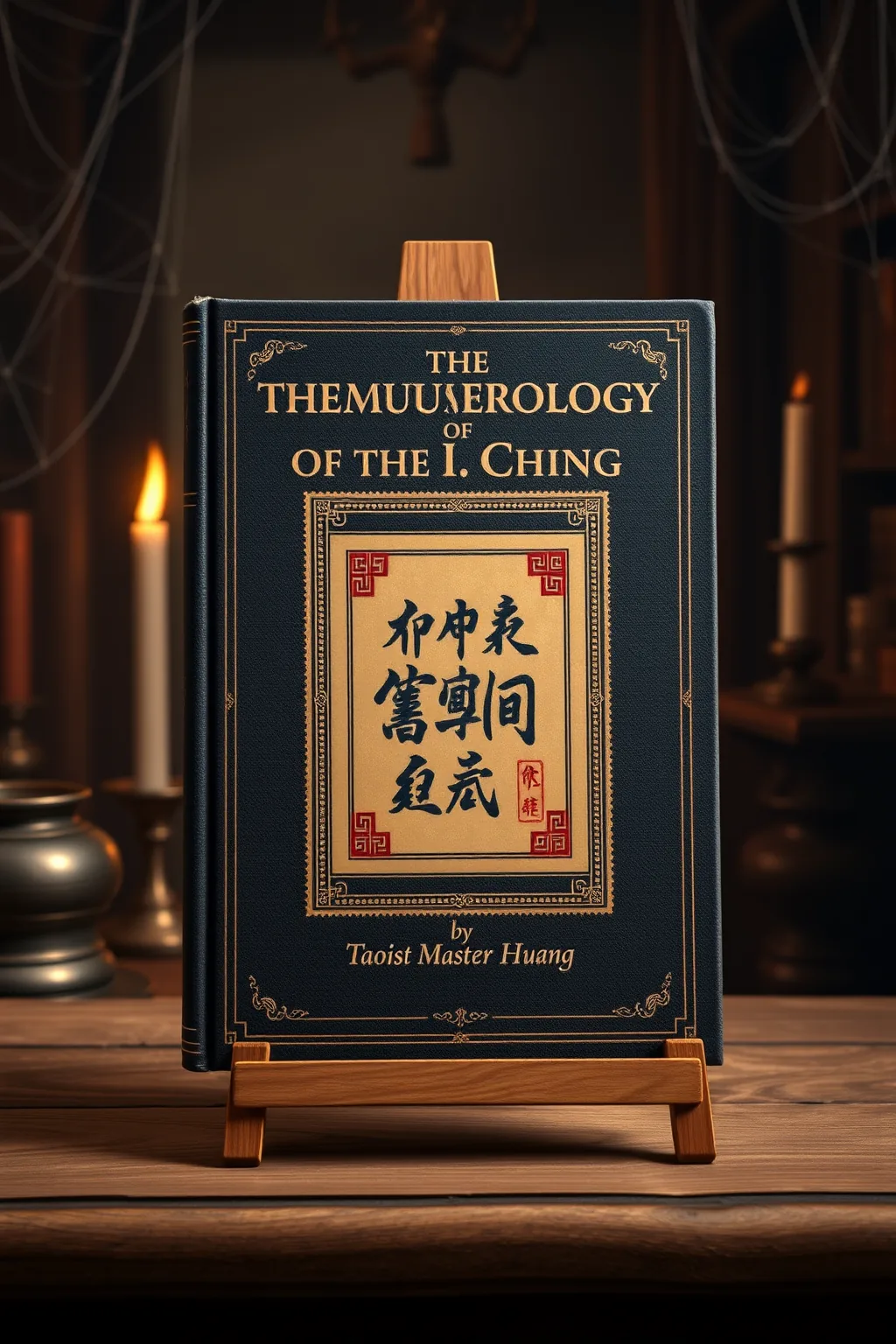
The Numerology of the I Ching
 73
73

The Numerology of the I Ching
Alfred Huang’s "The Numerology of the I Ching" offers a meticulously structured exploration of the venerable text, focusing on its Taoist framework. The strength of this work lies in its systematic presentation of concepts like "mutual hexagrams" and its provision of new diagrams for visualizing the hexagrammatic relationships, a significant aid for those accustomed to more text-heavy analyses. Huang’s authority as a Taoist Master lends weight to his interpretations. However, the sheer density of the numerological and structural information, while its primary virtue, might present a steep learning curve for newcomers to the I Ching. The exploration of "hosts of the hexagrams," for instance, while illuminating, requires dedicated study. Ultimately, Huang provides a valuable, specialized lens on the I Ching, essential for advanced students seeking its Taoist numerological architecture.
📝 Description
73
Alfred Huang's 2000 book examines the Taoist numerology behind the I Ching's 64 hexagrams.
Alfred Huang's work, published in 2000, offers a detailed look at the Taoist perspective on the I Ching's structure and symbolism. It moves past common interpretations to explain Taoist ideas about the form and arrangement of the 64 hexagrams. The book uses new diagrams and patterns to help readers visualize the hexagrammatic system.
This text is for dedicated students of the I Ching and Taoist philosophy who want a systematic grasp of its core principles. It will interest practitioners and academics focused on the mathematical and structural elements of the Book of Changes, especially those familiar with basic texts and seeking advanced Taoist explanations. It is also suitable for people interested in comparative cosmology and the symbolic systems of ancient Chinese thought.
Alfred Huang's study arrived in 2000, a time when interest in Eastern philosophies like the I Ching had grown significantly in the West. While many had studied the I Ching through translations or academic work, Huang's contribution focused specifically on the Taoist tradition's internal logic and numerical foundations. This provided a different view from abstract philosophical readings, anchoring the text in a specific lineage and its systematic teachings. It aimed to fill a need for a structured, esoteric interpretation tied to practice.
💡 Why Read This Book?
• Gain a structured understanding of the I Ching's internal logic through Taoist numerology, as presented in Huang's systematic breakdown of hexagram relationships, including "mutual hexagrams." • Visualize the complex interconnections of the 64 hexagrams using the numerous new patterns and diagrams specifically developed for this text. • Access advanced Taoist teachings on the "hosts of the hexagrams" and "core hexagrams," concepts not widely detailed in other I Ching literature, offering a unique esoteric perspective.
⭐ Reader Reviews
Honest opinions from readers who have explored this book.
❓ Frequently Asked Questions
What is the primary focus of "The Numerology of the I Ching"?
The book's primary focus is on the complete Taoist teachings regarding the form, structure, and symbolism of the I Ching, particularly its numerological and mathematical underpinnings.
Who is the author, Alfred Huang?
Alfred Huang is a recognized Taoist Master and the author of "The Complete I Ching," bringing significant authority and traditional knowledge to his interpretations.
When was "The Numerology of the I Ching" first published?
The book was first published on July 1, 2000.
What kind of new content does the book offer regarding the hexagrams?
It provides many new patterns and diagrams for visualizing the layout of the 64 hexagrams, along with advanced teachings on concepts like the hosts, mutual, and core hexagrams.
Is this book suitable for beginners in I Ching study?
While comprehensive, the book's advanced Taoist teachings and structural focus might be more suited for those with some existing familiarity with the I Ching or related philosophies.
What distinguishes this book from other I Ching texts?
It uniquely presents the complete Taoist teachings on the I Ching's form, structure, and symbol, emphasizing numerology and offering novel visual aids and advanced concepts.
🔮 Key Themes & Symbolism
Hexagrammatic Structure
This theme centers on the systematic organization of the 64 hexagrams according to Taoist principles. Huang elucidates how the trigrams combine and interact, forming the basis for the complete set. The work introduces concepts like "mutual hexagrams," which likely refers to pairs with reversed trigrammatic relationships, and "core hexagrams," suggesting fundamental archetypes within the system. The exploration aims to reveal an underlying mathematical and symbolic architecture that governs the entire I Ching cosmology.
Taoist Numerology
Central to the book is the application of Taoist numerological concepts to the I Ching. This goes beyond simple counting, exploring the symbolic weight and energetic significance of numbers as they relate to the trigrams and hexagrams. Huang's approach suggests that specific numerical relationships dictate the patterns and interactions within the I Ching, offering a framework for understanding its profound wisdom through a lens of cosmic calculation and inherent order.
Symbolic Visualization
Huang emphasizes the importance of visualizing the I Ching's structure. The book provides numerous new patterns and diagrams to aid readers in comprehending the spatial and relational aspects of the 64 hexagrams. This visual pedagogy is crucial for grasping concepts such as the "hosts of the hexagrams," which likely pertains to the energetic influence or symbolic lineage represented by trigrammatic components within a hexagram.
Advanced Esoteric Teachings
This work explores teachings typically reserved for advanced practitioners within the Taoist tradition. Concepts like the "hosts of the hexagrams," "mutual hexagrams," and "core hexagrams" represent a deeper layer of interpretation, moving beyond basic divination or philosophical commentary. Huang's exposition aims to unlock a more profound, systematic understanding of the I Ching as a complete system of cosmic principles.
💬 Memorable Quotes
Direct passages from the work, attributed to the author.
“Provides many new patterns and diagrams for visualizing the layout of the 64 hexagrams.”
— This highlights the book's practical, visual approach, offering tools to grasp the complex spatial relationships within the I Ching's structure in a way few other texts provide.
“Includes advanced teachings on the hosts of the hexagrams, the mutual hexagrams, and the core hexagrams.”
— This points to the book's specialized content, focusing on specific, intricate Taoist concepts that offer a deeper, more systematic understanding of the I Ching's internal logic.
“The first book to cover the complete Taoist teachings on form, structure, and symbol in the I Ching.”
— This emphasizes the work's unique contribution, presenting a comprehensive view of the I Ching from a specific, traditional Taoist perspective that integrates its symbolic, structural, and numerical dimensions.
“Written by Taoist Master Alfred Huang, author of The Complete I Ching.”
— This establishes the author's credentials and lineage, assuring readers of the authenticity and depth of the esoteric knowledge presented within the text.
“The Numerology of the I Ching is the first book to bring the complete Taoist teachings on form, structure, and symbol in the I Ch”
— This reiterates the book's pioneering status in consolidating and presenting the full spectrum of Taoist doctrine concerning the I Ching's foundational elements and symbolic representation.
🌙 Esoteric Significance
Tradition
This work is firmly rooted in the Taoist tradition, specifically focusing on the esoteric interpretations of the I Ching as a cosmological and philosophical system. It departs from more generalized Western adaptations by adhering to the specific numerological, structural, and symbolic conventions passed down within Taoist lineages. Huang's approach emphasizes the I Ching not merely as a text for divination but as a map of cosmic principles and energetic transformations, aligning with deeper Taoist practices of understanding the natural order.
Symbolism
Key symbols explored include the trigrams (Heaven, Earth, Water, Fire, etc.) and their combination into the 64 hexagrams. The numerology itself acts as a symbolic language, where numbers represent specific energetic qualities and relationships. The "hosts of the hexagrams" likely refers to the symbolic lineage or energetic source attributed to the constituent trigrams, while "mutual hexagrams" symbolize mirroring or complementary cosmic forces within the system.
Modern Relevance
Contemporary practitioners of Taoism, Daoism, and advanced I Ching students continue to draw on Huang's systematic approach. His work provides a crucial bridge for those seeking to understand the I Ching beyond its common divinatory uses, offering insights relevant to modern studies in comparative cosmology, symbolic systems, and esoteric mathematics. Thinkers interested in the structural integrity of ancient wisdom texts find value in his detailed analysis.
👥 Who Should Read This Book
• Advanced students of the I Ching: Those seeking to move beyond basic interpretations and understand the text's internal Taoist structure and numerological underpinnings. • Practitioners of Taoist arts: Individuals engaged in Qigong, Tai Chi, or internal alchemy who wish to deepen their understanding of the cosmic principles reflected in the I Ching. • Scholars of comparative religion and esoteric traditions: Researchers interested in the systematic, structural, and numerological dimensions of Eastern philosophical systems.
📜 Historical Context
Published in 2000, "The Numerology of the I Ching" by Taoist Master Alfred Huang arrived at a time when Western scholarship and esoteric circles had long engaged with the I Ching, notably through Richard Wilhelm's influential German translation (1924) and its subsequent English versions. Huang's work distinguished itself by focusing exclusively on the Taoist tradition's internal systematic approach to the text's structure and numerology. This offered a counter-narrative to more philosophical or divinatory interpretations prevalent in the West, providing a grounded, lineage-based understanding. Unlike contemporary comparative religion scholars who might synthesize various interpretations, Huang meticulously unpacks the specific Taoist framework, addressing concepts like "hosts of the hexagrams" and "mutual hexagrams" with an insider's perspective. Its reception likely appealed to dedicated practitioners and scholars seeking the esoteric architecture of the I Ching, complementing rather than competing with existing translations.
📔 Journal Prompts
The structure of the 64 hexagrams: how do the "mutual hexagrams" inform your understanding of duality?
Reflect on the concept of "hosts of the hexagrams"; what might this imply about energetic lineage?
Consider the "core hexagrams"; what fundamental principles do they represent in Taoist thought?
How can the diagrams presented for visualizing hexagram layouts enhance your personal practice or study?
Analyze the relationship between numerology and symbolic meaning in the context of the I Ching as presented by Huang.
🗂️ Glossary
I Ching
An ancient Chinese divination text and foundational philosophical classic, also known as the Book of Changes, comprising 64 hexagrams formed by combinations of trigrams.
Hexagram
A figure composed of six stacked horizontal lines, each line being either solid (yang) or broken (yin). There are 64 unique hexagrams in the I Ching.
Trigram
A figure composed of three stacked horizontal lines, either solid (yang) or broken (yin). There are eight basic trigrams, forming the building blocks of the hexagrams.
Taoism/Daoism
A philosophical and religious tradition emphasizing living in harmony with the Tao (or Dao), the fundamental principle of the universe.
Hosts of the Hexagrams
An advanced Taoist concept likely referring to the primary trigrammatic components or energetic influences that 'host' or define a hexagram's essential nature.
Mutual Hexagrams
A term describing specific relationships between hexagrams, often implying pairs that are structurally related through inversion or transformation, revealing complementary aspects.
Core Hexagrams
Refers to fundamental or archetypal hexagrams within the I Ching system, possibly representing foundational patterns or primary states of being according to Taoist interpretation.