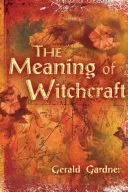
The Meaning of Witchcraft
 77
77

The Meaning of Witchcraft
Gerald Gardner's "The Meaning of Witchcraft" remains a crucial, if sometimes contentious, text. Its primary strength lies in its historical positioning; as one of the first published accounts from a self-proclaimed practicing witch after the repeal of anti-witchcraft laws, it offered a radically different perspective than the demonological tracts that preceded it. Gardner’s attempt to reconstruct an ancient pagan tradition, detailing elements like the "Witch's Memories and Beliefs," provides invaluable insight into the nascent forms of modern Wicca. However, the work is not without its limitations. Gardner's historical claims, particularly regarding Stone Age origins and direct lineage from ancient paganism, have been subject to considerable scholarly debate and are often viewed more as foundational mythology than strict historical fact. A particularly illustrative passage discusses "Magic Thinking," which, while revealing Gardner's view on altered states of consciousness, can also be seen as blending psychological observation with esoteric assertion. Ultimately, "The Meaning of Witchcraft" is essential for understanding the origins of modern witchcraft, even as its historical accuracy requires critical engagement.
📝 Description
77
Gerald Gardner published "The Meaning of Witchcraft" in 1959, arguing witchcraft was an ancient nature religion.
Gerald Gardner's 1959 book, "The Meaning of Witchcraft," presents his understanding of witchcraft as a nature-based religion rather than malevolent sorcery. Gardner, a key figure in modern witchcraft, details its practices, beliefs, and origins within his own tradition. The book serves as a primary account of the structure and philosophy of Gardnerian witchcraft.
This work is intended for serious students of witchcraft and comparative religion. It will interest practitioners looking to understand the historical and theological context of their craft. Researchers in occult studies, folklore, and anthropology will find it a valuable primary document. The book also speaks to those interested in the post-World War II revival of pagan traditions.
Published in 1959, following the repeal of the UK Witchcraft Act, Gardner's book entered a climate where occult and alternative spiritualities were beginning to resurface. It offered an insider's perspective on witchcraft, a practice previously subject to legal suppression and public misunderstanding. This work positioned witchcraft within a reconstructed paganism, drawing inspiration from, but distinct from, earlier occult movements like Theosophy and the work of figures such as Aleister Crowley.
💡 Why Read This Book?
• Gain insight into the historical context of modern witchcraft's emergence, particularly concerning the 1951 repeal of the Witchcraft Act in the UK, which shifted public discourse. • Understand Gardnerian concepts of witchcraft as an ancient fertility religion, examining his interpretations of "The Stone Age Origins of Witchcraft" and its connection to nature worship. • Explore Gardner's perspective on "Magic Thinking" and its role in ritual practice, offering a glimpse into the psychological and spiritual underpinnings of early Wicca.
⭐ Reader Reviews
Honest opinions from readers who have explored this book.
❓ Frequently Asked Questions
When was Gerald Gardner's "The Meaning of Witchcraft" first published?
Gerald Gardner's "The Meaning of Witchcraft" was first published in 1959, a significant period following the repeal of the Witchcraft Act in the United Kingdom.
What is Gerald Gardner's significance in the history of witchcraft?
Gerald Gardner is widely regarded as the father of modern witchcraft, or Wicca. His book "The Meaning of Witchcraft" was instrumental in presenting a sympathetic and organized view of the practice.
Does "The Meaning of Witchcraft" describe actual ancient witchcraft practices?
The book presents Gardner's interpretation of witchcraft as an ancient fertility religion, drawing on Stone Age and Druidic themes. While influential, many of his historical claims are debated by modern scholars.
What topics are covered in "The Meaning of Witchcraft"?
The book covers topics such as "Witch's Memories and Beliefs," "The Stone Age Origins of Witchcraft," Druidism, "Magic Thinking," and common misconceptions about witches.
Is this book suitable for beginners in witchcraft?
Yes, it's a foundational text for understanding the historical roots of modern witchcraft, though it requires critical reading due to debated historical assertions.
What is the significance of the chapter "Curious Beliefs about Witches"?
This chapter addresses and refutes historical accusations and superstitions surrounding witchcraft, offering a defense and redefinition of the practice from a witch's perspective.
🔮 Key Themes & Symbolism
Ancient Pagan Roots
Gardner posits that witchcraft is a direct descendant of pre-Christian, nature-based religions. He extensively explores "The Stone Age Origins of Witchcraft," attempting to link modern practices to Paleolithic fertility cults and shamanic traditions. The work also touches upon "Druidism and the Aryan Celts," suggesting a continuity of ancient European spiritual practices. This theme frames witchcraft not as a diabolical invention, but as an enduring, albeit hidden, spiritual path tied to the earth and its cycles, a stark contrast to later demonological views.
Witchcraft as Religion
Central to "The Meaning of Witchcraft" is the assertion that witchcraft is a genuine religion, not mere superstition or malicious magic. Gardner details "Witch's Memories and Beliefs," outlining the tenets and worldview of the witches he knew or reconstructed. He contrasts these beliefs with "Curious Beliefs about Witches," highlighting the historical misrepresentations. This theme reframes witchcraft as a system of spiritual practice, worship, and community, seeking to legitimize it in the public eye during a period of significant legal and social change.
The Nature of Magic
The concept of "Magic Thinking" is explored as a core component of witchcraft. Gardner discusses how altered states of consciousness, focused intent, and symbolic actions contribute to magical efficacy. This isn't presented as supernatural intervention in the simplistic sense, but as a psychological and spiritual discipline. The book examines how belief systems and focused mental energy can influence reality, offering a framework for understanding ritual and spellcraft within a coherent philosophical system.
Ritual and Practice
Gardner elucidates various aspects of ritual practice, from the use of "Signs and Symbols" to the structure of ceremonies. He emphasizes the importance of sacred space, the invocation of deities (often referred to as the Horned God and the Triple Goddess), and the use of tools. The book implies that these elements are not arbitrary but are derived from ancient traditions and serve specific spiritual and psychological purposes, facilitating connection with the divine and the natural world.
💬 Memorable Quotes
Direct passages from the work, attributed to the author.
“Witchcraft is the ultimate pagan religion.”
— This concise statement expresses Gardner's core argument: that witchcraft represents the survival and continuation of the oldest known forms of nature-based spirituality, predating and existing outside of patriarchal, monotheistic religions.
“The Stone Age was the great age of magic.”
— This highlights Gardner's belief in a direct lineage from primitive shamanism and fertility cults to modern witchcraft, positioning magic as a fundamental aspect of early human consciousness and survival.
“We have heard many curious beliefs about witches.”
— This phrase introduces Gardner's section dedicated to debunking common myths and demonizing stereotypes associated with witchcraft, signaling his intent to offer an alternative, more accurate portrayal.
“Druidism is a survival of the old religion.”
— Gardner connects the practices and lore of the Druids to the broader collection of ancient European paganism, suggesting that elements of witchcraft may have common roots or influences with ancient Celtic spiritual traditions.
“Magic thinking is part of the witch's mind.”
— This suggests that a specific mode of thought, distinct from rational, empirical thinking, is integral to the practice and understanding of witchcraft, enabling connection with subtle energies and forces.
🌙 Esoteric Significance
Tradition
Gardner's work is foundational to the Gardnerian tradition of Wicca, a major branch of modern witchcraft. While drawing inspiration from various esoteric and anthropological sources, including possibly Margaret Murray's controversial theories, Gardner synthesized these into a distinct system. It departs from strictly Hermetic or Kabbalistic traditions by centering on nature worship, fertility rites, and a dualistic divinity (Horned God and Triple Goddess), emphasizing immanence over transcendence.
Symbolism
Key symbols in "The Meaning of Witchcraft" include the Pentacle, representing the elements and the human form, often used for protection and invocation. The Athame, a ritual knife, symbolizes the will and the element of fire or air, used for directing energy rather than physical cutting. The symbolism of the Horned God, representing virility, nature, and the wild, is also central, often contrasted with the nurturing and creative aspects of the Triple Goddess, embodying the cycles of life, death, and rebirth.
Modern Relevance
Contemporary Wiccan and neo-pagan practitioners, particularly those within the Gardnerian and Alexandrian traditions, continue to draw directly from Gardner's foundational texts. His work influences modern discussions on witchcraft history, ritual structure, and the integration of magic into spiritual practice. Thinkers and authors exploring the evolution of Western esotericism and the re-emergence of pagan faiths often reference Gardner's role in shaping contemporary witchcraft.
👥 Who Should Read This Book
• Aspiring Witches and Wiccans: Those beginning their journey into modern witchcraft will find this book essential for understanding the historical and philosophical underpinnings of the Gardnerian tradition. • Students of Religious History: Researchers interested in the post-WWII revival of paganism and the evolution of esoteric movements will gain critical context from this primary source. • Comparative Religion Scholars: Individuals studying diverse spiritual practices will find Gardner's unique perspective on witchcraft as an ancient religion informative for comparative analysis.
📜 Historical Context
Gerald Gardner's "The Meaning of Witchcraft," published in 1959, arrived at a unique juncture in British social and legal history. The repeal of the Witchcraft Act in 1951 had decriminalized the practice of witchcraft, opening a space for public discourse previously impossible. Gardner, a key figure in the burgeoning neo-pagan movement, utilized this newfound freedom to articulate his vision of witchcraft as an ancient, nature-based religion. His work emerged amidst a broader post-war interest in the occult, influenced by figures like Aleister Crowley and the legacy of organizations such as the Golden Dawn and the Theosophical Society. However, Gardner's focus was distinct; he sought to reconstruct and revitalize a pre-Christian paganism, differentiating his approach from the ceremonial magic traditions. While figures like Margaret Murray had earlier popularized theories about a widespread witch-cult, Gardner claimed direct initiation into a surviving tradition, lending his work a sense of authenticity for adherents, though his historical claims have been heavily scrutinized by later academics.
📔 Journal Prompts
Reflect on the concept of 'Magic Thinking' as presented by Gardner and its potential applications.
Consider the historical context of "Curious Beliefs about Witches" and how those beliefs have evolved.
Analyze Gardner's interpretation of "The Stone Age Origins of Witchcraft" in relation to modern archaeological understanding.
Explore the significance of "Signs and Symbols" within the framework of Gardnerian ritual practice.
Evaluate the idea of witchcraft as "the ultimate pagan religion" as articulated in the book.
🗂️ Glossary
Gardnerian Witchcraft
A specific tradition of Wicca founded by Gerald B. Gardner, characterized by its rituals, structure, and initiation process, often considered the most historically significant branch of modern witchcraft.
The Old Religion
A term used by Gardner and others to refer to the pre-Christian, nature-based pagan faiths of Europe, which they believed survived in witchcraft traditions.
Horned God
A principal deity in Gardnerian Wicca, often depicted with horns, symbolizing masculinity, fertility, the hunt, and the wild aspects of nature.
Triple Goddess
The female counterpart to the Horned God in Gardnerian Wicca, typically represented in her three aspects: Maiden, Mother, and Crone, symbolizing the cycles of life, creation, and wisdom.
Athame
A ritual dagger used in Wiccan and other neo-pagan traditions, primarily for directing magical energy and consecrating space, not for physical cutting.
Pentacle
A five-pointed star, usually enclosed in a circle, symbolizing the five elements (Earth, Air, Fire, Water, and Spirit) or the human body; used for protection and invocation in witchcraft.
Magic Thinking
A concept discussed by Gardner referring to a mode of consciousness or perception that underlies magical practice, involving focused intent, belief, and symbolic understanding.




![Disputatio physica qua magiam doemoniacam [sic] ceu illicitam, & naturalem ceu licitam, ... 1667: Iss 181](/img/thumb/disputatio-physica-qua-magiam-doemoniacam-sic-ceu-illicitam-naturalem-ceu-licitam-1667-iss-181-bugges-laurentius.webp)