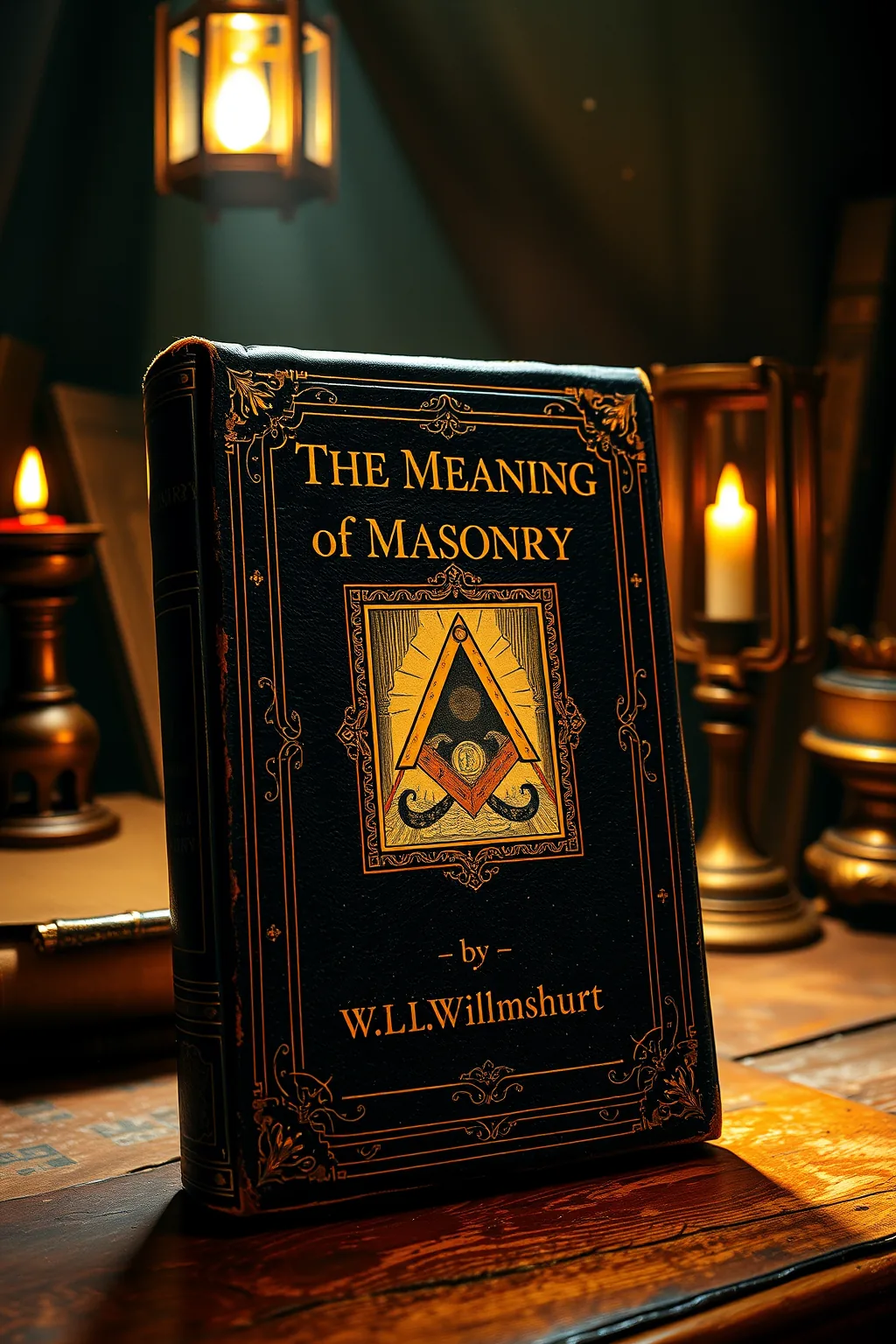
The Meaning of Masonry
 82
82

The Meaning of Masonry
W. L. Wilmshurst's The Meaning of Masonry offers a sophisticated interpretation of Masonic symbolism, positioning it as a profound spiritual discipline rather than a mere fraternal society. The strength of this work lies in Wilmshurst's ability to unpack complex allegories, revealing the underlying metaphysical principles. He adeptly connects Masonic tenets to universal spiritual concepts, particularly evident in his discussion of the symbolic tools as aids for inner work. However, the book's limitation is its dense, philosophical prose, which may prove challenging for casual readers or those unfamiliar with esoteric language. A particularly striking passage is the interpretation of the Temple of Solomon not as a physical structure but as the aspirant's own purified consciousness, a concept central to the book's thesis. Wilmshurst's analysis provides a compelling argument for Masonry's role in spiritual development. It serves as an illuminating guide for those prepared to engage with its profound symbolic depth.
📝 Description
82
W. L. Wilmshurst published 'The Meaning of Masonry' in 1993, viewing the Craft as a spiritual path.
Wilmshurst's 1993 book, 'The Meaning of Masonry,' examines Freemasonry not as a fraternal club, but as a symbolic system for personal spiritual growth. He argues that Masonic rituals and symbols are a language designed to lead the practitioner toward self-awareness and a connection with the divine. The book unpacks the allegories and tools of Masonic degrees, suggesting their deeper metaphysical significance. Wilmshurst encourages a move beyond superficial readings of the ritual, focusing instead on its symbolic core.
This work is for serious students of esoteric philosophy, comparative religion, and symbolic studies. Freemasons looking for a spiritual dimension to their practice will find much to consider, as will those outside the Craft interested in Western esoteric thought. Readers who enjoy allegorical interpretation and the study of ancient mysteries will find this book rich with material. It is not a manual for performing rituals, but a contemplative guide to understanding their symbolic meaning.
Published in 1993, 'The Meaning of Masonry' reflects a late 20th-century resurgence of interest in Western esoteric traditions. Wilmshurst's work connects with a long history of interpreting Freemasonry through philosophical and mystical lenses. It engages with established Masonic lore, aligning with interpretations found in movements like Theosophy and Rosicrucianism, which sought deeper spiritual meaning in ancient symbols and practices.
💡 Why Read This Book?
• Gain a deeper understanding of Masonic symbolism as a spiritual path, moving beyond literal interpretations to grasp its allegorical significance, as explored in Wilmshurst's analysis of the symbolic tools like the square and compasses. • Discover how the legend of the Temple of Solomon functions as a metaphor for inner spiritual construction, a concept central to the book's thesis on personal transformation. • Explore the Craft's connection to ancient wisdom traditions, appreciating its role as a system for self-knowledge and union with the divine, as presented in the book's metaphysical framework.
⭐ Reader Reviews
Honest opinions from readers who have explored this book.
❓ Frequently Asked Questions
What is the primary focus of W. L. Wilmshurst's The Meaning of Masonry?
The book interprets Freemasonry as a symbolic system for spiritual development and inner illumination, rather than solely a fraternal organization. It dissects Masonic symbols and rituals to reveal their deeper metaphysical significance for the aspirant's journey.
Who is the intended audience for this book?
It's for students of esoteric philosophy, comparative religion, and symbolic systems. It appeals to Freemasons seeking spiritual depth and non-Masons interested in Western esotericism and ancient mysteries.
When was The Meaning of Masonry first published?
The work was first published in 1993, emerging during a period of renewed interest in esoteric traditions and secret societies.
Does the book provide practical instructions for Masonic rituals?
No, the book focuses on the contemplative and philosophical interpretation of Masonic symbolism and allegory, not on the practical execution of rituals. It offers a framework for understanding, not a how-to guide.
What does Wilmshurst interpret the Temple of Solomon to represent?
Wilmshurst interprets the Temple of Solomon symbolically as the aspirant's inner sanctuary or the purified consciousness, representing the goal of spiritual construction and realization.
What is the significance of the 'lost word' according to this book?
In Wilmshurst's interpretation, the 'lost word' signifies the attainment of divine knowledge or spiritual realization, representing the ultimate goal of the Masonic path rather than a literal historical artifact.
🔮 Key Themes & Symbolism
Masonry as Spiritual Allegory
Wilmshurst posits that Freemasonry functions primarily as an allegorical system for the soul's progression toward spiritual enlightenment. The book meticulously unpacks the symbolic language of the Craft, arguing that its rituals, degrees, and legends are not mere historical narratives but coded instructions for inner transformation. The emphasis is on the internal journey, where external Masonic structures serve as metaphors for the development of the individual's consciousness and connection to the divine. This perspective frames Masonry as a path of self-discovery and spiritual attainment, aligning it with broader esoteric traditions.
Symbolic Tools of the Craft
The utilitarian tools of stonemasonry are reinterpreted by Wilmshurst as instruments for spiritual and ethical discipline. The square, for instance, represents morality and rectitude, the compasses symbolize the ability to circumscribe desires and relate to others, and the plumb line signifies uprightness and integrity. These tools, central to Masonic ritual, are presented as practical aids for shaping one's character and working through the complexities of spiritual life. Their symbolic application guides the aspirant in building their inner temple and living a virtuous existence.
The Inner Temple of Solomon
Central to Wilmshurst's interpretation is the symbolic representation of the Temple of Solomon. He argues that this legendary structure is not a historical edifice but a metaphor for the aspirant's own purified consciousness and spiritual being. The process of building the Temple within oneself mirrors the Masonic journey of initiation and self-perfection. The search for the 'lost word' is thus intrinsically linked to the completion of this inner temple, signifying the attainment of divine wisdom and spiritual wholeness.
The Path to Illumination
The overarching theme is Masonry's role in facilitating spiritual illumination. Wilmshurst presents the Craft as a structured path designed to guide individuals from a state of ignorance and material attachment towards higher consciousness and divine union. Each element of Masonic teaching, from its allegories to its symbols, is viewed as a step along this journey. The ultimate aim is not social advancement but the realization of one's divine potential and the attainment of true spiritual knowledge.
💬 Memorable Quotes
Direct passages from the work, attributed to the author.
“The whole of Masonry is a grand allegory of the spiritual life.”
— This statement expresses Wilmshurst's core thesis, presenting Freemasonry not as a historical institution but as a symbolic narrative for the human journey toward spiritual realization and divine connection.
“The Temple of Solomon is built within the heart of man.”
— This interpretation reframes the legendary temple as an internal, spiritual construct. It suggests that the true 'building' of Masonry occurs within the individual's consciousness and spiritual being.
“The tools of the Craft are instruments for the soul's refinement.”
— This highlights the symbolic function of Masonic tools, viewing them not for manual labor but as allegorical aids for moral discipline, ethical conduct, and spiritual self-improvement.
“The lost word is the attainment of divine knowledge.”
— This defines the ultimate quest within Masonry not as a literal search, but as the achievement of profound spiritual understanding and direct experience of the divine.
“Masonry is a path from darkness to light.”
— This concise phrase captures the essence of the initiatory journey presented in the book, symbolizing the transition from ignorance and limitation to spiritual awareness and freedom.
🌙 Esoteric Significance
Tradition
Wilmshurst's work firmly belongs to the Western Esoteric tradition, specifically drawing from Hermetic, Neoplatonic, and Gnostic philosophical underpinnings. It interprets Freemasonry as a modern manifestation of ancient mystery schools, utilizing a symbolic language designed to facilitate spiritual awakening. The book departs from purely ritualistic or historical Masonic interpretations by emphasizing the allegorical journey of the soul, aligning with traditions that view physical realities as reflections of spiritual truths and prioritize inner gnosis.
Symbolism
Key symbols like the Temple of Solomon are interpreted not as a physical structure but as the aspirant's purified consciousness, the inner sanctuary of spiritual realization. The tools of the Craft—the square, compasses, plumb line, and level—are seen as symbolic instruments for moral and spiritual self-discipline, guiding the initiate in shaping their character. The concept of the 'lost word' is central, representing the attainment of divine knowledge or direct spiritual experience, the ultimate goal of the Masonic path.
Modern Relevance
Contemporary students of comparative religion, symbolism, and Western esotericism continue to draw on Wilmshurst's insights. His work is relevant to modern practitioners of contemplative disciplines and those seeking to understand the spiritual dimensions of ritual and allegory. Thinkers exploring the intersection of psychology and spirituality, particularly concerning archetypes and the individuation process, may find parallels in his symbolic interpretations. The book remains a valuable resource for understanding Masonry as a potential vehicle for personal transformation in the 21st century.
👥 Who Should Read This Book
• Freemasons seeking to deepen their understanding of the spiritual and philosophical dimensions of their Craft beyond its fraternal aspects. • Students of Western Esotericism interested in how ancient symbolic systems are interpreted as paths to spiritual development and self-knowledge. • Comparative religion scholars and philosophers of symbolism looking for detailed allegorical interpretations of a well-known Western mystery tradition.
📜 Historical Context
W. L. Wilmshurst's "The Meaning of Masonry" was first published in 1993, a period marked by a resurgence of interest in Western esoteric traditions and philosophical interpretations of historical movements. While Freemasonry has deep roots stretching back to operative guilds and evolving into speculative lodges by the early 18th century, Wilmshurst's work engages with a long tradition of esoteric readings of its symbolism. His approach aligns with the mystical and philosophical currents that influenced figures like Manly P. Hall in the 20th century, who also sought to uncover the spiritual teachings within Masonic lore. Wilmshurst's analysis can be seen as a contribution to the ongoing discourse within Masonic and esoteric circles, offering a counterpoint to purely historical or social interpretations. The book's emphasis on spiritual development places it within a lineage of thought that views ancient and medieval symbols as vehicles for profound metaphysical insights, a perspective popular in circles influenced by Theosophy and Rosicrucianism.
📔 Journal Prompts
Reflect on the symbolic meaning of the square and compasses in your own life.
How does the concept of the 'inner temple' relate to your personal spiritual goals?
Consider the 'lost word' not as a historical artifact, but as a metaphor for ultimate realization.
Analyze the allegorical representation of the Temple of Solomon as described by Wilmshurst.
Explore the idea of Masonic tools as aids for spiritual refinement.
🗂️ Glossary
Allegory
A story, poem, or picture that can be interpreted to reveal a hidden meaning, typically a moral or political one. In this context, it refers to the symbolic narrative of Freemasonry representing spiritual truths.
Symbolic System
A collection of symbols and their associated meanings used to communicate complex ideas or represent abstract concepts, often found in religious, philosophical, or esoteric traditions.
Spiritual Development
The process of growth and refinement of one's inner self, consciousness, and connection to the divine or ultimate reality, often involving ethical conduct and self-awareness.
Inner Illumination
A state of spiritual enlightenment or profound understanding achieved through introspection, contemplation, and connection with higher consciousness.
Metaphysical
Relating to the fundamental nature of reality, including the relationship between mind and matter, substance and spirit. In this book, it refers to the spiritual and philosophical principles underlying Masonic symbolism.
Aspirant
A person who seeks or attempts to achieve a particular goal or position, especially in a spiritual context. In this book, it refers to an individual undertaking the path of Masonic initiation.
Gnosis
Knowledge of spiritual mysteries, often achieved through direct experience or intuition rather than intellectual reasoning. It is a key concept in Gnostic traditions and relevant to esoteric interpretations of Masonry.
🔮 Readers Also Liked
Browse all →






![Gould R F History Of Freemasonry Throughout The World V 3 [ 1936 Ed][ 361p]](/img/thumb/gould-r-f-history-of-freemasonry-throughout-the-world-v-3-1936-ed-361p.webp)

More by W. L. Wilmshurst
All books →

More Free Freemasonry & Secret Societies Books
View all →