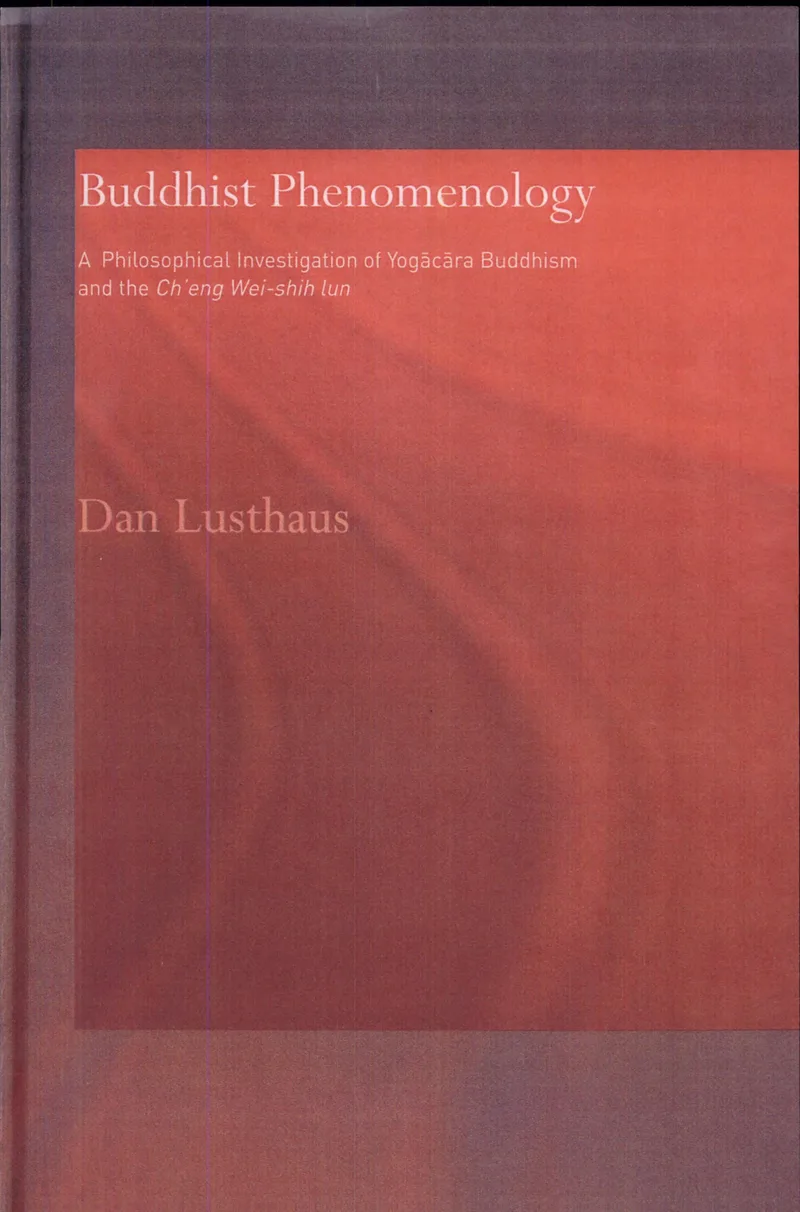
Buddhist Phenomenology
 79
79

Buddhist Phenomenology
Dan Lusthaus's Buddhist Phenomenology offers a dense, scholarly engagement with the Yogacara tradition, a significant departure from more accessible introductions. The work's strength lies in its meticulous dissection of the Trimsika and its commentaries, providing unparalleled clarity on complex textual lineages. However, the sheer academic rigor can be a barrier; the prose, while precise, rarely offers moments of stylistic relief. A particularly compelling section is Lusthaus's exploration of the five *vijñānas* (consciousness types) and their interaction with the *ālaya-vijñāna*, offering a sophisticated model of subjective experience. While the book is invaluable for specialists, its demanding nature means it is not for the casual reader seeking a quick overview. It demands sustained attention, rewarding the dedicated reader with a profound understanding of a critical Buddhist school.
📝 Description
79
Dan Lusthaus published Buddhist Phenomenology in 2014, examining Yogacara philosophy.
This 2014 book by Dan Lusthaus offers a detailed academic study of the Yogacara school of Indian Buddhism. It systematically breaks down the philosophical foundations of this tradition across five parts. The work begins by placing Yogacara within the wider context of phenomenology and Indian Buddhist thought, then proceeds to core ideas such as karma and how knowledge is acquired.
Lusthaus's research comes at a time when Western academics are showing renewed interest in Yogacara. The book directly engages with classical Indian Buddhist texts, translating and analyzing important works like the Trimsika and the Ch'eng Wei-shih Lun. These analyses aim to provide new ways of understanding their historical spread and interpretation. The book is aimed at advanced students and scholars of Buddhist philosophy, particularly those focused on Mahayana traditions and Yogacara. It will also interest philosophers of mind and consciousness interested in comparing different cultural approaches to these subjects. A basic grasp of Buddhist concepts is recommended for readers to fully appreciate the text's complex arguments.
Buddhist Phenomenology engages with the Yogacara tradition, a major school within Mahayana Buddhism that developed in India. Yogacara focuses on the nature of consciousness and perception, positing that reality as we experience it is mind-dependent. This perspective has deep roots in Buddhist contemplative practices, particularly meditation, which aims to observe the workings of the mind directly. Lusthaus's work situates these philosophical ideas within broader discussions of phenomenology, linking them to Western philosophical inquiries into consciousness and experience.
💡 Why Read This Book?
• Gain a precise understanding of Yogacara's *vijñapti-mātra* doctrine, moving beyond superficial interpretations to grasp its philosophical nuances as detailed in Part Two. • Comprehend the intricate relationship between karma, meditation, and epistemology within the Yogacara framework, as explored in Part Three, offering unique insights into Buddhist causality. • Analyze the historical transmission and interpretation of foundational texts like the Trimsika, as presented in Part Four, providing a scholarly foundation for understanding the school's development.
⭐ Reader Reviews
Honest opinions from readers who have explored this book.
❓ Frequently Asked Questions
What is the primary focus of Dan Lusthaus's Buddhist Phenomenology?
The book's primary focus is a detailed academic study of the Yogacara tradition of Buddhism, exploring its philosophical concepts, textual history, and relationship to phenomenology. It specifically examines texts like the Trimsika and the Ch'eng Wei-shih Lun.
When was Buddhist Phenomenology first published?
Buddhist Phenomenology by Dan Lusthaus was first published on February 4, 2014.
Who is the author of Buddhist Phenomenology?
The author of Buddhist Phenomenology is Dan Lusthaus, a scholar specializing in Buddhist philosophy and comparative studies.
What are the main sections of the book?
The book is divided into five parts: 1) Buddhism and phenomenology, 2) Four basic models of Indian Buddhist thought, 3) Karma, meditation, and epistemology, 4) The Trimsika and its translations, and 5) The Ch'eng Wei-shih Lun and Yogacara in China.
Is this book suitable for beginners in Buddhism?
This book is generally considered advanced. It is best suited for scholars, graduate students, or those with a solid existing knowledge of Buddhist philosophy due to its complex arguments and detailed textual analysis.
What philosophical tradition does Yogacara belong to?
Yogacara is a major school of Mahayana Buddhism, originating in India. It is often characterized by its emphasis on consciousness and its theories of mind-only or representation-only.
🔮 Key Themes & Symbolism
Consciousness-Only Doctrine
The book extensively analyzes the Yogacara concept of *vijñapti-mātra*, often translated as 'consciousness-only' or 'representation-only.' Lusthaus meticulously unpacks how this doctrine posits that perceived reality is a projection or construction of consciousness, not an external, independent world. This exploration studies the implications for epistemology and the nature of experience, challenging dualistic views and offering a sophisticated model for understanding subjective reality and its perceived objects.
Karma and Cognitive Models
Part Three of the study is dedicated to the intricate interplay between karma, meditation, and epistemology within the Yogacara framework. It examines how karmic imprints (*saṃskāras*) stored in the *ālaya-vijñāna* (storehouse consciousness) shape our cognitive models and sensory experiences. This section offers a unique perspective on Buddhist causality, explaining how past actions condition present perceptions and how meditative practices can alter these conditioning factors, leading to transformative insights.
Textual Analysis of Trimsika
A significant portion of Buddhist Phenomenology is devoted to the critical analysis and translation of Vasubandhu's Trimsika, a foundational text of the Yogacara school. Lusthaus provides a detailed commentary on the text and its various commentaries, including the influential Ch'eng Wei-shih Lun. This in-depth textual engagement illuminates the historical development of Yogacara thought and its philosophical arguments concerning the nature of reality and consciousness.
Phenomenology and Buddhism
The book bridges the gap between Buddhist philosophy and Western phenomenology, particularly the work of Edmund Husserl. Lusthaus explores how Yogacara's focus on the structures of consciousness and subjective experience offers a parallel, albeit distinct, approach to phenomenological inquiry. This comparative analysis highlights shared concerns regarding intentionality, lived experience, and the critique of naive realism, enriching both Buddhist studies and phenomenology.
💬 Memorable Quotes
Direct passages from the work, attributed to the author.
“The problem of the 'external world' is not so much an empirical one as it is a problem of consciousness's own structure.”
— This interpretation highlights the book's central argument that the perceived 'external world' is not the primary reality, but rather a construct or manifestation of the mind's internal workings and structures.
“The *ālaya-vijñāna* acts as a foundational consciousness, receiving and transmitting karmic seeds that ripen into our perceived reality.”
— This interpretation explains the function of the storehouse consciousness in Yogacara, positing it as the basis from which karmic potentials (seeds) are stored and from which the stream of consciousness and perceived phenomena arise.
“Understanding the five *vijñānas* is crucial for mapping the dynamics of sensory perception and cognitive processing.”
— This highlights the importance placed on the five sense consciousnesses and the mental consciousness within Yogacara, framing their study as key to understanding how we process information and construct our experience of the world.
“The goal is not to deny experience, but to understand its nature as representation.”
— This interpretation captures the essence of the Yogacara approach to *vijñapti-mātra*, suggesting it's not about negating the reality of lived experience, but about re-framing its ontological status as fundamentally mind-dependent.
💡 Key Ideas
Editorial paraphrase of the work's core concepts — not direct quotes.
Karma is not a system of reward and punishment, but a principle of causal efficacy inherent in intentional action.
This paraphrased concept emphasizes Yogacara's view of karma not as divine judgment, but as a natural law of cause and effect, where volitional acts create specific imprints that shape future experiences and perceptions.
🌙 Esoteric Significance
Tradition
While Yogacara is a mainstream Mahayana Buddhist tradition, its detailed explorations of consciousness, mind-training, and subtle cognitive processes have historically held significant esoteric appeal. For practitioners seeking deeper insights into the nature of reality and liberation, the Yogacara emphasis on the mind's power to shape perception and achieve enlightenment aligns with many esoteric goals. Lusthaus's work, by meticulously dissecting these mechanisms, provides a scholarly framework for understanding practices that aim at consciousness transformation, a common thread in esoteric traditions.
Symbolism
Key symbols explored implicitly within the Yogacara framework, and thus within Lusthaus's analysis, include the concept of the 'storehouse consciousness' (*ālaya-vijñāna*) often visualized as a foundational ground or repository. The 'seeds' (*bījas*) within this storehouse can be seen as karmic imprints or potentials. The transformation of these seeds and the arising of the 'three natures' (*trisvabhāva*)—imagined, dependent, and perfected—represent a symbolic journey from illusion to ultimate reality, central to the esoteric aspiration for spiritual realization.
Modern Relevance
Contemporary thinkers and practitioners in fields ranging from contemplative science and artificial intelligence ethics to depth psychology and integral philosophy find resonance in Yogacara's sophisticated models of consciousness. Scholars and practitioners interested in the philosophical underpinnings of mindfulness meditation, non-dual awareness, and the nature of subjective experience draw heavily on the detailed analyses presented in works like Lusthaus's. The book provides a crucial bridge for understanding how ancient Buddhist psychological insights can inform modern discussions on mind, reality, and well-being.
👥 Who Should Read This Book
• Advanced students and scholars of Buddhist philosophy, particularly those focusing on Mahayana and Yogacara, seeking a rigorous textual and conceptual analysis. • Philosophers of mind and consciousness interested in comparative studies, who wish to explore non-Western models of subjective experience and epistemology. • Researchers in contemplative sciences and cognitive psychology looking for detailed philosophical frameworks that underpin meditative practices and theories of mind.
📜 Historical Context
Published in 2014, Dan Lusthaus's Buddhist Phenomenology emerged during a period of sustained academic interest in Mahayana Buddhist philosophy, particularly the Yogacara school. This era saw ongoing scholarly efforts to translate and interpret complex Sanskrit and Chinese Buddhist texts, moving beyond earlier, more devotional or generalized studies. Lusthaus's work builds upon the foundations laid by scholars like Edward Conze and more recent figures engaging with Indian Buddhist logic and epistemology. The book's focus on comparing Yogacara with Western phenomenology, a trend gaining traction in the late 20th and early 21st centuries, situates it within a broader interdisciplinary conversation. While not directly engaging with a specific censorship event or contemporary rival school in its immediate reception, the book implicitly addresses ongoing debates within Buddhist studies regarding the philosophical sophistication and historical accuracy of Yogacara doctrines, particularly in relation to competing schools like Madhyamaka.
📔 Journal Prompts
The structure of *ālaya-vijñāna* and its role in karmic imprints.
The relationship between *vijñapti-mātra* and the concept of an external world.
How the Trimsika's arguments challenge conventional realism.
The practical implications of Yogacara's epistemology for meditation.
Comparing Yogacara's models of consciousness with Western phenomenological descriptions.
🗂️ Glossary
Yogacara
A major school of Mahayana Buddhism originating in India, known for its emphasis on consciousness and its theories of mind-only or representation-only. It seeks to understand the nature of reality through the analysis of consciousness.
Vijñapti-mātra
A key Yogacara concept, often translated as 'consciousness-only' or 'representation-only.' It posits that perceived reality is fundamentally a manifestation or projection of consciousness.
Ālaya-vijñāna
The 'storehouse consciousness' or 'fundamental consciousness' in Yogacara philosophy. It is considered the basis for all other consciousnesses and stores karmic imprints (saṃskāras).
Karma
In Buddhism, the principle of causality where intentional actions (physical, verbal, mental) lead to future consequences. Yogacara analyzes karma's role in shaping consciousness and experience.
Epistemology
The branch of philosophy concerned with the nature and scope of knowledge. Buddhist epistemology, particularly within Yogacara, explores how we know and the structures of knowing.
Trimsika
An important work by Vasubandhu, a foundational text of the Yogacara school. It outlines the core tenets of the tradition in thirty verses.
Saṃskāra
Mental imprints or tendencies, often translated as 'volitional formations.' In Yogacara, these are karmic seeds stored in the *ālaya-vijñāna* that condition future experiences.