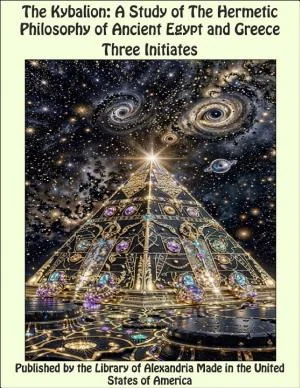
The Kybalion: A Study of The Hermetic Philosophy of Ancient Egypt and Greece
 75
75

The Kybalion: A Study of The Hermetic Philosophy of Ancient Egypt and Greece
The Kybalion presents its seven principles with a confident, almost dogmatic, assertion of universal truth. Its strength lies in its concise, aphoristic style, making complex metaphysical ideas accessible, even if the attribution to ancient Egypt and Greece feels more like branding than historical accuracy. The concept of Mentalism—that the universe is fundamentally mental—is particularly potent, offering a framework for understanding consciousness's role in reality. However, the work often feels more like a modern interpretation of esoteric thought, heavily influenced by 19th-century occultism and New Thought, rather than a direct transmission of ancient Hermetic doctrine. Its lack of specific historical or textual references, coupled with the anonymity of the "Three Initiates," leaves its origins shrouded in ambiguity. A notable passage discussing the "Great Work" on page 28 offers a glimpse into its practical application, framing personal transformation as a deliberate alchemical process of the mind. Despite its historical uncertainties, The Kybalion remains a significant text for its systematic articulation of metaphysical concepts, even if its claim to ancient lineage is debatable.
📝 Description
75
Published in 1908, The Kybalion distills seven Hermetic Principles concerning the cosmos, mind, and spirit.
The Kybalion, authored by the "Three Initiates," presents seven principles claimed to be derived from ancient Egyptian and Greek Hermetic philosophy. The book asserts these principles are universal truths that explain the nature of reality, the cosmos, and the human mind. Its core assertion is that "The All" is Mind, and the universe exists as a mental creation within this Universal Mind. The text uses aphorisms and commentary to guide readers toward recognizing their own mental faculties and their connection to this greater consciousness.
This work is aimed at serious students of esoteric philosophy and occultism, requiring careful thought and engagement with abstract metaphysical ideas. It is particularly relevant for those interested in comparative religion, ancient mystical traditions, or the foundational concepts of various occult schools. Readers seeking a structured explanation of mental powers and the nature of reality will find its content suitable for study. The book has become a foundational text for numerous modern occult organizations and philosophical movements.
The Kybalion emerged during the early 20th-century occult revival, a period marked by widespread interest in spiritualism and Theosophy. While claiming ancient Hermetic roots, its philosophical language and emphasis on mental power align more closely with 19th-century New Thought and metaphysical movements than with classical Hermetic texts like the Corpus Hermeticum. The identity of the "Three Initiates" remains unknown, though William Walker Atkinson is often cited as a likely contributor. The book quickly gained traction within esoteric circles, shaping subsequent occult thought.
💡 Why Read This Book?
• Understand the Principle of Mentalism: Learn how the book posits that "The All" is Mind and the universe is a mental creation, offering a unique perspective on consciousness and reality that differs from purely materialist viewpoints. • Explore the Principle of Correspondence: Grasp the concept of "as above, so below," a fundamental Hermetic axiom that suggests macrocosmic patterns reflect microcosmic ones, providing a tool for interpreting universal order. • Grasp the Seven Hermetic Principles: Acquire a foundational esoteric framework for understanding existence, presented as universal laws governing all phenomena, from the smallest particle to the largest cosmic body.
⭐ Reader Reviews
Honest opinions from readers who have explored this book.
❓ Frequently Asked Questions
What is the primary message of The Kybalion regarding reality?
The Kybalion's primary message is that reality is fundamentally mental, encapsulated in the first Hermetic Principle of Mentalism. It asserts that "The All" is Mind, and the universe is a mental projection within this Universal Mind.
Who were the 'Three Initiates' who authored The Kybalion?
The identity of the "Three Initiates" remains unknown. While speculation exists, the authors chose anonymity, presenting the work as a distillation of ancient Hermetic wisdom rather than a personal treatise.
How does The Kybalion relate to ancient Hermeticism?
While claiming to be a distillation of ancient Hermetic philosophy from Egypt and Greece, its presentation and emphasis on concepts like Mentalism and Vibration align more closely with 19th-century New Thought and occult revival movements than with verifiable ancient Hermetic texts like the Corpus Hermeticum.
What are the Seven Hermetic Principles?
The Seven Hermetic Principles are Mentalism, Correspondence, Vibration, Polarity, Rhythm, Cause and Effect, and Gender. They are presented as fundamental laws governing the universe and human experience.
Is The Kybalion considered a sacred text?
Within certain esoteric and occult traditions, The Kybalion is highly regarded as a foundational text for understanding metaphysical principles. However, it is not considered a sacred scripture in the same vein as major world religions.
Can The Kybalion be studied for practical application?
Yes, the book is designed for practical application. Its principles are presented as laws that can be understood and applied through mental discipline and focused will to achieve personal mastery and transformation.
🔮 Key Themes & Symbolism
The Principle of Mentalism
This principle asserts that 'The All' is Mind, and the universe is purely mental. It posits that our thoughts, beliefs, and consciousness are not merely products of the brain but are fundamental to the fabric of reality. Understanding Mentalism implies that by changing one's own mental state, one can alter their perceived reality and influence the external world. The work suggests that all phenomena, from the physical to the spiritual, are vibrations of this Universal Mind, accessible through introspection and mental discipline.
The Seven Hermetic Principles
The core of The Kybalion lies in its enumeration and explanation of seven universal laws. These principles—Mentalism, Correspondence, Vibration, Polarity, Rhythm, Cause and Effect, and Gender—are presented as the operating system of the cosmos. They are not mere philosophical concepts but active forces governing all creation. The text argues that mastery of these principles leads to self-mastery and a deeper understanding of life's intricate workings, offering a comprehensive metaphysical framework for interpreting existence.
The Great Work of Personal Transformation
Beyond abstract principles, The Kybalion frames its teachings as a path to 'The Great Work,' a process of spiritual and mental alchemy. This involves applying the Hermetic Principles to one's own life, transforming limitations into strengths and ignorance into wisdom. It's a journey of self-discovery and self-mastery, aimed at realizing one's true potential and connection to the Universal Mind. The text encourages diligent study and practice to achieve this elevated state of being.
Correspondence: As Above, So Below
This principle highlights the interconnectedness of all planes of existence. The Kybalion explains that the laws and phenomena of the physical world have their counterparts in the mental and spiritual realms, and vice versa. This concept serves as a crucial tool for understanding the universe, suggesting that by studying one plane, insights into others can be gained. It provides a basis for divination, spiritual intuition, and the recognition of universal patterns.
💬 Memorable Quotes
Direct passages from the work, attributed to the author.
“The lips of wisdom are closed, except to the ears of Understanding.”
— This aphorism emphasizes that true knowledge or wisdom is not freely available to all. It requires a prepared mind, an open consciousness, and the capacity for comprehension to receive and benefit from profound truths.
“All vibration is but a manifestation of degree of intensity in oscillation.”
— This explains the Principle of Vibration. It suggests that differences in phenomena, from physical matter to mental states, are due to varying degrees of energetic movement or oscillation, implying a unified underlying substance.
“The principle of Polarity states that everything is dual; everything has poles; everything has its pair of opposites.”
— This principle introduces the concept of duality in the universe. It asserts that seemingly opposite concepts (like hot/cold, good/evil) are merely different degrees of the same fundamental energy or substance.
“The All is Mind; The Universe is Mental.”
— This is the core statement of the Principle of Mentalism. It posits that consciousness is the ultimate reality, and the entire cosmos is a manifestation within this Universal Mind.
“As above, so below; as below, so above.”
— This classic Hermetic maxim, central to the Principle of Correspondence, illustrates the belief that there is a consistent relationship between different levels of reality, from the macrocosm to the microcosm.
🌙 Esoteric Significance
Tradition
The Kybalion positions itself within the Hermetic tradition, claiming to distill the wisdom of Hermes Trismegistus. However, its philosophical framework, particularly its emphasis on mentalism and the seven principles, shows significant overlap with 19th-century occultism and the New Thought movement. It synthesizes these streams, presenting a coherent, albeit modern, interpretation of Hermetic philosophy aimed at practical application for self-mastery and spiritual development.
Symbolism
The work employs universal archetypes rather than highly specific symbols. The "All" represents the undifferentiated, absolute consciousness. The "Great Work" symbolizes the alchemical process of spiritual transformation and self-perfection. The concept of "poles" in the Principle of Polarity (e.g., positive/negative, light/dark) represents the inherent duality found in all manifested phenomena, which can be transcended through understanding.
Modern Relevance
The Kybalion continues to influence contemporary esoteric thought, particularly within New Age spirituality, the Law of Attraction movement, and modern Hermetic orders. Its clear articulation of principles like Mentalism and Cause and Effect provides a foundational vocabulary for many modern spiritual practitioners seeking to understand consciousness, reality creation, and personal empowerment.
👥 Who Should Read This Book
• Aspiring occultists and metaphysical students: Those beginning their study of esoteric philosophies will find The Kybalion a structured introduction to fundamental metaphysical concepts and universal laws. • Seekers of personal mastery: Individuals interested in understanding and applying mental powers, transforming their reality, and achieving self-development will benefit from its practical principles. • Comparative religion and philosophy researchers: Scholars exploring the evolution of Western esoteric thought and its connections to earlier traditions will find it a significant text from the early 20th century.
📜 Historical Context
The Kybalion was published in 1908 by the esoteric publisher Yogi Publication Society, attributed to the anonymous "Three Initiates." This period was a fertile ground for occultism and spiritual inquiry in the West, heavily influenced by the Theosophical Society founded by Helena Blavatsky in 1875 and the burgeoning New Thought movement. While the book claims to transmit ancient Hermetic philosophy from Egypt and Greece, its actual content reflects more the metaphysical and mental science ideas popular in the late 19th and early 20th centuries. Scholars like Manly P. Hall, a contemporary occult author, acknowledged its influence but also noted its departure from strict ancient Hermetic texts. The work's anonymous authorship and its synthesis of various esoteric streams contributed to its mystique and widespread adoption within occult circles, despite lacking direct scholarly ties to ancient Egyptian or Greek Hermetic traditions as found in the Corpus Hermeticum.
📔 Journal Prompts
Reflect on the Principle of Mentalism as applied to a recent challenge.
How does the Principle of Correspondence manifest in your daily life?
Consider the concept of 'The All' and your place within it.
Explore the duality described in the Principle of Polarity.
Contemplate the process of 'The Great Work' for personal transformation.
🗂️ Glossary
The All
The ultimate reality, conceived as the Universal Mind or Absolute Consciousness, from which all existence emanates. It is the unmanifested source and substance of the universe.
Mentalism
The First Hermetic Principle, stating that the universe is fundamentally mental, with the All being Mind. It suggests that reality is a creation of thought and consciousness.
Correspondence
The Second Hermetic Principle, expressed as "As above, so below; as below, so above." It signifies the interconnectedness and parallel nature of different planes of existence.
Vibration
The Third Hermetic Principle, asserting that everything in the universe is in motion, constantly vibrating at different frequencies. Even seemingly inert objects possess vibrations.
Polarity
The Fourth Hermetic Principle, which states that everything has two poles or opposite extremes, and that these opposites are actually different degrees of the same fundamental thing.
Rhythm
The Fifth Hermetic Principle, describing the universal law of ebb and flow, rise and fall, and oscillation. It governs the regular pulsations of movement in all things.
Cause and Effect
The Sixth Hermetic Principle, which posits that every cause has its effect, and every effect has its cause. It implies a universe governed by immutable laws of action and reaction.
Gender
The Seventh Hermetic Principle, stating that there is gender in everything. This refers to the masculine and feminine principles that are present in all things, driving creation and manifestation.
This book appears in 1 collection
🔮 Readers Also Liked
Browse all →









From the “Occultism” Collection
View all →




More Free Occult Philosophy Books
View all →