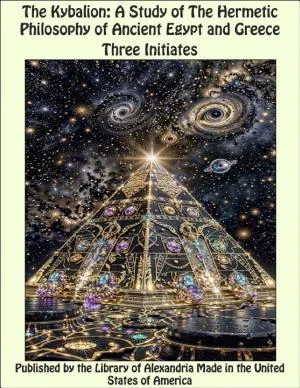
The Kybalion - A Study of the Hermetic Philosophy of Ancient Egypt and Greece
 79
79

The Kybalion - A Study of the Hermetic Philosophy of Ancient Egypt and Greece
The Kybalion arrives not with a bang, but with the quiet authority of a text that claims to distill millennia of wisdom. Its strength lies in its crystalline presentation of seven principles, each a potent aphorism for understanding existence. The principle of Polarity, for instance, offers a starkly effective lens through which to view apparent opposites – hot/cold, light/dark – as mere variations on a continuum. It’s a concept that feels both ancient and immediately applicable. However, the work’s brevity is also its limitation. The 'Three Initiates' offer pronouncements rather than detailed explorations, leaving the reader to ponder the practical application of, say, the principle of Gender without much explicit guidance. The assertion that the book appears only when needed feels more like a narrative flourish than a verifiable phenomenon. Nevertheless, for those drawn to Hermetic thought, The Kybalion serves as an accessible, if terse, primer on its foundational laws.
📝 Description
79
Published in 1912, The Kybalion offers a concise summary of Hermetic philosophy.
Authored by 'Three Initiates,' this book lays out seven fundamental principles claimed to explain the universe. These are Mentalism, Correspondence, Vibration, Polarity, Rhythm, Cause and Effect, and Gender. The text asserts these laws govern all existence, from thought to matter. It is written for those seeking direct statements on Hermeticism, eschewing lengthy historical discussion for axiomatic pronouncements. The book's approach is to distill complex ideas into understandable, fundamental laws. It aims to provide a framework for understanding esoteric concepts through these core tenets.
Its proponents suggest these principles offer a way to understand the underlying order of reality. The work presents these ideas as universal truths, applicable to personal development and the study of occult traditions. The brevity and declarative style are hallmarks of its presentation, intended to impart its teachings efficiently. Readers looking for a stripped-down introduction to Hermetic thought will find its direct style notable.
The Kybalion emerged in 1912, a time of significant Western interest in spiritualism and occult revival movements. It aligns with traditions that sought to recover and interpret ancient wisdom, such as those connected to Egyptian and Greek esoteric thought. The book's anonymous authorship, attributed to 'Three Initiates,' contributed to its mystique during an era fascinated by hidden knowledge and secret societies. It stands as a product of this period's engagement with Hermeticism and related philosophies.
💡 Why Read This Book?
• Gain a foundational understanding of Hermeticism's seven core principles, such as Mentalism, as presented in the 1912 publication, offering a unique framework for viewing reality. • Explore the concept of Correspondence ('As above, so below'), learning how this ancient Hermetic axiom, detailed in the book, can be applied to understanding the relationship between different planes of existence. • Grasp the principle of Polarity, as explained in the text, to reframe dualistic thinking and recognize the interconnectedness of seemingly opposite phenomena in your daily life.
⭐ Reader Reviews
Honest opinions from readers who have explored this book.
❓ Frequently Asked Questions
What is the origin of The Kybalion?
The Kybalion was first published in 1912 by the Yogi Publication Society. It is attributed to 'Three Initiates' and purports to be based on the teachings of ancient Hermeticism from Egypt and Greece.
What are the seven principles of Hermeticism outlined in The Kybalion?
The seven principles are Mentalism, Correspondence, Vibration, Polarity, Rhythm, Cause and Effect, and Gender. These are presented as fundamental laws governing the universe.
Is The Kybalion a primary source for ancient Hermetic teachings?
While it claims to be based on ancient Hermeticism, The Kybalion is a 20th-century interpretation and synthesis, not a direct translation of ancient Egyptian or Greek Hermetic texts.
Who were the 'Three Initiates'?
The identities of the 'Three Initiates' remain unknown. The pseudonym suggests a collective of individuals who possessed deep knowledge of Hermetic philosophy and intended to share it anonymously.
Where can I find The Kybalion?
The Kybalion is widely available in print and digital formats. As a work published in 1912, it is in the public domain in many regions, making it accessible online.
How does The Kybalion relate to other esoteric traditions?
The book's principles echo concepts found in various esoteric systems, including alchemy, astrology, and Eastern philosophies, offering a unique Hermetic perspective on universal laws.
🔮 Key Themes & Symbolism
The Seven Hermetic Principles
The work distills Hermetic philosophy into seven core tenets: Mentalism, Correspondence, Vibration, Polarity, Rhythm, Cause and Effect, and Gender. These are presented as immutable laws governing all creation, from the smallest atom to the largest galaxy. The book explains each principle with axiomatic clarity, suggesting they provide a framework for understanding the nature of reality and the human experience within it. The emphasis is on the universality and interconnectedness of these laws, urging the reader to recognize their operation in all aspects of life and the cosmos.
The Power of Mind (Mentalism)
Central to The Kybalion is the principle of Mentalism, which states that 'The All is Mind; The Universe is Mental.' This concept posits that reality is fundamentally a mental construct, shaped by the mind of the Great All. The book explores how understanding this principle empowers individuals to master their own mental states, influencing their circumstances and perception of the world. It suggests that our thoughts are not mere passive occurrences but active forces that contribute to the fabric of existence.
Universal Laws and Correspondence
The principle of Correspondence, famously summarized as 'As above, so below; as within, so without,' is a core part of The Kybalion. This theme highlights the interconnectedness of all planes of existence and the mirroring of patterns across different levels of reality. The book uses this to explain how understanding the workings of one level, such as the physical or mental, can provide insight into others. It underscores a holistic view of the universe where macrocosmic patterns are reflected in microcosmic experiences.
The Nature of Duality (Polarity)
The principle of Polarity asserts that all things exist in pairs of opposites, which are merely different degrees of the same fundamental substance or force. This theme is crucial for understanding concepts like good and evil, love and hate, or light and darkness not as absolute states but as points on a spectrum. The Kybalion suggests that by understanding Polarity, one can transcend the limitations of dualistic thinking and learn to transmute negative states into positive ones by shifting one's own position on the scale.
💬 Memorable Quotes
Direct passages from the work, attributed to the author.
“The lips of wisdom are closed, except to the ears of Understanding.”
— This aphorism suggests that true knowledge and esoteric wisdom are not freely given but must be earned through diligent study and a receptive state of mind. It implies a selective transmission of profound truths, accessible only to those prepared to receive them.
“The All is Mind; The Universe is Mental.”
— This foundational statement of the principle of Mentalism asserts that the ultimate reality is consciousness or mind. It suggests that the physical world and all phenomena are manifestations of this universal mind.
“Nothing rests; everything moves; everything vibrates; everything flies and returns.”
— This description of the principle of Vibration emphasizes the dynamic and ever-changing nature of existence. It conveys that all matter and energy are in constant motion and oscillation at various frequencies.
“Everything is dual; everything has poles; everything has its pair of opposites, resembling the two extremes of a line.”
— This expresses the principle of Polarity, illustrating that opposites are not mutually exclusive but rather two facets of the same underlying reality, differing only in degree.
💡 Key Ideas
Editorial paraphrase of the work's core concepts — not direct quotes.
The principle of Correspondence explains that 'As above, so below; as within, so without.'
This quote highlights the Hermetic belief in the interconnectedness of the universe. It implies that the patterns and laws governing the macrocosm (the universe) are reflected in the microcosm (the individual), and vice versa.
🌙 Esoteric Significance
Tradition
The Kybalion is a significant text within the Hermetic tradition, aiming to synthesize and present its core principles in a modern format. While drawing heavily on Hermeticism attributed to Hermes Trismegistus, it also incorporates elements and phrasing reminiscent of 19th and early 20th-century esoteric thought, particularly New Thought and Theosophy. It functions as an accessible entry point, translating ancient concepts into a digestible system for a new generation of seekers.
Symbolism
While not heavily reliant on overt symbolism in the manner of Tarot or Kabbalistic trees, The Kybalion uses symbolic language to convey its principles. The 'lips of wisdom' being closed except to the 'ears of Understanding' symbolizes the selective nature of esoteric knowledge. The concept of 'As above, so below' acts as a powerful symbolic link between the macrocosm and microcosm, representing the universal pattern and interconnectedness inherent in creation.
Modern Relevance
The Kybalion continues to influence contemporary esoteric practitioners, spiritual teachers, and self-help authors. Its seven principles are frequently referenced in discussions of manifestation, law of attraction, and personal development. Thinkers and groups in modern Hermeticism, New Age spirituality, and even some branches of psychology that explore consciousness and the power of belief systems, often draw upon its foundational concepts.
👥 Who Should Read This Book
• Aspiring practitioners of Hermeticism seeking a concise introduction to its fundamental laws, providing a clear framework for further study. • Students of comparative philosophy and religion interested in understanding the principles that underpin various esoteric traditions and their common threads. • Individuals engaged in personal development and the pursuit of self-mastery who are looking for actionable philosophical concepts like Polarity and Mentalism to apply to their lives.
📜 Historical Context
Published in 1912, The Kybalion emerged during the New Thought movement and a broader Western occult revival that saw a surge of interest in ancient traditions. It appeared amidst the proliferation of spiritualist literature and esoteric societies like the Hermetic Order of the Golden Dawn. While figures like Helena Blavatsky and her Theosophical Society were exploring Eastern philosophies and ancient wisdom, The Kybalion offered a more condensed, purportedly Hermetic, framework. The book's anonymous 'Three Initiates' authorship aligned with a cultural fascination for hidden knowledge and secret teachings prevalent at the time. It presented a stark contrast to the more academic or religiously rooted philosophical inquiries of the era, focusing instead on practical, axiomatic principles for personal transformation.
📔 Journal Prompts
The principle of Mentalism and its implications for your perceived reality.
How the law of Correspondence manifests in your daily experiences.
Transforming dualistic thinking through the lens of Polarity.
The cyclical nature described by the principle of Rhythm in your personal life.
Applying the concept of Cause and Effect to your intentions and actions.
🗂️ Glossary
The All
In The Kybalion, 'The All' refers to the ultimate reality or God, understood as infinite Mind, the fundamental substance from which all things originate.
Hermeticism
A philosophical and religious tradition based on writings attributed to Hermes Trismegistus, a legendary Hellenistic figure combining Greek and Egyptian deities. It emphasizes spiritual wisdom and the understanding of universal laws.
Mentalism
The first Hermetic principle, stating that reality is fundamentally mental or consciousness-based. The universe is seen as a mental creation of 'The All'.
Correspondence
The second Hermetic principle, articulated as 'As above, so below.' It posits that there is a harmony and mirroring between different planes of existence, from the greatest to the least.
Vibration
The third Hermetic principle, asserting that everything in the universe is in constant motion and possesses a unique vibrational frequency. Nothing is static.
Polarity
The fourth Hermetic principle, which states that all things exist in pairs of opposites, differing only in degree. These opposites are manifestations of a single underlying reality.
Rhythm
The fifth Hermetic principle, describing the universal law of ebb and flow, rise and fall, and the cyclical nature of all phenomena.