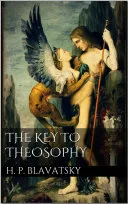
The Key to Theosophy
 79
79

The Key to Theosophy
H.P. Blavatsky's "The Key to Theosophy" succeeds admirably in its stated goal: to serve as an accessible portal into the vast landscape of Theosophical ideas. The question-and-answer format, while potentially dry for some, is remarkably effective for distilling complex doctrines into digestible pieces. A notable strength lies in its direct engagement with ethical principles, presenting them not as abstract ideals but as practical necessities for spiritual progress. The discussion around karma and reincarnation, for instance, is presented with a clarity that avoids much of the jargon found in other esoteric texts. However, the work occasionally reflects the scientific understanding and biases of its late 19th-century origin, which can feel dated to a contemporary reader. For example, its treatment of certain racial theories, while contextualized by the era's discourse, requires careful critical engagement. The book's assertion that "Theosophy is not a religion, but a science, a philosophy and a religion in one" provides a concise encapsulation of its ambitious scope. "The Key to Theosophy" remains a vital, albeit historically situated, introduction to a foundational esoteric movement.
📝 Description
79
H. P. Blavatsky published 'The Key to Theosophy' in 1889 to clarify Theosophy's core ideas.
Written as a series of questions and answers, 'The Key to Theosophy' aims to explain the fundamental principles of the Theosophical movement. Helena Blavatsky structured the book to address common inquiries about its philosophy, ethics, and the scientific ideas it engages with. She presented it as an accessible introduction, not a comprehensive study, intended to provide a clear understanding of the foundational concepts behind the Theosophical Society.
The book is suitable for readers new to Blavatsky's work or those interested in comparative religion and the occult interests of the late 19th century. Its question-and-answer format allows readers to find direct answers to specific points. Published during a period of widespread spiritual exploration, it offered a more detailed philosophical approach compared to contemporary spiritualism.
In 1889, 'The Key to Theosophy' appeared as Blavatsky sought to articulate the principles of her Theosophical Society. The book engages with the era's interest in spiritualism and occultism, but it grounds these in a complex philosophical system. Blavatsky links these ideas to ancient doctrines, proposing a universal wisdom underlying various religious and philosophical traditions. The text suggests that this wisdom is attainable through dedicated study and ethical conduct, reflecting a common goal in many esoteric traditions.
💡 Why Read This Book?
• Gain a clear exposition of karma and reincarnation, understanding how Blavatsky frames these concepts as fundamental laws of existence, distinct from their popular interpretations. • Explore the Theosophical Society's original mission, as outlined by Blavatsky, to foster universal brotherhood and the study of comparative religion and philosophy. • Comprehend the concept of the 'Seven Principles of Man' as presented in the text, providing a framework for understanding human consciousness beyond the physical body.
⭐ Reader Reviews
Honest opinions from readers who have explored this book.
❓ Frequently Asked Questions
What is the primary purpose of 'The Key to Theosophy'?
The book's primary purpose is to serve as an introductory guide or 'key' to the complex philosophical, ethical, and scientific ideas of Theosophy, making them accessible to a general audience through a question-and-answer format.
Who founded the Theosophical Society, and when?
The Theosophical Society was co-founded by Helena Blavatsky, along with Henry Steel Olcott and William Quan Judge, in New York City in 1875.
Does 'The Key to Theosophy' present a new religion?
No, Blavatsky explicitly states that Theosophy is not a religion, but rather a synthesis of philosophy, science, and religion, aiming to reveal the underlying truths common to all ancient wisdom traditions.
What are some core ethical principles discussed in the book?
The book emphasizes universal brotherhood, compassion, and the ethical implications of karma and reincarnation as central to spiritual development and societal harmony.
Is 'The Key to Theosophy' suitable for beginners in esoteric studies?
Yes, its question-and-answer format and clear explanations make it an excellent starting point for individuals new to Theosophy or esoteric philosophy in general.
What is the significance of the 'Secret Doctrine' in relation to this book?
'The Key to Theosophy' serves as an introduction to the broader philosophical system detailed in Blavatsky's more extensive work, 'The Secret Doctrine,' published in 1888.
🔮 Key Themes & Symbolism
Theosophy as Universal Wisdom
The work posits Theosophy not as a novel doctrine but as the ancient, underlying wisdom (Sophia-Theos) common to all religions and philosophies. It argues that core truths about existence, consciousness, and the cosmos have been preserved across diverse traditions, albeit often obscured by dogma and ritual. Blavatsky presents Theosophy as the key to rediscovering this universal spiritual science, emphasizing its scientific, philosophical, and religious dimensions as interconnected facets of a single, comprehensive understanding of reality.
Karma and Reincarnation
Central to Blavatsky's exposition are the doctrines of karma and reincarnation. Karma is presented as the immutable law of cause and effect, governing all actions and their consequences across lifetimes. Reincarnation is the mechanism through which the soul progresses, learning lessons and balancing karmic debts through successive physical existences. This cyclical view of existence offers a framework for understanding suffering, inequality, and the potential for spiritual evolution, moving beyond simple notions of divine judgment.
The Human Constitution
Blavatsky details a complex model of the human being, often described in terms of seven principles or planes of existence, extending beyond the physical body. This includes the vital principle (Prana), the astral body (Linga Sharira), the animal or lower desires (Kama), and the higher spiritual aspects (Manas, Buddhi, Atma). Understanding this multi-layered constitution is crucial for grasping the processes of reincarnation and the challenges of spiritual development, highlighting the interplay between material and spiritual elements within the individual.
Universal Brotherhood
The foundational principle of the Theosophical Society, universal brotherhood, is presented as more than a mere social ideal; it is an inherent truth of cosmic interconnectedness. The book argues that recognizing the divine spark within every being is essential for ethical conduct and spiritual progress. This principle transcends race, creed, sex, or caste, advocating for empathy, mutual understanding, and the dissolution of divisive prejudices as a necessary step towards collective spiritual awakening.
💬 Memorable Quotes
Direct passages from the work, attributed to the author.
“Theosophy is not a religion, but a science, a philosophy and a religion in one.”
— This statement expresses Blavatsky's ambitious attempt to synthesize ancient wisdom with modern inquiry, positioning Theosophy as a comprehensive system of understanding reality that transcends the limitations of separate disciplines.
“We are all pilgrims on the same path, though our stages of progress may differ.”
— This highlights the concept of shared spiritual journey and the inherent equality of all beings in their potential for evolution, regardless of their current level of understanding or attainment.
“Karma is the unerring, unerring law of retribution.”
— This emphasizes the impersonal and absolute nature of karmic law, presenting it not as punishment but as a fundamental principle of cosmic balance and consequence for all actions.
“Theosophy is the shore to which all religions are but streams.”
— This metaphor illustrates the idea that diverse religious traditions are merely different expressions or paths leading to the same fundamental, universal truth that Theosophy seeks to reveal.
💡 Key Ideas
Editorial paraphrase of the work's core concepts — not direct quotes.
The man who is not a brother to the man is not a Theosophist.
This quote underscores the absolute centrality of universal brotherhood to the practice and philosophy of Theosophy, framing it as a non-negotiable ethical requirement for genuine adherence to the movement's principles.
🌙 Esoteric Significance
Tradition
This work is foundational to the Theosophical tradition, a modern esoteric movement that draws heavily from Eastern philosophies (Hinduism, Buddhism) and Western Hermeticism, Neoplatonism, and Gnosticism. It departs from purely Western traditions by its systematic integration of concepts like karma and reincarnation as universal laws and its emphasis on a global, non-sectarian spiritual path aimed at fostering universal brotherhood.
Symbolism
The book frequently references the 'Lotus' as a symbol of spiritual unfolding and the higher consciousness emerging from the muddy waters of material existence. The concept of the 'Seven Principles of Man' functions symbolically, representing distinct planes of being and consciousness, from the dense physical to the ultimate spiritual monad (Atma-Buddhi-Manas). The serpent, often associated with wisdom and cyclic existence, also appears implicitly within discussions of reincarnation and cosmic cycles.
Modern Relevance
Contemporary esoteric thinkers, spiritual seekers, and scholars of religion continue to draw upon Blavatsky's framework. Modern New Age philosophies, concepts of holistic health, and discussions on consciousness often echo Theosophical ideas about interconnectedness, karma, and subtle bodies. The work remains a primary source for understanding the origins of many modern spiritual movements and their underlying philosophical architecture.
👥 Who Should Read This Book
• Students of comparative religion and philosophy seeking to understand the origins and core tenets of Theosophy as a distinct spiritual-intellectual movement. • Individuals interested in the late 19th-century occult revival and its key figures, particularly those wanting a direct exposition from one of its most influential proponents. • Seekers exploring concepts like karma, reincarnation, and the nature of consciousness, who desire a structured, philosophical approach grounded in esoteric traditions.
📜 Historical Context
Helena Blavatsky penned "The Key to Theosophy" in the late 19th century, a period characterized by intense spiritual seeking and intellectual ferment in Europe and America. The rise of scientific materialism on one hand, and the burgeoning interest in Eastern religions and occultism on the other, created fertile ground for Theosophy. Blavatsky's work directly engaged with contemporary scientific theories, attempting to harmonize them with ancient esoteric cosmologies. She also positioned Theosophy as a more intellectually rigorous alternative to the popular Spiritualist movement, which often focused on mediumship and communication with spirits. Competing with various occult orders and philosophical societies of the era, Theosophy distinguished itself through its synthesis of Eastern and Western thought and its emphasis on a structured hierarchy of spiritual evolution. The work's reception was varied, drawing both fervent adherents and sharp criticism from religious and academic circles, particularly concerning its claims of ancient wisdom and psychic phenomena.
📔 Journal Prompts
The seven principles of man as presented by Blavatsky: How do these layers of being relate to your own lived experience?
Reflecting on the law of karma: Identify a specific action and consider its potential long-term consequences beyond immediate observation.
Universal brotherhood: What practical steps can be taken to foster a sense of interconnectedness within your immediate community?
Theosophy as a synthesis: How might the integration of scientific inquiry and spiritual philosophy offer new perspectives on current challenges?
The purpose of reincarnation: Consider how understanding life as a series of lessons might alter one's approach to present difficulties.
🗂️ Glossary
Theosophy
Literally 'Divine Wisdom,' a term referring to the esoteric knowledge underlying all religions and philosophies. In the context of the book, it refers to the specific teachings and system of H.P. Blavatsky and the Theosophical Society.
Karma
The immutable law of cause and effect, where every action generates a corresponding reaction that influences an individual's present and future experiences, often across multiple lifetimes.
Reincarnation
The process by which the spiritual essence or soul of an individual is reborn into a new physical body after death, typically to learn lessons and balance karmic accounts.
Seven Principles of Man
A Theosophical model describing the human constitution as comprising seven distinct planes or aspects, ranging from the physical body to the highest spiritual monad.
Astral Body (Linga Sharira)
In Theosophy, a subtle, non-physical body that acts as a model or blueprint for the physical body and is the vehicle for desires and emotions.
Manas
The human mind or intellect, considered a distinct principle in the human constitution, capable of both lower (animalistic) and higher (spiritual) reasoning.
Universal Brotherhood
The core principle of the Theosophical Society, emphasizing the fundamental unity and interconnectedness of all humanity, irrespective of differences.