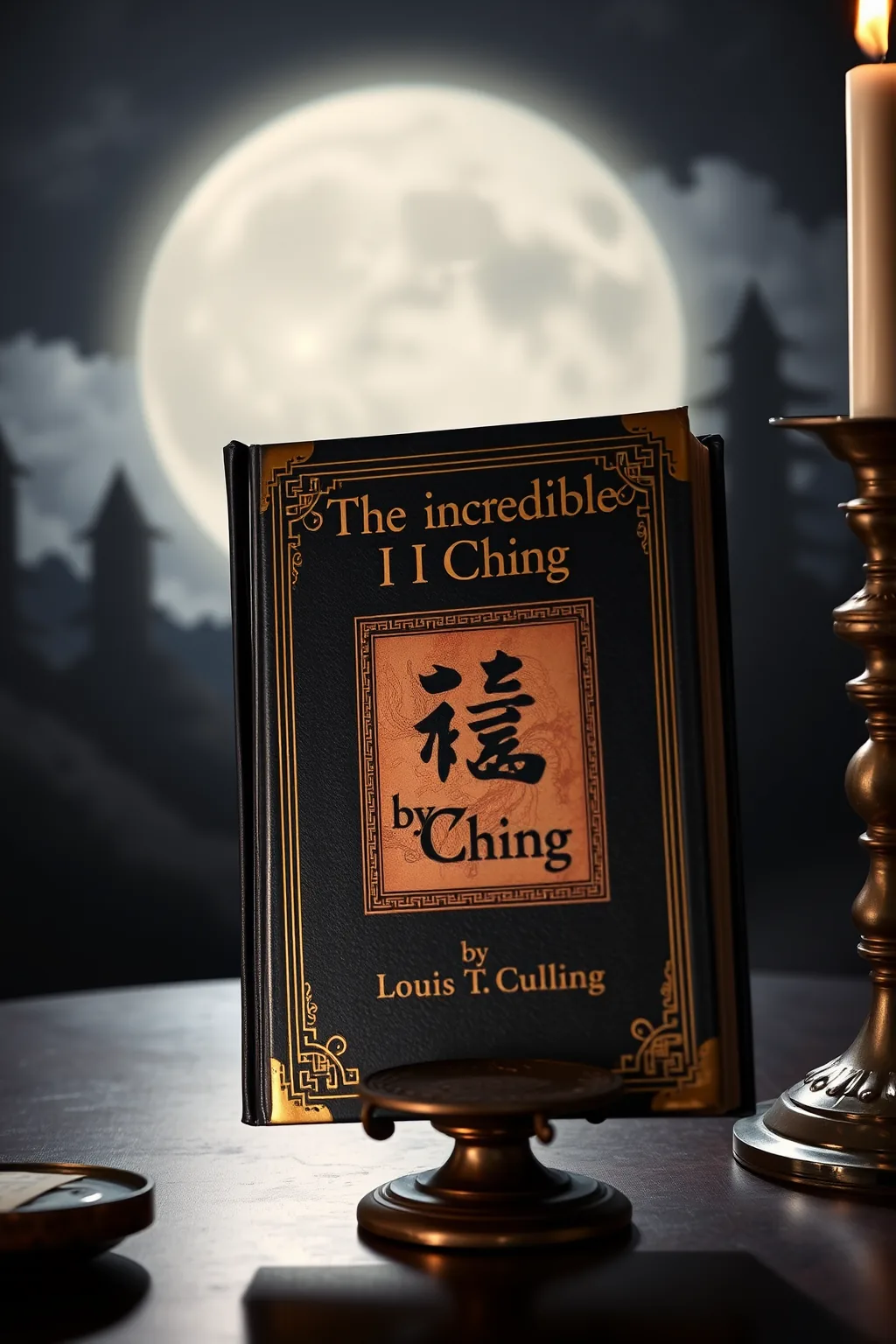
The incredible I Ching
 76
76

The incredible I Ching
Louis T. Culling’s “The Incredible I Ching” offers a refreshingly direct approach to a text often shrouded in academic and esoteric jargon. Unlike many dense commentaries, Culling’s 1969 publication prioritizes clarity, stripping away some of the philosophical layers to reveal the practical application of the hexagrams. The strength lies in its straightforward explanations of how to derive and interpret the readings, making it less intimidating for newcomers. However, this very directness can sometimes feel reductive. The nuanced interplay of trigrams and their deeper symbolic meanings, crucial to many traditional interpretations, receives less attention. A notable passage that exemplifies this is the simplified explanation of Hexagram 1, Qian (The Creative), focusing more on its 'advantageous' nature in consulting than its profound cosmological implications. It serves as a functional guide, but perhaps sacrifices some of the I Ching’s inherent poetic depth for accessibility. Ultimately, it’s a useful primer for those seeking a functional understanding of the hexagrams.
📝 Description
76
Louis T. Culling's 1969 book makes the I Ching accessible to Western readers.
The Incredible I Ching by Louis T. Culling serves as a practical introduction to the ancient Chinese divination system. Culling's work aims to clarify the hexagrams and their meanings, providing a structure for grasping the cyclical nature of existence and the balance of opposing forces. He breaks down the complex philosophical ideas into understandable parts, making the system approachable for those new to it.
This book is designed for people looking for a straightforward way to use the I Ching, whether for personal reflection, making decisions, or understanding its philosophical ideas more deeply. It is especially useful for readers who find standard translations difficult or too academic. Those interested in how ancient thought connects with Western esoteric traditions will find this a valuable resource. Culling's interpretation reflects a mid-20th century effort to adapt these old systems for a Western audience.
Published in 1969, this book appeared during a time when Western interest in Eastern philosophies grew significantly. It represents a mid-20th century attempt to interpret and synthesize systems like the I Ching for a Western audience, a trend seen among contemporaries focused on comparative religion and occult studies. Culling's approach situates the I Ching within a broader esoteric framework, connecting its principles to concepts familiar in Western mystical thought.
💡 Why Read This Book?
• Gain a functional understanding of the I Ching's 64 hexagrams, moving beyond abstract philosophy to practical interpretation as explained through Culling's 1969 framework. • Learn a concrete method for divination, focusing on the process of deriving hexagrams and interpreting their changing lines, as detailed within the book's instruction sections. • Appreciate the I Ching's core concepts of yin and yang through accessible explanations, understanding their role in cyclical change as presented by Louis T. Culling.
⭐ Reader Reviews
Honest opinions from readers who have explored this book.
❓ Frequently Asked Questions
When was 'The Incredible I Ching' first published?
The Incredible I Ching by Louis T. Culling was first published in 1969. This places its initial release during a period of significant Western interest in Eastern philosophies and esoteric studies.
What is the I Ching?
The I Ching, also known as the Book of Changes, is an ancient Chinese divination text and philosophical classic. It is based on a system of 64 hexagrams, each representing different states of being and change.
Who is Louis T. Culling?
Louis T. Culling was the author of 'The Incredible I Ching,' a work that sought to make the complex system of the I Ching more accessible to a Western audience upon its publication in 1969.
What are hexagrams in the I Ching?
Hexagrams are the fundamental symbols of the I Ching, each composed of six stacked lines. These lines are either solid (yang) or broken (yin), and their combinations, along with changing lines, form the basis of the divinatory system.
Is this book a traditional translation of the I Ching?
No, 'The Incredible I Ching' is not a direct translation but rather an interpretation and guide designed for Western readers. It focuses on practical application and understanding the hexagrams' meanings.
What is the purpose of the I Ching?
The I Ching is used for divination, seeking guidance on current situations, and understanding the flow of change. It offers insights into the dynamics of yin and yang and the cyclical nature of existence.
🔮 Key Themes & Symbolism
The Hexagram System
The book centers on the 64 hexagrams, the foundational symbols of the I Ching. Culling breaks down their construction from yin (broken) and yang (solid) lines, explaining how these binary elements combine to form complex patterns representing various states of reality. The work details how consulting the I Ching involves generating a specific hexagram, often through coin or yarrow stalk methods, to gain insight into a particular situation or question.
Yin and Yang Dynamics
Central to Culling's interpretation is the concept of yin and yang, the fundamental dual forces in Chinese philosophy. The book illustrates how these opposing yet complementary energies, represented by broken and solid lines respectively, are in constant interplay. Understanding their balance and movement within a hexagram is presented as key to interpreting the I Ching's messages about change, relationships, and natural processes.
Divination as Guidance
The Incredible I Ching frames the practice of consulting the I Ching not as fortune-telling, but as a method of gaining perspective and guidance. Culling explains how the hexagrams, particularly those with changing lines, offer advice on how to act or respond to circumstances. The book emphasizes using the I Ching's insights to align oneself with the natural flow of events, promoting wisdom and effective decision-making.
Cyclical Nature of Change
A pervasive theme is the I Ching's depiction of reality as a continuous process of change. The book interprets the hexagrams as snapshots of different phases within larger cycles. This perspective encourages readers to view challenges and opportunities as transient, fostering adaptability and resilience. The understanding of constant flux is presented as a core principle for navigating life's transformations.
💬 Memorable Quotes
Direct passages from the work, attributed to the author.
“The I Ching is not predicting the future, but showing the tendencies of the present.”
— This interpretation highlights the book's view of the I Ching as a tool for understanding current momentum and potential developments, rather than a deterministic prophecy. It suggests a focus on present actions and their likely outcomes.
“Each hexagram is a picture of a situation.”
— This concise statement underscores the visual and symbolic nature of the I Ching's core components. It frames the hexagrams as archetypal representations that can be applied to specific circumstances in the reader's life.
“Consult the I Ching when you need perspective, not just answers.”
— This interpretation suggests the I Ching's value lies in broadening one's viewpoint on a problem. It's presented as a method for gaining deeper comprehension and wisdom, rather than a simple solution provider.
“The balance of yin and yang dictates the character of the situation.”
— This interpretation points to the fundamental philosophical underpinnings of the I Ching. It explains that the relative strength and interaction of these two primal forces, as depicted in a hexagram, define the essence of the circumstance being examined.
💡 Key Ideas
Editorial paraphrase of the work's core concepts — not direct quotes.
Understanding the movement of lines is key to interpreting change.
This paraphrased concept emphasizes the dynamic aspect of the I Ching. It suggests that the transformation from one hexagram to another, indicated by changing lines, provides crucial information for discerning the unfolding of events.
🌙 Esoteric Significance
Tradition
While rooted in the ancient Chinese Taoist tradition, Culling's interpretation in "The Incredible I Ching" positions it within a broader Western esoteric framework. It aligns with Hermetic principles of correspondence and the understanding of universal laws governing change. The book acts as a bridge, translating the I Ching's complex symbolism and divinatory practices into terms more readily understood by those engaged in Western mystical studies, emphasizing its utility as a tool for self-knowledge and applied wisdom.
Symbolism
The primary symbols are the 64 hexagrams, each a composite of six lines, either solid (yang) or broken (yin). Culling interprets these lines and their combinations as representations of archetypal situations and forces. The book also implicitly utilizes the symbolism of yin and yang as fundamental dualities, mirroring concepts found in Gnostic and Hermetic thought, and explores the transformative potential inherent in the dynamic interplay between these forces.
Modern Relevance
Contemporary practitioners of modern divination systems, mindfulness, and psychological self-exploration often draw upon the I Ching's principles. Culling's accessible approach continues to be relevant for those interested in integrating ancient wisdom into daily life. Thinkers and groups exploring Jungian archetypes, systems thinking, and practical philosophy find value in the I Ching's framework for understanding cyclical patterns and psychological dynamics.
👥 Who Should Read This Book
• Aspiring diviners seeking a clear, step-by-step guide to consulting the I Ching, moving beyond theoretical discussions to practical application. • Students of comparative religion and philosophy interested in understanding the I Ching's place within Eastern thought and its cross-cultural reception. • Individuals exploring Western esoteric traditions who wish to integrate the insights of Chinese cosmology and divination into their existing practices.
📜 Historical Context
Published in 1969, Louis T. Culling's "The Incredible I Ching" arrived during a period of intense Western fascination with Eastern spirituality and philosophy. The counterculture movement embraced and reinterpreted traditions from India, China, and Japan, seeking alternatives to Western materialism. Figures like Alan Watts were popularizing Taoist and Buddhist thought, making texts like the I Ching increasingly sought after. While scholars like Richard Wilhelm had already provided influential translations, Culling’s work aimed for a more direct, less academic engagement, reflecting a broader trend of esoteric interpretation. This era saw a proliferation of books on divination and mysticism, sometimes divorced from their original cultural contexts, as Westerners explored new frameworks for understanding themselves and the universe. The reception was generally favorable among those seeking accessible esoteric knowledge, though it likely drew less attention from academic sinologists.
📔 Journal Prompts
The hexagrams as archetypes of situations.
Reflecting on the balance of yin and yang in a current challenge.
The I Ching's guidance on adapting to cyclical change.
Interpreting a specific changing line from a recent consultation.
The function of divination in seeking perspective.
🗂️ Glossary
Hexagram
A symbol composed of six stacked lines, used in the I Ching. Each line is either solid (yang) or broken (yin), and the 64 possible combinations represent various states and situations.
Line
The basic element of a hexagram, appearing as either a solid (yang) or broken (yin) stroke. Changing lines indicate a transition or transformation within the hexagram's meaning.
Yin
In Taoist philosophy, the passive, receptive, dark, and feminine principle. Represented by a broken line (--) in the I Ching.
Yang
In Taoist philosophy, the active, creative, light, and masculine principle. Represented by a solid line (—) in the I Ching.
Trigram
A symbol composed of three lines, forming the building blocks of a hexagram. There are eight basic trigrams, each with its own name and symbolism.
Divination
The practice of seeking knowledge of the future or the unknown by supernatural means, in this context, through the use of the I Ching.
Judgment
The interpretation or advice associated with each hexagram, offering guidance on how to act or understand the situation represented.
🔮 Readers Also Liked
Browse all →








More by Louis T. Culling
All books →
More Free Occult Philosophy Books
View all →