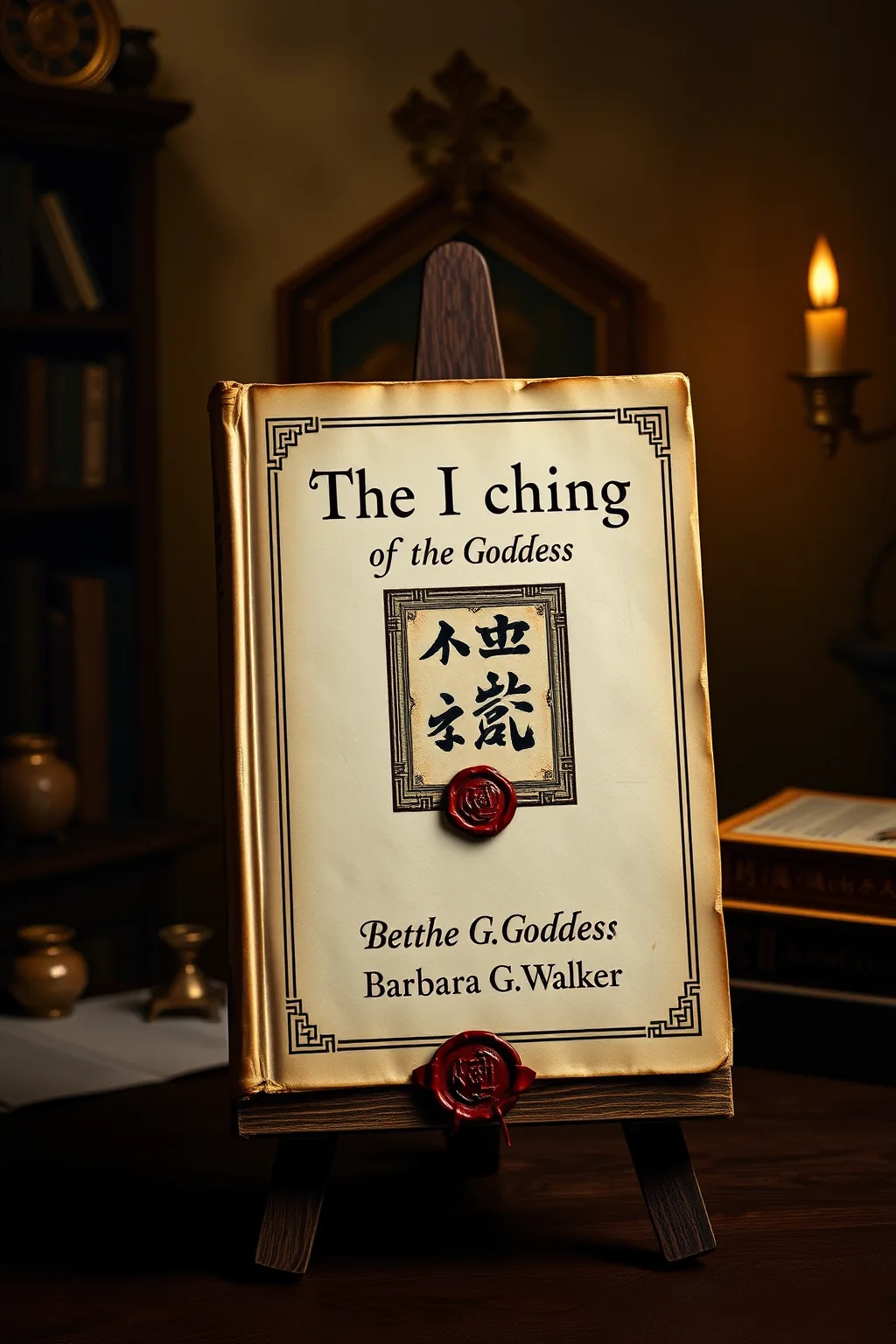
The I ching of the goddess
 80
80

The I ching of the goddess
Barbara G. Walker's "The I Ching of the Goddess" is an ambitious, if sometimes idiosyncratic, project that seeks to reclaim the ancient Chinese oracle for a modern, goddess-centered worldview. Walker’s extensive background in comparative mythology is evident, and her re-casting of the hexagrams to reflect matriarchal cycles offers a compelling alternative to traditional interpretations. The strength lies in its systematic reimagining and the rich mythological connections drawn to pre-patriarchal deities. However, the work occasionally strains to fit every hexagram into its predetermined framework, leading to interpretations that might feel less organic than others. A notable passage involves the reinterpretation of hexagram 1, Qian (The Creative), not as a masculine force, but as the primordial Void from which the Goddess emerges. This book is a valuable, though not universally accepted, contribution to feminist esoteric thought.
📝 Description
80
Barbara G. Walker's 2001 book reinterprets the I Ching through a feminist and matriarchal lens.
Barbara G. Walker's "The I Ching of the Goddess," published in 2001, offers a distinct reinterpretation of the ancient Chinese divination system. Walker reconfigures the traditional hexagrams and their imagery, aligning them with pre-patriarchal deities and archetypes. This work is for readers interested in comparative mythology, feminist spirituality, and alternative interpretations of divinatory tools. It seeks to illuminate the I Ching beyond its Confucian and Taoist frameworks, appealing to those drawn to goddess traditions and archaeo-feminist perspectives.
Walker's contribution emerged during a period of significant academic and spiritual re-evaluation of ancient mythologies. Her work builds upon earlier feminist scholarship that challenged patriarchal interpretations of history and religion. The book fundamentally reframes the sixty-four hexagrams, replacing the Yin and Yang binary with a Triadic Goddess principle. Each hexagram is re-evaluated for its potential connection to a Great Mother archetype, exploring themes of creation, destruction, and transformation through a feminine divine perspective.
This book situates itself within the broader esoteric tradition of reinterpreting ancient systems through contemporary spiritual lenses. It draws from feminist revisions of mythology and religion, particularly those that question patriarchal narratives. Walker's approach aligns with traditions that seek to uncover or reconstruct pre-patriarchal spiritual beliefs, connecting them to divination practices like the I Ching.
💡 Why Read This Book?
• Gain a novel perspective on the I Ching by exploring its reinterpretation through a Triadic Goddess principle, moving beyond the familiar Yin and Yang binary. • Understand how Walker connects ancient Chinese symbolism to pre-patriarchal matriarchal deities, offering a counter-narrative to patriarchal religious histories. • Discover alternative meanings for the sixty-four hexagrams, potentially enriching your personal divination practice with a focus on feminine archetypes and cycles.
⭐ Reader Reviews
Honest opinions from readers who have explored this book.
❓ Frequently Asked Questions
What is the primary difference between "The I Ching of the Goddess" and the traditional I Ching?
The core distinction lies in Walker's reinterpretation of the foundational principles. Instead of Yin and Yang, she centers a Triadic Goddess principle, re-envisioning the hexagrams and their meanings through a matriarchal and feminist lens.
Who was Barbara G. Walker and what is her background?
Barbara G. Walker was a prolific author and researcher known for her extensive work on comparative mythology and feminist spirituality. Her writings often explored ancient goddess traditions and challenged patriarchal interpretations of religious history.
When was "The I Ching of the Goddess" first published?
This particular work by Barbara G. Walker was first published in 2001, contributing to the late 20th and early 21st-century resurgence of interest in goddess-centered spirituality and alternative interpretations of ancient texts.
Does this book require prior knowledge of the I Ching?
While prior familiarity with the traditional I Ching can enhance understanding, Walker's reinterpretation is presented in a way that can be followed by readers new to the subject, provided they are open to her specific, goddess-focused framework.
What kind of deities are discussed in relation to the hexagrams?
The book frequently references pre-patriarchal deities and Great Mother archetypes, drawing connections to various ancient cultures and mythologies that Walker posits were originally centered around feminine divine figures.
Is this book a direct translation or interpretation of the original Chinese text?
No, it is not a direct translation. It is a creative reinterpretation and restructuring of the I Ching's symbolic system, viewed through the specific theoretical lens of feminist and matriarchal spirituality.
🔮 Key Themes & Symbolism
Matriarchal Reconfiguration of the I Ching
Walker systematically deconstructs the traditional I Ching's binary of Yin and Yang, proposing a Triadic Goddess principle as its foundational structure. She reassigns meanings and imagery to the sixty-four hexagrams, aligning them with archetypal feminine energies and pre-patriarchal creation myths. This approach seeks to reveal a hidden, goddess-centric layer within the ancient oracle, suggesting its original intent was rooted in feminine divine power and cycles of nature, rather than patriarchal hierarchies.
Goddess Archetypes and Mythology
The work extensively draws upon comparative mythology, linking the hexagrams to various manifestations of the Great Mother and Triple Goddess throughout ancient cultures. Walker explores how these divine feminine figures represent cosmic forces of birth, life, death, and rebirth. Each hexagram is presented as a potential reflection of a specific aspect or narrative related to these archetypes, offering a collection of mythological connections for the reader to explore.
Feminist Spirituality and Divination
"The I Ching of the Goddess" serves as a significant text within feminist spirituality, offering tools for personal and collective divination that center feminine power and perspectives. It challenges established patriarchal interpretations of sacred texts and practices, providing an alternative framework for understanding cosmic order and human experience through a goddess-centered lens. The book encourages readers to reclaim ancient wisdom for contemporary spiritual exploration.
Symbolic Reinterpretation
Walker re-examines the imagery and symbolism inherent in the I Ching's trigrams and hexagrams, imbuing them with new significance derived from matriarchal cosmologies. For instance, elements traditionally associated with masculine energy are recontextualized within feminine cycles of power. This process of symbolic reinterpretation is central to her argument, aiming to uncover a forgotten feminine lineage within the oracle's structure.
💬 Memorable Quotes
Direct passages from the work, attributed to the author.
“The Taoist Yin-Yang duality represents a relatively late and patriarchal imposition upon ancient concepts of the Goddess.”
— This interpretation posits that the widely accepted Yin and Yang cosmology of the I Ching is not its original form, but a later addition that reflects a patriarchal worldview, obscuring an earlier, feminine-centered understanding of the universe.
“Each hexagram can be seen as a different face or aspect of the primordial Mother.”
— This concept suggests that rather than representing abstract philosophical principles, the sixty-four hexagrams of the I Ching are best understood as symbolic representations of the diverse forms and functions of the Great Goddess.
“The cycles of nature—birth, growth, decay, and renewal—are the true basis of the I Ching's wisdom, reflecting the Goddess's dominion.”
— This highlights Walker's view that the fundamental wisdom of the I Ching is rooted in observable natural processes, which she connects directly to the inherent power and cyclical nature attributed to the divine feminine.
“The trigrams themselves can be reinterpreted to signify stages of the Goddess's life or power.”
— This focuses on the building blocks of the hexagrams, suggesting that the eight trigrams, when viewed through a matriarchal lens, represent specific phases or manifestations of the Goddess's creative and destructive forces.
“To understand the I Ching truly is to understand the power of the feminine principle in creation.”
— This statement captures the book's central thesis: that a genuine comprehension of the I Ching's profound meanings requires acknowledging and centering the role of the feminine as the primary creative force in existence.
🌙 Esoteric Significance
Tradition
Walker's work draws heavily from comparative mythology and feminist spirituality, positioning itself as a revisionist interpretation of a foundational Eastern esoteric text through a Western matriarchal lens. It departs from traditional Hermeticism and Kabbalah by prioritizing goddess-centric cosmologies and reinterpreting universal archetypes through a specifically feminine divine paradigm, challenging established patriarchal lineages within Western esotericism.
Symbolism
Key symbols include the Triadic Goddess, representing maiden, mother, and crone aspects, which Walker uses to supplant the Yin/Yang binary. The hexagrams themselves are re-symbolized, with each potentially representing a facet of the Great Mother's creative, destructive, or transformative power. The trigrams are also reinterpreted to signify stages or attributes of this divine feminine principle, shifting their traditional elemental and familial associations.
Modern Relevance
Contemporary practitioners of goddess spirituality, eco-feminist thinkers, and those engaged in alternative divination methods continue to find value in Walker's work. Her reinterpretation provides a framework for understanding ancient wisdom through a modern feminist lens, influencing discussions on reclaiming feminine divinity and challenging patriarchal narratives in spiritual and mythological studies.
👥 Who Should Read This Book
• Students of comparative mythology and ancient religions seeking alternative interpretations of Eastern spiritual traditions through a feminist lens. • Practitioners of divination interested in expanding their repertoire with a goddess-centered approach to the I Ching, moving beyond traditional interpretations. • Scholars and enthusiasts of feminist spirituality and matriarchal theory looking for texts that actively reconstruct ancient cosmologies and divine feminine archetypes.
📜 Historical Context
Published in 2001, "The I Ching of the Goddess" emerged from the fertile ground of late 20th-century feminist scholarship and the New Age spiritual movement. Barbara G. Walker's work was contemporaneous with scholars like Merlin Stone and Riane Eisler, who were actively reconstructing and advocating for the recognition of ancient matriarchal societies. While the traditional I Ching had been studied and adapted by Western esotericists for decades, Walker's specific focus on a Triadic Goddess principle and her systematic reinterpretation of all sixty-four hexagrams offered a novel departure. Her approach can be seen as a direct engagement with, and reorientation of, the symbolic language inherited from movements like Theosophy and Jungian archetypal psychology, but with a pronounced anti-patriarchal agenda. Reception within academic sinology was likely limited, given its overtly spiritual and revisionist nature, but within feminist and esoteric circles, it provided a significant alternative framework for divination and mythological study.
📔 Journal Prompts
The Triadic Goddess principle and its relation to the hexagrams.
Identify three hexagrams and reinterpret their meanings based on Walker's matriarchal framework.
How does the concept of the Great Mother archetype manifest in your understanding of cosmic order?
Reflect on the symbolism of the maiden, mother, and crone within the context of the I Ching's cycles.
Explore the implications of shifting from a Yin-Yang binary to a Triadic Goddess foundation for divination.
🗂️ Glossary
Triadic Goddess
A concept central to Walker's work, representing the divine feminine in its three primary manifestations: maiden, mother, and crone. This triad is proposed as the foundational principle replacing the Yin and Yang duality in the I Ching.
Matriarchal Reinterpretation
The process of analyzing and re-contextualizing the I Ching's structure and meanings through a lens that prioritizes feminine power, deities, and societal structures over patriarchal ones.
Pre-patriarchal Deities
Divine figures and archetypes believed to have been worshipped in societies preceding the dominance of patriarchal religious systems, often characterized by a focus on feminine creative and life-giving forces.
Hexagram
A symbol composed of six stacked horizontal lines, each line being either Yang (solid) or Yin (broken). In Walker's work, the traditional meanings are re-envisioned through her Triadic Goddess framework.
Trigram
A symbol composed of three single lines, each being either Yang or Yin. The eight trigrams form the basis for constructing the sixty-four hexagrams in the I Ching.
Great Mother
An archetypal representation of the divine feminine as the source of all creation, life, nurturing, and often destruction and rebirth, central to many ancient and goddess-based spiritual traditions.
Feminist Spirituality
A diverse spiritual movement that seeks to understand and revitalize the divine feminine, often challenging patriarchal religious structures and interpretations, and reclaiming goddess imagery and traditions.
🔮 Readers Also Liked
Browse all →









More by Barbara G. Walker
All books →



More Free Divination & Tarot Books
View all →