Henry Cornelius Agrippa's Fourth book of occult philosophy, and geomancy
 64
64

Henry Cornelius Agrippa's Fourth book of occult philosophy, and geomancy



Balthazar Finch (Senior Critic, Occult Philosophy): Agrippa's Fourth Book, a testament to the enduring power of occult science, is an indispensable artifact for any serious student of the esoteric. De Abano's careful compilation illuminates the intricate art of geomancy, a practice steeped in ancient wisdom and predictive power. The work masterfully navigates the complexities of celestial correspondences and elemental forces, offering profound insights into the hidden order of the universe. Its strength lies in its systematic approach to divination, making the seemingly inscrutable accessible to the dedicated practitioner. This is a text that rewards diligent study, essential for those seeking to unlock the deeper mysteries of causality and cosmic influence.
📝 Description
64
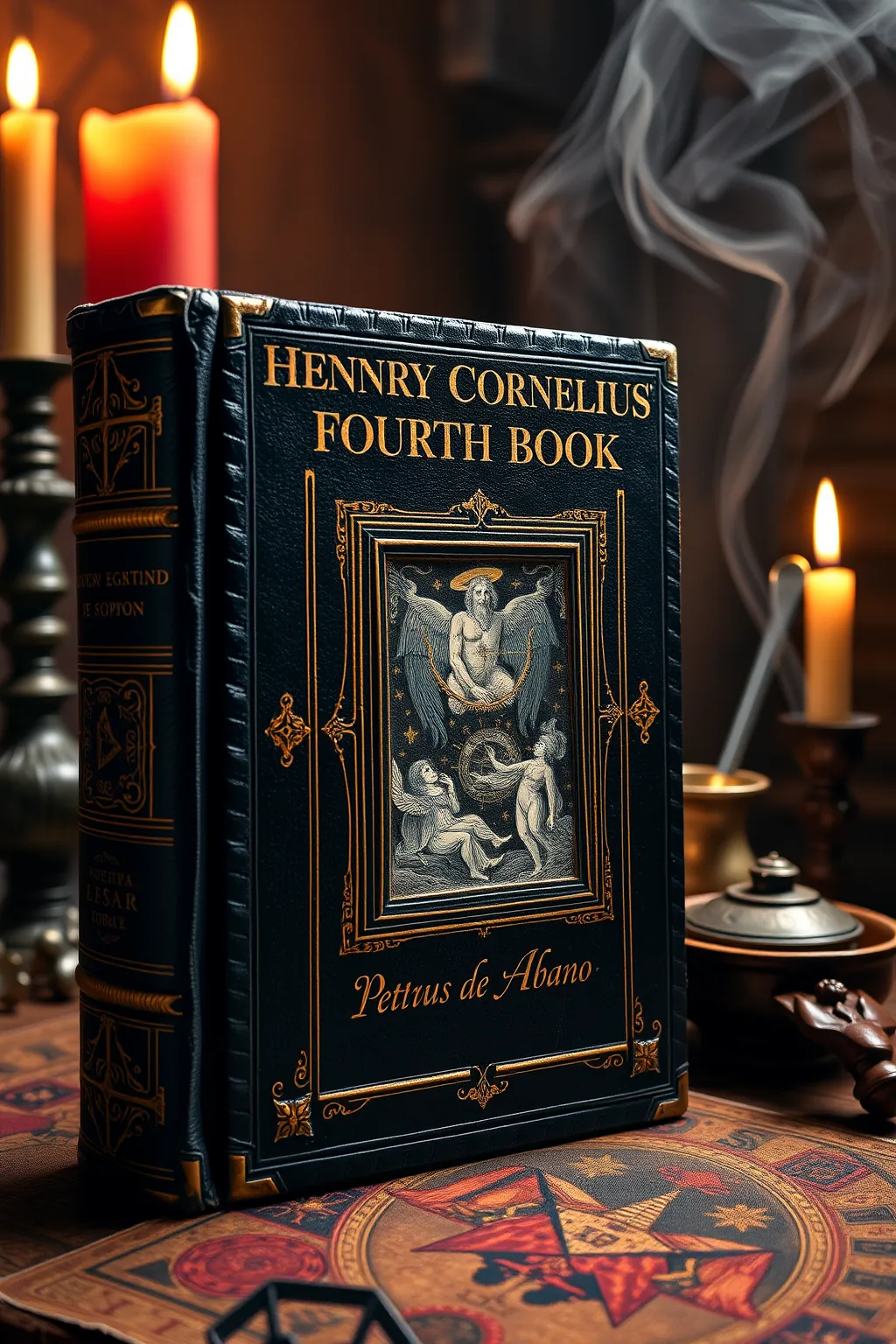
Petrus de Abano is credited with this 16th-century text on geomancy and occult philosophy.
This volume presents Agrippa's Fourth Book of Occult Philosophy and Geomancy, attributed to Petrus de Abano. It details methods of divination through geomancy, a practice involving the interpretation of figures derived from random markings. The book also covers angelic hierarchies and the influence of planets and elements on human affairs. Agrippa, known for his work in alchemy and philosophy, structures these teachings in a manner that attempts to blend traditional magical concepts with a systematic worldview.
The text aims to provide a framework for understanding the forces that connect the material and spiritual worlds. It discusses the symbolic language used in occult practices and the underlying principles believed to govern the cosmos. This work is intended for those who study magic and seek a deeper comprehension of the universe's structure and humanity's role within it.
This text belongs to the tradition of Renaissance magic, which sought to integrate Neoplatonic philosophy, Hermeticism, and Kabbalah with existing magical practices. Agrippa, drawing on sources like the Picatrix and the works of Marsilio Ficino, aimed to create a comprehensive system of natural magic. This book, in particular, focuses on geomancy, one of the oldest forms of divination, and its connection to other occult sciences. It reflects a period where scholars and practitioners attempted to find rational explanations for supernatural phenomena and establish a structured approach to magic.
💡 Why Read This Book?
Unveil the ancient secrets of geomancy, a powerful divinatory art that deciphers the will of the cosmos through earth patterns. Agrippa’s Fourth Book offers a structured path to understanding celestial influences and elemental forces, crucial for scholars of esoteric history, practitioners of ritual magic, and seekers of profound self-knowledge. It is a gateway to a more conscious engagement with the universe's hidden currents.
⭐ Reader Reviews
Honest opinions from readers who have explored this book.
❓ Frequently Asked Questions
What is the primary focus of this book?
The primary focus is on geomancy, a divinatory art that uses patterns derived from the earth to interpret future events and understand hidden influences. It also delves into the broader principles of occult philosophy and celestial correspondences.
Who is considered the true author?
While attributed to Petrus de Abano, the content is widely understood to be a compilation and elaboration of teachings by Henry Cornelius Agrippa, a prominent figure in Renaissance occultism.
Is this book suitable for beginners in the occult?
This text is advanced and requires prior knowledge of occult principles. It is best suited for serious students and practitioners who have a foundational understanding of esoteric concepts and symbolism.
What makes geomancy distinct from other divination methods?
Geomancy is unique in its reliance on terrestrial figures generated through a systematic process, often involving the casting of dice or drawing of dots. It connects earthly patterns to celestial influences and psychological states.
What kind of knowledge can one expect to gain?
Readers can expect to gain insights into the principles of sympathetic magic, the correspondences between the macrocosm and microcosm, angelic hierarchies, and practical methods for divination and spiritual understanding.
🔮 Key Themes & Symbolism
The Art of Geomancy
This section explores the profound practice of geomancy, a divinatory art that draws upon the earth's energies to reveal hidden truths and future possibilities. It details the systematic construction of geomantic figures, the interpretation of their symbolic meanings, and their connection to celestial influences and elemental forces. The text emphasizes geomancy as a sophisticated tool for understanding cosmic order and individual destiny, requiring not just mechanical execution but deep intuitive understanding and spiritual attunement.
Celestial Correspondences and Microcosm/Macrocosm
A central theme is the intricate web of correspondences that link the celestial realms to the earthly plane and the human soul. Agrippa elucidates how planetary positions, zodiacal signs, and stellar influences are mirrored within the human body (the microcosm) and the universe at large (the macrocosm). This understanding is crucial for comprehending the interconnectedness of all things and for harnessing these universal forces through magical practice and divination.
Angelic Hierarchies and Elemental Powers
The book explores the spiritual architecture of the cosmos, detailing the various orders of angels and their roles in governing the universe. It also explores the fundamental elemental powers – Fire, Air, Water, and Earth – and their interplay in shaping phenomena. Understanding these unseen forces and their angelic custodians is presented as essential for any practitioner seeking to engage with the divine and manipulate the subtle energies of existence.
💬 Memorable Quotes
Direct passages from the work, attributed to the author.
“Know thyself, and thou shalt know the universe.”
— Highlighting the Hermetic principle of 'As above, so below,' this suggests that by understanding the intricacies of one's own being, one can gain clear insights into the workings of the cosmos.
“The stars impel, they do not compel.”
— This emphasizes that while celestial bodies exert influence, human free will and conscious choice remain paramount in shaping destiny, offering a nuanced view of astrological determinism.
“Through the figures, the voice of the divine speaks.”
— This speaks to the core of geomancy, positing that the patterns generated are not random but are direct communications from higher powers, revealing divine will and guidance.
“Magic is the science of the hidden.”
— This concise definition expresses the essence of occult philosophy, framing magic as a systematic discipline dedicated to uncovering and working with the unseen forces and principles of reality.
💡 Key Ideas
Editorial paraphrase of the work's core concepts — not direct quotes.
The sensible world is but a shadow of the intelligible.
This quote underscores the Platonic concept that the physical reality we perceive is merely a reflection of a higher, more perfect, spiritual field of forms and essences.
🌙 Esoteric Significance
Tradition
This work is deeply rooted in the Hermetic and Neoplatonic traditions, synthesizing their philosophical underpinnings with practical magical applications. It embodies the Renaissance occultist's quest to understand the divine order of the cosmos through a systematic, symbolic language, bridging the gap between the spiritual and material realms.
Symbolism
The text is rich with symbolism, from the geometric purity of geomantic figures to the complex correspondences between planets, elements, and divine intelligences. Each symbol serves as a key, unlocking deeper layers of meaning and facilitating communion with the unseen forces that govern existence.
Modern Relevance
In an age often perceived as purely materialistic, Agrippa's Fourth Book offers a powerful counterpoint, reminding us of the interconnectedness of all things and the profound influence of subtle energies. Its principles of divination and symbolic interpretation remain relevant for those seeking to deepen their intuition and understand life's synchronicities.
👥 Who Should Read This Book
This esoteric treasure is indispensable for the dedicated scholar of Western esotericism, the practicing occultist seeking to refine their divinatory skills, and the philosophical seeker yearning to comprehend the hidden architecture of reality. While challenging, it offers invaluable insights for those with a foundational understanding of occult principles. Beginners are advised to approach with guidance, focusing initially on the core concepts of geomancy before exploring the more complex philosophical and angelic correspondences.
📜 Historical Context
Emerging from the fertile intellectual soil of the Renaissance, a period characterized by a fervent resurgence of interest in classical antiquity and esoteric traditions, Agrippa's Fourth Book represents an important moment in the codification of Western occultism. Written in the early 16th century, it reflects the era's syncretic approach, blending Neoplatonic philosophy, Hermeticism, Kabbalah, and Christian mysticism. This period saw scholars and practitioners actively seeking to reconcile ancient magical practices with emerging scientific thought, viewing the universe as an intricate, divinely ordered system accessible through rigorous study and specialized techniques. The book's influence extended far beyond its immediate circle, shaping the trajectory of magical theory and practice for centuries, becoming a foundational text for subsequent generations of occultists and philosophers.
📔 Journal Prompts
Reflect on a recent event and consider how a geomantic figure might interpret its underlying influences.
Explore the concept of 'As above, so below' in relation to your personal experiences and inner world.
Meditate on the elemental qualities of Fire, Air, Water, and Earth and how they manifest in your immediate environment.
Consider the 'stars impel, they do not compel' principle in a situation where you felt external pressure.
What hidden knowledge do you currently seek, and how might a symbolic approach aid your quest?
🗂️ Glossary
Geomancy
An ancient divinatory art that interprets patterns formed from the earth (or through systematic casting) to reveal insights into present conditions, future events, and hidden influences.
Microcosm
The belief that the human being is a smaller version of the universe, reflecting its structure and principles within themselves. 'As above, so below.'
Macrocosm
The universe as a whole, considered in its entirety and its grand, overarching order and structure.
Celestial Correspondences
The relationships and influences between heavenly bodies (planets, stars, zodiacal signs) and earthly phenomena, including human life and events.
Angelic Hierarchies
The ordered ranks or classes of angels as described in theological and mystical traditions, believed to govern different aspects of the cosmos and act as intermediaries between the divine and humanity.
This book appears in 4 collections
🔮 Readers Also Liked
Browse all →






From the “Occultism” Collection
View all →


![The Empire Of '' The City Of London'' [ World Superstate] Citi Bank nwo illuminati freemasons british-israel](/img/thumb/the-empire-of-the-city-of-london-world-superstate-citi-bank-nwo-illuminati-freemasons-british-israel.webp)



More Free Divination & Tarot Books
View all →