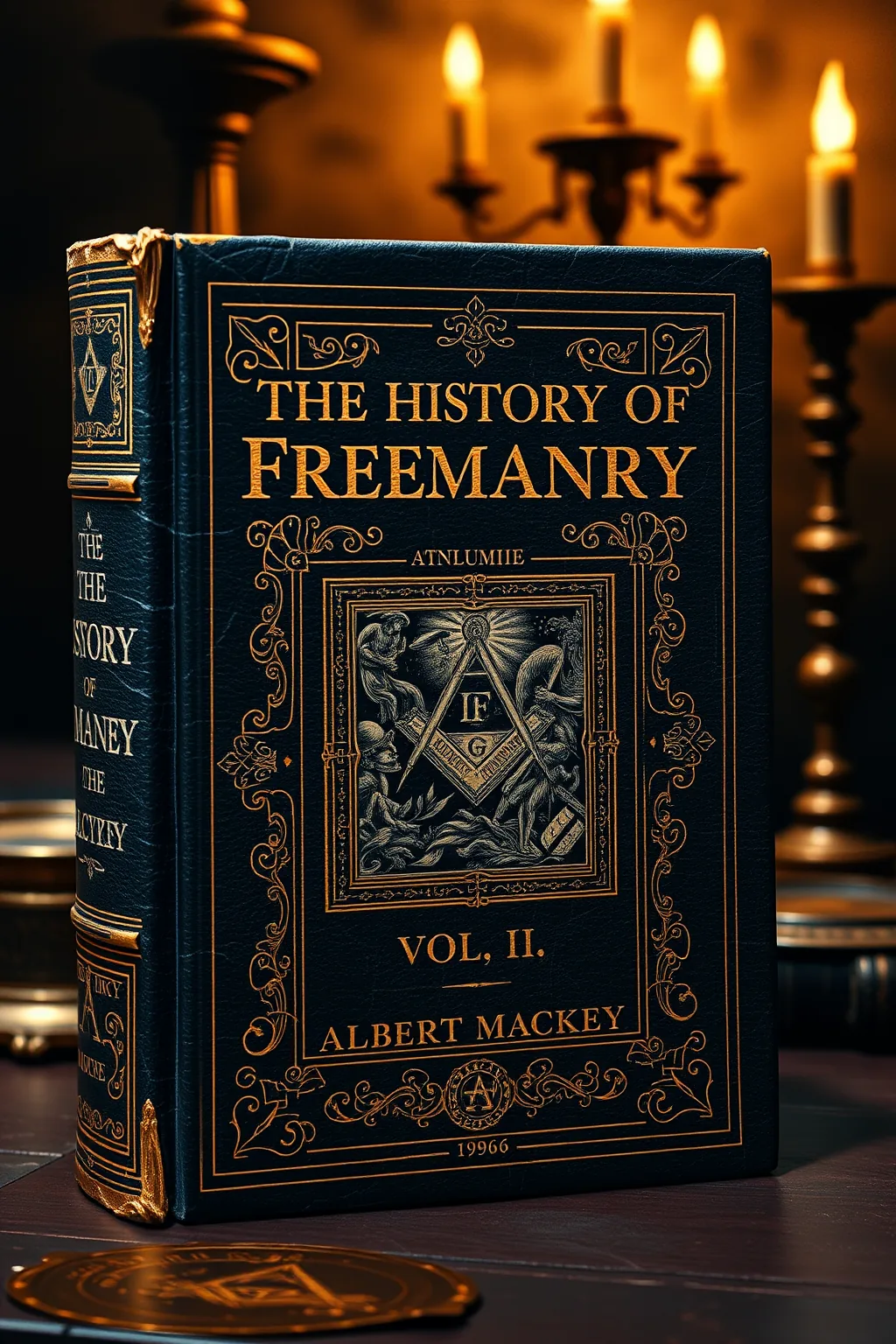
The History Of Freemasonry Vol. II by Albert Mackey - 1906
 74
74

The History Of Freemasonry Vol. II by Albert Mackey - 1906


Celeste Moreau (Divination & Symbolism Reviewer) — Albert Mackey's 'The History of Freemasonry, Vol. II' remains an indispensable beacon for serious students of esoteric traditions. This volume excels in its comprehensive exploration of Masonic symbolism, meticulously dissecting allegorical narratives and tracing their lineage through historical epochs. Mackey’s profound grasp of occult philosophy and his ability to articulate complex ideas with clarity make this a treasure trove of hidden knowledge. It is particularly valuable for those seeking to understand the philosophical underpinnings and mystical insights embedded within Masonic practice. Highly recommended for scholars, practitioners, and anyone drawn to the enduring mysteries of secret societies.
📝 Description
74
Albert Mackey's 1906 'The History of Freemasonry, Vol. II' details the evolution of Masonic ritual and philosophy.
This second volume of Albert Mackey's history focuses on the development of Masonic ritual and philosophy. Mackey examines the symbolic language and doctrines that have informed the fraternity over centuries. The text aims to connect Masonic practices with allegorical meanings and historical progression. It discusses the philosophical foundations and spiritual aims central to Freemasonry.
The book invites readers to understand the deeper aspects of Masonic thought. It presents a structured account of the fraternity's evolution, tracing its intellectual and spiritual lineage. Mackey's work serves as a detailed record for those interested in the historical and philosophical dimensions of Freemasonry.
Albert Mackey's work on Freemasonry places it within the broader tradition of Western esotericism. This tradition often seeks hidden meanings and spiritual correspondences within established systems, whether religious, philosophical, or fraternal. Mackey's analysis connects Masonic symbolism to these deeper currents, suggesting an underlying mystical or philosophical framework that transcends simple historical accounts. His approach aligns with esoteric scholarship that interprets symbols and rituals as keys to understanding human spiritual development.
💡 Why Read This Book?
Uncover the profound esoteric symbolism and hidden philosophical currents that define Freemasonry. This volume offers a deep dive into the allegorical language and ancient wisdom that have captivated seekers for generations. Ideal for scholars, practitioners, and anyone on a quest for deeper understanding of secret societies and their enduring influence on Western thought.
⭐ Reader Reviews
Honest opinions from readers who have explored this book.
❓ Frequently Asked Questions
What makes this volume particularly esoteric?
Mackey focuses on the symbolic language, allegorical interpretations, and philosophical underpinnings of Freemasonry, revealing the hidden knowledge and spiritual aspirations central to its esoteric dimension.
Is this book suitable for beginners?
While dense with information, it serves as an excellent foundational text for those seriously interested in understanding the esoteric aspects of Freemasonry, though prior exposure to related subjects may enhance comprehension.
What historical period does Volume II primarily cover?
Volume II typically delves into the later periods of Freemasonry's development, exploring the evolution of its rituals, philosophical interpretations, and the establishment of various rites and degrees.
Does this book discuss specific Masonic rituals?
Yes, Mackey extensively analyzes and interprets the symbolism and philosophical significance embedded within various Masonic rituals and degrees, offering insights into their esoteric meanings.
What is the primary focus of Albert Mackey's writing?
Albert Mackey's primary focus is on the history, philosophy, and symbolism of Freemasonry, seeking to uncover its ancient origins and esoteric doctrines through rigorous scholarship.
🔮 Key Themes & Symbolism
The Alchemical Allegory in Masonic Ritual
This volume meticulously unravels the profound connections between Masonic degrees and the ancient art of alchemy. Mackey illuminates how the symbolic language of transmutation, purification, and the pursuit of the Philosopher's Stone is woven into the very fabric of Masonic rituals and teachings. It suggests that the Masonic journey is an inner alchemical process, aimed at transforming the profane into the enlightened, mirroring the alchemist's quest for spiritual perfection and material creation.
Gnostic Roots and Esoteric Lineages
Mackey explores the potential Gnostic influences and connections within the historical development of Freemasonry, highlighting shared themes of hidden knowledge, divine spark, and the path to spiritual liberation. This section explores the esoteric lineages that may have contributed to Masonic symbolism, suggesting a continuity of ancient wisdom traditions that emphasize the pursuit of gnosis – direct, intuitive knowledge of the divine.
The Geometry of the Divine and Sacred Architecture
This theme examines how Freemasonry utilizes principles of geometry and sacred architecture as metaphors for the divine order and the construction of the inner temple. Mackey reveals how concepts of measurement, proportion, and symmetry in Masonic symbolism represent the underlying cosmic laws and the blueprint of creation, inviting the initiate to perceive the divine architect behind the manifest universe.
💬 Memorable Quotes
Direct passages from the work, attributed to the author.
“Every degree is a step on the ladder of spiritual ascent.”
— This highlights the progressive nature of Masonic initiation, framing each level of advancement as a crucial stage in the aspirant's journey towards higher consciousness and self-realization.
“True Masonry lies not in ceremony, but in the cultivation of virtue.”
— This emphasizes the ethical and moral core of Freemasonry, suggesting that outward ritual is secondary to the internal development of character and the practice of virtuous living.
“The ancient mysteries whisper through the symbols of the Craft.”
— This evocative statement connects Freemasonry to a lineage of ancient esoteric traditions, implying that its symbols are conduits for preserving and transmitting timeless spiritual wisdom.
💡 Key Ideas
Editorial paraphrase of the work's core concepts — not direct quotes.
The symbols of Freemasonry are keys to unlock the hidden doors of wisdom.
This quote emphasizes the symbolic nature of Masonic teachings, suggesting that their true meaning is not superficial but requires diligent study and contemplation to reveal profound spiritual truths.
The Temple of Solomon is not merely a building, but a representation of the soul.
This quote points to the allegorical interpretation of Masonic narratives, asserting that the physical structures described are symbolic representations of the inner, spiritual edifice of the human being.
🌙 Esoteric Significance
Tradition
This work is deeply rooted in the Western Esoteric Tradition, specifically within the framework of Hermeticism, Alchemy, and Gnosticism, as they intersect with Freemasonry. Mackey elucidates how these ancient streams of wisdom are encoded within Masonic symbolism and ritual, presenting Freemasonry not merely as a social or fraternal organization, but as a vehicle for transmitting profound spiritual knowledge and facilitating personal transformation.
Symbolism
The text is a body of Masonic symbolism, meticulously analyzed and interpreted. Key symbols such as the Square and Compasses, the All-Seeing Eye, the Letter 'G', and the tools of operative stonemasons are presented not just as emblems, but as potent vehicles for conveying complex philosophical and spiritual concepts related to morality, the cosmos, and the divine.
Modern Relevance
In an age often characterized by superficiality, Mackey's exploration of Freemasonry's esoteric dimensions offers a compelling call to deeper inquiry and self-reflection. The emphasis on moral development, the pursuit of truth, and the understanding of universal principles remains profoundly relevant for contemporary seekers interested in personal growth and the exploration of hidden wisdom traditions. It provides a historical anchor for understanding enduring quests for meaning.
👥 Who Should Read This Book
This volume is a vital resource for Masonic scholars seeking a deeper understanding of their Craft's philosophical and historical underpinnings. Esoteric practitioners and students of Western mystery traditions will find it useful for its insights into the symbolic language and ancient wisdom encoded within Freemasonry. Beginners curious about secret societies and their esoteric dimensions will discover a comprehensive and authoritative introduction. Anyone interested in the intersection of history, philosophy, and spirituality will find this work informative and thought-provoking.
📜 Historical Context
Published in 1906, 'The History of Freemasonry, Vol. II' emerges from an era of burgeoning interest in occultism, spiritualism, and comparative religion. The late Victorian and Edwardian periods saw a resurgence of scholarly and popular fascination with ancient mysteries, secret societies, and esoteric philosophies. Albert Mackey, a prominent Masonic scholar, was deeply embedded in this intellectual milieu. His work reflects the era's desire to trace the origins of fraternal organizations back to antiquity, seeking to imbue them with a sense of profound, timeless wisdom. The book's detailed exploration of symbols and rituals aligns with a broader cultural trend of seeking hidden meanings and spiritual truths in historical artifacts and traditions, making it a significant contribution to the esoteric literature of its time and a valuable lens through which to view the intellectual currents of early 20th-century esotericism.
📔 Journal Prompts
Reflect on a Masonic symbol discussed in this volume and its personal resonance with your own spiritual journey.
How does Mackey's interpretation of a specific ritual shed light on the concept of 'hidden knowledge' for you?
Consider the potential Gnostic or Hermetic influences described. How do these ancient philosophies manifest in your understanding of the world today?
Mackey speaks of Freemasonry as a path to self-transformation. What 'inner alchemy' might be suggested by the teachings presented in this volume?
Analyze the concept of the 'divine architect' as presented by Mackey. What does this archetype signify in your personal worldview?
🗂️ Glossary
Gnosis
In esoteric traditions, gnosis refers to direct, intuitive knowledge of spiritual truths, often achieved through mystical experience rather than empirical reasoning. It signifies a profound understanding of the divine and one's place within the cosmos.
Hermeticism
A philosophical and religious tradition based on the purported teachings of Hermes Trismegistus, emphasizing esoteric knowledge, the unity of all things, and the principle of 'as above, so below'. It profoundly influenced Western esotericism.
Alchemy
An ancient proto-scientific and philosophical tradition focused on the transformation of matter, particularly the transmutation of base metals into gold, but also understood as a spiritual allegory for the purification and perfection of the human soul.
Allegory
A literary or symbolic representation in which characters, events, and settings represent abstract ideas or moral qualities. Masonic teachings often employ allegory to convey profound spiritual lessons.
Esotericism
Teachings or practices that are intended for or understood by only a small number of people with a specialized knowledge or interest. It often involves hidden meanings, mystical insights, and spiritual development.
This book appears in 2 collections
🔮 Readers Also Liked
Browse all →



From the “Secret Societies” Collection
View all →


More Free Freemasonry & Secret Societies Books
View all →