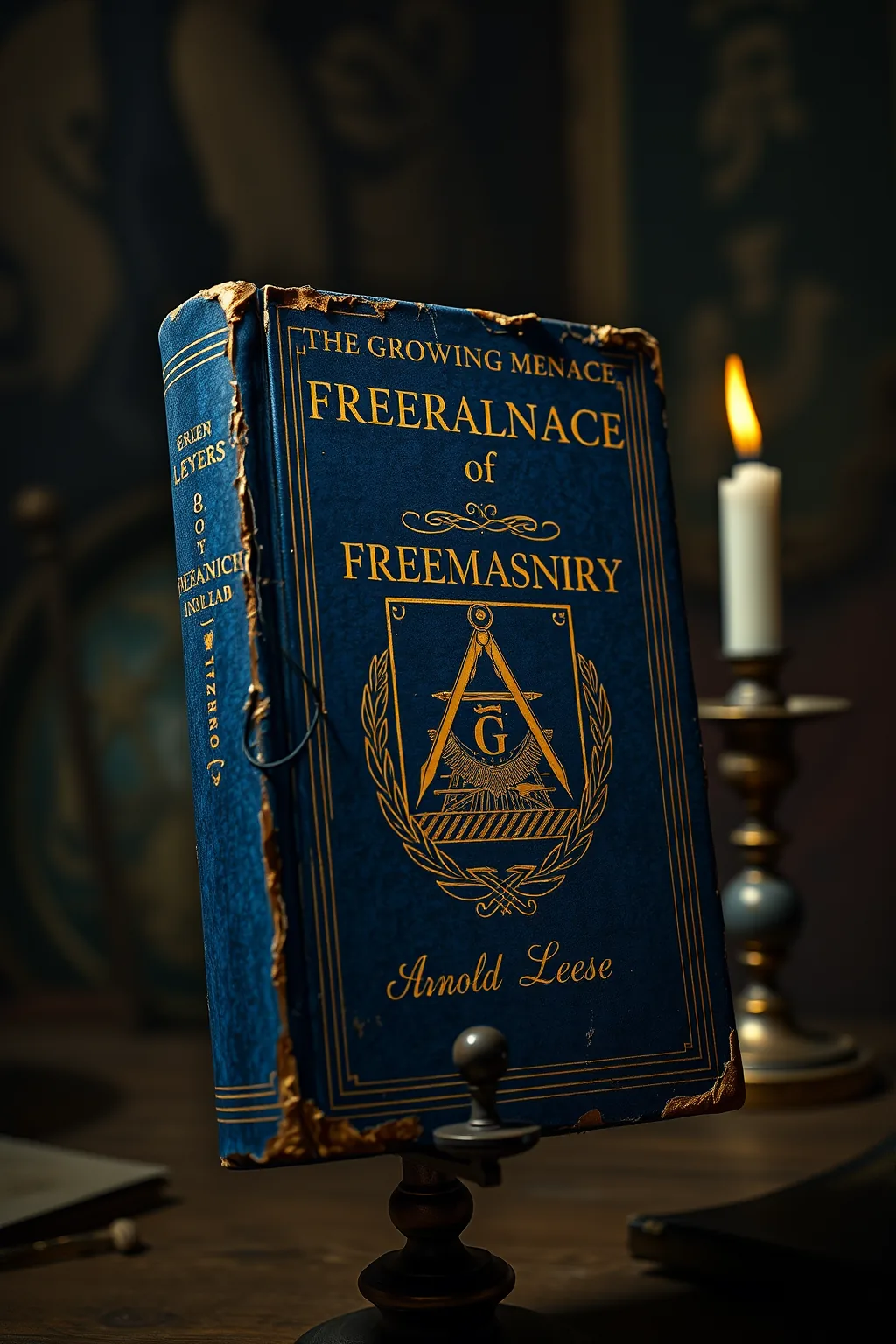
The Growing Menace of Freemasonry in Britain - Arnold Leese
 72
72

The Growing Menace of Freemasonry in Britain - Arnold Leese


Arnold Leese's "The Growing Menace of Freemasonry in Britain" is a potent and provocative examination of a society often shrouded in mystery. Leese, writing with a fervent conviction, pulls back the veil on what he perceives as the pervasive influence of Freemasonry. Esoteric scholars will find his analysis of Masonic symbolism and alleged hidden agendas particularly compelling, offering a unique, albeit critical, lens through which to view the organization's historical impact. While controversial, the book serves as a vital document for understanding traditionalist critiques of secret societies and their perceived role in shaping political and social structures. It’s a challenging read for those seeking a deeper understanding of power dynamics and esoteric influence, urging critical engagement with the unseen forces that may shape our world.
📝 Description
72
Arnold Leese published "The Growing Menace of Freemasonry in Britain" in 1936, detailing perceived Masonic influence.
Arnold Leese's 1936 book, "The Growing Menace of Freemasonry in Britain," presents a critical examination of Freemasonry. Leese argues that the organization exerts a significant, often hidden, influence on British society and its institutions. He details specific aspects of Masonic practice, including rituals and symbolism, which he believes are employed to maintain and expand this influence. The book functions as an alert to the public, urging awareness of what Leese describes as subtle but widespread control mechanisms. It appeals to individuals interested in uncovering what they perceive as concealed operations behind political and social structures.
Leese's writing aims to provoke thought about the nature of power, the role of secret knowledge, and the lasting impact of organized esoteric groups. The text is positioned for readers who are drawn to investigations of clandestine societies and their alleged impact on historical and contemporary events. It offers a particular viewpoint on the ongoing debates surrounding societal control and influence.
This work fits within a tradition of anti-establishment and conspiracy literature that often intersects with esoteric thought. Such writings frequently focus on secret societies, viewing them as hidden powers manipulating global or national affairs. The analysis of symbols, rituals, and alleged hidden doctrines aligns with esoteric approaches to understanding secret knowledge and its application. Leese's perspective reflects a concern with concealed hierarchies and their impact, a common theme in esoteric critiques of existing power structures.
💡 Why Read This Book?
This book is essential for seekers of hidden knowledge and scholars of esoteric traditions who wish to understand critical perspectives on Freemasonry. Leese's work provides a unique, albeit controversial, viewpoint on the perceived influence of secret societies on public life. It's ideal for those interested in traditional politics, alternative histories, and the study of symbolic orders that have shaped societal structures.
⭐ Reader Reviews
Honest opinions from readers who have explored this book.
❓ Frequently Asked Questions
What is the primary focus of Arnold Leese's critique of Freemasonry?
Leese's primary focus is on the alleged pervasive and often hidden influence of Freemasonry on British society and politics, which he views as a growing threat to traditional order and sovereignty.
Does the book delve into Masonic rituals and symbolism?
Yes, Leese dedicates significant attention to dissecting what he interprets as the esoteric symbolism, rituals, and doctrines of Freemasonry, presenting them as evidence of its clandestine agenda.
Who is the intended audience for this book?
The book is intended for readers interested in the critical study of secret societies, traditionalist political thought, and those seeking to understand alternative interpretations of historical and societal influences.
Is this book a neutral academic study?
No, Leese's work is a highly opinionated and critical exposé, written from a specific ideological standpoint. It is not a neutral academic study but a polemic against Freemasonry.
What is the 'traditional politics' aspect mentioned in the subjects?
It refers to a political philosophy that emphasizes established hierarchies, traditional institutions, and often views secret societies as subversive forces that undermine these traditional structures.
🔮 Key Themes & Symbolism
The Veiled Hand of Power
This theme explores Leese's central argument: that Freemasonry operates as a clandestine network, subtly manipulating political and social structures from behind the scenes. It examines how hidden knowledge, secret oaths, and a shared esoteric understanding are posited as the tools through which this influence is maintained, impacting national discourse and decision-making without overt public accountability. The narrative suggests an ancient, persistent force working through modern institutions.
Symbolism as Subversion
Leese meticulously deconstructs Masonic symbols, interpreting them not as benign allegories but as coded messages and markers of an exclusive, hierarchical knowledge system. This theme explores how these symbols are allegedly used to indoctrinate members, communicate covertly, and reinforce a sense of separate identity and purpose, distinct from the broader societal good. It highlights the perceived danger in symbols that are understood only by initiates, creating a hidden layer of meaning and control.
The Erosion of Traditional Order
Central to Leese's thesis is the idea that Freemasonry actively undermines established, traditional forms of governance and social cohesion. This theme examines his concern that Masonic ideals and practices are inherently antithetical to a divinely ordained or historically validated social hierarchy, promoting instead a form of universalism or egalitarianism that he believes weakens national identity and moral fortitude. The book presents a stark warning about societal decay stemming from the infiltration of such secret orders.
💬 Memorable Quotes
Direct passages from the work, attributed to the author.
“They build their temples not of stone, but of influence.”
— This evocative phrase suggests that Freemasonry's true power lies not in physical structures but in its ability to exert subtle control and shape events through its members' positions and connections.
“A chain is only as strong as its weakest link, and their chain is forged in secrecy.”
— This emphasizes Leese's belief that the strength of Freemasonry lies in its clandestine nature, suggesting that its power is derived from its hidden connections and the inability of outsiders to fully comprehend its structure.
“The compass and square are not merely tools, but ensigns of a hidden dominion.”
— This interprets familiar Masonic symbols as markers of a secret authority and a claim to rule or influence that extends beyond the visible world.
💡 Key Ideas
Editorial paraphrase of the work's core concepts — not direct quotes.
The apron is a symbol of labour, but it is also a symbol of initiation.
This quote highlights Leese's interpretation of Masonic symbols as having dual meanings: one public and benign, the other hidden and significant, relating to the secret knowledge and progression within the order.
The light they seek is not the light of truth for all, but the exclusivity of knowledge for the few.
This quote captures Leese's view that Masonic 'enlightenment' is a private, secretive affair, intentionally withheld from the general populace, fostering an elite understanding.
🌙 Esoteric Significance
Tradition
Leese's work is deeply rooted in a particular strand of anti-Masonic thought that often draws upon apocalyptic and conspiratorial interpretations of esoteric traditions. While critiquing Freemasonry, his framework implicitly engages with concepts of hidden knowledge, spiritual hierarchies, and the perceived battle between forces of light and darkness, often framed within a traditionalist or religious worldview that sees Freemasonry as a manifestation of opposing forces.
Symbolism
The book's core lies in its interpretation of Masonic symbols. Leese views symbols like the square, compass, apron, and various geometric figures not as mere operative tools or allegorical aids, but as potent emblems of a hidden, hierarchical system of knowledge and power. He analyzes them as keys to understanding the alleged intentions and structure of the organization, believing they reveal a deeper, often sinister, agenda concealed from the uninitiated.
Modern Relevance
Despite its historical context, Leese's critique appeals to contemporary concerns about transparency, influence, and the power of elite networks. For those interested in critical analyses of power structures, the enduring mystery surrounding certain organizations, and the role of symbolism in shaping perception, the book offers a historical case study. It prompts reflection on whether similar dynamics of hidden influence and esoteric communication persist in modern society.
👥 Who Should Read This Book
This book is recommended for seasoned researchers of secret societies, scholars of esoteric movements, and practitioners of critical thinking who are interested in understanding a historical and highly critical perspective on Freemasonry. It is particularly relevant for those engaged with traditionalist political thought and the study of historical conspiracy theories. While not for the faint of heart or those seeking simple answers, it offers a deep dive into one individual's fervent interpretation of hidden power structures.
📜 Historical Context
Written during a period of significant social and political upheaval in Britain, "The Growing Menace of Freemasonry" reflects the anxieties and suspicions prevalent in certain circles regarding secret societies and their perceived influence. The early to mid-20th century saw a heightened awareness of organized groups operating outside mainstream public scrutiny, fueled by events like the rise of totalitarian regimes and the aftermath of World War I. Leese's work taps into a long tradition of anti-Masonic sentiment, often rooted in fears of subversion of established religious, monarchical, or nationalistic orders. The book's traditionalist political stance aligns with conservative reactions to modernity, secularism, and perceived liberal erosions of societal norms, positioning Freemasonry as a symbol of these threatening changes.
📔 Journal Prompts
How might 'hidden knowledge' influence societal structures, even without overt control?
In what ways can symbols be used to create both inclusion for initiates and exclusion for outsiders?
What are the historical roots of suspicion towards organized, non-transparent groups?
How does the concept of 'traditional order' differ from modern societal ideals, and why might groups like Freemasonry be seen as a threat to it?
Reflect on the idea of 'influence' versus 'direct power' in shaping public affairs.
🗂️ Glossary
Esoteric
Relating to or accessible only by a relatively small number of people with a specialized knowledge or interest; intended for or likely to be understood by only a small number of people with a specialized knowledge or interest.
Arcane
Understood by few; mysterious or secret. Often used to describe knowledge or practices considered to be profound or obscure.
Symbolism
The use of symbols to represent ideas and qualities by giving them symbolic meanings that are different from their literal sense.
Traditionalism
A political or religious philosophy that emphasizes the importance of tradition and established institutions, often viewing modern changes with suspicion.
Exposé
A revelation of the facts about something, typically something illicit or scandalous. In this context, a critique revealing perceived hidden activities.
This book appears in 2 collections
🔮 Readers Also Liked
Browse all →









More by Arnold Leese
All books →
From the “Secret Societies” Collection
View all →





More Free Freemasonry & Secret Societies Books
View all →