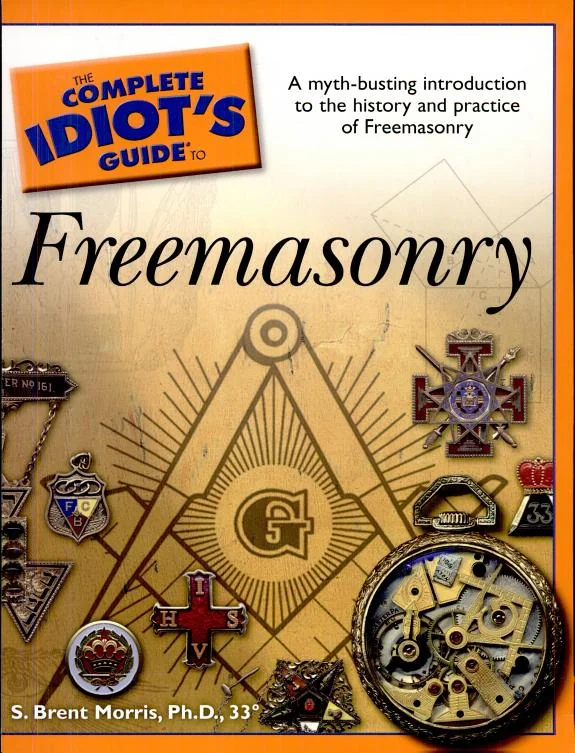
The Complete Idiot's Guide to Freemasonry
 77
77

The Complete Idiot's Guide to Freemasonry
S. Brent Morris's "The Complete Idiot's Guide to Freemasonry" tackles a subject riddled with speculation and folklore. Morris, a 33rd Degree Mason and respected Masonic scholar, brings a degree of authority to the text that is palpable. The book's strength lies in its systematic dismantling of sensationalist myths. For instance, the section addressing the purported link between Masons and the Boston Tea Party offers a grounded, historical perspective that cuts through the usual hyperbole. However, the 'Complete Idiot's Guide' format, while aiming for accessibility, occasionally simplifies complex philosophical concepts to a degree that might dissatisfy seasoned occultists or historians seeking deeper nuance. The work explores the Masonic insistence on a Supreme Being, a concept central to the fraternity, but the exploration remains introductory. Morris manages to present a vast amount of information without resorting to the most common clichés, a commendable feat. It serves as a solid primer, if not an exhaustive treatise.
📝 Description
77
S. Brent Morris's 2005 guide aims to clarify Freemasonry's history, rituals, and principles for a general audience.
Published in 2005, S. Brent Morris's guide offers a straightforward look at Freemasonry, a fraternal organization with a long history. The book addresses common misunderstandings and conspiracy theories by presenting information based on historical research and Masonic traditions. It covers the fraternity's origins, which are debated but often linked to medieval stonemasons, and its formal establishment in the early 18th century. The text discusses how the Enlightenment influenced Masonic ideas and how the organization spread throughout Europe and the Americas, sometimes alongside major historical events.
Morris explains fundamental Masonic beliefs, such as faith in a Supreme Being, the importance of moral conduct, and the use of allegory and symbolism drawn from the building trades. The book details the organization of Masonic lodges, the system of progression through degrees, and the philosophical basis of its teachings. It also examines connections to other historical groups, like the Knights Templar, distinguishing historical evidence from speculation. The guide is written for anyone curious about Freemasonry, from complete beginners to existing members seeking a clearer understanding of their fraternity's background.
Freemasonry, often categorized within esoteric traditions, draws on symbolism and allegory related to operative masonry and ancient mystery schools. This book situates the fraternity's practices within a historical and philosophical framework, touching on themes of moral instruction and spiritual development through symbolic degrees. While not a deep dive into occultism, it explains the structure and conceptual underpinnings that lend Freemasonry its character as a society with esoteric elements, distinguishing its actual teachings from popular myths.
💡 Why Read This Book?
• Gain clarity on Freemasonry's historical roots, understanding the debates surrounding its origins from operative stonemasons to alleged ancient connections, providing context beyond sensationalist theories. • Learn about the foundational principles and symbolism of Freemasonry, such as the belief in a Supreme Being and the use of allegorical tools, as presented in the book's exploration of key concepts. • Differentiate between historical fact and persistent myth regarding Masonic involvement in events like the American Revolution, offering a critical perspective on popular conspiracy narratives.
⭐ Reader Reviews
Honest opinions from readers who have explored this book.
❓ Frequently Asked Questions
What are the primary myths about Freemasonry that "The Complete Idiot's Guide to Freemasonry" addresses?
The book confronts widespread myths, including claims about Freemasonry's ancient origins in Egypt or Babylon, its supposed role in orchestrating major historical events like the American Revolution, and its connection to groups like the Knights Templar.
Does "The Complete Idiot's Guide to Freemasonry" explain the requirement of believing in a Supreme Being?
Yes, the guide details the Masonic requirement for a belief in a Supreme Being, explaining it as a fundamental principle that unites members across different faiths without dictating specific doctrines.
What historical period is most associated with the formal establishment of Freemasonry according to the book?
While exploring earlier theories, the book points to the early 18th century as the period when Freemasonry, as a structured fraternal organization with formal lodges and rituals, became widely established.
Is the book suitable for someone with no prior knowledge of Freemasonry?
Absolutely. The 'Complete Idiot's Guide' format is designed for beginners, breaking down complex history, symbols, and principles into easily understandable terms without assuming prior familiarity.
Does S. Brent Morris discuss the relationship between Freemasonry and the Knights Templar?
Yes, the work explores the alleged connections between Freemasonry and the Knights Templar, distinguishing between historical evidence and later associations or speculative theories that have arisen over centuries.
What role does symbolism play in Freemasonry as described in the book?
The guide explains that Freemasonry utilizes a rich system of symbolism, often drawn from the tools and practices of operative stonemasons, to teach moral and philosophical lessons through allegory.
🔮 Key Themes & Symbolism
Myth vs. Reality
The work meticulously separates verifiable historical accounts from centuries of speculation and conspiracy theories surrounding Freemasonry. It addresses sensational claims about ancient origins, secret world control, and connections to fringe groups, presenting a grounded perspective. The book clarifies that while Freemasonry has evolved, its core tenets and historical trajectory are distinct from many popular, often unfounded, narratives that have attached themselves to the fraternity over time.
Masonic Principles and Ethics
Central to the guide is an exploration of the ethical and philosophical framework that underpins Freemasonry. It emphasizes the requirement for belief in a Supreme Being as a unifying, non-denominational principle and details how Masonic teachings use allegory and symbolism, particularly from stonemasonry, to impart lessons on morality, brotherhood, and self-improvement. The focus is on the practical application of these virtues in daily life.
Historical Development
The book traces the formal development of Freemasonry, particularly from its roots in operative guilds to its transformation into a speculative fraternity in the early 18th century. It examines the fraternity's spread during the Enlightenment, its engagement with societal changes, and its role in significant historical movements, such as the American Revolution, providing factual context for these associations.
Symbolism and Ritual
Freemasonry's rich symbolic language is a key theme. The guide explains how symbols, often derived from the tools and practices of medieval stonemasons, serve as allegorical devices to convey moral and spiritual lessons. It touches upon the structure of Masonic degrees and rituals, presenting them not as arcane secrets but as vehicles for personal growth and understanding within the fraternity.
💬 Memorable Quotes
Direct passages from the work, attributed to the author.
“The Masonic insistence on the belief in a Supreme Being.”
— This highlights a core tenet of Freemasonry: the requirement for members to believe in a higher power, irrespective of their specific religious affiliation, serving as a foundational element for fraternity.
“Were the first masons 14th-century stone masons and cathedral builders, or can Freemasonry really be traced back as far as Egypt, Babylon, and Palestine?”
— This question frames the book's approach to Masonic origins, indicating its intention to critically examine historical claims, from operative masonry to more ancient, speculative roots, and present a reasoned analysis.
“True or false- the Masons coordinated the Boston Tea Party and the American Revolution.”
— This directly addresses a popular conspiracy theory, signaling the book's commitment to debunking sensational myths by providing factual historical context and evidence regarding Masonic involvement in major historical events.
“The Masons and the Knights Templar”
— This phrase points to another area of historical speculation the book aims to clarify, examining the complex and often mythologized relationship between the Knights Templar and the later development of Freemasonry.
“an expert author reveals the truths and dispels the myths that have surrounded the Freemasons for hundreds of years”
— This introductory statement sets the book's objective: to provide an authoritative, fact-based account that corrects widespread misconceptions and offers genuine insight into the fraternity's history and practices.
🌙 Esoteric Significance
Tradition
The work sits within the Western Esoteric Tradition, specifically concerning the study of fraternal organizations and their philosophical underpinnings. While not strictly Hermetic or Kabbalistic in its primary focus, it engages with the symbolic and allegorical methods common to these traditions. Its departure lies in its explicit goal of demystification rather than esoteric instruction, aiming to present Masonic principles to a secular audience as historical and ethical frameworks.
Symbolism
Key symbols explored include the Square and Compasses, representing morality and restraint, and the Trowel, symbolizing the spreading of brotherly love. The book interprets these symbols as allegorical tools derived from operative masonry, used to teach Masons about rectitude, self-control, and the importance of unity and harmony within the fraternity and society.
Modern Relevance
Morris's work remains relevant for contemporary practitioners of Western esoteric studies seeking to understand the historical context and philosophical basis of Freemasonry, a fraternity that has influenced numerous esoteric orders. Thinkers and groups interested in comparative religion, secret societies, and the history of Western philosophy find its clear explanations valuable for contextualizing Masonic elements within broader esoteric currents.
👥 Who Should Read This Book
["• Individuals curious about Freemasonry's history and practices, seeking a factual counterpoint to sensationalist media and conspiracy theories.", '• Researchers of fraternal organizations and secret societies, looking for a foundational overview of Masonic structure, symbolism, and historical development.', "• New or prospective members of Freemasonry, needing a clear, accessible introduction to the fraternity's core tenets, rituals, and ethical teachings."]
📜 Historical Context
Published in 2006, "The Complete Idiot's Guide to Freemasonry" arrived at a time when interest in Freemasonry, often fueled by Dan Brown's "The Da Vinci Code" (2003), was high, yet public understanding remained fragmented and frequently sensationalized. The early 18th century, specifically the formation of the Premier Grand Lodge of England in 1717, is widely considered the central moment for the formal organization of speculative Freemasonry. This period, the height of the Enlightenment, saw an intellectual climate receptive to reason, morality, and philosophical inquiry, which deeply influenced Masonic tenets. S. Brent Morris, a prominent Masonic scholar, engages with this historical milieu, contrasting the fraternity's structured development with earlier, less defined operative guilds. While the book doesn't engage directly with specific contemporary scholars in its narrative, its factual approach implicitly counters the more fringe theories popularized by authors like Lewis Spence or even earlier figures who speculated wildly about Masonic origins without rigorous evidence.
📔 Journal Prompts
The Masonic insistence on belief in a Supreme Being: initial thoughts on its unifying purpose.
Reflecting on the symbolism of the Square and Compasses as presented in the book.
Investigating the historical claims versus myths surrounding Freemasonry's origins.
How does the book's approach to the Knights Templar challenge common narratives?
Considering the role of allegory in teaching moral lessons within the Masonic context.
🗂️ Glossary
Supreme Being
A fundamental requirement for all Freemasons, representing a universal concept of a higher power, allowing individuals of various faiths to unite without compromising their personal religious beliefs.
Operative Masons
The historical guilds of stonemasons who built cathedrals and other structures, from whose practices and tools many Masonic symbols and allegories are derived.
Speculative Freemasonry
The modern form of Freemasonry that evolved from operative guilds, focusing on philosophical and moral instruction through ritual and symbolism rather than manual labor.
Lodge
The basic organizational unit of Freemasonry, a local assembly of Masons, which serves as the venue for meetings, rituals, and discussions.
Allegory
The use of symbols and symbolic narratives to convey deeper moral, spiritual, or philosophical meanings, a primary teaching method within Freemasonry.
Knights Templar
A medieval Catholic military order, often linked speculatively to Freemasonry due to shared symbolism and historical narratives, though direct historical lineage is debated.
Degrees
Levels of initiation and instruction within Freemasonry, such as Entered Apprentice, Fellow Craft, and Master Mason, each conveying specific teachings and symbolism.
This book appears in 1 collection
🔮 Readers Also Liked
Browse all →






From the “Freemasonry” Collection
View all →




More Free Freemasonry & Secret Societies Books
View all →