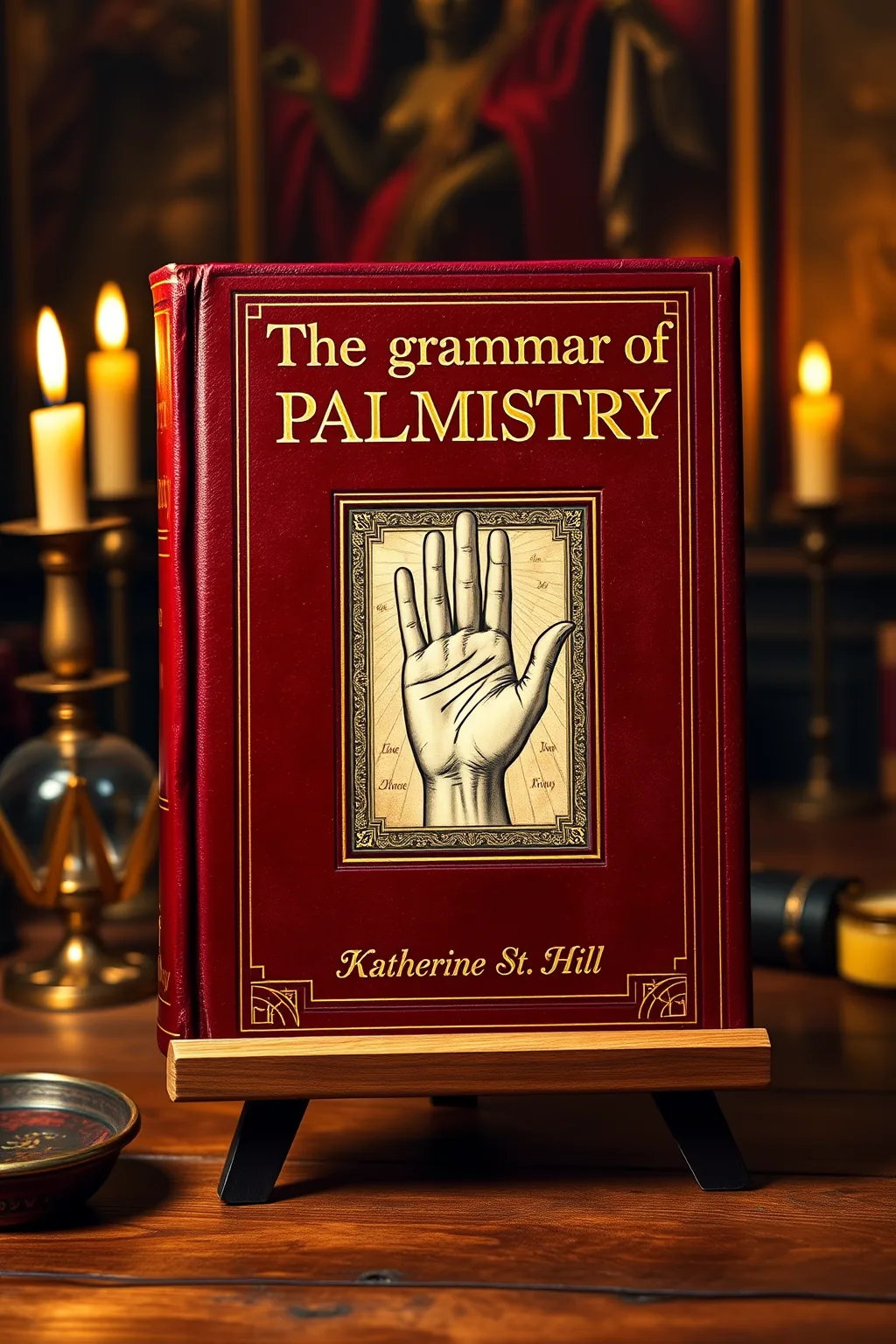
The grammar of palmistry
 61
61

The grammar of palmistry



Celeste Moreau, Divination & Symbolism Reviewer: Katherine St. Hill's 'The Grammar of Palmistry' stands as a cornerstone for any serious student of chiromancy. Eschewing sensationalism, St. Hill presents palmistry as a sophisticated system of interpretation, deeply rooted in symbolism and cosmic correspondence. Her authoritative yet accessible prose demystifies complex concepts, offering profound esoteric insights into character assessment and predictive potential. The book's strength lies in its comprehensive approach, treating the hand not just as a map of the future, but as a living testament to the soul's journey. Ideal for dedicated practitioners and scholars of occult sciences, this work provides a robust foundation for advanced study and personal divination.
📝 Description
61
Katherine St. Hill published 'The Grammar of Palmistry' in 1900, detailing a systematic approach to chiromancy.
Katherine St. Hill's 1900 book, 'The Grammar of Palmistry,' presents a detailed system for interpreting the lines, mounts, and markings on the hand. The author treats chiromancy not simply as a method for predicting future events, but as a philosophical discipline that reflects universal principles. St. Hill guides readers through the specific features of the palm, explaining how each element relates to character, disposition, and the individual's life path. The work emphasizes the symbolic language of the hand, suggesting it offers a map of personal potential and inherent traits.
This volume moves beyond superficial fortune-telling to examine the deeper connections between the physical form and esoteric knowledge. It frames palmistry as a 'sacred science,' a means by which the microcosm of the individual hand mirrors the macrocosm of the universe. The text aims to equip readers with the tools to understand this symbolic language, fostering a deeper sense of self-awareness and a connection to broader cosmic patterns. It is written for those interested in the serious study of chiromancy and its place within esoteric traditions.
Published at the height of the Western esoteric revival, 'The Grammar of Palmistry' engages with the period's widespread interest in divination and symbolic systems. Chiromancy, alongside astrology and numerology, was considered a key to understanding hidden correspondences and universal laws. St. Hill's work situates palmistry within this broader context, presenting it as an ancient yet systematic method for accessing spiritual and psychological truths. The book reflects a desire to codify such practices, moving them from folk tradition towards a more structured, almost scientific, presentation of esoteric principles.
💡 Why Read This Book?
Unlock the ancient wisdom concealed within your own hands. 'The Grammar of Palmistry' offers a profound exploration of chiromancy, revealing the intricate symbolism that maps your destiny and character. Ideal for seekers of self-knowledge, practitioners of divination, and scholars of esoteric traditions, this book provides a clear, insightful, and spiritually enriching guide to understanding the 'language' of your palm.
⭐ Reader Reviews
Honest opinions from readers who have explored this book.
❓ Frequently Asked Questions
What is palmistry?
Palmistry, or chiromancy, is the ancient practice of interpreting the lines, mounts, and shapes of the hand to gain insight into a person's character, potential, and future. It is considered an esoteric art that views the hand as a reflection of the individual's inner self and life path.
Is palmistry scientific?
While not considered a science in the modern empirical sense, palmistry is viewed within esoteric traditions as a symbolic language and a divinatory art. Its validity lies in its symbolic correlations and the insights it offers into human psychology and potential.
How detailed is this book?
'The Grammar of Palmistry' offers a comprehensive and detailed examination of palmistry, covering the interpretation of all major and minor lines, the various mounts, hand shapes, finger characteristics, and their symbolic meanings.
Who is Katherine St. Hill?
Katherine St. Hill was an influential figure in the early 20th-century occult revival, known for her insightful works on various divinatory arts. Her writings are highly regarded for their clarity and depth.
Can beginners learn palmistry from this book?
Yes, while comprehensive, the book is structured to guide beginners through the fundamental principles of palmistry. Its clear explanations and systematic approach make it an excellent starting point for those new to the subject.
🔮 Key Themes & Symbolism
The Hand as a Cosmic Map
This theme explores the profound belief that the human hand is not merely a physical appendage but a divinely inscribed map of one's life journey. It explores how the lines, mounts, and shapes are seen as celestial correspondences, mirroring the influences of planets and stars. The hand becomes a sacred text, a microcosm of the universe, offering a tangible connection to esoteric knowledge and the overarching order of existence. Understanding this perspective reveals palmistry as a dialogue with destiny, an art of deciphering the divine blueprint etched within our very being.
Symbolism and Archetypal Meanings
The book meticulously unpacks the wide range of symbols inherent in palmistry. Each line, mound, and finger possesses archetypal meanings, representing facets of human experience such as love, intellect, ambition, and spirituality. St. Hill illuminates how these symbols interact, forming a complex narrative of the individual's potential, challenges, and innate strengths. This theme highlights the power of symbolism as a universal language, bridging the conscious and subconscious, and offering clear insights into the human psyche through the intricate visual language of the hand.
Chiromancy as a Sacred Science
Katherine St. Hill elevates palmistry beyond simple fortune-telling, presenting it as a 'sacred science' or an esoteric art with deep philosophical and spiritual underpinnings. This theme emphasizes the systematic and disciplined study required to master chiromancy, viewing it as a tool for self-awareness, personal growth, and understanding the interconnectedness of all things. It posits that by understanding the 'grammar' of the hand, one can gain wisdom, navigate life's complexities with greater insight, and align oneself with cosmic principles.
💬 Memorable Quotes
Direct passages from the work, attributed to the author.
“Each mount a planet, each line a river of experience.”
— This evocative metaphor likens the raised areas of the palm (mounts) to planetary energies and the lines to the flowing currents of life events, suggesting a profound connection between celestial forces and personal history.
“To read the palm is to read the silent symphony of the cosmos.”
— This statement highlights the grand philosophical scope of palmistry, presenting it as a means to understand the universal order and the intricate harmonies that govern existence, as mirrored in the human hand.
💡 Key Ideas
Editorial paraphrase of the work's core concepts — not direct quotes.
The lines on our palms are but the whispers of destiny.
This quote captures the core mystical idea that the physical markings on the hand are not random but are imbued with a higher purpose, representing the subtle influences that guide our life's trajectory and predetermined encounters.
The hand reveals the soul's silent pronouncements.
This quote emphasizes the introspective and spiritual aspect of palmistry, suggesting that the hand is a direct manifestation of our inner essence and the unspoken truths of our spirit.
Wisdom is not found in the future, but in the understanding of the present's roots.
This quote shifts the focus from mere prediction to insightful analysis, suggesting that the true value of palmistry lies in comprehending the underlying causes and present manifestations of our life's circumstances.
🌙 Esoteric Significance
Tradition
This work is deeply rooted in the Western Esoteric Tradition, drawing from ancient Hermeticism, Neoplatonism, and astrological correspondences. Palmistry, in this context, is viewed as a divinatory art that reflects the macrocosmic influences of the planets and the divine order upon the microcosm of the human being. It aligns with the Hermetic principle of 'As Above, So Below,' suggesting that the patterns on the hand are a direct reflection of celestial configurations and the soul's journey.
Symbolism
The symbolism in 'The Grammar of Palmistry' is rich and many-sided. Key symbols include the primary lines (Life, Head, Heart, Fate) representing fundamental aspects of existence, the mounts (Venus, Jupiter, Saturn, Sun, Mercury, Luna, Mars) symbolizing planetary influences and character traits, and the various hand shapes and finger formations denoting innate tendencies and life paths. Each element is imbued with archetypal meanings, offering a complex symbolic language for understanding human nature and destiny.
Modern Relevance
In an age often characterized by rapid technological advancement and a perceived disconnection from deeper meaning, 'The Grammar of Palmistry' offers a timeless path to self-discovery and introspection. Its principles of symbolic interpretation and focus on understanding one's innate potentials and challenges remain highly relevant for personal growth, mindfulness, and the exploration of consciousness. The book provides a framework for individuals seeking to understand themselves on a more profound level and to find meaning in the intricate range of their lives.
👥 Who Should Read This Book
This key work is an indispensable resource for a diverse audience. Beginners in divination will find a clear, systematic, and profoundly insightful introduction to the art of palmistry. Scholars of esoteric history and symbolism will appreciate its historical context and detailed exploration of chiromantic principles. Seekers of self-knowledge will discover a powerful tool for understanding their character, potentials, and life path. Practitioners of tarot, astrology, and other divinatory arts will find it a valuable complement, enriching their understanding of human nature and the subtle energies that shape our existence.
📜 Historical Context
Written during the late Victorian and Edwardian eras, a period often referred to as the 'Golden Age of Occultism,' Katherine St. Hill's 'The Grammar of Palmistry' emerged amidst a burgeoning interest in spiritualism, theosophy, and esoteric philosophies. This era saw a significant intellectual and cultural engagement with ancient wisdom traditions, mystical practices, and alternative ways of understanding the universe and human consciousness. Influenced by earlier palmistry texts and a broader resurgence of interest in divination, St. Hill's work contributed to the systematic codification and popularization of chiromancy. It was a time when many sought to reconcile scientific advancements with spiritual inquiry, finding in practices like palmistry a means to explore the hidden dimensions of existence and the potential for personal transformation.
📔 Journal Prompts
Examine the primary lines on your dominant hand. What aspects of your life do they seem to represent most strongly, and why?
Identify the most prominent mount on your palm. How does its associated planetary influence manifest in your personality and daily life?
Consider a significant life event. Can you find any corresponding patterns or symbols in your palm that might have indicated its arrival?
How does the 'grammar' of your palm align with or challenge your current self-perception?
Reflect on the interplay between your dominant and non-dominant hand. What insights does this comparison offer about your conscious choices versus your innate potentials?
🗂️ Glossary
Chiromancy
The art or practice of telling fortunes by lines on the palm of the hand; also called palmistry. It is considered an esoteric art that interprets hand markings as symbolic representations of life and character.
Mounts
The fleshy, raised areas on the palm of the hand, each associated with a specific planet and corresponding character traits or potentials. Examples include the Mount of Venus and the Mount of Jupiter.
Lines
The various markings etched into the palm, the most significant being the Life Line, Head Line, Heart Line, and Fate Line, which symbolize fundamental aspects of a person's existence and destiny.
Archetype
A universal, inherited pattern of thought or imagery derived from the collective unconscious and capable of deeply affecting behavior. In palmistry, each line and mount often represents an archetype.
Esoteric
Intended for or likely to be understood by only a small number of people with a specialized knowledge or interest. In this context, it refers to the hidden or inner teachings of palmistry.
This book appears in 1 collection
🔮 Readers Also Liked
Browse all →







More by Katherine St. Hill
All books →
From the “Palmistry” Collection
View all →







More Free Divination & Tarot Books
View all →