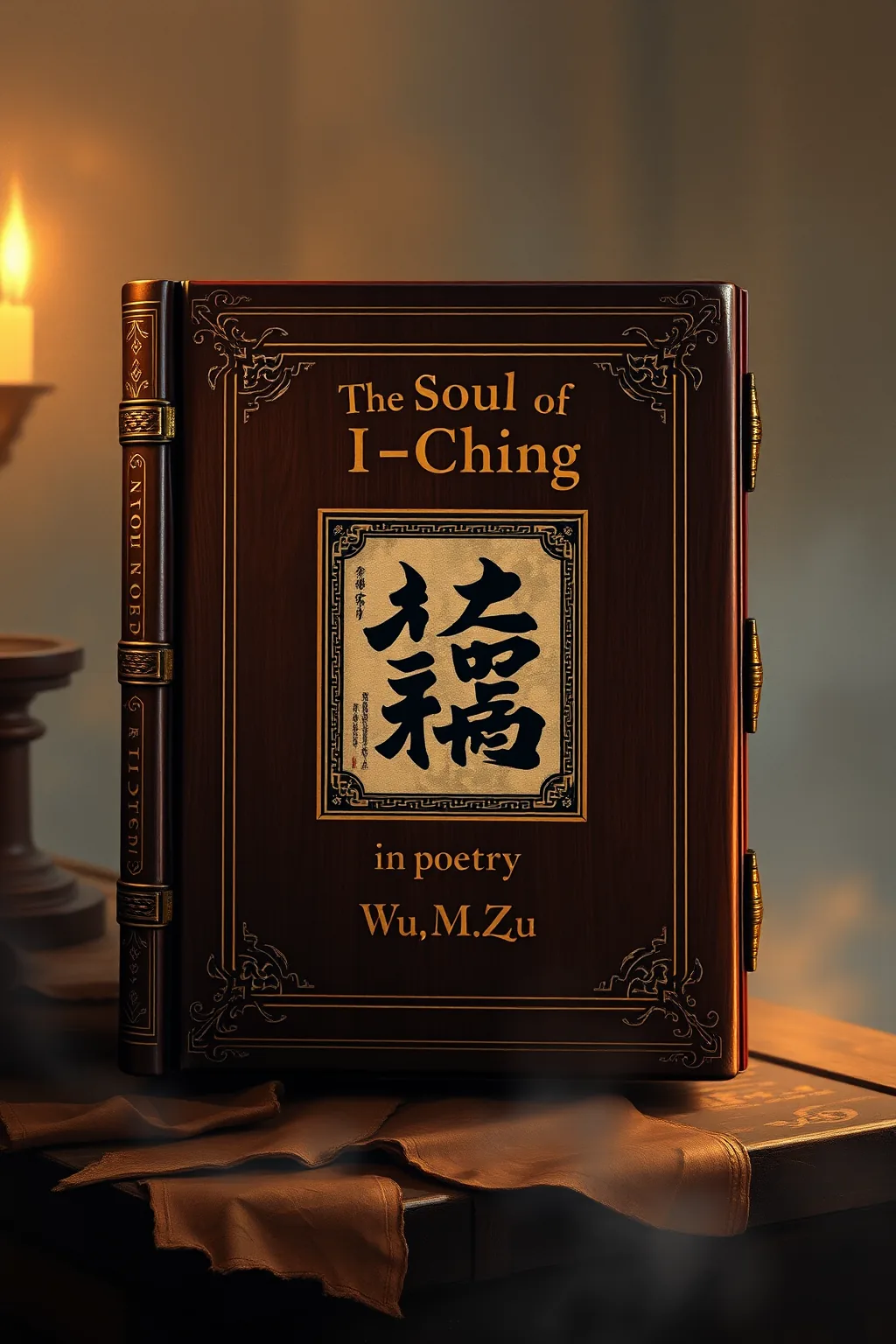
The Soul of I-Ching in poetry
 61
61

The Soul of I-Ching in poetry



Silas Hawthorne (Hermetic Studies Editor) — Wu Mu Zu's "The Soul of I-Ching in Poetry" is a breathtaking achievement, breathing new life into the venerable oracle. Eschewing dry exposition, the author transmutes the I-Ching's hexagrams into luminous, resonant poetry. This work offers profound esoteric insights, revealing the deep metaphysical underpinnings of change and destiny. The poetic form not only enhances accessibility but also unlocks intuitive comprehension, making complex principles feel immediate and deeply personal. It is an indispensable resource for anyone seeking to engage with the I-Ching on a soul level, particularly those drawn to its mystical and philosophical dimensions. A true gem for practitioners and seekers alike.
📝 Description
61
Wu Mu Zu's 1991 book, 'The Soul of I-Ching in Poetry,' translates I-Ching hexagrams into verse.
This book interprets the I-Ching through poetry. Wu Mu Zu transforms the classic text's hexagrams and their associated meanings into a collection of poems. The author aims to reveal the philosophical and spiritual dimensions of the I-Ching beyond simple divination. Each poem is presented as a means to access deeper truths about existence, change, and the human condition. The work is intended for those interested in a more contemplative approach to the I-Ching, seeking to understand its symbolic language and its connection to the wider cosmos. It encourages a perception of the universe through mystical poetry, highlighting the subtle forces at play and the possibilities for personal change.
This work fits within the tradition of Chinese esoteric practices that view the I-Ching not merely as a divinatory tool but as a text rich with cosmological and philosophical insights. It echoes approaches that sought to understand the Dao and the underlying principles of the universe through symbolic systems. By rendering these concepts in poetry, Wu Mu Zu connects the I-Ching to a lineage of Chinese literary arts that often served as vehicles for spiritual and philosophical expression, bridging the gap between intellectual understanding and intuitive experience.
💡 Why Read This Book?
Delve into the I-Ching like never before. This book transforms the ancient oracle into captivating poetry, revealing hidden layers of meaning and spiritual insight. Ideal for seekers of wisdom, practitioners of divination, and anyone fascinated by the interplay of art and philosophy. Experience the profound wisdom of the I-Ching through a unique, soul-stirring lens.
⭐ Reader Reviews
Honest opinions from readers who have explored this book.
❓ Frequently Asked Questions
What is the I-Ching?
The I-Ching, or Book of Changes, is an ancient Chinese divination text and the oldest of the Chinese classics. It comprises 64 hexagrams, each representing a fundamental situation or archetype, used to offer guidance and insight into life's challenges.
How does poetry enhance the I-Ching?
Poetry can evoke emotional and intuitive understanding, making abstract concepts more accessible and resonant. In this book, verse captures the essence and symbolic richness of each hexagram, offering a deeper, more personal connection to its wisdom than traditional prose.
Who is the intended audience for this book?
This book is for anyone interested in the I-Ching, particularly those who appreciate poetic expression and seek a more intuitive, spiritual understanding of its teachings. It appeals to seekers, scholars, and practitioners of divination.
Is prior knowledge of the I-Ching required?
While prior knowledge can enhance appreciation, the poetic format makes this work accessible to newcomers. The verses themselves often convey the core meaning and feeling of each hexagram, inviting exploration.
What kind of insights can one expect?
Readers can expect profound insights into the nature of change, cosmic order, personal growth, and the interconnectedness of all things. The poems offer a contemplative approach to understanding life's patterns and navigating its transitions.
🔮 Key Themes & Symbolism
The Dance of Change and Transformation
This theme explores the fundamental principle of impermanence as taught by the I-Ching. Wu Mu Zu's poetry captures the dynamic ebb and flow of life, illustrating how every situation, no matter how challenging, contains the seeds of its own transformation. It emphasizes the acceptance of flux and the wisdom found in adapting to shifting circumstances. The verses poetically articulate the cyclical nature of existence, from growth and flourishing to decline and renewal, encouraging readers to find balance and resilience amidst life's inevitable changes. This is the very soul of the oracle, revealed through lyrical contemplation.
Unveiling Cosmic Harmony and Symbolism
Wu Mu Zu explores the profound symbolism woven into the I-Ching's hexagrams, presenting them not as mere divinatory tools, but as keys to understanding universal patterns and cosmic harmony. The poetry illuminates the archetypal forces at play, reflecting the macrocosm within the microcosm of human experience. Each hexagram's imagery is rendered with a mystical sensibility, revealing its deeper philosophical and spiritual significance. Readers are guided to perceive the interconnectedness of all phenomena, seeing how celestial order manifests in earthly events and personal destinies, fostering a sense of awe and belonging within the grand design.
The Inner Oracle: Self-Discovery Through Ancient Wisdom
Beyond prediction, 'The Soul of I-Ching in Poetry' serves as a profound guide for self-discovery. The verses act as mirrors, reflecting the reader's inner landscape and offering clear insights into their own motivations, challenges, and potential. Wu Mu Zu encourages an introspective journey, showing how the ancient wisdom of the I-Ching can be a powerful catalyst for personal growth and spiritual awakening. By contemplating the poetic interpretations of the hexagrams, readers are invited to cultivate inner wisdom, align with their true path, and harness the transformative power that resides within their own being.
💬 Memorable Quotes
Direct passages from the work, attributed to the author.
“The hexagrams whisper secrets of the cosmic loom.”
— This poetic line suggests that the I-Ching's symbols are not arbitrary but carry deep, hidden knowledge about the universe's underlying order and interconnectedness, akin to threads in a grand collection.
“Poetry is the echo of the oracle's heart.”
— This emphasizes the emotional and intuitive connection that poetry provides to the I-Ching. It posits that verse can convey the essence and feeling of the oracle's wisdom more profoundly than literal interpretation.
“The I-Ching's soul, a mirror to your own.”
— This poignant line underscores the book's function as a tool for self-reflection. It implies that by engaging with the oracle's wisdom, one can gain clarity and understanding about their own inner self and life path.
💡 Key Ideas
Editorial paraphrase of the work's core concepts — not direct quotes.
In areas of change, the soul finds its true measure.
This quote speaks to the transformative power of embracing life's impermanence. It suggests that true self-understanding and spiritual growth occur when we confront and learn from life's shifts, rather than resisting them.
Within the stillness, futures unfurl.
This quote highlights the importance of introspection and contemplation in understanding destiny. It suggests that by quieting the external noise, one can access inner wisdom and perceive the unfolding patterns of the future.
🌙 Esoteric Significance
Tradition
The I-Ching is a foundational text within the Taoist tradition, deeply connected to concepts of Yin and Yang, the Tao, and the natural cycles of the universe. Its esoteric significance extends to Neidan (internal alchemy) practices, where its principles are used to understand and cultivate the inner energetic landscape. It also holds a prominent place in Chinese geomancy (Feng Shui) and various forms of divination, serving as a cosmic blueprint for understanding the interplay of forces.
Symbolism
The core symbolism of the I-Ching lies in its 64 hexagrams, composed of six lines, each either solid (Yang) or broken (Yin). These lines and their combinations represent fundamental archetypes, natural phenomena, and human situations. The symbolism extends to the trigrams (three-line figures) that form the hexagrams, each associated with elements, family members, directions, and cosmic forces. The dynamic interplay of Yin and Yang within the hexagrams symbolizes the constant flux and transformation inherent in the universe.
Modern Relevance
In contemporary times, the I-Ching's relevance transcends its traditional divination. It offers profound psychological and philosophical insights, resonating with modern explorations of archetypes, chaos theory, and systems thinking. Its emphasis on adaptability, balance, and the understanding of cyclical patterns provides valuable frameworks for navigating personal challenges, organizational change, and global complexities. The poetic interpretation in this volume further makes its ancient wisdom accessible and applicable to the modern seeker's quest for meaning and self-awareness.
👥 Who Should Read This Book
This book is a treasure for a diverse audience. For the **beginner**, it offers an intuitive and emotionally resonant entry point into the profound world of the I-Ching, making its complex ideas accessible through art. **Scholars** of Eastern philosophy and comparative religion will find a unique perspective that bridges textual analysis with lyrical interpretation. **Seekers** of spiritual wisdom and personal growth will discover a powerful tool for introspection and self-discovery, revealing the deep connections between the cosmos and the individual soul. **Practitioners** of divination and esoteric arts will appreciate the fresh, evocative approach that enhances their intuitive understanding and practice.
📜 Historical Context
The I-Ching, or Book of Changes, has a lineage stretching back over three millennia, making it one of the oldest living philosophical and divination texts in the world. Its origins are deeply entwined with ancient Chinese cosmology, philosophy, and early forms of shamanism and divination. Initially, it likely served as a practical guide for rulers and shamans to understand and predict natural and social phenomena, using a system of trigrams and hexagrams derived from observations of the natural world. Over centuries, it was elaborated upon by Confucian scholars, who imbued it with ethical and moral teachings, transforming it into a core part of Chinese thought and culture. Philosophers like Confucius and his followers engaged deeply with its principles, integrating its ideas of change, balance, and cyclical progression into their understanding of governance, personal cultivation, and the human condition. This long history has made the I-Ching a continuously evolving source of wisdom, influencing not only East Asian thought but also inspiring spiritual and philosophical movements worldwide, including contemporary esoteric traditions seeking ancient knowledge.
📔 Journal Prompts
Reflect on a recent 'change' in your life. How does a specific hexagram's poetic portrayal resonate with this experience?
Consider the interplay of Yin and Yang in your daily interactions. How can you cultivate greater balance?
Which poetic verse from this book feels most personally significant, and why?
Imagine the I-Ching hexagrams as archetypal characters. Who do you see yourself as, and what is your current 'story'?
How can the wisdom of constant change, as depicted poetically, help you navigate an upcoming decision or challenge?
🗂️ Glossary
Hexagram
A figure composed of six stacked horizontal lines, where each line is either solid (Yang) or broken (Yin). There are 64 unique hexagrams in the I-Ching, each representing a fundamental situation or archetype.
Yin
In Taoist philosophy, Yin represents the passive, feminine, dark, and receptive principle. It is often associated with the moon, earth, and stillness, and is depicted by a broken line (--) in I-Ching hexagrams.
Yang
In Taoist philosophy, Yang represents the active, masculine, light, and assertive principle. It is often associated with the sun, heaven, and movement, and is depicted by a solid line (—) in I-Ching hexagrams.
Trigram
A figure composed of three stacked horizontal lines, each either solid (Yang) or broken (Yin). There are eight basic trigrams, which are the building blocks for the 64 hexagrams, each carrying specific symbolic meanings.
Oracle
In the context of the I-Ching, an oracle is a system or text used for divination or seeking guidance, providing insights into the past, present, and future, or offering wisdom for navigating life's circumstances.
This book appears in 3 collections
🔮 Readers Also Liked
Browse all →








More by Wu, Mu Zu
All books →
From the “I Ching” Collection
View all →









More Free Divination & Tarot Books
View all →