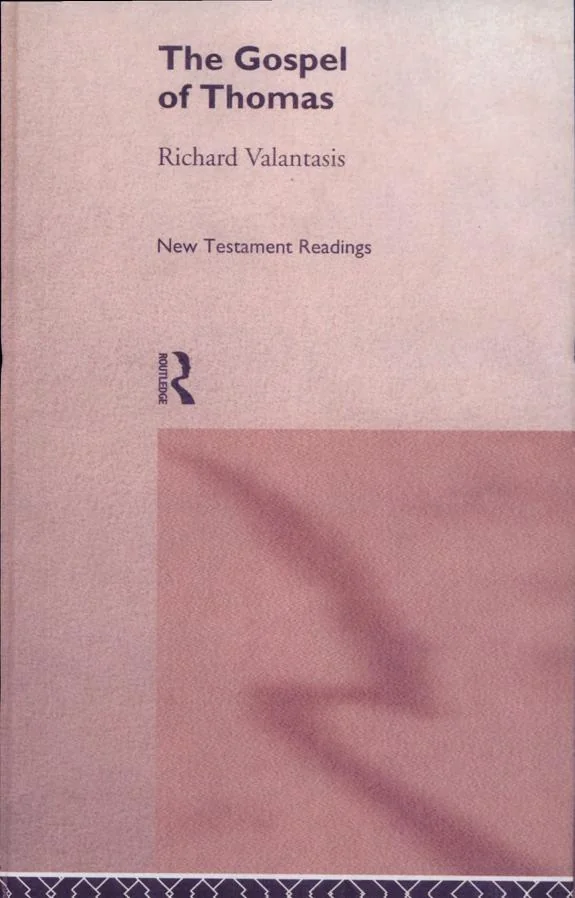
The Gospel of Thomas
 75
75

The Gospel of Thomas
Richard Valantasis's commentary on the Gospel of Thomas offers a meticulous, line-by-line examination that demystifies a text often shrouded in scholarly jargon. His fresh translations from the Coptic and Greek are a significant asset, bringing clarity to difficult passages. Valantasis effectively situates the Gospel within its historical context, referencing the Nag Hammadi discoveries and the scholarly debates surrounding its origins. A particular strength lies in his detailed exposition of sayings like Thomas 3: 'But if you bring forth what is within you, what you bring forth will save you. If you do not bring forth what is within you, what you do not bring forth will destroy you.' This direct engagement with the text’s challenging pronouncements is illuminating. However, the sheer density of the commentary, while thorough, can occasionally feel overwhelming for the uninitiated reader. The book ultimately serves as an indispensable scholarly tool for understanding this pivotal early Christian document.
📝 Description
75
Richard Valantasis's 1997 edition translates the Gospel of Thomas, a collection of Jesus's sayings distinct from canonical scripture.
The Gospel of Thomas presents sayings attributed to Jesus, separate from the narratives found in the New Testament Gospels. This text focuses on esoteric teachings and direct spiritual experience rather than historical events. Valantasis's 1997 edition offers new translations from Coptic and Greek, making the sayings accessible beyond academic study.
The work is suited for those interested in the historical Jesus and early Christian traditions outside the mainstream. It appeals to readers seeking a personal understanding of Jesus's teachings, moving past conventional interpretations. Scholars of early Christianity, comparative religion, and Gnosticism will find Valantasis's commentary useful for textual analysis and historical context.
Compiled likely in the 2nd century CE, the Gospel of Thomas was rediscovered in 1945 at Nag Hammadi, Egypt. Its contents, focusing on 'secret sayings,' suggest an oral tradition emphasizing inner knowledge and spiritual awakening. The text's relationship to early Christian groups like Marcionism is a subject of ongoing scholarly discussion.
The Gospel of Thomas stands apart from the narrative Gospels by emphasizing Jesus's direct pronouncements on inner knowledge and spiritual awakening. Its rediscovery at Nag Hammadi placed it within the broader spectrum of Gnostic literature, texts often concerned with secret teachings and a personal path to divinity. Unlike later orthodox Christian development, Thomas focuses on the individual's immediate access to divine truth, challenging established religious structures and suggesting a mystical, internal experience of God.
💡 Why Read This Book?
• Gain a clearer understanding of Jesus's 'secret sayings' as presented in the Gospel of Thomas, distinct from the canonical Gospels, by engaging with Valantasis's direct translations from the Coptic and Greek texts. • Grasp the historical significance of the Nag Hammadi library and its impact on early Christian studies, as Valantasis details the context of the Gospel's discovery and its place within 2nd-century CE Christian diversity. • Explore the esoteric interpretation of core Christian concepts, such as the 'Kingdom of God' being an internal state, as illuminated by Valantasis's detailed analysis of specific sayings.
⭐ Reader Reviews
Honest opinions from readers who have explored this book.
❓ Frequently Asked Questions
What makes the Gospel of Thomas different from the New Testament Gospels?
The Gospel of Thomas is a collection of sayings, not a narrative. It focuses on esoteric teachings and internal spiritual states, lacking the parables, miracles, and crucifixion accounts found in Matthew, Mark, Luke, and John.
When and where was the Gospel of Thomas discovered?
The Gospel of Thomas was discovered in 1945 among a collection of texts in Nag Hammadi, Egypt, dating to the early Christian period.
What is the significance of the Coptic and Greek translations in Valantasis's work?
Valantasis provides new translations from the original Coptic and Greek texts, aiming for greater accuracy and accessibility than previous scholarly interpretations, allowing for a direct engagement with the source material.
Who was Richard Valantasis in relation to this text?
Richard Valantasis is the author of the 1997 commentary and translation of the Gospel of Thomas, offering a scholarly yet accessible analysis of the text for a wider audience.
Does this book discuss Gnosticism?
Yes, the commentary situates the Gospel of Thomas within the broader context of early Christianity, frequently discussing its relationship to Gnostic thought and other heterodox movements of the 2nd century CE.
Is the Gospel of Thomas considered canonical scripture?
No, the Gospel of Thomas is considered apocryphal, meaning it is not part of the accepted canon of Christian scripture, though it provides vital insights into early Christian beliefs.
🔮 Key Themes & Symbolism
Inner Kingdom
The Gospel of Thomas emphasizes that the Kingdom of God is not a future event or a physical place, but an internal state of being, accessible through self-awareness and direct spiritual perception. Sayings often point inward, suggesting that true enlightenment comes from understanding one's own consciousness and divine potential, rather than seeking external validation or dogma.
The Revealer
Jesus in the Gospel of Thomas functions primarily as a revealer of hidden truths, a guide to inner knowledge. He is not depicted as a savior in the salvific sense of later Christian theology, but as one who unlocks understanding. His role is to provide the 'secret sayings' that enable individuals to recognize their true spiritual nature and the divine spark within.
Spiritual Perception
A core theme is the development of spiritual perception, often contrasted with mundane or conventional understanding. The text encourages readers to see beyond the material world and societal constructs, to recognize the divine in the ordinary, and to trust intuitive wisdom. This emphasis on direct experience and inner knowing positions Thomas as a key text for mystical traditions.
The Twin
The concept of the 'twin' or the 'other self' appears in some interpretations of the Gospel, suggesting a dual nature of human existence or the need to integrate the spiritual and material aspects of oneself. This relates to the idea of achieving wholeness and recognizing the divine counterpart within.
💬 Memorable Quotes
Direct passages from the work, attributed to the author.
“If you bring forth what is within you, what you bring forth will save you. If you do not bring forth what is within you, what you do not bring forth will destroy you.”
— This saying highlights the critical importance of self-knowledge and the active manifestation of one's inner potential. It suggests that true salvation or liberation comes from confronting and integrating one's inner truths, rather than suppressing them.
“Jesus said, 'Know what is before your face, and what is hidden from you will be revealed to you.'”
— This emphasizes direct observation and present-moment awareness as keys to unlocking deeper understanding. It implies that the mysteries of existence are accessible through attentive focus on the immediate reality before us.
“The Kingdom of the Father is not according to [expectation] or progress, but it is the attainment of the end.”
— This interpretation challenges conventional notions of progress or reward in spiritual life, suggesting the Kingdom is a state of completion or realization, perhaps an ultimate awakening, rather than a journey through stages.
“Let him who seeks not cease seeking, until he finds. And when he finds, he will be astonished; and when he is astonished, he will rule over [all].”
— This speaks to the persistent nature of spiritual seeking and the profound reward of discovery. Astonishment implies a radical shift in perspective, leading to a state of mastery or liberation from ordinary limitations.
“His disciples said to him, 'When will the kingdom appear?' 'It will not come by waiting for it. It will not be a matter of saying, 'Here it is' or 'There it is.' Rather, the kingdom of the Father is spread out upon the earth, and men do not see it.'”
— This iconic saying refutes the idea of the Kingdom as a future, external event. It asserts that the divine reality is present all around us, obscured by our lack of perception or conventional expectations.
🌙 Esoteric Significance
Tradition
The Gospel of Thomas is intrinsically linked to Gnostic traditions, though its exact relationship remains debated. It shares with Gnosticism an emphasis on hidden knowledge (gnosis), the divine spark within humanity, and the figure of Jesus as a revealer rather than solely a sacrificial savior. It diverges from some Gnostic systems by its lack of elaborate cosmologies and its focus on direct interpretation of Jesus's sayings.
Symbolism
Key symbols include the 'Kingdom of God' as an internal, present reality, contrasting with external, future-oriented eschatology. Light and darkness often represent spiritual awareness versus ignorance. The 'pure' or 'perfect' human is one who achieves self-knowledge and aligns with the divine principle, often symbolized by recognizing the 'hidden' truths within.
Modern Relevance
Contemporary esoteric thinkers and spiritual seekers often turn to the Gospel of Thomas for its emphasis on personal authority, direct experience, and the immanence of the divine. It influences modern Gnostic revival movements, contemplative Christian practices, and New Age spirituality, offering a framework for understanding Jesus's teachings outside traditional dogmatic structures.
👥 Who Should Read This Book
['• Students of early Christianity: Those seeking to understand the diversity of beliefs and texts circulating in the 1st and 2nd centuries CE, beyond the canonical scriptures.', "• Esoteric practitioners: Individuals interested in mystical interpretations of Jesus's teachings, focusing on inner transformation and direct spiritual insight.", '• Comparative religion scholars: Researchers looking to analyze the parallels and divergences between the Gospel of Thomas and other wisdom traditions or philosophical systems.']
📜 Historical Context
The Gospel of Thomas, likely compiled around the mid-2nd century CE, emerged from a vibrant and diverse early Christian landscape. Its textual form, discovered in 1945 within the Nag Hammadi library in Egypt, presented a significant challenge to established narratives of Christian development. Unlike the developing orthodox canon, Thomas presents a collection of Jesus's sayings without narrative, emphasizing Gnostic-like themes of inner knowledge and spiritual awakening. Scholars debated its relationship to the canonical Gospels, with some proposing it drew from a common source (Q), while others saw it as an independent tradition. Its focus on esoteric wisdom and personal gnosis placed it at odds with emerging hierarchical structures and theological doctrines that would later define mainstream Christianity. Contemporary figures like Irenaeus of Lyons, writing in the late 2nd century, actively sought to refute such 'heretical' texts, highlighting the reception challenges these documents faced.
📔 Journal Prompts
The saying 'Know what is before your face, and what is hidden from you will be revealed to you'—reflect on a moment this proved true.
Contemplate the meaning of 'the Kingdom of the Father' as presented in the Gospel of Thomas.
Consider the implications of Jesus functioning as a 'revealer' of hidden truths rather than a traditional savior figure.
Analyze the concept of 'bringing forth what is within you' from Thomas's sayings.
Reflect on the idea that the Kingdom of God is 'spread out upon the earth, and men do not see it.'
🗂️ Glossary
Apocrypha
Texts related to the Bible that are not part of the accepted canon. The Gospel of Thomas is considered an apocryphal text, offering valuable historical and theological insights but not recognized as divinely inspired scripture by most Christian denominations.
Gnosis
Greek for 'knowledge'. In esoteric traditions, particularly Gnosticism, gnosis refers to intuitive, spiritual knowledge or enlightenment, often seen as a direct experience of the divine, distinct from intellectual understanding.
Nag Hammadi Library
A collection of early Christian and Gnostic texts discovered in 1945 near Nag Hammadi, Egypt. These texts, including the Gospel of Thomas, provided unprecedented access to non-canonical Christian writings from the first few centuries CE.
Sayings Gospel
A type of gospel that primarily consists of a collection of sayings attributed to Jesus, rather than a narrative of his life and ministry. The Gospel of Thomas is the most famous example of this genre.
Orthodox Christianity
Refers to the mainstream, established forms of Christianity that adhere to the doctrines and creeds recognized by major church councils. The Gospel of Thomas was often viewed as outside of or contrary to these developing orthodoxies.
Coptic
A late stage of the Egyptian language, written using a modified Greek alphabet. Coptic was the liturgical language of Egyptian Christians and is the language in which the Gospel of Thomas was preserved.
The Kingdom of God
A central concept in Jesus's teachings. In the Gospel of Thomas, it is often interpreted as an inner, present reality accessible through spiritual awareness, rather than a future, external event.
This book appears in 1 collection
🔮 Readers Also Liked
Browse all →









From the “Gospel of Thomas” Collection
View all →






More Free Occult Philosophy Books
View all →