Clairvoyance and Occult Powers
 79
79

Clairvoyance and Occult Powers
Swami Panchadasi's "Clairvoyance and Occult Powers" offers a surprisingly grounded perspective on psychic abilities, particularly within the context of its 2015 publication. The strength lies in its systematic dissection of concepts like clairaudience and psychometry, presenting them as trainable skills rather than ethereal gifts. The chapter "Telepathy vs. Clairvoyance" provides a clear, if dated, distinction that remains useful for beginners. However, the work occasionally betrays its antiquarian roots with an earnestness that can feel naive to a modern, skeptical reader. While it meticulously details methods for developing "astral senses," the lack of rigorous scientific framing, common for its implicit historical period, limits its appeal for those seeking empirical validation. The author's conviction is palpable, but the absence of comparative analysis with contemporary psychological research on perception is a notable limitation. Overall, it serves as a valuable historical document and a practical guide for the devout student of esoteric arts.
📝 Description
79
Swami Panchadasi's 1919 book details practical methods for developing psychic abilities.
First published in 1919, Clairvoyance and Occult Powers serves as a practical guide for individuals interested in psychic development. The book moves beyond abstract theory to provide concrete instruction on cultivating faculties like clairvoyance, clairaudience, and precognition. It outlines specific disciplines and techniques intended to awaken these latent capacities, making them achievable through focused study and practice. The text is best suited for those with a serious commitment to occult sciences and extrasensory perception. It will also interest academics studying parapsychology and esoteric traditions. Readers who appreciate detailed explanations and a systematic approach to developing psychic abilities will find this volume valuable.
The content draws on earlier occult philosophies, aligning with interest in spiritualism and theosophy prevalent in the late 19th and early 20th centuries. The author’s structured approach reflects a desire to organize occult knowledge, similar to academic attempts to study these phenomena. The work systematically breaks down the nature of clairvoyance, distinguishing it from telepathy and examining its various forms, such as psychometry and second-sight. It introduces the concept of 'astral senses,' suggesting a parallel sensory system that operates on a less physical plane. The book also discusses the importance of will, concentration, and imagination in cultivating these powers, presenting them as trainable faculties rather than innate gifts.
This work emerges from the fertile ground of early 20th-century occultism, a period marked by widespread fascination with spiritualism and theosophy. It reflects a broader effort to systematize esoteric knowledge, mirroring academic endeavors to understand psychic phenomena. The book's focus on practical techniques for cultivating clairvoyance, clairaudience, and precognition aligns with a tradition that sought to demystify psychic abilities, presenting them as attainable through diligent practice rather than solely as inherent gifts. Its approach builds upon earlier occult philosophies, contributing to a growing body of literature that aimed to make these concepts accessible.
💡 Why Read This Book?
• Learn the distinct methods for developing clairvoyance and clairaudience, as detailed in chapters like "The Astral Senses," offering practical exercises not found in general psychology texts. • Understand the historical debate between telepathy and clairvoyance, a key concept explored in the book, to contextualize your own exploration of extrasensory perception. • Gain practical techniques for psychometry and crystal-gazing, explicitly mentioned in the original blurb, providing actionable skills for sensing residual energies or divining information.
⭐ Reader Reviews
Honest opinions from readers who have explored this book.
❓ Frequently Asked Questions
What specific types of clairvoyance are covered in Swami Panchadasi's book?
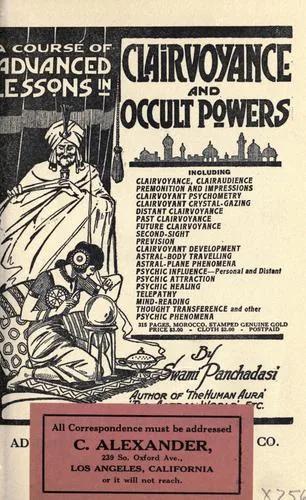
The book covers a broad spectrum, including clairaudience (hearing psychic sounds), premonition (future sight), psychometry (object reading), crystal-gazing, distant clairvoyance, past clairvoyance, and second-sight, providing a comprehensive overview of extrasensory perception.
Is "Clairvoyance and Occult Powers" suitable for absolute beginners in occult studies?
Yes, the work is designed as a complete guide, moving from foundational concepts of "astral senses" to practical applications, making it accessible for beginners with a serious interest in developing psychic abilities.
What is the historical period associated with the ideas presented in this book?
Although first published in 2015, the book's content draws heavily from occult and esoteric traditions popular in the late 19th and early 20th centuries, a period of intense interest in spiritualism and psychic phenomena.
Does the book offer practical exercises for developing psychic powers?
Indeed, it does. The volume provides detailed instructions and methodologies aimed at cultivating specific psychic faculties, treating them as trainable skills rather than innate gifts.
How does Swami Panchadasi differentiate clairvoyance from telepathy?
The book dedicates a section to this distinction, exploring the unique nature and mechanisms of clairvoyance as a form of psychic perception, separate from the transmission of thoughts inherent in telepathy.
Is this book considered a primary source for understanding early 20th-century occultism?
While published in 2015, its content reflects the teachings and perspectives prevalent during the early 20th century's occult revival, making it a valuable secondary source for understanding that era's thought.
🔮 Key Themes & Symbolism
The Astral Senses
This theme explores the concept of a subtle body possessing senses akin to the physical ones, but operating on a non-physical plane. Swami Panchadasi posits that clairvoyance, clairaudience, and other psychic perceptions are functions of these "astral senses." The work details how these senses can be trained and refined through focused intention and specific exercises, suggesting that the development of psychic ability is a disciplined practice rather than an arbitrary gift. This concept is central to understanding how one might perceive beyond the limitations of the physical world.
Clairvoyance vs. Telepathy
A critical distinction is drawn between clairvoyance and telepathy, addressing a common point of confusion in psychic literature. While telepathy involves the direct transmission of thoughts between individuals, clairvoyance is presented as a form of perception – seeing, hearing, or knowing things psychically, independent of another person's mind. The book argues for the unique nature of clairvoyant phenomena, providing frameworks to differentiate between these two distinct extrasensory abilities and detailing the specific training required for each.
Practical Cultivation of Psychic Powers
Beyond theoretical exposition, the book emphasizes the practical cultivation of occult powers. It treats abilities like psychometry, premonition, and crystal-gazing as skills that can be systematically developed through diligent practice and understanding of underlying principles. This approach explains psychic phenomena, framing them as natural extensions of human consciousness that can be consciously honed, aligning with a practical, almost scientific, methodology within esoteric study.
The Nature of Second-Sight
The phenomenon of 'second-sight' is examined, often associated with specific cultural contexts or individuals perceived as having innate psychic gifts. Swami Panchadasi analyzes this ability, integrating it into the broader framework of clairvoyant perception. The work suggests that second-sight, like other psychic faculties, can be understood and potentially developed through the application of the principles discussed concerning the "astral senses" and focused mental discipline.
💬 Memorable Quotes
Direct passages from the work, attributed to the author.
“The astral senses are the instruments through which the soul perceives the finer planes of existence.”
— This statement highlights the core premise that psychic perception relies on a set of senses operating beyond the physical, accessible through focused spiritual or mental discipline.
“Clairvoyance is not the reception of another's thought, but the perception of facts and events.”
— This differentiates clairvoyance from telepathy, defining it as a direct form of psychic knowing or seeing, rather than a mind-to-mind communication.
“Willpower and concentration are the keys to unlocking latent psychic faculties.”
— This emphasizes the active role of the practitioner, suggesting that psychic development is achieved through directed mental effort and sustained focus.
“Psychometry allows one to read the history of an object through energetic impressions.”
— This concisely explains the concept of psychometry, a specific form of clairvoyance involving the ability to perceive information from inanimate objects.
“Premonition is the capacity to perceive future events before they manifest.”
— This defines premonition, positioning it as a specific type of foresight that can be cultivated and understood within the broader context of occult powers.
🌙 Esoteric Significance
Tradition
The work fits within the Western Esoteric Tradition, specifically drawing from Theosophical and Neo-Theosophical thought, which gained prominence in the late 19th century. It aligns with the Theosophical emphasis on the evolution of consciousness and the development of latent human faculties beyond the physical senses. The concept of "astral senses" is a common motif in such traditions, suggesting a connection to planes of existence beyond the material.
Symbolism
While the text is more instructional than symbolic, the concept of "astral senses" itself functions metaphorically, representing a higher, more refined mode of perception. Crystal-gazing, mentioned in the blurb, is a symbolic practice in many traditions, representing a focal point for inner vision. The distinction between telepathy and clairvoyance can be seen as symbolizing different modes of connection: one based on shared consciousness (telepathy) and another on direct spiritual insight (clairvoyance).
Modern Relevance
Contemporary practitioners of energy work, remote viewing, and modern psychic development techniques often engage with foundational texts like this one. Thinkers and groups exploring consciousness studies, parapsychology, and new age spirituality continue to reference and build upon the ideas of systematic psychic training presented here. The book's structured approach to developing extrasensory perception remains relevant for those seeking practical methods in these fields.
👥 Who Should Read This Book
• Aspiring practitioners of psychic arts seeking a foundational text on clairvoyance, clairaudience, and psychometry. • Students of esoteric history interested in the literature that shaped occult thought in the early 20th century. • Individuals curious about the philosophical underpinnings of extrasensory perception and its potential for development.
📜 Historical Context
Swami Panchadasi's "Clairvoyance and Occult Powers," though published in 2015, is deeply rooted in the esoteric currents of the late 19th and early 20th centuries. This era, marked by the rise of spiritualism and movements like Theosophy founded by Helena Blavatsky, saw a burgeoning interest in psychic phenomena and alternative philosophies. Works from this period often sought to systematize and explain occult abilities, moving them from folk belief towards a more structured, albeit still mystical, discipline. The book's methodical approach and focus on "astral senses" echo the efforts of contemporary authors like Annie Besant, who also explored psychic development within a Theosophical framework. While not explicitly engaging with rival schools like scientific materialism, the book implicitly positions itself against a purely physicalist worldview, offering a spiritual interpretation of consciousness and perception prevalent in esoteric circles of the time.
📔 Journal Prompts
The nature of "astral senses" and their potential for perception.
Distinguishing clairvoyance from telepathy in personal experience.
Methods for cultivating willpower and concentration for psychic development.
Reflections on psychometry and the energetic impressions of objects.
The concept of "second-sight" and its relation to clairvoyant ability.
🗂️ Glossary
Clairvoyance
The faculty of perceiving things or events in the future or beyond normal sensory contact. It is a form of extrasensory perception involving psychic sight.
Clairaudience
The faculty of hearing perceived by means other than the physical ears. This psychic sense allows one to hear sounds or voices from non-physical sources.
Premonition
A strong feeling that something is about to happen, especially something unpleasant. In an occult context, it refers to foresight or precognition of future events.
Psychometry
A psychic ability to gain information about a person or object by touching it. It involves sensing residual energies or historical impressions.
Astral Senses
Hypothetical sensory organs or faculties that operate on the astral plane, allowing for perception beyond the limitations of physical senses.
Second-Sight
A term often used to describe a form of clairvoyance, particularly in Scottish folklore, referring to the ability to see visions or future events.
Crystal-Gazing
A method of divination or clairvoyance practiced by gazing into a crystal ball or other reflective surface to receive visions or insights.