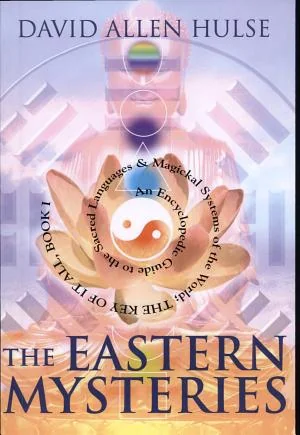
The Eastern Mysteries
 82
82

The Eastern Mysteries
David Allen Hulse's The Eastern Mysteries is an ambitious attempt to codify the esoteric principles of Eastern magic. Its strength lies in its sheer scope and the author's dedication to presenting complex systems through comparative tables and symbolic breakdowns. Hulse’s analytical approach, which first appeared in 2000, provides a structured way to examine traditions often presented in more narrative or devotional forms. One particularly effective section details the correspondences within Tibetan Buddhist tantric symbolism, offering a clear visual representation of otherwise abstract concepts. However, the book’s analytical rigor can sometimes lead to a dry presentation, potentially alienating readers seeking a more experiential or devotional approach to these traditions. The sheer volume of information, while comprehensive, can feel overwhelming without significant prior grounding. Despite this, for the dedicated student of comparative occultism, it remains a valuable, if demanding, reference.
This is a rigorous, albeit dense, academic survey of Eastern magical systems.
📝 Description
82
David Allen Hulse's The Eastern Mysteries, published in 2000, systematically deciphers Eastern magical traditions.
First published in 2000, The Eastern Mysteries by David Allen Hulse offers a systematic catalog of magical practices originating in India, Tibet, and China. Hulse's work deciphers the symbolic languages and occult principles inherent in these traditions. He uses detailed tables and analyses to clarify hidden meanings within each distinct magical system, aiming for a clear and structured understanding.
This book is for serious students of the occult and comparative mysticism. It functions as a reference for those wanting to grasp the underlying structures and symbolic lexicons of various Eastern magical systems. Readers interested in decoding ancient texts, understanding ritual symbolism, or tracing connections between esoteric traditions will find this a valuable resource. Hulse dissects these traditions, examining their cosmologies, deities, and ritualistic frameworks. He stresses the importance of a specific symbolic vocabulary for true comprehension, providing an accessible key through structured analysis.
The Eastern Mysteries emerged at the turn of the millennium, a time when interest in cross-cultural comparisons within esoteric studies was growing. While earlier figures popularized Eastern philosophies, Hulse's book aimed for a more analytical breakdown of magical traditions. It appeared as occultism saw increasing academic and amateur interest, yet detailed scholarly treatments of specific Eastern magical languages were not common. Hulse's work provides a structured approach to these complex systems.
💡 Why Read This Book?
• Understand the specific symbolic languages of various Eastern magical traditions, moving beyond generalized mysticism, as detailed in Hulse's comparative tables. • Gain a structured framework for analyzing complex cosmologies and ritualistic practices, particularly evident in the chapters on Tibetan Buddhism, which aids in deciphering esoteric texts. • Explore the foundational principles of Eastern magick as distinct systems, providing a scholarly contrast to the broader syncretism found in works by earlier authors like Blavatsky.
⭐ Reader Reviews
Honest opinions from readers who have explored this book.
❓ Frequently Asked Questions
When was The Eastern Mysteries first published and who is the author?
The Eastern Mysteries was first published in the year 2000. The author is David Allen Hulse, known for his systematic approach to esoteric subjects.
What specific Eastern traditions does the book cover?
The book catalogs and distills numerous Eastern magical traditions, including, but not limited to, those originating from India, Tibet, and China, focusing on their unique symbolism and occult principles.
Is The Eastern Mysteries suitable for beginners in occult studies?
While comprehensive, the book's analytical depth and extensive use of tables may be best suited for intermediate to advanced students of the occult seeking detailed comparative information.
What is the main objective of David Allen Hulse's research in this book?
Hulse aimed to catalog and clarify the true import of ancient Eastern magical traditions by analyzing their secret symbolism and linguistic structures, making complex systems more accessible.
Does the book offer practical magical techniques?
The primary focus is on understanding the theoretical and symbolic underpinnings of Eastern magick, rather than providing direct practical instructions for ritual or spellcasting.
What makes this book unique compared to other works on Eastern mysticism?
Its uniqueness lies in its systematic cataloging and detailed symbolic analysis presented through hundreds of tables, offering a comparative and scholarly approach to distinct magical languages.
🔮 Key Themes & Symbolism
Symbolic Language Decipherment
The core of Hulse's work lies in treating each Eastern magical tradition as a distinct symbolic language. He meticulously breaks down the iconography, numerology, and cosmological frameworks to reveal their hidden meanings. For instance, the book likely explores how specific mudras in Indian traditions or mandala elements in Tibetan Buddhism function not just as visual art, but as keys to complex spiritual and magical concepts. This approach emphasizes that true understanding requires decoding these visual and conceptual lexicons, moving beyond superficial interpretation to grasp the inherent logic of each system.
Comparative Esoteric Structures
Hulse systematically compares and contrasts the structural elements of various Eastern magical systems. Rather than merely presenting them in isolation, he seeks commonalities and divergences in their occult principles. This comparative analysis helps students identify recurring patterns in spiritual development and magical practice across different cultures. The book's tables are crucial here, allowing readers to see, for example, how the concept of divine emanations in one tradition might parallel energy centers in another, facilitating a deeper, cross-cultural understanding of esoteric thought.
The Import of Ancient Magick
The work stresses the enduring significance and hidden power within ancient Eastern magical traditions. Hulse argues that these systems, often overlooked or misunderstood in the West, contain useful insights into the nature of reality and consciousness. By cataloging their secret symbolism, he aims to reintroduce these potent frameworks to a modern audience. The book suggests that engaging with these traditions offers not just historical knowledge but practical keys to unlocking deeper spiritual potential and understanding the universal laws of magick.
Esoteric Cataloging and Analysis
A defining feature of The Eastern Mysteries is its meticulous cataloging and analytical approach. Hulse presents information not as narrative prose alone, but through hundreds of tables designed to distill complex information into digestible formats. This method highlights the 'occult' nature of the knowledge by presenting it in a structured, almost scientific manner. The book serves as a reference guide, enabling students to systematically study and cross-reference elements of different magical systems, fostering a critical and analytical engagement with esoteric subjects.
💬 Memorable Quotes
Direct passages from the work, attributed to the author.
“Each chapter is a key that unlocks the meaning behind one of the magickal languages.”
— This highlights Hulse's central thesis: that Eastern magical traditions possess unique symbolic vocabularies. The book functions as a decoder, offering readers the tools to understand these distinct 'languages' rather than just observing them from the outside.
“Hundreds of tables of secret symbolism distill the true import of each ancient Eastern magickal tradition.”
— This emphasizes the book's unique methodology. The use of extensive tables is presented not merely for organization, but as a method to reveal profound, often hidden, meanings within complex esoteric systems.
“This reissue of David Allen Hulse's landmark work is the one book all students of the occult must own.”
— This statement positions the book as an indispensable resource for anyone seriously studying occultism, particularly its Eastern branches. It suggests the work provides foundational knowledge not readily available elsewhere.
“Through painstaking research and analysis, Hulse has accomplished...”
— This phrase suggests the book is the result of significant scholarly effort. It implies that the information presented is well-researched and critically analyzed, lending it authority and depth.
“Unlock the meaning of Eastern magick.”
— This serves as a direct call to action and a promise of the book's core benefit. It suggests that the complex world of Eastern esoteric practices can be made accessible and understandable through Hulse's work.
🌙 Esoteric Significance
Tradition
The Eastern Mysteries fits within the broader Western esoteric tradition's long-standing fascination with Eastern philosophies, particularly since the 19th century. It departs from earlier, often romanticized, interpretations by applying a more analytical and cataloging methodology, akin to comparative religion studies but focused specifically on magical applications. Hulse's work attempts to bridge the gap between the academic study of religion and practical occultism, offering a systematic framework for understanding diverse Eastern traditions within their own esoteric contexts.
Symbolism
The book studies the strong symbolism of Eastern traditions. For example, it likely explores the complex iconography of Tibetan Buddhist mandalas, which represent the enlightened mind and the cosmos, and the symbolic significance of various deities like Kali in Hindu Tantra, representing primal energy and transformation. Hulse's work deciphers these symbols not as mere artistic representations but as integral components of magical systems, revealing their function in ritual, meditation, and cosmology.
Modern Relevance
Contemporary practitioners of Western esotericism, comparative religion scholars, and students of Jungian psychology often reference or draw upon works that systematically analyze Eastern traditions. Hulse's detailed cataloging of symbolic languages and esoteric structures provides a valuable reference point for those seeking to understand the underlying principles of Eastern magick, informing modern interpretations of meditation, energy work, and symbolic interpretation across various spiritual disciplines.
👥 Who Should Read This Book
["• Students of comparative mysticism: Individuals seeking to understand the structural similarities and differences between global esoteric traditions will find Hulse's cataloging and analytical tables invaluable.", '• Practitioners of Western occultism: Those interested in expanding their knowledge beyond European traditions can use this book to decipher the symbolic languages and principles of Eastern magick.', "• Researchers of religious and spiritual history: Academics and serious amateurs studying the development and transmission of esoteric ideas will appreciate the book's systematic approach and detailed references."]
📜 Historical Context
David Allen Hulse's The Eastern Mysteries, first published in 2000, arrived at a time when Western esoteric interests were increasingly turning towards cross-cultural comparisons, building on the groundwork laid by earlier figures like Helena Blavatsky and Theosophy in the late 19th century. While popular interest in Eastern religions had surged for decades, Hulse's work distinguished itself by aiming for a systematic, analytical breakdown of specific magical traditions rather than broad syncretism. It entered a publishing landscape where detailed, comparative analyses of the symbolic languages of traditions like Tibetan Buddhism or Indian Tantra were relatively scarce, especially outside specialized academic circles. The book sought to provide a structured framework for understanding these systems, offering a scholarly antidote to more generalized or devotional approaches. Its appearance coincided with a growing academic and amateur engagement with occultism, but also with a general skepticism towards esoteric claims, positioning it as a work of serious study for dedicated practitioners and researchers.
📔 Journal Prompts
The symbolic language of Tibetan Buddhist mandalas as presented in the book: what core concepts do they represent?
Analyze the concept of 'secret symbolism' Hulse discusses, using examples from Indian Tantra.
How does Hulse's cataloging method illuminate the differences between Eastern and Western magical frameworks?
Reflect on the 'true import' of a specific Eastern tradition detailed in the book.
Consider the practical implications of understanding Eastern magickal languages for contemporary spiritual practice.
🗂️ Glossary
Magickal Tradition
A system of esoteric beliefs and practices passed down through generations, often involving rituals, symbolism, and specific cosmological views aimed at spiritual transformation or influencing reality.
Symbolism
The use of symbols, images, or motifs to represent abstract ideas, concepts, or spiritual truths within a specific cultural or esoteric context.
Esoteric
Relating to or accessible only by a relatively small number of people with a specialized knowledge or interest; intended for or known by only a few initiates.
Occult
Practices, teachings, or knowledge that are of a supernatural, mystical, or magical nature; hidden or secret.
Cosmology
The branch of philosophy dealing with the origin and general structure of the universe; a theory about the nature of the universe.
Tantra
A set of spiritual traditions originating in India, characterized by the use of mantras, tantras (lures or threads), and sometimes ritualistic meditation aimed at spiritual liberation.
Mandala
A geometric configuration of symbols, typically in a circular pattern, used in various spiritual traditions, especially Hinduism and Buddhism, as a tool for meditation and concentration.
This book appears in 1 collection
🔮 Readers Also Liked
Browse all →








From the “Divination” Collection
View all →







More Free Occult Philosophy Books
View all →