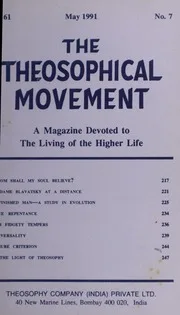
Space, time, and self

 76
76

Space, time, and self
Pearson’s 1991 text, Space, Time, and Self, offers a more intricate dissection of subjective experience than many contemporary works. The author’s persistent interrogation of how temporal perception shapes identity is particularly strong, moving beyond simple philosophical musings into a detailed examination of the phenomenological experience. For instance, the discussion on "time-binding" as a mechanism for self-cohesion provides a concrete, if challenging, framework. However, the prose can become dense, at times obscuring the very clarity it seeks to establish. The lack of clear chapter breaks or subheadings in some editions further exacerbates this, making it difficult to pinpoint specific arguments without sustained effort. Despite these structural hurdles, the core ideas presented offer a significant challenge to common assumptions about consciousness. Pearson’s work remains a valuable, if demanding, contribution to esoteric thought.
📝 Description
76
E. Norman Pearson's 1991 book, Space, Time, and Self, examines consciousness and reality.
Published in 1991, Space, Time, and Self by E. Norman Pearson investigates the nature of consciousness and reality through an esoteric lens. The work questions ordinary views of time and space, analyzing how our subjective experience of temporal flow and spatial awareness shapes our perception. Pearson posits that the self is not a static entity but a dynamic formation influenced by our understanding of time and space.
This book considers how our internal sense of time and perceived spatial limits affect our identity and engagement with the world. It suggests these perceptions are not passive reflections but actively contribute to the creation of reality. The text is suited for individuals interested in metaphysics, the philosophy of mind, and esoteric thought who are comfortable with abstract reasoning.
Emerging in the early 1990s, Space, Time, and Self participated in a period of growing interest in consciousness studies and non-traditional philosophies. Pearson's work synthesized ideas relevant to the intellectual currents influenced by figures like Carl Jung and the philosophical implications of quantum physics. It presented a perspective distinct from mainstream academic discussions, aligning with esoteric traditions that explore the relationship between mind and the fabric of existence.
💡 Why Read This Book?
• Gain a nuanced understanding of "time-binding," a concept Pearson uses to describe how our perception of time actively constructs our sense of self, a perspective not commonly found in standard psychological texts. • Explore the idea of "subjective geometry," which details how our internal spatial awareness can be as influential as external physical dimensions in shaping our lived reality, as presented in the book's analyses. • Engage with Pearson's critique of the "fixed self" model, offering an alternative view rooted in the dynamic interplay of temporal and spatial perception, drawing directly from his 1991 publication.
⭐ Reader Reviews
Honest opinions from readers who have explored this book.
❓ Frequently Asked Questions
What is the primary focus of E. Norman Pearson's Space, Time, and Self?
The book primarily focuses on the esoteric exploration of consciousness, examining how our subjective perception of time and space actively constructs our sense of self and reality. It challenges conventional notions of identity.
When was Space, Time, and Self first published?
Space, Time, and Self was first published in 1991, positioning it within a period of growing interest in consciousness studies and metaphysical inquiries.
Who is E. Norman Pearson?
E. Norman Pearson is an author known for his work in esoteric philosophy and metaphysics. Space, Time, and Self is a notable example of his exploration into the nature of consciousness and reality.
What esoteric traditions or concepts does Space, Time, and Self engage with?
The work engages with concepts related to the philosophy of mind, phenomenology, and esoteric psychology, examining how temporal and spatial awareness influence the self, echoing themes found in Gnostic and Hermetic thought.
Is Space, Time, and Self suitable for beginners in esoteric studies?
While accessible to those with a serious interest, the book's abstract nature and dense prose might be more challenging for absolute beginners. It is best suited for readers already familiar with metaphysical concepts.
What is the concept of 'subjective geometry' as discussed in the book?
Subjective geometry refers to the internal, perceived spatial relationships and boundaries that individuals experience, which Pearson argues play a significant role in shaping identity and interaction with the world, distinct from objective physical space.
🔮 Key Themes & Symbolism
Subjective Time Perception
Pearson meticulously examines how our internal experience of time—its flow, duration, and sequence—is not a passive reflection of an objective clock but an active component in constructing our identity. The concept of "time-binding" is central, suggesting that our ability to mentally connect past, present, and future moments is fundamental to maintaining a coherent sense of self. This challenges the common assumption of a linear, externally imposed temporality, instead positing it as a deeply personal, subjective phenomenon.
The Fluidity of Self
Contrary to static models of identity, Pearson proposes that the "self" is a dynamic construct, constantly being shaped and reshaped by our perceptions of space and time. He argues that the boundaries we perceive, both spatial and temporal, are not inherent but are mental constructs that define our existence. This perspective invites readers to reconsider their own fixed notions of self, encouraging an awareness of its mutable nature.
Consciousness and Reality Co-Creation
The book posits that our internal states, particularly our perceptions of space and time, actively participate in the creation of our experienced reality. It moves beyond a purely objective view of the external world, suggesting a reciprocal relationship between the observer and the observed. This theme touches upon ideas of subjective idealism and the power of consciousness to influence the manifest world.
Metaphysical Geography
Pearson explores "subjective geometry" and "metaphysical geography," which concern how our internal sense of space and location influences our psychological state and self-perception. This goes beyond mere physical orientation, looking at how our mental maps and perceived boundaries contribute to our existential framework, impacting our sense of freedom, confinement, and connection to the world around us.
💬 Memorable Quotes
Direct passages from the work, attributed to the author.
“The clock ticks, but the self unfolds.”
— This concise statement captures Pearson's central thesis: that our subjective experience of time, our inner unfolding, is more fundamental to identity than the objective measurement of external clocks.
“Space is not merely distance, but the shape of our being.”
— This highlights the concept of subjective geometry, suggesting that our perception of spatial relationships and boundaries is intrinsically linked to our sense of self and existence, not just an external, objective measure.
“Time-binding: the thread that ties the fragmented moments into a person.”
— This interprets the key concept of 'time-binding,' presenting it as the crucial mechanism by which disparate temporal experiences are integrated to form a coherent individual identity.
“The self is a process, not a fixed point in time.”
— This directly challenges the notion of a static self, portraying identity as an ongoing, dynamic process influenced by the continuous flow and subjective experience of temporal progression.
💡 Key Ideas
Editorial paraphrase of the work's core concepts — not direct quotes.
We inhabit not a space, but a geometry of awareness.
This paraphrased idea emphasizes that our experienced reality is shaped by our internal, subjective framework of spatial perception, rather than solely by the physical dimensions of our surroundings.
🌙 Esoteric Significance
Tradition
Pearson's work can be situated within the broader lineage of Western esotericism, particularly drawing from Hermetic and Gnostic philosophical underpinnings that emphasize the primacy of consciousness and the subjective nature of reality. It appeals to traditions that explore the inner cosmos and the self as a microcosm. While not explicitly tied to a single school, it departs from rigid dogma by focusing on phenomenological experience and abstract conceptualization rather than ritual or specific magical practices.
Symbolism
The book frequently utilizes abstract conceptual symbols rather than concrete imagery. Key motifs include the "clock" representing objective, external time versus the "unfolding self" symbolizing subjective, internal temporal experience. "Boundaries" serve as symbolic representations of perceived limitations, both spatial and temporal, that define the self. The "thread" is a recurring symbol for the connective principle, "time-binding," that integrates discrete moments into a coherent identity.
Modern Relevance
Contemporary thinkers in fields like transpersonal psychology, consciousness studies, and even some branches of theoretical physics continue to explore the subjective nature of time and reality. Pearson's conceptual framework provides a valuable reference point for those investigating the malleability of the self and the co-creative relationship between consciousness and the perceived world, offering a unique perspective on subjective experience in an increasingly digitized and objectively-oriented society.
👥 Who Should Read This Book
• Students of esoteric philosophy and metaphysics seeking to deepen their understanding of consciousness and reality beyond materialist explanations. • Philosophers of mind and phenomenology researchers interested in subjective experience, particularly the roles of time and space perception. • Individuals undergoing personal growth or spiritual development who wish to critically examine their own sense of self and its relationship to temporal and spatial frameworks.
📜 Historical Context
E. Norman Pearson’s Space, Time, and Self emerged in 1991, a period when the intellectual climate was increasingly receptive to explorations of consciousness beyond purely materialist paradigms. The late 20th century saw a resurgence of interest in Jungian psychology, quantum physics’ implications for observers, and various metaphysical traditions. Pearson’s work offered a unique synthesis, engaging with these currents while maintaining a distinct focus on the phenomenology of temporal and spatial perception. This was a time when authors like Fritjof Capra were popularizing connections between physics and Eastern thought, and various New Age movements were exploring consciousness. Pearson’s approach, however, was more philosophically rigorous than much popular literature, differentiating it. While not directly engaging with specific academic debates in the way a peer-reviewed journal article would, its publication can be seen as part of a broader intellectual movement questioning Enlightenment-era assumptions about objective reality and the nature of the self.
📔 Journal Prompts
The unfolding of the self across temporal awareness.
Reflect on a moment where perceived space significantly altered your state of being.
Analyze the "time-binding" of a significant personal memory.
How does your "subjective geometry" influence your daily interactions?
Consider the "fixed self" versus the "process self" in your life.
🗂️ Glossary
Time-Binding
A concept posited by Pearson referring to the psychological mechanism by which individuals connect discrete temporal experiences (past, present, future) to form a coherent sense of self and continuity.
Subjective Geometry
The internal, perceived framework of spatial relationships, distances, and boundaries that individuals experience, which Pearson argues is integral to their sense of self and reality.
Fixed Self
The common perception of the self as a stable, unchanging entity over time. Pearson critiques this notion, advocating for a view of the self as dynamic and fluid.
Process Self
Pearson's concept of the self as an ongoing, dynamic process, continuously shaped by temporal and spatial perceptions, rather than a static entity.
Metaphysical Geography
The study of how internal, perceived spatial structures and relationships contribute to an individual's existential framework and sense of self, distinct from objective physical geography.
Consciousness Co-Creation
The idea that conscious awareness actively participates in shaping or creating the experienced reality, rather than merely passively observing an independent external world.
Temporal Perception
The individual's subjective experience and interpretation of time, including its flow, duration, and relationship to events.
🔮 Readers Also Liked
Browse all →




More Free Theosophy & Anthroposophy Books
View all →