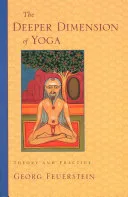
The Deeper Dimension of Yoga
 76
76

The Deeper Dimension of Yoga
Georg Feuerstein’s "The Deeper Dimension of Yoga" is a welcome corrective to the often-diluted understanding of this ancient practice prevalent in Western circles. Feuerstein, a respected scholar, grounds the reader in yoga’s extensive history and profound philosophical framework, arguing convincingly that its physical aspects are but one limb of a much larger spiritual endeavor. His treatment of the *Yoga Sutras of Patanjali* offers a clear pathway into the core teachings. While the book’s scholarly density might be a hurdle for absolute beginners seeking quick tips, its thoroughness is precisely its strength for those committed to a deeper understanding. The author effectively demonstrates that yoga is a serious spiritual discipline, not merely a fitness trend. This work serves as an essential primer for anyone wishing to engage with yoga beyond the mat.
📝 Description
76
Georg Feuerstein's 2003 book, The Deeper Dimension of Yoga, argues yoga is a spiritual discipline, not just physical exercise.
Published in 2003, Georg Feuerstein's "The Deeper Dimension of Yoga" presents yoga as a complete system for spiritual growth and personal change. The book moves beyond common understandings of yoga, which often focus on physical postures. Feuerstein roots yoga in thousands of years of Indian philosophical thought and practice. He aims to show yoga as a potent spiritual vision and philosophy, correcting the contemporary view of it as merely a form of physical training.
This work is for individuals seriously studying yoga, philosophy, or comparative religion. It provides a thorough grounding in yoga's history, its philosophical foundations, and its aims for spiritual realization. Feuerstein examines yoga as a broad path that includes ethical guidelines, meditation, contemplative exercises, and philosophical understanding. The book details how the physical aspects (asana), breath control (pranayama), and mental focus (dhyana) connect within the larger goal of yogic liberation.
This book engages with the classical Yoga tradition of India, a lineage that extends back centuries before its modern popularization. Feuerstein places the physical practices of asana within a larger framework that includes ethical precepts (yama, niyama), concentration (dharana), meditation (dhyana), and absorption (samadhi), as described in foundational texts like Patanjali's Yoga Sutras. It emphasizes yoga's aim for self-knowledge and liberation, distinguishing it from purely physical or therapeutic applications.
💡 Why Read This Book?
• Gain a scholarly perspective on yoga's 5,000-year history, understanding its origins beyond modern physical practices, as detailed in the book's historical survey. • Grasp the philosophical underpinnings of yoga as a path of self-transformation, moving past the asana-centric view presented in the section on *Patanjali's Yoga Sutras*. • Explore the integral relationship between physical postures, breath control, and mental discipline as outlined in the key concepts section, revealing yoga's holistic spiritual vision.
⭐ Reader Reviews
Honest opinions from readers who have explored this book.
❓ Frequently Asked Questions
What is the primary historical period covered in "The Deeper Dimension of Yoga"?
The book traces yoga's history over approximately 5,000 years, from its ancient Indian roots through its evolution into a comprehensive spiritual discipline.
Who is Georg Feuerstein, the author of "The Deeper Dimension of Yoga"?
Georg Feuerstein, Ph.D., is a respected scholar and longtime practitioner of yoga, known for his extensive research into its history, philosophy, and esoteric traditions.
Does "The Deeper Dimension of Yoga" focus solely on physical yoga postures?
No, the book emphasizes that yoga is much more than a system of physical exercises. It explores its potent philosophy, spiritual vision, and practices aimed at self-transformation.
What is the significance of *Patanjali's Yoga Sutras* in Feuerstein's work?
Feuerstein highlights *Patanjali's Yoga Sutras* as a foundational text that outlines the philosophical and ethical framework of yoga as a path to liberation.
When was "The Deeper Dimension of Yoga" first published?
The book was first published on July 8, 2003, offering a comprehensive survey of the Yoga tradition at the turn of the millennium.
What does the book mean by yoga as a 'path of self-transformation'?
It refers to yoga's capacity to facilitate profound inner change through its teachings and practices, leading to spiritual growth and self-realization, extending beyond mere physical conditioning.
🔮 Key Themes & Symbolism
Yoga as Spiritual Discipline
Feuerstein meticulously details yoga not as a contemporary fitness trend, but as an ancient and profound spiritual discipline originating in India. He emphasizes its role as a complete system for self-transformation, encompassing ethical precepts, contemplative practices, and philosophical inquiry. The work underscores that the physical postures (asana) are but one component within a much larger framework designed to guide the practitioner towards liberation and self-realization.
Historical and Philosophical Roots
The book offers a comprehensive survey of yoga's 5,000-year history, tracing its evolution from ancient Vedic traditions through the development of classical yoga as codified by Patanjali. Feuerstein explores the philosophical schools that influenced and were influenced by yoga, presenting it as a sophisticated intellectual and spiritual tradition deeply embedded in Indian culture.
Beyond Asana
A central argument is that modern Western interpretations often overemphasize asana at the expense of yoga's broader spiritual and philosophical dimensions. Feuerstein contrasts this with the traditional understanding, where practices like pranayama (breath control), dhyana (meditation), and ethical observances (yama and niyama) are presented as equally, if not more, vital for achieving the ultimate goals of yogic practice.
The Path of Liberation
Feuerstein frames yoga as a potent path toward spiritual freedom and enlightenment. He explores the concept of *moksha* (liberation) and how the various teachings and practices within the yogic tradition are designed to dismantle ignorance, purify the mind, and lead to a state of profound inner peace and self-awareness.
💬 Memorable Quotes
Direct passages from the work, attributed to the author.
“Yoga is much more than a system of physical exercises.”
— This statement directly challenges the common perception of yoga in the West, asserting its true nature as a comprehensive spiritual path for inner transformation.
“A profound path of self-transformation.”
— This phrase expresses the book's core message, highlighting yoga's potential to effect deep personal and spiritual change in the practitioner's life.
“The potent philosophy and spiritual vision of Yoga.”
— Feuerstein emphasizes the intellectual depth and aspirational quality of yoga, positioning it as a rich tradition of thought and spiritual pursuit.
“A comprehensive survey of the full breadth and depth of the 5,000-year-old Yoga tradition.”
— This indicates the book's ambitious scope, aiming to cover the vast historical and philosophical field of yoga from its ancient origins to its contemporary manifestations.
“Yoga encompasses a range of teachings, practices, and sacred texts.”
— This highlights the many-sided nature of yoga, acknowledging its diverse components including philosophical doctrines, practical methods, and scriptural guidance.
🌙 Esoteric Significance
Tradition
Feuerstein's work aligns with the broader esoteric tradition of studying and preserving ancient spiritual knowledge, particularly from Indic civilizations. While not strictly Hermetic or Kabbalistic, it shares the esoteric library's aim of presenting profound spiritual systems in a manner that respects their original context and depth. It fits within the lineage of scholars who sought to understand Eastern mysticism through a Western academic lens, bridging the gap between scholarly research and spiritual practice.
Symbolism
The book implicitly engages with symbolism by exploring concepts like *asana* (posture, often seen as a stable seat for meditation), *pranayama* (breath control, linked to life force or *prana*), and *dhyana* (meditation, the stilling of mental fluctuations). The overarching symbol is the 'path' itself, representing the journey of self-transformation and liberation from suffering (*dukkha*), a central motif in many esoteric traditions.
Modern Relevance
Contemporary scholars of religion, comparative philosophy, and embodied spirituality continue to draw upon Feuerstein's foundational work. His rigorous historical and philosophical approach provides a crucial reference point for discussions on yoga's authenticity, its adaptation in global contexts, and its potential for psychological and spiritual well-being, influencing academics and practitioners alike.
👥 Who Should Read This Book
• Serious students of yoga seeking to understand its philosophical and historical depth beyond physical practice. • Comparative religion scholars interested in the evolution of Indic spiritual traditions and their global impact. • Practitioners of meditation and contemplative disciplines looking for a foundational understanding of yoga's integrated approach to mind-body development.
📜 Historical Context
Published in 2003, Georg Feuerstein's "The Deeper Dimension of Yoga" emerged during a period when yoga's popularity in the West was rapidly expanding, often divorced from its spiritual and philosophical roots. Feuerstein, a scholar with deep roots in yogic traditions, sought to provide a scholarly counterpoint to the burgeoning fitness-oriented interpretations. The era saw a growing academic interest in comparative religion and Eastern philosophies, yet accessible, comprehensive overviews that respected yoga's spiritual integrity were less common. Feuerstein's work engaged with the ongoing discourse surrounding the transmission of Eastern spiritual practices to the West, implicitly dialoguing with thinkers like Mircea Eliade, whose earlier works had also explored shamanic and yogic traditions, though sometimes with less nuanced distinctions. The book aimed to anchor yoga's identity in its 5,000-year lineage and profound philosophical systems, offering a scholarly perspective that stood apart from both purely academic analyses and popular, secularized versions.
📔 Journal Prompts
The 5,000-year history of Yoga: What connections can be drawn between its ancient origins and contemporary practice?
Patanjali's Yoga Sutras: How does this foundational text conceptualize the 'path of self-transformation'?
The concept of yoga as a system of physical exercises versus a spiritual path: Reflect on personal experiences.
The integral relationship between asana, pranayama, and dhyana: Explore potential synergies in personal practice.
Yoga's potent philosophy and spiritual vision: Identify one core principle that challenges common assumptions.
🗂️ Glossary
Asana
Refers to the physical postures practiced in yoga, traditionally intended as a stable and comfortable seat for meditation and spiritual discipline.
Pranayama
Literally 'life force extension' or 'breath control', a key yogic practice involving the regulation and manipulation of breath to influence energy and consciousness.
Dhyana
A state of deep meditation or contemplation, characterized by sustained focus and the quieting of the mind, considered a crucial limb of yoga.
Patanjali's Yoga Sutras
A foundational text of classical yoga, attributed to the sage Patanjali, which outlines the philosophy and practice of yoga as a path to liberation.
Self-transformation
The process of profound inner change and personal growth facilitated by spiritual practices, leading to a shift in consciousness and being.
Moksha
The ultimate goal in many Indic spiritual traditions, signifying liberation, release, or spiritual freedom from the cycle of birth and death.
Yama and Niyama
The ethical restraints (Yama) and observances (Niyama) that form the foundation of Patanjali's eight-limbed path of yoga, guiding moral conduct and personal discipline.