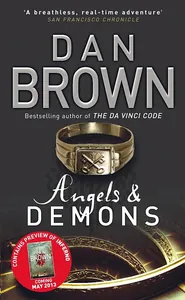
Angels & Demons
 82
82

Angels & Demons
Dan Brown’s "Angels & Demons" is a meticulously plotted chase through the hallowed halls of the Vatican, a place rarely depicted with such breathless urgency. The novel’s strength lies in its intricate puzzle-box structure, where each clue, symbol, and historical tidbit propels Robert Langdon forward. Brown excels at making complex scientific and religious concepts accessible, even if the simplification sometimes borders on the didactic. The central premise—a race against time to prevent an antimatter device from destroying the Vatican—is undeniably compelling. However, the characterizations, particularly of Langdon’s companions, can feel somewhat thinly drawn, serving primarily as conduits for exposition or plot devices rather than fully realized individuals. The rapid-fire pacing, while engaging, occasionally sacrifices deeper thematic exploration for the sake of forward momentum. Ultimately, "Angels & Demons" delivers a thrilling, if occasionally superficial, intellectual adventure.
📝 Description
82
Published in 2000, Dan Brown's Angels & Demons is a thriller set against the Vatican.
Robert Langdon, a Harvard symbologist, is drawn to the Vatican after a CERN physicist is murdered and a powerful antimatter device is stolen. The novel unfolds over a single day, creating a race against time to stop a devastating act of terror. It appeals to readers who enjoy complex puzzles, historical mysteries, and the relationship between science and faith.
Those interested in secret societies, Vatican history, and the philosophical questions of belief versus empirical evidence will find the plot especially engaging. The story blends action with intellectual inquiry, using a fictional narrative to examine significant theological and scientific ideas. The book taps into anxieties about change and the potential for both technological progress and existential threats.
Angels & Demons engages with the enduring fascination surrounding secret societies and their purported influence on major institutions. The novel specifically references the historical Illuminati, a group often depicted in conspiracy narratives as working against established religious powers. It also touches upon the symbolic rituals and traditions of the Catholic Church, particularly during a papal conclave. The book places these elements within a fictional conflict between scientific discovery and religious doctrine, a theme common in speculative fiction that examines hidden histories.
💡 Why Read This Book?
• You will learn about the historical concept of the Illuminati and their supposed conflict with the Catholic Church, gaining insight into a popular conspiracy theory that fuels many fictional narratives. • You will encounter the scientific concept of antimatter and its theoretical implications, understanding how real-world physics can be dramatized in suspenseful storytelling. • You will experience a fictionalized depiction of the papal conclave process, grasping the symbolic rituals and historical significance of electing a new Pope.
⭐ Reader Reviews
Honest opinions from readers who have explored this book.
❓ Frequently Asked Questions
What is the main conflict in Dan Brown's "Angels & Demons"?
The core conflict revolves around a race against time to prevent a devastating antimatter explosion orchestrated by the Illuminati, a secret society, within the Vatican.
Who is Robert Langdon in "Angels & Demons"?
Robert Langdon is a Harvard symbologist and the protagonist of the novel, who is called upon to decipher ancient symbols and solve the mystery.
What is antimatter and its role in the book?
Antimatter is a real scientific concept where particles have opposite charge and mass to normal matter. In the book, it's weaponized and stolen from CERN.
What historical society is central to the plot?
The Illuminati, a historical secret society with alleged anti-Catholic aims, is central to the plot, driving the conspiracy and the antagonists' motives.
Where does "Angels & Demons" primarily take place?
The novel is set predominantly in Rome and Vatican City, with key scenes involving famous landmarks and religious sites.
When was Dan Brown's "Angels & Demons" first published?
"Angels & Demons" was first published in the year 2000, preceding Brown's later bestseller "The Da Vinci Code."
🔮 Key Themes & Symbolism
Illuminati Conspiracy
The novel heavily features the historical Illuminati, a secret society believed to have opposed the Catholic Church. Brown fictionalizes their return in the modern era, positing them as orchestrators of a plot against the papacy. This theme explores the enduring power of ancient conspiracies and their potential to influence contemporary events, tapping into public fascination with hidden organizations and their supposed agendas.
Science vs. Religion
A central tension in "Angels & Demons" is the perceived conflict between scientific advancement and religious doctrine. The narrative pits the cutting-edge research from CERN, particularly the creation of antimatter, against the ancient traditions and dogma of the Catholic Church. It presents a fictional battleground where scientific discovery is seen as a threat by some religious factions, and vice versa.
Symbolism and Sacred Spaces
The book is rich with the interpretation of symbols, both religious and scientific, often located within the sacred spaces of Rome and Vatican City. Robert Langdon's expertise lies in deciphering these symbols, which serve as clues to the unfolding mystery. This theme highlights how hidden meanings can be embedded in art, architecture, and ritual, and how their understanding can unlock secrets.
The Papal Conclave
The process of electing a new Pope, known as the papal conclave, forms the dramatic backdrop for much of the novel's action. Brown details the historical traditions, the secrecy, and the intense spiritual and political maneuvering involved. This theme explores the power structures within the Catholic Church and the symbolic weight of the papacy.
💬 Memorable Quotes
Direct passages from the work, attributed to the author.
“Antimatter is the most powerful substance in the universe.”
— This statement, representing a key concept from the book, underscores the extreme danger posed by the stolen device. It frames antimatter not just as a scientific curiosity but as a potent weapon central to the novel's high stakes.
“The path to God lies through the understanding of His creation.”
— This interpretation reflects a philosophical viewpoint explored in the book, suggesting that scientific inquiry can be a form of spiritual pursuit, reconciling the perceived divide between science and faith.
“The Church has always feared what it does not understand.”
— This interpretation points to a recurring theme of institutional fear and control within the narrative. It suggests that the Catholic Church's historical resistance to new ideas, particularly scientific ones, is a driving force behind the conflict.
💡 Key Ideas
Editorial paraphrase of the work's core concepts — not direct quotes.
The Illuminati fear the Church. They believe the Church has suppressed scientific truth for centuries.
This paraphrase captures the core antagonistic belief system presented in the novel. It highlights the fictional Illuminati's motive: a perceived historical oppression of science by religious institutions, justifying their present actions.
Every symbol has a meaning. Every meaning has a story.
This quote emphasizes the book's reliance on symbology. It suggests that the narrative itself is built upon deciphering hidden messages within the environment, a core skill of the protagonist, Robert Langdon.
🌙 Esoteric Significance
Tradition
While not strictly an esoteric text, "Angels & Demons" draws heavily on concepts associated with historical secret societies and Gnostic ideas concerning hidden knowledge. The portrayal of the Illuminati, albeit fictionalized, echoes a lineage of esoteric groups seeking to challenge dominant religious or political powers through concealed wisdom. The narrative's focus on deciphering symbols and uncovering suppressed truths aligns with the Gnostic pursuit of gnosis, or salvific knowledge.
Symbolism
The book is replete with symbolism, chief among them the "Illuminati’s” emblem of the ambigram, a design that reads the same forwards and backward, symbolizing duality and hidden unity. The four "Elements” (Earth, Air, Fire, Water) are used as symbolic markers for the locations of the antimatter, representing ancient philosophical concepts. The Angel of Death motif also appears, linking to themes of mortality and divine judgment within the narrative.
Modern Relevance
Contemporary interest in "Angels & Demons" reflects a continued fascination with conspiracy narratives and the perceived conflicts between science and religion. Modern readers are drawn to its exploration of secret societies and the idea of hidden forces shaping world events. Furthermore, the book's popularization of symbology and historical mystery continues to influence discussions in comparative religion and the public's engagement with art and architecture as carriers of meaning.
👥 Who Should Read This Book
• Readers interested in historical conspiracy theories and secret societies, particularly those fascinated by the lore surrounding the Illuminati and their alleged opposition to established religious power. • Students of comparative religion and art history who appreciate fictional narratives that incorporate real-world landmarks, religious rituals, and symbolic interpretation within a thrilling plot. • Fans of intricate puzzle-solving and fast-paced thrillers who enjoy narratives that blend scientific concepts with historical intrigue and action-packed sequences.
📜 Historical Context
Published in 2000, "Angels & Demons" arrived as the millennium turned, a period marked by both technological optimism and anxieties about the future. Dan Brown's novel tapped into a public fascination with secret societies, conspiracy theories, and the historical power of institutions like the Catholic Church. It emerged during a cultural moment where the intersection of faith, history, and hidden knowledge was gaining significant traction in popular discourse, partly fueled by earlier works exploring similar themes. The book's release preceded that of "The Da Vinci Code" (2003), which would catapult Brown to global fame. While not directly engaging with a specific contemporary author's work, "Angels & Demons" participated in a broader trend of historical thrillers that questioned established narratives, a genre that also saw authors like Umberto Eco exploring semiotics and hidden histories. The novel's reception highlighted a public appetite for fictional explorations of religious and historical mysteries, often set against the backdrop of iconic European locations.
📔 Journal Prompts
The Vatican's secret archives and their potential contents.
Robert Langdon's reliance on ambigrams and their significance.
The symbolic meaning of the four elements as used in the narrative.
The perceived conflict between scientific discovery and religious doctrine.
The historical Illuminati and their modern fictional representation.
🗂️ Glossary
Ambigram
A calligraphic design that can be read in more than one way, often as both the same word or different words when viewed from different orientations. In the book, it's a key symbol of the Illuminati.
Antimatter
A substance composed of antiparticles, which are counterparts to ordinary matter particles. When antimatter and matter meet, they annihilate each other, releasing enormous energy. It's a central plot device in the novel.
CERN
The European Organization for Nuclear Research, a multinational organization where scientists conduct research into the fundamental nature of matter. It is the source of the stolen antimatter.
Illuminati
A historical Bavarian secret society founded in 1776, known for its Enlightenment ideals. In the novel, Brown reimagines them as an ancient, powerful organization with a vendetta against the Catholic Church.
Papal Conclave
The assembly of Roman Catholic cardinals convened to elect a new Pope. The novel's events unfold during a conclave, adding urgency and high stakes to the plot.
Path of Illumination
A series of locations within Rome, each marked by a sculpture representing one of the four elements, that the antagonist must visit. It serves as a symbolic trail for Robert Langdon to follow.
Symbologist
An expert in the study of symbols and their meanings. This is the profession of the protagonist, Robert Langdon, who uses his skills to decipher clues.
🔮 Readers Also Liked
Browse all →








More by Dan Brown
All books →




More Free Occult Philosophy Books
View all →