The debatable land between this world and the next
 81
81

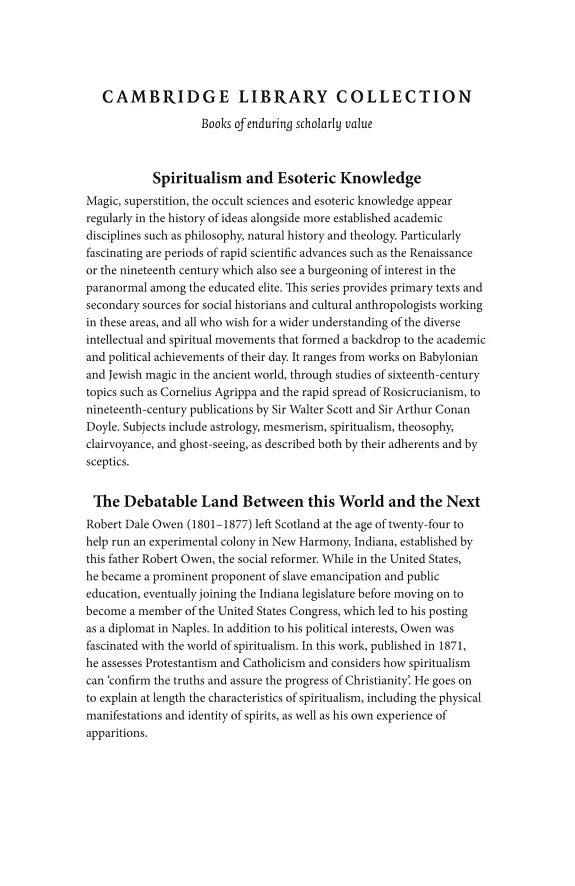
The debatable land between this world and the next
Robert Dale Owen's "The debatable land between this world and the next" offers a remarkably measured and intellectually rigorous examination of spiritualist phenomena for its time. Unlike many sensationalist accounts, Owen, a seasoned parliamentarian and diplomat, approaches the subject with a systematic, almost legalistic, dissection of evidence and argument. His detailed consideration of alleged communications with spirits, particularly his attempts to reconcile these with established scientific understanding, remains a compelling aspect of the text. However, the book's primary limitation is its inherent reliance on the evidence available in the late 19th century, which, by modern standards, lacks the rigor of controlled scientific experimentation. The section detailing Owen's own investigations into various mediums, while fascinating, can sometimes read as overly credulous, a common pitfall for investigators of his era. The work serves best as a historical document, showcasing a serious attempt to bridge the material and spiritual through rational inquiry.
📝 Description
81
Robert Dale Owen's 1891 book examines claims of communication with the departed.
First published in 1891, "The debatable land between this world and the next" is Robert Dale Owen's systematic inquiry into spiritualism. Owen, a figure known for his political and social reform work, applied his intellect to phenomena that questioned materialist views of existence. This volume goes beyond simple anecdotes; it constructs an argument that considers various accounts of contact with deceased individuals and the philosophical questions these accounts raise.
Owen's work is for readers interested in consciousness, parapsychology, and the history of spiritualism, particularly those with a critical yet receptive mindset. It appeals to those studying late Victorian intellectual history, a period marked by widespread interest in séances, mediumship, and the question of life after death. Students of comparative religion and esoteric thought will find Owen's methodical approach useful.
The book addresses concepts like the nature of spiritualistic events, the potential for communication with non-corporeal beings, and the philosophical problems these experiences present to established scientific and religious ideas. Owen attempts to differentiate authentic spiritual phenomena from deception.
Published in 1891, Owen's book emerged during a period of heightened spiritualist activity in Europe and America, following the sensational claims of the Fox sisters. This era also saw the founding of the Theosophical Society by Helena Blavatsky in 1875, reflecting a wider intellectual current that explored mystical and occult subjects. Owen's work engaged directly with the scientific and philosophical debates of his time concerning post-mortem survival and the nature of consciousness.
💡 Why Read This Book?
• Gain insight into the intellectual climate of the late 19th century that fostered widespread interest in spiritualism, specifically examining Robert Dale Owen's reasoned approach to phenomena documented in 1891. • Understand the philosophical challenges posed by alleged spirit communication to materialist science, as Owen grapples with reconciling empirical data with spiritual claims. • Explore a historical attempt to validate claims of life after death, learning how Owen critically analyzed evidence for mediums and séances.
⭐ Reader Reviews
Honest opinions from readers who have explored this book.
❓ Frequently Asked Questions
What is Robert Dale Owen's background related to this book?
Robert Dale Owen (1801-1877) was a prominent American politician, diplomat, and social reformer. Before writing about spiritualism, he served in the Indiana legislature and as the U.S. Minister to Naples. His background lent considerable weight to his investigations into the phenomena discussed in "The debatable land between this world and the next."
When was "The debatable land between this world and the next" first published?
The book was first published in 1891, long after Robert Dale Owen's death in 1877. This posthumous publication reflects his deep engagement with spiritualist phenomena throughout the latter part of his life.
What specific phenomena does the book examine?
The book examines phenomena associated with the spiritualist movement of the 19th century, including alleged spirit communications, séances, mediumship, and physical manifestations purportedly from the spirit world.
Does the book present evidence of fraud?
Yes, Robert Dale Owen was acutely aware of the prevalence of fraud within the spiritualist movement. A significant portion of his work involves critically examining purported evidence, attempting to distinguish genuine phenomena from deception.
Is this book considered a primary source for spiritualism?
Yes, "The debatable land between this world and the next" is considered a valuable primary source. It provides a firsthand account of the investigations and arguments of a respected intellectual figure during the height of the spiritualist movement in the 19th century.
What was the intellectual climate surrounding the book's publication?
The book was published in 1891, during a period of intense interest in spiritualism and the occult. It followed the establishment of the Theosophical Society in 1875 and reflected a broader societal questioning of materialist explanations for reality.
🔮 Key Themes & Symbolism
Evidence and Skepticism
Owen meticulously dissects claims of spiritualistic phenomena, applying a critical lens informed by his background in law and politics. He grapples with the challenge of distinguishing genuine interactions with discarnate entities from elaborate fraud, a central tension in 19th-century spiritualist investigations. The work explores how to evaluate testimony and physical manifestations when confronting phenomena that defy conventional scientific understanding, reflecting the era's struggle to adapt empirical methods to subjective or inexplicable events.
The Nature of Consciousness
Central to Owen's inquiry is the question of consciousness's persistence beyond physical death. He examines how alleged communications from spirits challenge the materialist view that consciousness is solely a product of the brain. The book probes the implications of mediumship and spiritual encounters for our understanding of the self, suggesting that the mind might operate independently of the body, thus expanding the perceived boundaries of existence.
Bridging Worlds
The 'debatable land' itself refers to the liminal space between the physical world and what lies beyond. Owen's work is an attempt to map this territory, exploring the possibility of interaction and communication across this perceived divide. He investigates the methods and alleged outcomes of séances and other spiritualist practices as potential bridges, examining whether these offer verifiable glimpses into a non-corporeal reality.
Social and Philosophical Implications
Beyond the immediate phenomena, Owen considers the wide impact of spiritualism on societal beliefs and philosophical frameworks. He addresses how affirmations of an afterlife and spirit communication could reshape religious doctrines, ethical considerations, and humanity's place in the cosmos. The book reflects the broader late 19th-century intellectual ferment, where established certainties were being questioned by new scientific discoveries and alternative spiritual movements.
💬 Memorable Quotes
Direct passages from the work, attributed to the author.
“Fraud is the shadow that follows genuine marvels.”
— This highlights Owen's awareness of the pervasive issue of deception within spiritualism. He recognizes that the allure of the extraordinary often attracts charlatans, making rigorous discernment essential for anyone seeking truth in these matters.
“Our senses are but limited instruments.”
— Owen suggests that conventional human perception might be insufficient to grasp the full spectrum of reality. This opens the door to considering phenomena that appear supernatural as simply beyond our current, limited sensory or scientific apparatus.
“The law of evidence must apply even to the unseen.”
— This interpretation reflects Owen's methodical approach. He argues that principles of logic and evidence, typically applied in the material world, should also be employed when evaluating claims about the spiritual realm, demanding a consistent standard of proof.
“The veil between worlds is thin, but not easily pierced.”
— This conveys the idea that while the existence of an afterlife or spirit world is plausible, direct, verifiable interaction remains difficult. It underscores the challenges Owen faced in his investigations and the elusive nature of the phenomena he studied.
💡 Key Ideas
Editorial paraphrase of the work's core concepts — not direct quotes.
The question is not whether spirits can communicate, but whether they *do*.
This paraphrase captures Owen's core investigative stance: moving beyond theoretical possibility to empirical verification. He acknowledges the potential for spirit communication but emphasizes the need for demonstrable evidence, a critical point in the spiritualist debates of his era.
🌙 Esoteric Significance
Tradition
While not strictly adhering to a single esoteric lineage, Owen's work engages with themes common in spiritualist and broader metaphysical traditions. It shares the spiritualist movement's core tenet of communication with the departed, a practice found in various ancient and modern esoteric systems, including some forms of Hermeticism and Neoplatonism that explore intermediary realms. His approach, however, attempts to apply rational, almost scientific, scrutiny, setting it apart from more purely faith-based or mystical traditions.
Symbolism
The 'debatable land' itself functions as a central symbol, representing the liminal space between the known physical world and the unknown spiritual or afterlife realms. Owen's investigation into séances and mediumship can be seen as exploring symbolic gateways or bridges, where the veil between these worlds is purportedly thin. The phenomena he documents – apparitions, disembodied voices, or moving objects – serve as symbolic manifestations of a reality beyond corporeal limitations.
Modern Relevance
Owen's rigorous, albeit era-specific, methodology for investigating purported paranormal phenomena remains relevant for contemporary parapsychology and critical thinking about consciousness studies. Researchers and practitioners interested in the history of belief in life after death, or those exploring the intersection of science and spirituality, often reference works like this. It provides historical context for modern discussions on consciousness, mediumship, and the philosophical challenges posed by experiences that lie outside conventional scientific paradigms.
👥 Who Should Read This Book
• Students of 19th-century American history and social movements, seeking to understand the intellectual currents that fueled the spiritualist craze. • Researchers in comparative religion and esoteric studies, interested in primary accounts of spiritualism and its philosophical underpinnings. • Skeptics and open-minded inquirers, examining historical attempts to rationally investigate claims of life after death and spirit communication.
📜 Historical Context
Robert Dale Owen's "The debatable land between this world and the next" emerged in 1891, a period saturated with interest in spiritualism following the Fox sisters' initial claims in the mid-19th century. This era saw a significant portion of the Western intelligentsia grappling with the implications of science versus faith, and many turned to spiritualism for answers. Contemporaries like Helena Blavatsky were actively shaping the Theosophical movement, offering a more structured, philosophical alternative to popular spiritualism, which Owen's work implicitly engaged with by seeking rational explanations. The book's publication occurred during a time when scientific materialism was ascendant, yet the desire to find evidence for survival beyond death was widespread, creating a fertile ground for Owen's methodical investigations. The reception of such works often involved intense debate, with proponents citing personal experiences and skeptics pointing to widespread fraud.
📔 Journal Prompts
Robert Dale Owen's critical evaluation of séance phenomena.
The concept of the 'debatable land' as a space between worlds.
Evidence for consciousness surviving physical death presented in the text.
Distinguishing genuine spiritualistic manifestations from fraud.
The philosophical implications of spirit communication for materialism.
🗂️ Glossary
Spiritualism
A religious movement that holds as its central tenet that the spirits of the dead can communicate with the living. Prominent in the 19th and early 20th centuries, it often involved séances and mediums.
Mediumship
The practice by which a person, known as a medium, is believed to be able to communicate with spirits or entities from other realms, often acting as an intermediary between the physical and spiritual worlds.
Séance
A meeting where spiritualists attempt to make contact with the spirits of the dead, often involving a medium and specific rituals or conditions designed to facilitate communication.
Materialism
A philosophical stance that matter is the fundamental substance in nature, and that all phenomena, including consciousness, are results of material interactions. It often denies the existence of spirit or the supernatural.
Discarnate Entity
A being or consciousness that exists without a physical body, typically understood as a spirit or ghost after death.
Empirical Evidence
Information acquired through observation and experience rather than through theory or pure logic. In scientific contexts, it refers to data gathered via experimentation and sensory observation.
Liminal Space
A transitional or in-between state or place, often associated with ambiguity, uncertainty, and the potential for transformation. In this context, it refers to the boundary between the physical and spiritual realms.
🔮 Readers Also Liked
Browse all →









More by Robert Dale Owen
All books →



More Free Occult Philosophy Books
View all →